
Big Ben is the name of the great bell inside the clock tower at the north end of the Houses of Parliament, although most people use it for the whole tower, which has been called the Elizabeth Tower since 2012. You can admire it free from the street at any time, and since the tower reopened after restoration you can also climb its 334 steps on an official tour costing £55 for an adult.
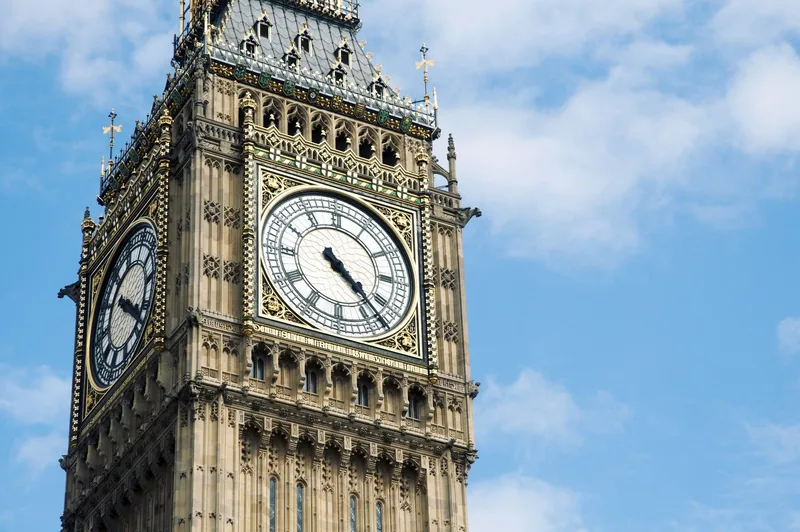
Big Ben is one of London's most famous landmarks. It stands beside the River Thames and is part of the Palace of Westminster, the building where the UK Parliament meets. Strictly speaking, "Big Ben" is only the largest of the five bells in the belfry, the one that strikes the hours. The clock is officially the Great Clock, and the tower was known simply as the Clock Tower until it was renamed to mark Queen Elizabeth II's Diamond Jubilee.
When this guide was first written, the tower was not open to the public, so the advice was simply to come for the photographs. That is still the main reason most people visit, and it costs nothing. But the tower is now open to all visitors aged 11 and over on a guided climb, and this guide explains how that works, what the bell and clock can tell you about Victorian London, and where to stand for the best view.
Big Ben and the Elizabeth Tower in brief
- What "Big Ben" is
- The Great Bell in the belfry; the name is also used for the clock and tower
- Tower height
- 96 metres, 11 floors
- Steps
- 281 to the clock faces, 334 to the belfry
- Weight of the bell
- 13.7 tonnes
- Tour price
- £55 adult, £35 child aged 11 to 17 (tours from 1 August 2026)
- Minimum age for the tour
- 11
- Tour length
- Up to 90 minutes; allow 1 hour 45 minutes in total
- Nearest station
- Westminster (Jubilee, District and Circle lines), step-free
Bell, clock or tower: what the name Big Ben really means
Visitors often say "Let's go and see Big Ben" and point at the tower. Nobody in London will correct you, and Parliament itself calls the tower "affectionately known around the world as Big Ben". But if you join the tour, the guides will make the distinction clear: the bell is Big Ben, the timekeeper is the Great Clock, and the building is the Elizabeth Tower.
Where the name came from is not completely certain. Parliament's own history says the bell was probably named in fun after Sir Benjamin Hall, the First Commissioner of Works who oversaw the later stages of the building, because he was a tall man. The bell was originally going to be called "Royal Victoria", but the nickname stuck.
Big Ben is not alone up there. Four smaller quarter bells hang beside it and play the familiar chime every fifteen minutes. The tune is known as the Cambridge Quarters, because Edmund Beckett Denison, who designed the clock, borrowed it from the church of Great St Mary's in Cambridge. The bells are fixed in place and struck by hammers from outside. They do not swing.
How the tower rose from the ashes of the 1834 fire
Parliament had a clock tower long before this one. A tower with a public chiming clock stood on the site in 1367, and when it was pulled down its bell was sent to St Paul's Cathedral. The present tower exists because of disaster: in 1834 the old Palace of Westminster was almost completely destroyed by fire.
The architect Charles Barry won the commission for a new palace and included a clock tower in his design. He brought in Augustus Welby Pugin to create the Gothic Revival detail you see today. The foundation stone of the tower was laid in 1843. The Astronomer Royal, Sir George Airy, insisted the clock should be accurate to within one second when striking the hour, a very demanding standard at the time, and it took until 1852 before an acceptable design by Denison was chosen and the clockmaker Edward John Dent appointed to build it.
The bell was even more troublesome. The first Big Ben was cast near Stockton-on-Tees in 1856 and cracked during testing in 1857. A second bell was cast at the Whitechapel Bell Foundry in East London in 1858, pulled across Westminster Bridge by 16 white horses and winched up inside the tower. The clock started keeping time on 31 May 1859, and Big Ben rang out for the first time on 11 July 1859. By September it had cracked too.
For four years the largest quarter bell struck the hours instead. Airy found the solution: the bell was turned 90 degrees so the hammer hit a different spot, and a lighter hammer was fitted. Big Ben has struck the hours with that crack ever since, and both the crack and a small square cut out to stop it spreading are still visible.
Inside the Great Clock: pennies, pendulums and 7-metre dials
The clock mechanism weighs 5 tonnes and is made of cast iron. Its pendulum is 4.4 metres long, and each "beat" lasts two seconds. The way the clock is fine-tuned sounds like a joke but is true: keepers add or remove old pre-decimal pennies on the pendulum. Adding one penny makes the clock gain two-fifths of a second in 24 hours.
Each of the four dials is about 7 metres across and made of 324 pieces of pot opal glass in a cast-iron frame. The copper minute hands are 4.2 metres long. At night the dials are lit, which is when the tower is at its most photogenic. They stayed dark from 1939 to April 1945, to comply with wartime blackout rules.
Look higher, above the clock faces, and you may see a light shining in the lantern at the very top. This is the Ayrton Light, and it is switched on when the Houses of Parliament are sitting. It is a small detail, but it tells you whether debates are going on inside.
When Big Ben fell silent
Because the clock is so reliable, a stoppage makes the news. Parliament lists several long ones: two months in 1934, six months in 1956, and six weeks in 2007, when Big Ben and the quarter bells were silenced from 11 August to 1 October for maintenance. In 2005 the clock was stopped for two days so that a brake shaft could be inspected.
The most dramatic failure came in the middle of the night on 5 August 1976, when a mechanical fault sent the pendulum weights spiralling down the weight shaft and seriously damaged the clock. Big Ben was silent for nearly nine months.
The longest quiet period in living memory was the conservation project of 2017 to 2022, when the tower was wrapped in scaffolding and repaired from the gilt cross and orb at the top to the bottom of the staircase. Parliament describes it as the largest and most complex conservation in the tower's history. Big Ben returned to regular service in 2022.
St Paul's has a back-up bell for Big Ben. The bell from Parliament's medieval clock tower was recast in 1716 and hung in the south-west tower of St Paul's Cathedral. According to Parliament, if Big Ben is ever unable to strike, that bell is heard instead. It is one more reason to add Wren's cathedral in the City to the same trip.
Climbing the Elizabeth Tower: how the official tour works
The tour takes you up a narrow stone spiral staircase to the belfry, 62 metres above the ground. On the way you pass exhibition spaces, the room with the clock mechanism and the backs of the four clock dials. At the top you stand beside Big Ben as it strikes the hour, wearing ear defenders that the staff provide. After the tour you can explore medieval Westminster Hall.
The tour is open to UK and international visitors aged 11 and over. Children aged 11 to 17 must be with an adult, and staff may ask for proof of age. Tickets for tours from 1 August 2026 cost £55 for adults and £35 for children aged 11 to 17, and you can book up to eight tickets.
- When tickets go on sale: three months in advance, on the second Wednesday of every month at 10am. Popular dates go quickly, so set a reminder.
- How to buy: online only, through Parliament's official ticketing site. Tickets are non-refundable.
- Arrival: be at the Cromwell Green entrance at least 30 minutes before your tour. If you arrive later than that, you cannot join and you get no refund or exchange.
- Length: the tour itself lasts up to 90 minutes, and the whole visit about 1 hour 45 minutes including security and lockers.
UK residents can also ask their MP for a free tour, but availability is limited and the option is not open to overseas visitors. Full details are on Parliament's Big Ben tours page.
Phones, cameras and walking sticks stay at the bottom of the tower. All bags and belongings, including phones and cameras, go into a locker in Westminster Hall, and photography is not allowed inside the tower. You must be able to climb without walking aids, there are no toilets in the tower, and assistance dogs cannot go up. Wear flat, closed shoes: sandals, flip-flops and heels are refused. Parliament offers a separate accessible tour for people who would find the standard climb difficult.
Who should think twice before booking
Parliament is frank about the physical demands. You climb 334 steps within the tour time, on uneven surfaces and through narrow passages, and the belfry is open to the weather. It advises people with heart or breathing conditions, vertigo, recent major surgery or a fear of heights or confined spaces to seek medical advice or not to take part. Read the suitability information carefully before you pay.
Is the Big Ben tour worth £55?
For a family of two adults and two teenagers, the climb costs £180, which is a lot for 90 minutes. Whether it is good value depends on what you enjoy. The comparison below should help.
Book it if
- You love engineering, clocks or Victorian history
- You want to stand next to the bell as it strikes, which few people ever do
- You are fit and comfortable with heights and small spaces
- You can plan three months ahead
Skip it if
- You mainly want photos: none are allowed inside, and the view from the belfry is not the point of the tour
- You are travelling with children under 11
- You would rather see inside Parliament itself, which is a separate tour
- Your budget is tight: the best views of the tower are free
If you are more interested in the chambers where laws are made, our guide to guided and audio tours of Parliament compares those options. The Big Ben tour does not go into the House of Commons or the House of Lords.
The best places to see and photograph Big Ben for free
You do not need a ticket to enjoy the tower. It looks different from every side, and the light changes it through the day. These are the spots we would choose:
- Westminster Bridge. The classic view, with the tower rising over the river. The bridge is also the closest to Parliament and gets very crowded, so hold on to your phone and bag.
- The south bank of the Thames, opposite Parliament. Walk along the riverside path south of Westminster Bridge for the whole Palace of Westminster in one frame. At dusk, with the dials lit, this is the view most postcards use.
- Parliament Square. From the green in the middle you see the tower from below, together with the statues and Westminster Abbey across the road.
- From the river. River buses and sightseeing boats leave from Westminster Pier, right beside the tower. The Uber Boat river bus is a cheap way to see the Palace from the water, and our guide to Thames sightseeing cruises compares the commentated boats.
- From above. A capsule on the London Eye looks straight across the river at the tower. For views that cost nothing, see our list of free viewpoints across London.
If you take a Parliament tour of any kind, you may also photograph the tower from the visitor area of New Palace Yard, inside the security line.
After dark the tower is at its best and the crowds are thinner. The illuminated dials make the clearest photos an hour or so after sunset, when the sky is deep blue rather than black. Combine it with a walk along the river, one of the ideas in our guide to evenings in London.
Hearing the bongs, from New Year's Eve to the hour
Big Ben strikes every hour, and the quarter bells chime every fifteen minutes, so you only need to stand nearby on the hour to hear it. The sound carries well across the river.
The chimes have a special place in British life. BBC Radio first broadcast them on New Year's Eve in 1923, and the "bongs" at midnight are still the signal for the start of the year. The Mayor's fireworks on the river follow them. Tickets are needed to watch the display from the official viewing areas, and our guide to New Year's Eve in London explains how that works.
Getting to Big Ben and what to see nearby
Westminster station, on the Jubilee, District and Circle lines, comes out almost at the foot of the tower. Parliament describes it as fully wheelchair accessible, and TfL staff can help without advance booking; our guide to step-free travel has more. Waterloo, Victoria and Charing Cross main-line stations are about 20 minutes away on foot, and many buses stop on Whitehall and around Parliament Square.
Big Ben sits at the centre of a remarkable cluster of sights. Walk up Whitehall past Downing Street to Trafalgar Square, or turn the other way to the Churchill War Rooms beside St James's Park. Across the bridge lies the South Bank, with its riverside walk. Our guide to the Westminster neighbourhood ties it together, and if you only have a short time, Big Ben is an easy first stop on our one-day London itinerary.
Frequently asked questions
Can you go inside Big Ben?
Yes. The Elizabeth Tower is open on official guided tours for UK and international visitors aged 11 and over. You climb 334 steps to the belfry and see the clock mechanism and dials. Tickets cost £55 for adults and £35 for children aged 11 to 17, bought online only.
Is Big Ben the bell, the clock or the tower?
Officially, Big Ben is the Great Bell that strikes the hours. The clock is the Great Clock, and the tower has been named the Elizabeth Tower since 2012. In everyday speech, though, almost everyone uses Big Ben for the whole tower, and that is perfectly understood.
How far in advance should I book the Big Ben tour?
Tickets are released three months ahead, on the second Wednesday of each month at 10am. Book as soon as your dates open if you have fixed plans. Tickets are non-refundable, and arriving later than 30 minutes before your tour time means you cannot join.
Why is it called Big Ben?
Parliament says the bell was probably named in fun after Sir Benjamin Hall, the First Commissioner of Works when the bell was installed, because he was a tall man. It had originally been planned to call the bell "Royal Victoria".
Can I take photos on the Big Ben tour?
No. Photography is not allowed inside the Elizabeth Tower, and all phones, cameras and bags are locked away before the climb. You can take photos in Westminster Hall before or after the tour, and from the New Palace Yard visitor area.
Sources
- UK Parliament - Big Ben tours (checked September 2026)
- UK Parliament - Further information before you book (checked September 2026)
- UK Parliament - Getting ready for your Big Ben tour (checked September 2026)
- UK Parliament - Facts and figures: Big Ben and Elizabeth Tower (checked September 2026)
- UK Parliament - A brief history of Big Ben and Elizabeth Tower (checked September 2026)
- UK Parliament - Constructing the most accurate clock in the world (checked September 2026)
- UK Parliament - Getting here (checked September 2026)