
Tower Bridge is the Victorian bridge with two stone towers next to the Tower of London, and you can go inside it: walk the high-level walkways between the towers, stand on the glass floors above the traffic and see the steam engines that once raised the road. An adult ticket costs £18.00 (September 2026), and we would allow about an hour and a half inside.
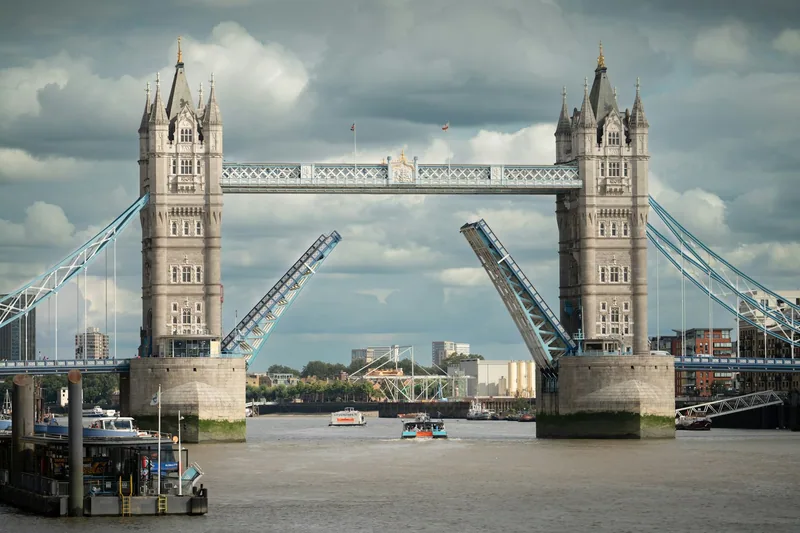
Tower Bridge crosses the River Thames at the eastern edge of central London. It is often confused with London Bridge, which is the next bridge upstream and a much plainer concrete structure. If a photo shows two tall towers joined by blue walkways, it is Tower Bridge.
Two things make it special. First, the road in the middle is made of two huge hinged sections, called bascules, which still lift so that tall ships can pass. Second, the two towers are joined high above the road by walkways. They were built so that people on foot could keep crossing while the bridge was open for a ship. Today those walkways are the heart of the paid visit, and the bridge itself remains free to walk across at street level.
Tower Bridge in brief
- Adult ticket (18+)
- £18.00
- Child (5-15)
- £9.00; under-5s free
- Concession
- £13.50 (seniors 60+, students 18+, ages 16-17, disabled adults)
- Opening
- Daily from 09:30; closing and last-entry times vary, so check the official site for your date
- What the ticket covers
- North and South Towers, high-level walkways with glass floors, Victorian Engine Rooms, audio tour
- Time needed
- Allow about 1.5 hours (our estimate)
- Nearest Tube
- Tower Hill (District and Circle lines), about 7 minutes on foot
- Operator
- City Bridge Foundation, a charity
Tower Bridge or London Bridge: which one is which
Visitors mix these two up all the time, and the famous nursery rhyme about London Bridge falling down only adds to the confusion. London Bridge is the crossing between the City and Southwark, a short walk upstream. The current version is a low, modern bridge from the 1970s. Tower Bridge is the next bridge downstream, named after the Tower of London that stands beside its northern end.
Building work on Tower Bridge started in 1886, and it opened in 1894. It was designed by the architect Sir Horace Jones and the civil engineer Sir John Wolfe Barry. The Gothic stone towers hide a steel frame inside, which is why the bridge can carry modern traffic and still look like part of the medieval castle next door.
If you want to see both bridges and several others in one walk, our walking guide to the Thames bridges links them into a single route along the river.
The route inside, from the North Tower to the Engine Rooms
The visit follows a fixed one-way route. You enter through the ticket office on the west side of the North Tower, go through a bag search, and then climb the tower. Lifts are available, but the staff recommend walking up if you can, because the displays on each landing tell the story of the people who built the bridge.
From the top of the North Tower you cross the East Walkway and the West Walkway to the South Tower. Both walkways have their own views and their own glass floor, so make sure you see both. You then walk down the South Tower, where the displays turn to the people who have run and maintained the bridge since it opened.
Back at street level on the south side, a painted blue line on the pavement leads you to the Engine Rooms, a short outdoor walk away. This is the last part of the visit and the one many people remember best.
- North Tower: the architects, engineers, divers and riveters who built the bridge, with films from the time.
- High-Level Walkways: views east and west along the Thames, 70 metres long between the towers.
- Glass Floors: one in each walkway, looking straight down at buses, cabs and boats.
- South Tower: stories of the staff who have kept the bridge working.
- Engine Rooms: the original Victorian steam machinery that once lifted the bascules.
Standing on the glass floors
The glass floors were installed in 2014, one in each walkway. Each floor is 11.5 metres long and 1.8 metres wide and sits 33.5 metres above the road. The panels are made of five layers of glass, and the top layer is replaced regularly so the view stays clear.
The first step onto the glass is harder than it looks, even for people who are not afraid of heights. Most visitors edge out slowly, then relax once they see others standing, sitting and even lying down on it. Children tend to love it. The ceiling above is mirrored, which makes it easier to take a photo of yourself with the road far below.
The best moment of all is a bridge lift seen from above. If your visit coincides with one, you can watch the two halves of the road rise beneath your feet. You cannot plan this to the minute, but you can check the lift schedule and time your visit around it (see below).
Leave glass bottles in your bag near the walkways. Tower Bridge does not allow glass items such as bottles near the glass floors, for safety reasons. A plastic or metal bottle is fine, and it is worth bringing one because there are no water dispensers inside.
The Victorian Engine Rooms
The Engine Rooms are in a separate building next to the southern end of the bridge. For more than 80 years, steam engines here powered the lifts, using boilers and large tanks called accumulators that stored energy under pressure. The displays explain how the system worked without needing any engineering knowledge, and the stories of the workers who kept the bridge moving are told alongside the machines.
The bridge still lifts today, but by modern hydraulic power rather than steam. What you see in the Engine Rooms is the original system, preserved as it was. Allow at least 20 minutes here. There is also a gift shop at the end.
For people who want to see more, Tower Bridge runs paid Behind-the-Scenes Tours in autumn and winter that go into the Control Cabin, the Machinery Room and the Bascule Chambers, where the huge counterweights sit. In September 2026 the November and December dates were already sold out, with a waitlist open and later dates due to go on sale. They cost far more than a normal ticket, so they suit engineering fans rather than casual visitors.
Bridge lift times and how to catch one
Tower Bridge lifts around 800 times a year, mostly for sailing barges, paddle steamers and other tall vessels. Ships have to request a lift in advance, so the times are published ahead on the official bridge lift schedule, together with the name of each vessel and its direction.
There is no daily lift at a fixed hour, and some days have none at all. In late September 2026, for example, the schedule showed lifts spread across mornings, afternoons and evenings, often in pairs as a boat went upriver and later came back down. Lifts can also be added at short notice for maintenance.
To watch from the street, arrive 10 to 15 minutes before the listed time, because traffic and pedestrians are stopped before the bascules rise, and pick your spot before the crowds form. From inside, a lift can delay your entry slightly, and staff say they will do their best to fit you in if you are held up.
Check the lift list the night before. If a lift falls during opening hours, book an entry slot about 30 to 45 minutes earlier. That gives you time to reach the walkways and watch the road open from the glass floors, which is the best view of a lift anywhere.
Tickets, prices and what a family pays
Tickets are sold for timed entry slots and can be booked up to eight weeks in advance on the official website. Booking is recommended if you want a particular time, but it does not give you fast-track entry: everyone queues outside for the bag check.
| Ticket | Price (September 2026) |
|---|---|
| Adult (18+) | £18.00 |
| Concession: seniors 60+ and students 18+ with ID, ages 16-17, disabled adults | £13.50 |
| Child (5-15) | £9.00 |
| Disabled child (5-15) | £6.80 |
| Companion of a disabled visitor | Free |
| Under 5 | Free |
A couple pays £36.00, and a family of two adults and two children aged 5-15 pays £54.00. That makes Tower Bridge one of the cheaper paid landmarks in central London, well below the Tower of London next door. Check current prices on the official entry tickets page before you go.
The audio tour is included; it comes in several languages, and you need to bring your own headphones. Student cards from any country are accepted for the concession price. If you arrive in London by National Rail, the National Rail Days Out 2FOR1 offer works on general entry, but only for a full-price adult ticket and only with valid train tickets.
Tower Bridge is also included in some sightseeing passes, and pass holders must reserve a time slot through the pass provider first. Whether a pass saves money depends on how many other attractions you visit; our look at whether the London Pass pays for itself runs the numbers.
Opening hours, bags and other practical details
Tower Bridge is open daily from 09:30. In September 2026 its website gave two different closing times (18:00 on the visitor information page and 16:00 in the site footer), and on some days last entry was moved earlier. Check the official plan-your-visit page for your date. It closes on 24, 25 and 26 December and opens at 10:00 on New Year's Day.
Bags are searched on entry. Shoulder bags and backpacks up to 45 x 35 x 20 cm are allowed, but suitcases, wheeled bags and oversized items are not, and there is no storage. If you are between hotels, use a left luggage service first.
There is no café inside. You may eat your own food, but not nuts. Potters Field Park, on the south bank right beside the bridge, is a good place for a picnic afterwards. Well-behaved dogs on a lead are welcome, which is unusual for a London attraction.
Access for wheelchair users and families with buggies
Lifts serve the walkways in both towers and the Engine Rooms, and there are accessible toilets inside. The short walk between the South Tower and the Engine Rooms is outdoors. On the second Saturday of each month, a Relaxed Opening session from 09:30 to 11:30 offers lower visitor numbers and a quieter soundscape, designed with neurodivergent visitors in mind. Our family guide to London has more ideas for days out with children.
Getting to Tower Bridge
Tower Hill station, on the District and Circle lines, is about a seven-minute walk (500 metres) from the ticket office and has step-free access from platform to street. London Bridge station, on the Northern and Jubilee lines, is about a kilometre from the Engine Rooms entrance on the south side. Tower Gateway on the DLR and Fenchurch Street rail station are also close.
Bus routes 15, 42, 78, 100 and 343 serve the bridge. The Tower of London bus stop was closed in September 2026, so use the stops on the south side if you need step-free access. For more on lifts and ramps across the network, see our guide to step-free travel in London.
The river is the most scenic way to arrive. Tower Pier is on the north side and London Bridge City Pier on the south, both served by Uber Boat by Thames Clippers. You can pay by contactless or Oyster, but boat fares do not count towards the daily cap; our guide to the river bus explains the routes and fares. There are also Santander Cycles docking stations on Tooley Street and St Katharine's Way, covered in our page on hiring a bike in London.
The best places to photograph Tower Bridge
You do not need a ticket for the classic photo. Some of the best views are from the riverbanks, and several are free and open around the clock.
- Potters Field Park (south bank, west side): the full side view with the Tower of London behind. Good in the afternoon light.
- The Tower of London riverside path (north bank): a close, low angle on the towers from beside the castle walls.
- Butler's Wharf and Shad Thames (south bank, east side): the bridge framed by old warehouses, best in the morning.
- London Bridge: a straight view downstream with HMS Belfast in the foreground.
- From the water: a sightseeing cruise on the Thames passes right underneath.
The bridge is lit after dark, and a walk across in the evening is one of the easiest free pleasures in the city. Our guide to London after dark suggests how to build an evening around the river. For views over the bridge from above, see our list of free viewpoints across London.
What to combine with a visit
Tower Bridge is easy to fit into a half-day in the area. The Tower of London is right beside the northern end, and the City of London with its churches and skyscrapers starts just behind it. The free Sky Garden at 20 Fenchurch Street is a short walk away, but it needs a free ticket booked in advance.
On the south side, a walk west along the river takes you past HMS Belfast to London Bridge, Borough Market and The Shard. To the east lie Shad Thames and the old warehouses of Bermondsey, with plenty of places to eat.
Good reasons to go inside
- Much cheaper than most major London attractions
- The glass floors are a genuine thrill for all ages
- The Engine Rooms are a rare, well-kept piece of Victorian engineering
Reasons you might skip it
- The views are lower than from tall buildings nearby
- The exhibitions are small; an hour and a half is enough
- The best part of the bridge, its outside, is free
Frequently asked questions
How much does it cost to go inside Tower Bridge?
An adult ticket costs £18.00 and a child aged 5-15 pays £9.00 (September 2026). Seniors aged 60 and over, students and 16-17-year-olds pay £13.50, and under-5s go free. Walking across the bridge at street level is free.
Is Tower Bridge the same as London Bridge?
No. London Bridge is a separate, plain modern bridge a short walk upstream. Tower Bridge is the one with two stone towers and blue walkways, next to the Tower of London. The two are often confused, even by visitors who have seen photos of both.
How often does Tower Bridge open for ships?
It lifts around 800 times a year, but not on a fixed timetable. Each lift is booked by a vessel in advance, and the official bridge lift page lists upcoming dates, times and ships. Some days have several lifts and some have none.
How long does a visit inside Tower Bridge take?
We would allow about an hour and a half to see both towers, both walkways with their glass floors, and the Engine Rooms. Add extra time for the queue outside, which includes a bag search, and for watching a bridge lift if one is due.
Is the glass floor on Tower Bridge safe?
Yes. Each floor is made of panels with five layers of glass, and Tower Bridge says each panel can carry the weight of an elephant. The top layer is replaced regularly to keep it clear. It feels strange at first, but it is designed for crowds to stand on.
Sources
- Tower Bridge - Entry to Tower Bridge (prices and booking) (checked September 2026)
- Tower Bridge - Plan your visit (checked September 2026)
- Tower Bridge - Explore inside (checked September 2026)
- Tower Bridge - Bridge Lifts (checked September 2026)
- Tower Bridge - Concessions and offers (checked September 2026)
- Tower Bridge - Behind-the-Scenes Tours (checked September 2026)
- Transport for London - About the River Bus (checked September 2026)