
The Tower of London is a medieval castle on the north bank of the Thames where the Crown Jewels are kept, the Yeoman Warders give free guided tours and nearly a thousand years of royal history are packed inside one set of walls. An adult ticket costs £37.00 (September 2026), and you should allow at least three hours.
William the Conqueror began building a fortress here soon after he took England in 1066, and the great stone keep we now call the White Tower was started around 1078. Later kings kept adding walls, towers and a moat, and by around 1300 the castle had roughly the size and shape you see today. Over the centuries it has been a royal palace, a prison, a place of execution, an armoury, the home of the Royal Mint and even a zoo.
It is not one building but a whole walled complex. Besides the White Tower there are more than twenty named towers and buildings, among them the Bloody Tower, the Beauchamp Tower, the Wakefield Tower, the Salt Tower and the Jewel House. The Tower is also famous for two living traditions: the Yeoman Warders (often called Beefeaters) in their dark blue and red uniforms, and the ravens, which by old tradition must never number fewer than six.
Tower of London in brief
- Adult ticket (18-64)
- £37.00, or £40.70 with the optional donation
- Child (5-15)
- £18.50; under-5s free
- Senior (65+) or student
- £29.50
- Summer 2026 hours
- 09:00-17:30 Tuesday to Saturday, 10:00-17:30 Sunday and Monday; last entry 16:30
- Time needed
- At least three hours
- Re-entry
- No: a ticket is valid for one entry only
- Nearest station
- Tower Hill (District and Circle lines), about 5 minutes on foot
- Operator
- Historic Royal Palaces, a charity
What you will find inside the walls
You enter from the west side, close to the river, and cross into the outer ward between two rings of defensive walls. From there the castle opens up into a series of courtyards, towers and lawns. It feels less like a museum and more like a small walled town, and that is part of its appeal.
The main areas most visitors want to see are the Jewel House with the Crown Jewels, the White Tower with its armour collection, the Medieval Palace in the riverside towers, the walk along the battlements, Tower Green with the scaffold site memorial, and the Bloody Tower, linked by legend to the two young princes who disappeared in 1483. There are also smaller exhibitions on the Tower as a prison, on the royal animals that were once kept here, and on the Mint.
The ground is old and uneven. Cobbles, worn stone steps and narrow spiral staircases are everywhere, and some surfaces become slippery in the rain. Comfortable shoes matter more here than at almost any other London sight.
Seeing the Crown Jewels in the Jewel House
For many visitors the Crown Jewels are the reason to come. They are the regalia used at coronations and other state ceremonies, and they are still used today. The collection includes St Edward's Crown, which is placed on the monarch's head at the moment of crowning, the Imperial State Crown, worn at the State Opening of Parliament, and the Sovereign's Sceptre with Cross, set with the huge Cullinan I diamond.
The Jewel House is in the Waterloo Block on the north side of the inner ward. You walk through rooms that explain the ceremonies and show films of past coronations, and then reach the vault where the crowns are displayed. A short moving walkway carries you past the most famous pieces, so you get a good look but cannot stand still for long.
Photography is not allowed inside the Jewel House. The queue for it is the one that decides how your visit feels, so plan around it (see the section on queues below).
The Yeoman Warders and their free tours
The Yeoman Warders are the Tower's ceremonial guardians. They are former senior members of the armed forces, and many of them live inside the Tower with their families. Their nickname, Beefeaters, is old and widely used, although nobody is completely sure where it comes from.
A guided tour with a Yeoman Warder is included in your ticket. Tours run through the day, and they are the best introduction to the place: part history lesson, part performance, with plenty of dark humour about executions and prisoners. The last tour of the day starts at 15:15. On days when a gun salute is fired from the Wharf at 13:00, the 13:00 tour is cancelled and tours start again at 13:30.
Start with a Yeoman Warder before you explore alone. The tour gives you the stories behind Traitors' Gate, Tower Green and the chapel, and the rest of the site makes far more sense afterwards. If the first tour is already full of people, wait for the next group rather than trying to hear from the back.
The White Tower, the armour and the Medieval Palace
The White Tower is the oldest and largest building in the castle and the one on most postcards. Inside it is the Royal Armouries' historic collection, including the Line of Kings, a display of royal armour and carved wooden horses that has been shown here in one form or another for centuries. Look for the armour made for Henry VIII, which shows how his size changed over his life. On the upper floor is the Chapel of St John the Evangelist, a plain Norman chapel that is one of the oldest church interiors in London.
Along the river side, the Medieval Palace shows rooms from the 13th-century royal lodgings in the St Thomas's Tower and Wakefield Tower. From here you can walk a stretch of the wall walk, which gives good views of the inner ward and across to Tower Bridge.
Tower Green, the chapel and the ravens
Tower Green is the lawn where a small number of famous prisoners, including Anne Boleyn and Lady Jane Grey, were executed in private. A glass memorial marks the scaffold site. Next to it is the Chapel Royal of St Peter ad Vincula, where Anne Boleyn is buried. It is a working chapel with its own community, so it can close for services and private events.
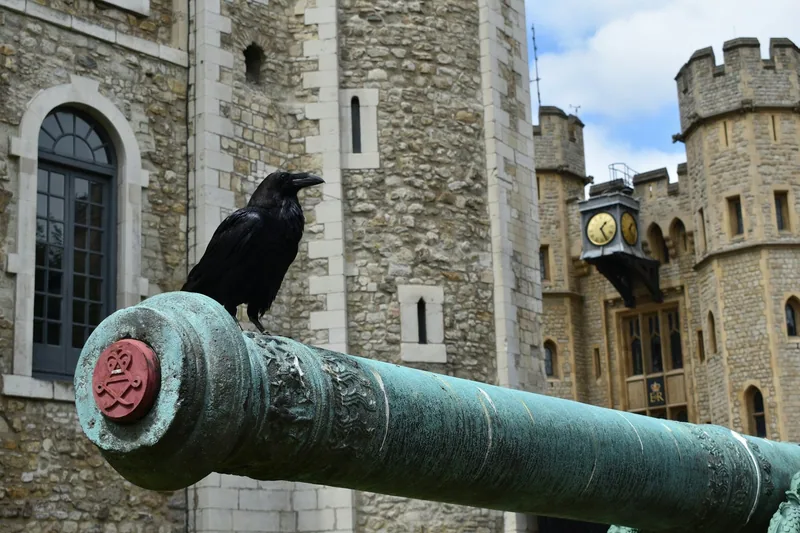
The ravens live near Tower Green and the White Tower. They are looked after by a Yeoman Warder known as the Ravenmaster. Keep your distance and do not feed them: they are wild birds with strong beaks.
Tickets, prices and what a family pays
Historic Royal Palaces publishes one ticket price and says you can book online or buy on the day at the ticket office. Booking is not required, but it advises booking ahead during busy times such as school holidays. The optional donation adds about 10% to the price.
| Ticket | Price | With donation |
|---|---|---|
| Adult (18-64) | £37.00 | £40.70 |
| Senior (65+) or full-time student | £29.50 | check when booking |
| Child (5-15) | £18.50 | check when booking |
| Under 5 | Free | Free |
For a family of two adults and two children aged 5-15, that comes to £111.00 without the donation. A couple pays £74.00. Prices are for September 2026: check the current figures on the official tickets page before you go.
An audio guide can be booked with advance tickets online, from £5.00. There is also a free highlights audio tour that you open on your own phone through the Historic Royal Palaces visitor guide link, so bring headphones and a charged battery.
The Tower is included in some sightseeing passes. Whether one saves you money depends on how many other paid attractions you will actually fit in; our analysis of whether the London Pass pays off works through real examples.
Opening hours and how long to stay
In summer 2026 the Tower opened at 09:00 from Tuesday to Saturday and at 10:00 on Sunday and Monday, closing at 17:30 with last entry at 16:30. Hours can change with the season and for events, and parts of the site sometimes close for conservation work, so check the opening times and closures page for your date.
Historic Royal Palaces recommends at least three hours. That is realistic if you want the Crown Jewels, a Yeoman Warder tour, the White Tower and the walls. A rushed visit focused only on the jewels and one tour can be done in two hours, but it feels like poor value at this price. Remember that there is no re-entry, so eat before you go in or use the cafés inside.
Suitcases and large or rolling bags are not allowed, and there is no left luggage on site. If you are coming straight from a train or checking out of a hotel, find a left luggage service first.
How to avoid the worst of the queues
There are usually two queues: one at the entrance for security and tickets, and one for the Jewel House. Having a ticket in advance helps with the first. The second depends on crowd timing.
- Arrive for opening. Walk straight to the Jewel House before the tour groups build up, then join a Yeoman Warder tour afterwards.
- Or come later in the day. In July 2026 Historic Royal Palaces said the Tower is quieter in the afternoon, after midday. If you arrive around 13:30, remember that last entry is 16:30 and the last Yeoman Warder tour is at 15:15.
- Avoid school holidays and weekends if you can. A weekday in term time is noticeably calmer.
- Go in drier weather. Most queues are outdoors and much of the visit is outside.
The Jewel House line is the one to beat. If you arrive at opening, resist the urge to wander. Go to the Waterloo Block first, see the crowns while the vault is quiet, and save the walls and towers for later, when the jewel queue has grown and you no longer need it.
Getting to the Tower of London
Tower Hill station, on the District and Circle lines, is about five minutes' walk away and has step-free access to street level. Tower Gateway on the DLR is also close. Monument, Bank, Aldgate, Aldgate East, London Bridge and Fenchurch Street are all within 10 to 15 minutes' walk. Our guide to using the Tube explains lines, fares and touching in and out.
If you need lifts, Tower Hill, Bank, London Bridge, Fenchurch Street and Tower Gateway all have lifts to street level, according to Historic Royal Palaces; the wider picture is in our guide to step-free travel around London. There is no car park at the Tower.
The river is a pleasant alternative. Uber Boat by Thames Clippers stops at Tower pier on its main RB1 route between Westminster, the London Eye and Greenwich. You can pay with contactless or Oyster, but boat fares do not count towards the daily cap. See our page on the river bus and its fares before you plan a whole day on the water.
Ceremonies you can watch at the Tower
The Tower still runs on a daily routine of small ceremonies. According to the Household Division, the military guard takes part in the ceremonial opening at 09:00, collects the daily password known as "the Word" at 15:00, and at exactly seven minutes to 22:00 every night the Chief Yeoman Warder locks the gates in the Ceremony of the Keys, a tradition that goes back centuries.
The Ceremony of the Keys takes place after closing time, so you need a separate ticket from Historic Royal Palaces. Places are limited, so look at the booking page well before your trip. In summer 2026 Historic Royal Palaces also sold a paid "Opening Ceremony experience" in the morning. Check what is running during your visit on its website.
Combining the Tower with nearby sights
The Tower sits at the eastern edge of the City of London, the historic financial district, and it is easy to build a day around it. Tower Bridge is right outside, and its high walkways and glass floors make a good second stop. Across the river, a walk along the south bank brings you to Borough Market for lunch.
For views, the free Sky Garden at the top of 20 Fenchurch Street is only a few minutes' walk away, but you need to book a free ticket in advance. To the west, St Paul's Cathedral is a short Tube ride or a longer walk through the City.
If you are planning a first trip, our three-day London itinerary shows how the Tower fits with Westminster and the museums, and the other royal palaces are covered in our guides to Buckingham Palace and Hampton Court, which is run by the same charity.
Is it good for children?
Yes, for most ages. Knights' armour, the ravens, the stories of prisoners and escapes, and the Yeoman Warders' performance style work well for children aged about six and up. Very young children may find the crowds and the jewel queue tiring, and there are many steps. Under-5s go free. There are baby changing facilities and buggy parks on site. Our family guide to London has more ideas for a day with children.
Frequently asked questions
How much does it cost to visit the Tower of London?
An adult ticket costs £37.00, or £40.70 with the optional donation (September 2026). Children aged 5-15 pay £18.50, seniors and full-time students £29.50, and under-5s go free. A Yeoman Warder tour is included. Check current prices on the Historic Royal Palaces website.
Do I need to book Tower of London tickets in advance?
No, you can buy tickets on the day at the ticket office. Historic Royal Palaces advises booking online in advance at busy times such as school holidays, and having a ticket already makes the entrance queue quicker.
How long do you need at the Tower of London?
Allow at least three hours to see the Crown Jewels, join a Yeoman Warder tour and explore the White Tower and the walls. Your ticket is valid for one entry only, so you cannot leave for lunch and come back in.
Can I bring a suitcase to the Tower of London?
No. Suitcases and large or rolling bags are not allowed, and there is no left luggage at the Tower. Leave your bags at your hotel or at a left luggage service before you arrive.
Are the Crown Jewels real?
Yes. The crowns, sceptres and other regalia in the Jewel House are the real objects, and several of them are still used by the monarch at coronations and state occasions. When a piece is needed for a ceremony, it is removed from display for a time.
Sources
- Historic Royal Palaces - Tower of London tickets and prices (checked September 2026)
- Historic Royal Palaces - Tower of London opening and closing times (checked September 2026)
- Historic Royal Palaces - Visit the Tower of London (checked September 2026)
- The Household Division - Guard at the Tower of London (checked September 2026)
- Transport for London - About the River Bus (checked September 2026)