
London hosted the Summer Olympic Games in 2012, and the Olympic Park built for them in Stratford, East London, is now Queen Elizabeth Olympic Park: a free public park with the old stadium, the Olympic pool, a velodrome and a red steel tower you can still visit. It is open every day, it is about 10 minutes' walk from Stratford station, and it makes a good half-day or full day away from the crowds of central London.
The 2012 Olympics ran from 27 July to 12 August, followed by the Paralympic Games from 29 August to 9 September. It was the third time London had hosted the Olympics, after 1908 and 1948. Years before the Games, a large area of old industrial land, railway sidings and polluted rivers in the Lower Lea Valley was cleared and rebuilt as the Olympic Park, and the construction work spread across several parts of East London.
The big idea was legacy: the Games should leave behind things Londoners and visitors would use for decades. That largely worked. The transport links built up around Stratford are still among the best in the city, the venues are open to the public, and the park itself has become a neighbourhood with homes, universities, museums and a theatre. For a visitor, the result is a very different side of London from Westminster or the West End, and most of it costs nothing.
Queen Elizabeth Olympic Park: key facts
- Entry
- Free, open every day
- Size
- 560 acres of parkland, waterways and venues
- Main station
- Stratford (Central, Jubilee and Elizabeth lines, DLR, Overground, National Rail), Zone 2/3
- Other stations
- Stratford International, Hackney Wick, Pudding Mill Lane
- Information Point
- The Pavilion at Stratford Cross, 11:00-16:00 daily
- Paid highlights
- ArcelorMittal Orbit and its Helix slide, a swim in the Olympic pool, a London Stadium tour
- Time needed
- Two or three hours for a walk; a full day with a swim, a tour or a museum
How the Games reshaped the Lower Lea Valley
Before 2008 the land between Stratford and Hackney Wick was a mix of warehouses, scrapyards and waste ground cut through by neglected branches of the River Lea. The Victorian industries that once used these waterways had closed long before. Building the Olympic Park meant cleaning the soil, restoring the channels and laying out new meadows and wetlands along the river.
The waterways were repaired after the Games in a joint project between the park's owner, the London Legacy Development Corporation, and the Canal & River Trust. Today you can walk, cycle or run along the river paths, and the loop of channels around the stadium is open to boats. After very heavy rain the paths closest to the River Lea, especially in the north of the park, can flood, because the park is designed to hold water and protect the homes around it.
Several buildings from 2012 have changed their purpose completely. The Athletes' Village is now East Village, a residential area with bars and cafés. The former press and broadcast centre is Here East, a technology campus with canalside restaurants. The park took its current name, Queen Elizabeth Olympic Park, after the Games, and the southern half reopened to the public in April 2014.
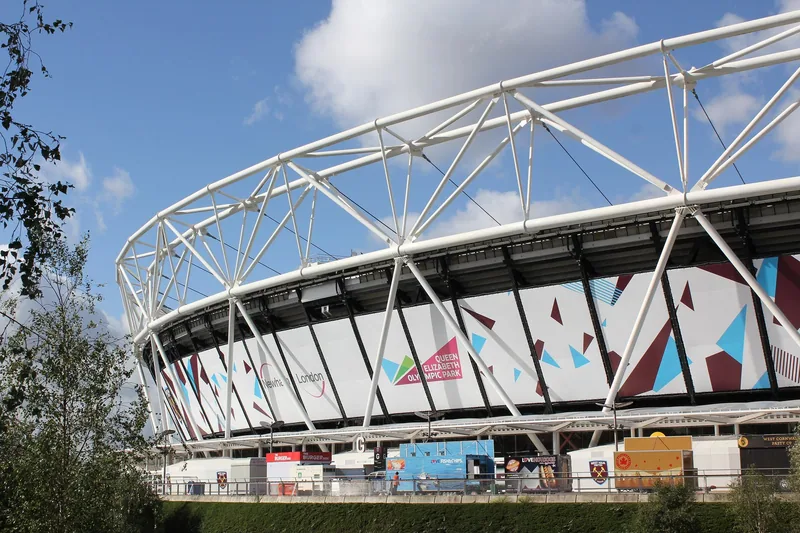
Photo: Kittelträger · CC BY-SA 4.0 · Wikimedia Commons · resized
Olympic venues you can still use
This is what makes the park unusual. Most Olympic cities struggle to find a use for their venues, but in Stratford nearly everything is open to the public in some form, and much of it at ordinary leisure-centre prices.
| Venue | Role in 2012 | What you can do now |
|---|---|---|
| London Stadium | Opening and closing ceremonies, athletics | West Ham United matches, concerts, athletics, guided tours (adult £22 in advance) |
| London Aquatics Centre | Swimming, diving and artistic swimming | Public swimming in the Olympic pool, diving, gym |
| Copper Box Arena | Handball, modern pentathlon fencing, goalball | Basketball (London Lions), netball (London Pulse), concerts, e-sports, a public gym |
| Lee Valley VeloPark | Track cycling and BMX | Track taster sessions, BMX, a road circuit and mountain-bike trails |
| Lee Valley Hockey and Tennis Centre | Wheelchair tennis | Public tennis courts and hockey pitches |
| ArcelorMittal Orbit | A landmark sculpture and viewing tower | Viewing platform and the Helix tunnel slide, run by Zip World |
You do not need to book anything to look at the buildings from outside, and the architecture alone justifies a walk. The Aquatics Centre, with its wave-shaped roof by Zaha Hadid, is the most striking. If you want to go further, our guides cover swimming in the Olympic pool, the Orbit tower and its long slide and match days and tours at the stadium.
West Ham play in the Championship in 2026/27. The club was relegated from the Premier League in 2025/26, so matches at the London Stadium this season are second-tier games. If you specifically want top-flight football, see our overview of the six London clubs in the Premier League.
South Park and North Park: two different moods
The park divides naturally into two halves. The southern part, next to Westfield Stratford City and Stratford station, is where most visitors start. It holds the stadium, the Orbit, the Aquatics Centre and the new East Bank cultural quarter, with wide paved walkways, cafés and water fountains. It feels urban and busy, especially at weekends.
The northern part is greener and quieter. Here you find the VeloPark, the Hockey and Tennis Centre, the Tumbling Bay playground, wetlands along the river and the Olympic Rings and Paralympic Agitos, which are popular photo spots. The London Blossom Garden has 33 blossom trees, one for each London borough and the City of London, and the lawns known as the Park Meadows fill with wildflowers in spring and summer.
Things to do for free
- Walk the river paths from the Aquatics Centre north to the VeloPark and back (allow about an hour at a relaxed pace).
- Follow one of the park's trails: an art trail through 28 artworks, a wildlife walk or a children's adventure trail. Maps are on the park's website or at the Information Point.
- Let children play in the South Park fountains, which run daily from 10:00 to 17:00 (they are turned off three hours before stadium events).
- Use the free orienteering courses in the North and South Park, with maps for beginners and more experienced walkers.
- Visit the two V&A East sites, both free (see below).
For more ideas that cost nothing across the city, see our list of free things to do in London.
East Bank: the park's new cultural quarter
The newest part of the park lies along the river opposite the stadium. East Bank brings together a museum, a theatre, a fashion college and a university campus. For a visitor, two places stand out.
V&A East Museum opened on 18 April 2026. Like the main V&A in South Kensington, it is free, and it is open daily from 10:00 to 18:00, until 22:00 on Thursdays and Saturdays. The museum warns that there may be a queue to get in. V&A East Storehouse, a short walk away near Hackney Wick, opened in May 2025. It is the museum's working store, where you walk among the shelves of the collection, and it keeps the same hours. It is also free, and no booking is needed.
Sadler's Wells East, a 550-seat dance theatre, opened in February 2025. London College of Fashion and UCL East are mainly for students but host exhibitions and events. The last building, the BBC Music Studios, is due to open in 2027. Both V&A sites are good rainy-day options, and they appear in our round-up of London's free museums.
Getting to Stratford and into the park
Stratford is one of the best-connected stations in London, which is part of the Olympic legacy. From central London the Central line, the Jubilee line and the Elizabeth line all run there directly, and the park's operators put the journey at about 11 minutes from the City and 19 minutes from the West End. From Stratford station, follow the signs through Westfield Stratford City and across the road into the park. The walk to the Aquatics Centre takes about 10 minutes.
| Station | Lines | Best for |
|---|---|---|
| Stratford | Central, Jubilee, Elizabeth line, DLR, Overground (Mildmay line), Greater Anglia, c2c | Most visits; the Aquatics Centre, Orbit and East Bank |
| Stratford International | DLR, Southeastern high-speed trains | Arriving from St Pancras; East Village |
| Hackney Wick | Overground (Mildmay line) | V&A East Storehouse, Here East, the north-west of the park |
| Pudding Mill Lane | DLR | The south-west corner, closest to the stadium |
Stratford is in fare zones 2 and 3, and our guide to how London's fare zones work explains what that means for your fare. As an example, a single journey from Oxford Circus to Stratford costs £3.60 at peak times and £3.10 off-peak with contactless or Oyster (TfL fare data, September 2026). Check other journeys on the TfL fare finder. The simplest way to pay is with a contactless bank card; our comparison of Oyster and contactless covers the daily caps.
Southeastern high-speed trains reach Stratford International from St Pancras in about seven minutes, but they are not included in the TfL daily caps or in Travelcards, so the Tube is usually cheaper. The Elizabeth line is the fastest option from Paddington, Bond Street, Tottenham Court Road and Liverpool Street. The Central and Jubilee lines both run through the night at weekends, which helps after evening events; see our Night Tube guide for times.
Planning a day in the Olympic Park
You can see the main sights in a morning, but the park rewards a slower day. This plan works well for adults and older children:
- Morning: arrive at Stratford around 10:00 and walk into the park past the Aquatics Centre. Go up the ArcelorMittal Orbit early, when the light is often clearer and the slide queues are shorter. Book ahead online.
- Late morning: take a London Stadium tour if you have booked one (weekday departures are usually at 11:00, 13:00 and 15:00), or walk north along the river to the Olympic Rings and the VeloPark.
- Lunch: eat at one of the cafés on Aquatics Walk, at the Timber Lodge café by the playground in the north, or in Westfield Stratford City.
- Afternoon: spend an hour or two in V&A East Museum or the Storehouse, or book a public swim in the Olympic pool.
- Evening: on Thursdays and Saturdays both V&A East sites stay open until 22:00, or catch a performance at Sadler's Wells East.
If you want to know more about the surrounding area, including where to eat and stay, read our guide to Stratford and its neighbourhoods.
Check the stadium calendar before you choose your date. On West Ham home games and big concerts, roads around the stadium close about three hours before the start, the fountains are switched off, and Stratford station becomes very crowded after the event. A quiet weekday is far more pleasant for a first visit.
Visiting with children or with limited mobility
The park is one of the best free spaces in East London for families. Tumbling Bay, in the north of the park, is a large natural-style playground with rope bridges, sand, water and climbing structures, and it has a café next to it. The fountains in the south are a favourite on warm days. Our wider guide to London with children has more ideas for combining the park with other sights.
The park was designed to be step-free, with hard paths, regular seating and accessible toilets in the venues. A Park Mobility service lends mobility scooters and manual wheelchairs and offers a sighted guide; the park strongly advises booking in advance on 0800 0722 110. Stratford, Stratford International, Pudding Mill Lane and all DLR stations are step-free; our page on step-free travel in London explains how to plan the rest of the journey. If you are coming from Canary Wharf or Hackney rather than the centre, the DLR and the Overground are often quicker than the Tube.
Is the Olympic Park worth the trip?
Reasons to go
- Free to enter, with two free museums inside
- You can swim, cycle or play where Olympians competed
- Fast, frequent transport from central London
- Plenty of space for children, and few crowds on weekdays
- A clear picture of how modern London is changing
Reasons to skip it
- Little historic architecture: this is a modern landscape
- Exposed and windy in bad weather, with long walks between venues
- Very busy and partly closed on stadium event days
- If you have only two or three days in London, the classic sights come first
Our verdict: if you have four days or more, or if you are interested in sport, architecture or urban regeneration, the park is well worth half a day. Combine it with V&A East and you have a full day that costs very little apart from transport.
Frequently asked questions
Is Queen Elizabeth Olympic Park free to visit?
Yes. The park is free and open every day of the week. You only pay for specific activities, such as the ArcelorMittal Orbit, the Helix slide, a swim at the London Aquatics Centre, a London Stadium tour or tickets for a match or concert.
Where was the London 2012 Olympic Park?
It was built in Stratford, in the London Borough of Newham in East London, on former industrial land in the Lower Lea Valley. After the Games it was renamed Queen Elizabeth Olympic Park. The main station is Stratford, served by the Central, Jubilee and Elizabeth lines, the DLR and the Overground.
Can you still go inside the Olympic venues from 2012?
Yes, most of them. You can swim in the Olympic pool at the London Aquatics Centre, take a guided tour or watch a match at the London Stadium, ride the velodrome at Lee Valley VeloPark, watch basketball or netball at the Copper Box Arena, and go up the ArcelorMittal Orbit.
How long should I spend at the Olympic Park?
Allow two to three hours for a walk around the main venues and the river paths. Plan a full day if you add the Orbit, a swim or a stadium tour, and a visit to V&A East Museum or the Storehouse.
How do I get from central London to the Olympic Park?
Take the Central, Jubilee or Elizabeth line to Stratford, then walk about 10 minutes through Westfield Stratford City into the park. Pay with contactless or Oyster; a single from Oxford Circus costs £3.60 at peak times and £3.10 off-peak (September 2026).
Sources
- Queen Elizabeth Olympic Park - Getting here (checked September 2026)
- Queen Elizabeth Olympic Park - Visitor information (checked September 2026)
- Queen Elizabeth Olympic Park - Experience the legacy of London 2012 (checked September 2026)
- Queen Elizabeth Olympic Park - East Bank (checked September 2026)
- V&A - Visit V&A East Museum (checked September 2026)
- London Stadium - All events (checked September 2026)
- Transport for London - Tube and rail fares (checked September 2026)