
The sounds that wake visitors in London are not the ones they expect. Pub closing time is over by one; the bin lorry, the cellar drop and the street sweeper come between five and seven, and in west and central London the first aircraft crosses at about half past four. Almost none of it is anything a council will investigate, which means the only person who can protect your sleep is the person taking your booking.
The good news is that a quiet room in central London is free to arrange and easy to ask for. The bad news is that it has to be asked for before you arrive, because the hotel allocates rooms in the order bookings are confirmed and cannot move you once it is full.
This page sets out what actually makes the noise, hour by hour; why a Georgian sash window in a listed building cannot simply be double-glazed; which areas and which building types are worst; and the eight things to put in an email before you pay. What the room itself is like, including which side of a building to request in general, is in our guide to what a London hotel room is actually like.
The London night, hour by hour
- 23:00 to 01:00
- Pubs and bars closing. Loud, but short, and mostly in known districts
- 23:00 to 07:00
- "Night hours" in the Noise Act 1996, and the window in which late deliveries become reportable
- From about 04:30
- The first aircraft over west and central London. Heathrow schedules no flights between 23:30 and 04:30
- 05:00 to 07:00
- Refuse collection, street cleaning, cellar drops and restaurant deliveries
- From 08:00
- Building work and non-emergency street works may legally start
- Not investigated at all
- Sirens, traffic, essential roadworks and aircraft
The bin lorry is the real enemy, not the pub
In the West End the complaints come from the early morning, not the late night. A district with several hundred restaurants in a few streets has to be emptied and restocked before it opens, and that work runs between five and seven, exactly when a jet-lagged visitor has finally fallen asleep.
Three operations overlap. Commercial waste is collected from the kerb, with a lorry, a compactor and men calling to each other. Cellars are dropped, which means metal doors in the pavement and kegs rolling down a ramp. And the street is swept and washed. None of it is unlawful and none of it will stop.
The difference between a good night and a bad one is therefore about fifteen metres of building. A fourth-floor room at the back hears very little. The same hotel's second-floor room over the street hears all three. Nothing about the rate or the star rating predicts which you get.
Why the window cannot be fixed
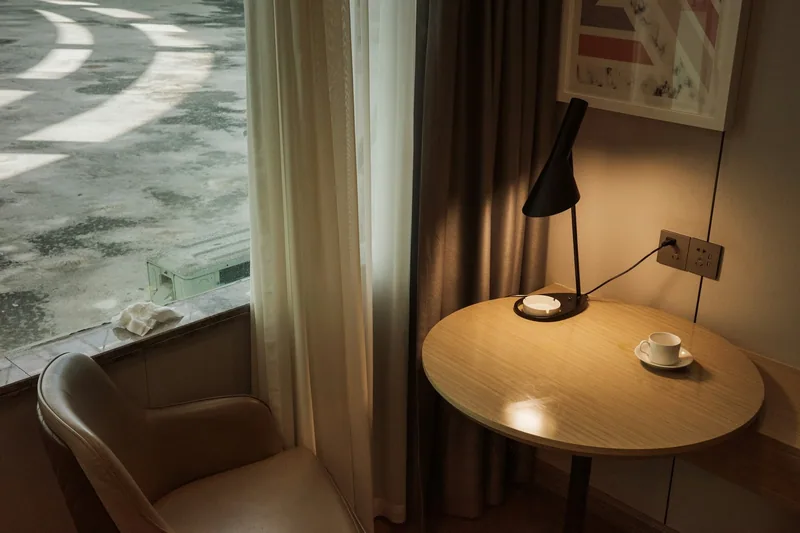
A great many central London hotels occupy listed buildings or sit in conservation areas, where replacing original sash windows with modern sealed units generally needs consent and is often refused, because the windows are part of what is being protected. The usual solution is secondary glazing: a second pane fitted inside the room, which works well and is not meant to be opened.
Newer hotels are covered by a building standard, and it is worth knowing the numbers because they explain why one hotel sounds like a library and another does not. Approved Document E of the Building Regulations sets sound insulation standards for "rooms for residential purposes", a category that expressly includes hotel bedrooms. Walls separating them must achieve a minimum of 43 dB, and floors 45 dB in a purpose-built building or 43 dB in one converted from another use, with limits on impact sound from above.
The catch is the date. Those standards apply to new building work and to material changes of use, not retrospectively. A hotel carved out of a terrace of 1840s houses in the 1960s was built to whatever the builder felt like, and the party wall between your room and the next may be a single layer of lath and plaster. This is the single clearest reason why a modern purpose-built hotel two zones out can be quieter than a handsome one in the middle of town.
Secondary glazing is a better sign than new windows in a period building. If the hotel says the rooms have secondary glazing, it has spent money specifically on noise, which a hotel that has only redecorated has not. Ask the question in those words, because "double glazing" in a listed terrace usually means secondary glazing anyway.
Aircraft, and the half-past-four problem
This one catches people out because nobody warns them. When aircraft are landing at Heathrow from the east, which is the prevailing pattern, the approach passes over west and central London at low altitude. The Department for Transport's own description of the regime sets the bounds: Heathrow is limited to 5,800 night flights a year, 3,250 in the summer season and 2,550 in winter, which is roughly sixteen a night on average, and under a voluntary agreement no flights are scheduled between 23:30 and 04:30, with flights scheduled between 04:30 and 06:00 prevented from landing before 04:30.
In practice that means a broad quiet band in the middle of the night and then a steady stream from about half past four, building through the early morning. If you are a light sleeper, this is a reason to prefer a rear-facing room with secondary glazing, and a reason not to be surprised. It is also completely outside the complaints system: Westminster City Council states flatly that it cannot investigate noise caused by aircraft, including helicopters, and points people to the Civil Aviation Authority.
What a council will and will not do
This matters because it tells you where your leverage is. Westminster, which contains most of the hotel districts that generate complaints, publishes the clearest list in London.
| Noise | Position | Permitted hours, where there are any |
|---|---|---|
| Bars, pubs, nightclubs and licensed premises | Investigated, reviewed within one hour, 24 hours a day | Set by each premises licence |
| Building and construction work | Investigated. Out-of-hours work reviewed within one hour | 08:00 to 18:00 weekdays, 08:00 to 13:00 Saturdays, none on Sundays or bank holidays without permission |
| Non-emergency street works | Investigated out of hours | 08:00 to 18:00 weekdays, 08:00 to 13:00 Saturdays. Emergency works may happen at any hour |
| Deliveries | Investigated if late at night | Reportable between 23:00 and 07:00 |
| Loudspeakers in the street | Reportable | Between 21:00 and 08:00 |
| Sirens, traffic, essential roadworks, aircraft | Not investigated at all | None |
Two things follow. First, demolition, excavation and piling are not permitted on Saturdays without special permission, so a weekend beside a building site is usually bearable and a Tuesday is not. Second, the statutory test behind all of this is framed around a home: noise counts as a statutory nuisance if it unreasonably and substantially interferes with the use or enjoyment of a home or other premises, or injures health. A hotel guest is not the natural complainant, which is why the practical remedy is always the hotel rather than the council.
There is one exception worth knowing. The Noise Act 1996 defines night hours as the period from 23:00 to 07:00 and gives councils a power to serve notice about excessive noise at night, but the complaint has to come from an individual present in a dwelling. Your hotel is not your dwelling. Ask the duty manager instead.
Which parts of London are loudest at night
Noise in London is concentrated, not general, and it follows licensing rather than population. The pattern is consistent enough to plan around.
- Soho and the streets around Leicester Square are the loudest place to sleep in Britain, and honestly so: our guide to staying in Soho and Covent Garden sets out what the night sounds like there and which streets are calmer.
- Shoreditch and Hoxton run late at weekends and have the additional feature of a cluster of late licences in a small area; our guide to the area has the detail.
- Around the main stations. Euston Road, the front of Victoria, the streets behind King's Cross and the approaches to Paddington carry traffic all night. Our guide to staying near King's Cross and Paddington and our Victoria page both cover it.
- Camden and Brixton have big music venues, and a venue emptying at eleven puts two thousand people on one pavement at once.
- Near a hospital or a fire station. Sirens are unpredictable, unavoidable and specifically outside the complaints system. If you know you react badly to them, check the map before booking.
The quietest central options are the residential squares and the streets behind them: Bloomsbury away from Euston Road, Kensington and Chelsea, Marylebone's side streets and Westminster outside office hours. Their weakness is the opposite one: very little is open in the evening, which our comparison of the districts weighs up properly.
Inside the building: the three noises you can avoid for nothing
Street noise gets the attention, but a great deal of what wakes people in a London hotel comes from inside it, and every one of these can be avoided by asking.
- The lift. A lift dropped into a Victorian stairwell has motors, gates and a shaft that carries sound. The room next to it is the one to refuse.
- Fire doors. Corridor doors are heavy and self-closing, and they bang. A room away from the stairwell and the ice machine is worth more than a better view.
- Plumbing and plant. Ventilation, lifts and pumps are the "fixed plant" that councils will investigate for residents, and in an old conversion the pipes are boxed in beside beds. A room not directly above or below a bar, a kitchen or a plant room is the one to ask for.
Eight things to put in an email before you pay
- A room at the rear of the building, away from the street.
- A high floor if there is a lift, a low one if there is not.
- Not next to the lift, the stairwell or a service door.
- Not above or below the bar, the kitchen, the function room or a plant room.
- Secondary glazing, if the building is a period one.
- Confirmation of whether there is building work at the hotel or next door on your dates.
- Whether the hotel has a late licence of its own, and until when.
- Whether there is a function or an event booked on your dates.
All eight are free, and a hotel that answers all eight fully is telling you something useful about how it is run. Ask again at check-in, before you go up: the desk can usually still change a room then, and cannot at ten at night.
Reception at 15:00 has rooms to choose from; reception at 22:00 has one. If sleep matters, arrive early enough to be moved, and say so pleasantly at the desk rather than complaining afterwards. This is the single most effective thing in this article and it costs nothing at all.
If the room turns out to be loud anyway
Go to reception the same night, not in the morning, and ask to be moved. Be specific about what is wrong, because "it's noisy" invites a shrug and "there is a delivery bay under the window" invites a different room. If the hotel is full, ask what it can do instead: a fan or a white-noise machine, a different room for the following night, or earplugs, which many hotels keep at the desk.
If the noise is coming from a licensed premises, a party or out-of-hours building work, that is the one category the borough will act on quickly, and Westminster reviews such reports within an hour, at any time of day or night. Report it through the council rather than confronting anyone. If the hotel simply refuses to engage and the stay is ruined, our guide to complaining and consumer rights in Britain sets out the escalation, and a flexible rate gives you the option of leaving, as our page on rates you can cancel explains.
Visitors who are sensitive to noise for reasons beyond preference will find more practical detail, including which attractions run quieter sessions, in our guide to London for autistic and sensory-sensitive visitors.
Frequently asked questions
What time do bin lorries collect in central London?
Commercial waste collection, cellar drops and street cleaning are concentrated between about five and seven in the morning, because restaurant districts have to be emptied and restocked before they open. Late-night deliveries between 23:00 and 07:00 can be reported to the council, but early-morning collection within permitted hours cannot.
Can I complain to the council about noise from my hotel room?
You can report it, but the statutory test is framed around interference with a home, and the Noise Act's night-noise procedure requires a complainant present in a dwelling. Licensed premises, parties and out-of-hours building work are acted on quickly in any case. For everything else, the hotel is the effective route.
What hours can building work take place in London?
In Westminster, noisy building work is permitted from 08:00 to 18:00 on weekdays and 08:00 to 13:00 on Saturdays, with none on Sundays or bank holidays without special permission, and demolition, excavation and piling not permitted on Saturdays without permission. Other boroughs set similar hours; check the relevant council's page.
How early do aircraft fly over central London?
From about 04:30 when aircraft are landing at Heathrow from the east. Heathrow is limited to 5,800 night flights a year and schedules none between 23:30 and 04:30, with flights timetabled from 04:30 onwards prevented from landing earlier. Aircraft noise is outside the council complaints system entirely.
Which London areas are quietest for sleeping?
The residential squares and their side streets: Bloomsbury away from Euston Road, Kensington, Chelsea, the quieter parts of Marylebone, and Westminster outside office hours. The trade is that these districts have little open in the evening, so you gain sleep and lose a night-time neighbourhood.
Does asking for a quiet room actually work?
Usually, yes, if you ask in writing when you book and again at check-in. Hotels grant the request when they still have rooms to allocate, and it costs nothing. What they cannot do is move you at eleven at night in a full hotel, which is why the timing of the request matters more than the wording.
Sources
- Noise Act 1996, section 2 - investigation of complaints of noise at night (checked September 2026)
- Environmental Protection Act 1990, section 79 - statutory nuisances (checked September 2026)
- GOV.UK - Noise nuisances: how councils deal with complaints (checked September 2026)
- Ministry of Housing, Communities and Local Government - Approved Document E, resistance to the passage of sound (checked September 2026)
- Westminster City Council - Noise problems we can investigate (checked September 2026)
- Westminster City Council - Noise we cannot investigate (checked September 2026)
- Department for Transport - Night flight restrictions at Heathrow, Gatwick and Stansted from October 2025 (checked September 2026)