
For most visitors, a contactless bank card or phone is the simplest way to pay for London transport: it charges the same fares and daily caps as an Oyster card, and you don't pay the £10.50 Oyster card fee. Oyster still makes sense if your card is not contactless, if your bank charges heavy overseas fees, or if you want a discount that has to be loaded onto a card.
London's buses, Tube, trams, DLR, London Overground and most of the Elizabeth line work on "pay as you go". You do not buy a ticket before each journey. You touch a card on the yellow reader when you enter the station, and touch the same card again when you leave. The system works out the fare, and a cap stops the total from growing once you have travelled enough in one day or one week.
You can pay this way with your own contactless bank card (or a phone or watch linked to it), or with an Oyster card, TfL's blue smartcard, loaded with credit. This page is about choosing between the two.
Pay as you go in London: the key numbers
- Oyster card fee
- £10.50, not refundable (2026)
- Cost of using your own contactless card
- Nothing from TfL; your bank may add a fee
- Tube single, Zone 1 only
- £3.10 peak, £3.00 off-peak
- Paper single ticket, Zones 1-6
- £7.00
- Daily cap, Zones 1-2
- £8.90
- Weekly cap, Zones 1-2 (Monday to Sunday)
- £44.70
- Bus or tram journey
- £1.75 (rising to £1.85 on 1 November 2026)
How pay as you go works on the Tube and buses
On the Tube, DLR, Overground, Elizabeth line and trains within London, you touch in at the start and touch out at the end. The fare depends on the zones your journey passes through and the time you travel. If you forget to touch out, the system cannot tell where you went, so it charges a maximum fare.
On buses and trams it is simpler. You touch in once when you board, and you never touch out. Every bus journey costs the same flat fare, however far you ride. Cash is not accepted on London's red buses, so you need a contactless card, a phone or an Oyster card before you board.
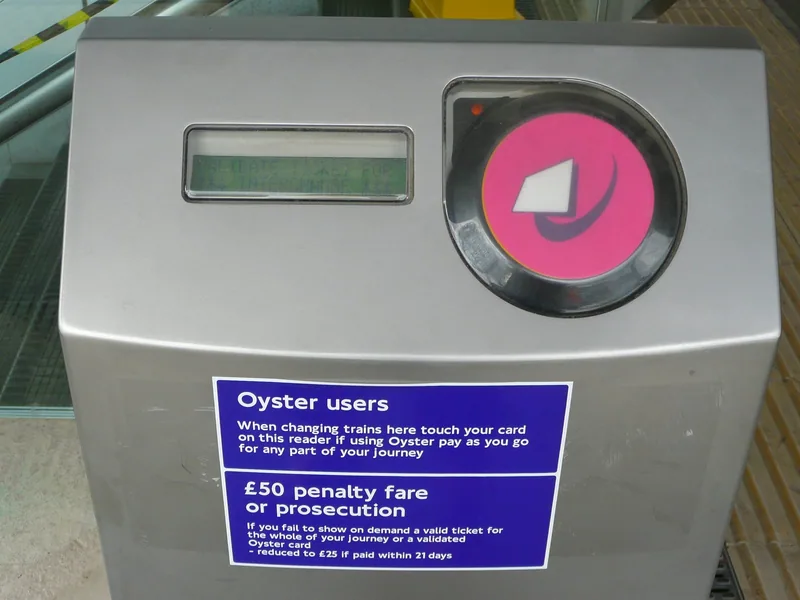
Contactless and Oyster charge the same fares
This is the point many visitors miss. An adult paying with contactless and an adult paying with Oyster are charged the same pay as you go fare for the same journey, and both are protected by the same caps. There is no "Oyster discount". The only price difference is the card itself: an Oyster card costs £10.50, and for cards bought since 4 September 2022 that fee is not refunded.
Either way you pay far less than at a ticket window. These adult fares (valid from 5 July 2026) show how the price moves with distance and time of day:
| Journey | Peak | Off-peak | Paper single |
|---|---|---|---|
| Oxford Circus to Piccadilly Circus (Zone 1) | £3.10 | £3.00 | £7.00 |
| Oxford Circus to Camden Town (Zones 1-2) | £3.10 | £3.00 | £7.00 |
| Oxford Circus to Brixton (Zones 1-2) | £3.60 | £3.10 | £7.00 |
| Oxford Circus to Uxbridge (Zones 1-6) | £5.90 | £4.00 | £7.00 |
Notice that the two Zone 1-2 journeys cost different amounts: Camden Town is priced like a Zone 1 trip, Brixton is not. For a journey you will make often, look it up on TfL's Single Fare Finder rather than trusting a general "zone price".
When peak fares apply
Peak hours are Monday to Friday (not public holidays), 06:30 to 09:30 and 16:00 to 19:00. Everything else is off-peak, the whole weekend included. One exception helps visitors: a journey from outside Zone 1 into Zone 1 between 16:00 and 19:00 counts as off-peak. Start your sightseeing after 09:30 and you pay less for every Tube ride until the evening rush.
Daily caps: the most you pay in a day
A cap is a ceiling. Once your fares in one day add up to the cap for the zones you used, further journeys in those zones that day are free, though you still touch in and out as normal. The travel day runs from 04:30 to 04:29 the next morning, so a late journey home after midnight belongs to the day before.
| Zones | Daily cap | Weekly cap (Monday to Sunday) |
|---|---|---|
| Zone 1 only, or Zones 1-2 | £8.90 | £44.70 |
| Zones 1-3 | £10.50 | £52.50 |
| Zones 1-4 | £12.80 | £64.20 |
| Zones 1-5 | £15.30 | £76.40 |
| Zones 1-6 | £16.30 | £81.60 |
| Bus and tram only | £5.25 | £24.70 |
In Zones 1-6 the daily cap is the same at peak and off-peak times; further out, in Zones 7-9, it depends on when you start. Tube and rail caps are frozen until March 2027, while the bus-only daily cap rises from £5.25 to £5.55 on 1 November 2026. Current figures are on TfL's fare capping page.
If you reach the Zones 1-2 cap and then travel out to Zone 3, you pay only the difference up to the Zones 1-3 cap. A cap counts only what one card or device has spent, which is why swapping between them mid-day is expensive.
A daily cap beats a Day Travelcard for Zones 1-6. A paper Anytime Day Travelcard for Zones 1-6 costs £23.60, while the pay as you go cap for the same zones is £16.30. Unless you need a paper ticket for a specific reason, such as a railcard discount, let the cap do the work. Our guide to Travelcards and railcard discounts covers the exceptions.
Weekly capping and how it helps a longer stay
The weekly cap works over a fixed Monday to Sunday period. It applies to adult pay as you go on both contactless and Oyster, so neither option has an advantage here. Older guides sometimes claim weekly capping is only for contactless. That is no longer how TfL describes it.
For Zones 1-2 the weekly cap is £44.70, only 20p more than five daily caps (5 × £8.90 = £44.50). Hit the daily cap every day from Monday and your sixth and seventh days are almost free.
The catch is the fixed week. Arrive on a Thursday and leave the following Wednesday and you never travel enough within one Monday to Sunday period to reach it. TfL itself says a 7 Day Travelcard may be better value for a week shaped like that, and a 7 Day Travelcard loads onto an Oyster card but not onto a bank card. For a stay of four or five days, the daily cap is the only one that matters.
What the £10.50 fee has to earn back
Since the fares are identical, the whole decision is one sum: does the card fee come back to you in some other form? On a three-day trip, £10.50 is more than a full day of capped travel in Zones 1-2, and only two things clear a hurdle that high. One is a bank that makes your own card expensive to use here. The other is a discount no bank card can carry.
The bank sum is easy to do before you leave home, and it usually goes against Oyster. A charge set as a percentage almost never adds up: a full week at the Zones 1-2 weekly cap is £44.70, and 3% of that is about £1.34. You would have to spend some £350 on travel before a 3% charge matched the card fee.
A fixed amount taken from each payment made abroad is the case that can tip the other way, and even that is smaller than people fear, because TfL's conditions of use set out that a day's fares are taken once you have stopped travelling for the day. Fourteen taps do not become fourteen payments. Multiply the charge by the number of days you will travel and compare it with £10.50: five days at £1 a day does not justify the card, ten days at £1.50 a day does.
The fee never buys a cheaper journey, and it never comes back. Unspent credit is another matter: our guide to Oyster refunds and the deposit that no longer exists explains how to reclaim it, and our review of the Visitor Oyster card covers ordering one, loading it and where each kind is sold.
Contactless cards and phones from abroad
Any card showing the contactless symbol can be used, and TfL says many cards issued outside the UK work. Apple Pay, Google Pay, Samsung Pay, Fitbit Pay, Garmin Pay, bPay and Barclaycard Contactless Mobile are all accepted. Prepaid and travel money cards are a gamble, and TfL's advice is to ask the issuer rather than find out at the gate.
What your own bank adds is worth checking before you fly, and it fills a page of its own: we have a whole guide to paying with a card issued outside Britain. The short version is that TfL charges nothing extra, the bill is always in pounds, and a phone wallet running on a non-UK card is the arrangement most likely to fail.
Register the card in a TfL contactless and Oyster account to see every journey and fare. An unregistered contactless card is not eligible for refunds.
An iPhone and an Apple Watch are two different cards to TfL. Touch in with your phone and out with your watch, and the system sees two incomplete journeys. You may pay two maximum fares, and none of it counts towards the cap. Pick one device or card for the whole trip, and keep your phone charged: a flat battery at the exit barrier also means a maximum fare.
Oyster or contactless: which saves you more?
Because fares and caps are the same, the choice comes down to the card fee, bank charges and discounts. This comparison sums it up.
Reasons to use contactless
- No £10.50 card fee
- Nothing to top up, and no unspent balance left over at the end
- Daily and weekly caps apply automatically
- Works on some airport routes where Oyster does not, such as trains to Stansted and Luton
Reasons to choose Oyster
- Your bank adds a fixed amount to each payment made abroad
- Your card is not contactless, or your issuer cannot confirm that it will work
- Somebody in the party is 11 to 15 and needs the half-price rate
- You want a railcard discount, or a 7 Day Travelcard on the same card
Our view: with a contactless card that carries no overseas fees, use it, and buy an Oyster card only for one of the reasons above. Families are the usual exception.
No discount of any kind works on contactless
National Rail states that discounts cannot currently be applied to pay as you go with contactless, and TfL works the same way. A reduction of any sort has to be written onto plastic by a member of staff.
For a child aged 11 to 15 that means the Young Visitor discount, which halves adult fares and caps for up to 14 days. The rules for each age band are worth reading before you buy anything.
Adults can load a UK railcard instead. The 16-25, 26-30, Senior, and HM Forces and Veterans railcards each take one third off off-peak fares, and the Disabled Persons Railcard takes a third off peak fares too. Two Together, Network and Family & Friends railcards cannot be added at all. Some are open to overseas buyers: our page on railcards worth buying as a visitor says which.
Where each option works, and where it doesn't
Pay as you go covers buses, the Tube, trams, the DLR, the Overground, most of the Elizabeth line and most National Rail services in Zones 1-9. Airport routes are where the two methods part company, and where visitors get caught out.
| Route | Contactless | Oyster | Counts towards caps? |
|---|---|---|---|
| Piccadilly line and Elizabeth line to Heathrow | Yes | Yes | Yes |
| Heathrow Express (Paddington) | Yes, £26.00 | Yes, £26.00 | No |
| Gatwick Express, Southern and Thameslink to Gatwick | Yes | Yes | Gatwick Express: no |
| Stansted Express | Yes | No | Yes, with its own caps |
| Trains to Luton Airport Parkway | Yes | No | – |
| Elizabeth line between Iver and Reading | Yes | No | – |
Journeys to Heathrow that start, end or pass through Zone 1 are charged the peak fare at all times. Our comparison of ways to get from Heathrow into the centre sets out the prices, and there are separate guides to Gatwick and its trains, Stansted's rail link and getting to and from Luton.
Stansted changed in March 2026 and older advice has not caught up. Contactless reached twenty more National Rail stations, Stansted Airport among them, with caps of its own: £47.20 peak and £35.20 off-peak to Zones 1-9. Oyster is still refused there.
Some services accept pay as you go but sit outside the caps altogether. These are the Uber Boat river bus, the IFS Cloud Cable Car, Heathrow Express, Gatwick Express and Southeastern high-speed trains. You pay the full fare for these even after you have reached your daily cap.
Where neither card gets you through the barrier
Pay as you go stops at a line on the map, and the reader simply refuses you beyond it. Neither method is valid south of Gatwick, so Brighton, Crawley and the Sussex coast need a rail ticket. Going east, the area ends at Shenfield: a train onward to London Southend Airport needs a ticket for the last stretch.
Some operators stand outside the system altogether. CrossCountry trains from Stansted do not take contactless. Coaches never have, so a National Express or Flixbus departure from Victoria Coach Station needs its own ticket, even though the coach station sells Oyster cards and tops them up. If a journey planner quotes a ticket price rather than a fare, that is your warning.
Mistakes that cost visitors money
Most overcharges come from a few simple errors, and they catch Oyster and contactless users alike.
- Forgetting to touch out. You are charged a maximum fare, and maximum fares do not count towards the cap. At stations with open gates, look for the yellow reader. Our page on what happens when you miss the reader explains how to get the money back.
- Card clash. Holding a wallet of several contactless cards against the reader may charge the wrong one, or reject both. Take out only the card you mean to use.
- Switching cards during the day. A phone in the morning and a plastic card in the evening are two separate customers, with two separate caps.
- Sharing a card. Two people cannot travel on one card. Each adult needs their own card or device. You can pay for a companion only with a different card or device.
If a fare looks wrong, wait before you complain. Caps are worked out at the end of the travel day, and on Sunday night for the week, so allow 48 hours before anything is final.
The Hopper fare makes bus changes free for an hour. After you touch in on a bus or tram, any further bus or tram journey started within the hour costs nothing extra, provided you use the same card. An Oyster card left with a negative balance by the first journey loses the benefit unless you top it up in time.
Frequently asked questions
Is Oyster cheaper than contactless in London?
No. For adults, Oyster and contactless charge the same fares and have the same daily and weekly caps. The card itself costs £10.50, which is not refunded, so contactless is usually cheaper unless your bank adds fees to foreign payments.
Does weekly capping work on an Oyster card?
Yes. TfL says the Monday to Sunday weekly cap works with adult pay as you go on both contactless and Oyster. The week is fixed, so a trip running from Thursday to Wednesday may never reach it.
Can two people use one contactless card or Oyster card?
No. Each person needs their own card or device for every journey. You can pay for a companion's travel only by using a different card or device for them. An Oyster card carrying nothing but travel credit can be lent to someone else, but not used by two people at once.
Can I get a child fare with a contactless bank card?
No. Discounts of every kind, child rates and railcard rates included, work only on a card that TfL can load them onto. A child aged 11 to 15 therefore needs an Oyster card with the Young Visitor discount added by staff. Children under 11 travel free with a fare-paying adult and need nothing at all.
Will my foreign bank card work on the Tube?
Many contactless cards issued outside the UK work on London transport, and so do phone wallets such as Apple Pay and Google Pay. TfL warns that overseas charges may apply and that some phone wallets linked to non-UK cards may not work, so check with your bank before you travel.
Sources
- Transport for London - Fare capping (checked September 2026)
- Transport for London - Pay as you go (checked September 2026)
- Transport for London - Tube and rail fares (checked September 2026)
- Transport for London - Contactless cards and devices: conditions of use (checked September 2026)
- Transport for London - Bus and tram fares (checked September 2026)
- National Rail - Pay as you go with contactless (checked September 2026)
- Mayor of London - MD3517 July 2026 fare changes (checked September 2026)