
Heathrow (LHR) is Britain's biggest airport, roughly 15 miles (24 km) west of the centre of London, with four passenger terminals: 2, 3, 4 and 5. This guide covers the airport itself: the border, your bags, the terminals, what there is to do while you wait, and how to reach the other London airports.
For many international visitors, Heathrow is the first thing they see of Britain. It is a very large place, but well signposted in English, and the sequence after you leave the aircraft is the same in every terminal: passport control, then baggage reclaim, then customs, then the arrivals hall. Railway stations sit underneath or beside each terminal, so nobody has to find a bus.
This page follows that order, then answers what people ask once they are through: where to store a suitcase, where to find a shower or a quiet room, how long a terminal change takes. If you have landed and want the quickest way to your hotel, read our separate comparison of every route from Heathrow into central London instead.
Heathrow for arriving visitors: key facts
- Terminals in use
- 2, 3, 4 and 5 (Terminal 1 is closed)
- Fare zone
- All Heathrow stations are in Zone 6
- Rail time to central London
- 15 to 50 minutes, £5.90 to £26.00, by train
- Luggage storage
- From £10 per item for up to three hours, desks in every terminal
- Wi-Fi
- Free in all terminals (network "Heathrow Wi-Fi", registration needed)
- Terminal changes
- Free by rail or by the H30 bus
- Being collected by car
- No waiting on the forecourt; first 29 minutes free in a Park & Ride car park
Before you fly: the ETA and your passport
Visitors who do not need a visa mostly do need a UK Electronic Travel Authorisation before they board. It applies to Americans, Canadians, Australians, New Zealanders, Japanese and European travellers alike, Irish citizens excepted, and babies need one as much as adults do. The charge is £20 and it lasts two years, or until the passport runs out. Apply through GOV.UK or the official UK ETA app, never a lookalike site that adds a fee of its own.
Take a passport. Identity cards from EU, EEA and Swiss countries will not get you in, apart from a handful of special cases such as holders of settled status. Who needs what, and what happens if the application is refused, is set out in our guide to entry rules for visitors to Britain, and the authority on the subject is the GOV.UK ETA page.
Passport control and the eGates
Follow the Arrivals signs from the gate. The walk can be a long one, particularly in Terminal 5, so keep your passport where you can reach it. Nothing has to be filled in on the way, as landing cards were abolished years ago.
Most arriving passengers go through an eGate, which reads the chip in your passport and matches your face to the photograph. British and Irish passport holders qualify, as do citizens of the EU and of a further list of countries that includes the United States, Canada, Australia, Japan, Singapore and South Korea. You need a biometric passport and, where it applies, a valid ETA. There is a minimum height of 120 cm. Since 8 July 2026 the gates have also been open to children aged 8 and 9 when an adult is with them; younger children see an officer at a desk.
Heathrow asks passengers to take the passport out of its cover, open it at the photograph page, remove hats and dark glasses, and put the phone away before reaching the gate. Border Force may ask about your relationship to a child whose surname differs from yours, and a birth certificate or a letter from the other parent settles that quickly.
A child under 8 sends the whole family to a staffed desk. The gates are closed to under-8s, and Heathrow asks families to stay together at the border, so expect to queue at a desk rather than split up. Heathrow publishes live immigration waiting times on its website, which is worth a look before you promise anyone a pick-up time.
Baggage reclaim, customs and the arrivals hall
Screens in the baggage hall list flight numbers against belt numbers, and trolleys cost nothing. A bag that fails to appear, or appears damaged, is the airline's responsibility, and the desks for reporting it stand inside the hall. Do that before you walk out, because once you are through customs you cannot return.
Customs has a green channel for travellers within the allowances and a red channel for everything else. Goods other than alcohol and tobacco are allowed up to a value of £390, cash of £10,000 or more must be declared, and since April 2025 meat and dairy products from EU countries, including a sandwich or a piece of cheese in your hand luggage, may no longer be brought into Great Britain. The full limits are in our summary of what you may bring into Britain.
Each terminal has a marked spot for meeting people: opposite the international exit in Terminal 2, in the ground-floor seating area in Terminal 3, beside WHSmith in Terminal 4, and two in Terminal 5, one by Travelex and one by Costa Coffee. Heathrow's meeting points page shows each of them. Anyone driving to collect you cannot stop outside the terminal at all, and must use a terminal car park or a Park & Ride car park, where the first 29 minutes are free.
The four terminals, and crossing between them
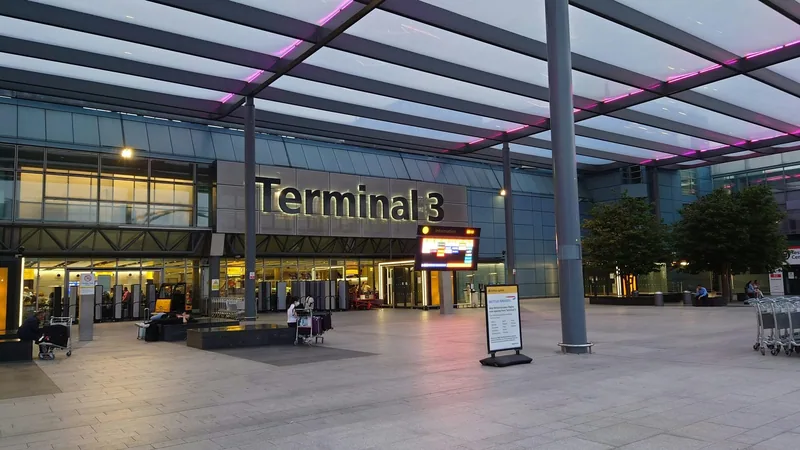
Terminals 2 and 3 sit together at the heart of the airfield and share one railway station. Terminals 4 and 5 lie further out, each with a station of its own. British Airways is based at Terminal 5; Virgin Atlantic and more than twenty other carriers use Terminal 3; Terminal 2 carries the name Queen's Terminal; Terminal 4 mixes European and long-haul airlines and is being rebuilt, its multi-storey car park having closed in June 2026 with parking moved to Zone A of the Park & Ride.
Carriers do get shifted from one building to another, and a flight sold by one airline but flown by another may go from a terminal you did not expect, so look yours up on the booking or in Heathrow's terminal finder. Which airline goes where, and what each building offers inside, is the subject of our guide to the four Heathrow terminals.
Changing terminals outside security costs nothing. The Elizabeth line carries passengers between Terminals 2 & 3, Terminal 4 and Terminal 5 without charge, Heathrow Express does the same between Terminals 2 & 3 and Terminal 5, and National Express says the Underground and the H30 bus are free for that journey too. Allow more time than the distance suggests. Terminal 5 has only two Elizabeth line departures an hour, so a train missed there is half an hour lost on the platform.
Twenty-nine free minutes in a car park beat the £7 forecourt. Every entry to a terminal drop-off zone costs £7, payable online or by telephone by midnight the following day and not at the barrier, with an £80 penalty for forgetting. A friend collecting you pays nothing at all if they park in Park & Ride and are away within 29 minutes.
Getting into London: the short answer
Three railways run from under the airport, and all take contactless cards, phones and Oyster. The Elizabeth line reaches Paddington in 28 minutes for £14.60 and carries straight on through the middle of London. Heathrow Express covers the same distance in 15 minutes for £26.00. The Piccadilly line asks £5.90 and takes about 50 minutes to the West End. A black cab is £70 to £120, and National Express coaches use the bus station between Terminals 2 and 3, from £10.50 one way.
Which suits you depends on your hotel, your luggage and the ages of anyone with you. The route comparison linked at the top of this page works through the times, the fares, what a family of four pays and what runs after midnight. It also answers the question most arrivals actually ask, which of the two fast trains from Paddington is worth the difference.
A long wait at Heathrow: bags, showers and somewhere to sit
Luggage storage is run by Excess Baggage Company, with desks in all four terminals, in the arrivals areas and near check-in. The published price is £10 per item for up to three hours, £15 up to 24 hours, £27.50 up to 48 hours and £40 up to 72 hours, then £12.50 a day and £10 a day beyond a week. The catch is closing time: the desks shut in the evening while flights keep departing, so ask as you hand the bag over. If your return falls later than that, leave it in town, and our guide to left luggage at London's stations lists the alternatives.
The terminals also have showers, water fountains, charging points, postal services and a multi-faith prayer room apiece. St George's Chapel, between Terminals 2 and 3, welcomes travellers of any faith or none and is the quietest room at the airport. Property left in a terminal goes to Heathrow's lost property service; anything left on the aircraft is the airline's.
Whether the wait justifies a trip into town is arithmetic, not mood. Our page on making use of a long layover at Heathrow works out what four, six and ten hours buy once the border and the journey back are subtracted, and for an overnight gap the hotels at and around the London airports include several within walking distance of a terminal.
Shops, restaurants and lounges
Cafes and restaurants trade on both sides of security, though the choice is always wider once your boarding pass has been scanned. The landside outlets mainly serve people meeting a delayed flight. In school holidays a child under 12 eats free at several sit-down restaurants alongside a full-price adult main course, an offer covered with the rest of the family facilities in our guide to flying from London with children.
Lounges are more restricted here than at the other London airports, because most of them belong to airlines and are not for sale. Terminal 3 has the widest choice, and the independent lounges that do sell entry quote a price at booking rather than publishing one. The detail, terminal by terminal, is in our survey of airport lounges in London.
The shops run from paperbacks to watches, but do not plan around a tax refund: VAT-free airport shopping in Great Britain ended on 1 January 2021, and the high-street refund scheme went with it. What is left is explained in our page on tax-free shopping in the UK.
Going on to Gatwick, Stansted or Luton
Plenty of visitors land at Heathrow and fly onward from another London airport. No railway links any two of them directly, so the choice is a through coach or a train with a change in the middle of London. Treat every published journey time as a minimum.
| From Heathrow to | Direct coach | By rail |
|---|---|---|
| Gatwick | National Express, 63 a day, about 1 hour 5 minutes, from £14.70 | Elizabeth line to Farringdon, then Thameslink; about 1 hour 30 minutes |
| Stansted | National Express, 13 a day, about 1 hour 20 minutes | Elizabeth line to Liverpool Street, then Stansted Express |
| Luton | National Express, about 55 minutes (Heathrow's figure) | Tube or train to St Pancras, then a train to Luton Airport Parkway and the DART shuttle |
Coach times depend on the M25 motorway, slow at both rush hours and unpredictable in between. The busiest of these routes has a page to itself, our guide to the transfer between Heathrow and Gatwick, while the other pairings and the margin to leave are covered in connecting between London's airports. What waits at the far end is described on our pages for Stansted and Luton.
Hiring a car at Heathrow
Hire desks and their car parks are on site, and the airport is a sensible place to pick up a car if you are driving away from London rather than into it. The airport lies inside Greater London, so the ULEZ applies from the first mile at £12.50 a day for a vehicle that fails the emission standards, with the Congestion Charge (£18 a day) on top in the centre. Traffic drives on the left. For a stay in the city itself a car is usually the slowest and dearest way to get about, and our guide to hiring a car in London sets out when it earns its keep.
Wi-Fi, cash and staying connected
Free Wi-Fi covers all four terminals: pick "Heathrow Wi-Fi" and complete the short registration. Free internet kiosks stand in each terminal for anyone travelling without a device, handy for checking a hotel address before you leave the building.
Cash is rarely necessary in London, since cards and phones are taken on all public transport, in every black cab and in almost every shop. The terminal machines dispense pounds and accept most international cards, although your own bank may charge for the withdrawal. Notes, cards and exchange rates are covered in our guide to money and payments in London, and the cheapest ways to stay online in our page on SIM cards, eSIMs and roaming. EU roam-like-at-home rules stop at the British border.
Flying out: check-in, security and the liquid rule
Check your departure terminal again before you set off, because it may not be the one you landed in, then allow for the journey, the check-in queue and security as early as your airline advises. Fast Track security is sold in advance and comes with a Heathrow Express Premier+ ticket, and live security waiting times are published on the airport's website.
Newer scanners have changed what happens at the belt. Liquids may stay in your cabin bag in containers holding up to 2 litres, laptops and tablets stay in the bag too, and a metal or insulated bottle has to be emptied first and refilled afterwards. Do not count on the same at your next airport, since the equipment varies and the Heathrow security pages speak only for Heathrow.
Two flights on one ticket keep you airside, walking the purple signs marked for connections while the airline moves your hold bag. Everybody is screened a second time, and only passengers going on to a domestic or Irish flight meet an immigration officer. Anyone needing help at any stage should book it before leaving home, as our guide to special assistance at the London airports explains.
Two separate tickets mean starting again at Heathrow. If you booked the two flights apart from each other, the airport treats you as arriving and then departing. You clear the border, collect the bags, check in a second time and queue for security once more. With a terminal change on top, that can swallow three hours, so leave a generous gap.
Frequently asked questions
How many terminals does Heathrow have?
Four are in use: Terminals 2, 3, 4 and 5. Terminal 1 is closed and has not reopened. Terminals 2 and 3 share a station, while Terminal 4 and Terminal 5 each have one of their own.
Which terminal does British Airways use at Heathrow?
Heathrow describes Terminal 5 as the main British Airways base. A handful of its services, and tickets sold under the British Airways name but operated by a partner airline, go from elsewhere, so read the terminal off your own booking rather than assuming.
Can I use the eGates at Heathrow with an EU passport?
Yes, provided the passport is biometric and you hold a valid ETA where one is required. The gates cannot read a national identity card, and most EU identity cards are in any case no longer accepted at the British border, so bring the passport even for a short visit.
Is there free Wi-Fi at Heathrow?
Yes, in all four terminals. Choose "Heathrow Wi-Fi" on your phone or laptop and follow the registration screen. The terminals also have free internet kiosks for travellers with no device of their own.
Can I keep liquids in my hand luggage at Heathrow security?
Yes. The scanners allow containers of up to 2 litres to stay inside your cabin bag, along with laptops and other large electronics. Other airports, British ones included, may still apply the older limits, so check before your return flight.
How much does luggage storage cost at Heathrow?
The desks charge per item: £10 for up to three hours, £15 for up to 24 hours, £27.50 for two days and £40 for three, then £12.50 a day. Check the desk's closing time before you leave a bag.
Sources
- Heathrow - Immigration and passports (checked September 2026)
- Heathrow - Terminal guides (checked September 2026)
- Heathrow - Luggage storage prices (checked September 2026)
- Heathrow - Terminal facilities (checked September 2026)
- Heathrow - Security and baggage (checked September 2026)
- Heathrow - Travelling between London airports (checked September 2026)
- GOV.UK - Electronic Travel Authorisation (ETA) (checked September 2026)
- GOV.UK - Bringing goods into the UK for personal use (checked September 2026)