
The best areas to stay in London with children are those that combine a park, a short and simple Tube ride to the big family sights and quiet streets at night. South Kensington and Bayswater (next to Hyde Park and the museums), the South Bank, Bloomsbury, Marylebone near Regent's Park, and Greenwich all work well, and Stratford can give you more space for the money.
Travelling with children changes what a good hotel location means. Being in the middle of the West End matters less than being able to get back to the room for a rest, finding a playground nearby and avoiding long journeys with changes and stairs. A quieter street also helps if your children go to bed before the city does.
This guide looks at the areas that suit families best, what to look for in a hotel room or apartment, and how getting around with children works in practice. We do not quote room prices, which change constantly. Instead we explain how the areas compare, so you can judge a booking for your own dates and family size.
Family bases at a glance
- Museums and big parks
- South Kensington, Kensington, Bayswater
- River and easy walks
- South Bank, Waterloo
- Zoo and green space
- Marylebone and Regent's Park
- Village feel and space
- Greenwich
- Larger modern rooms
- Stratford, Canary Wharf
- Children's fares
- Under-11s travel free on the Tube with a paying adult (up to four per adult); 11-15s can get a Young Visitor discount
What makes a good family base in London
Before comparing areas, it is worth deciding what matters most for your family. These are the points that make the biggest difference day to day.
- A park within a few minutes' walk. Children need somewhere to run after a morning in a museum. London's big parks are free and have playgrounds.
- A station with a direct line to your main sights. Every change of train means stairs, crowds and a tired child. A direct line matters more than a central postcode.
- Step-free access if you use a pushchair. Many older Tube stations have long staircases. Check whether your nearest station is step-free before you book.
- A quiet street at night. Avoid rooms above bars, on main roads or next to railway lines if your children are light sleepers.
- Somewhere to eat simply. A supermarket, a café for breakfast and a family-friendly restaurant nearby save money and stress.
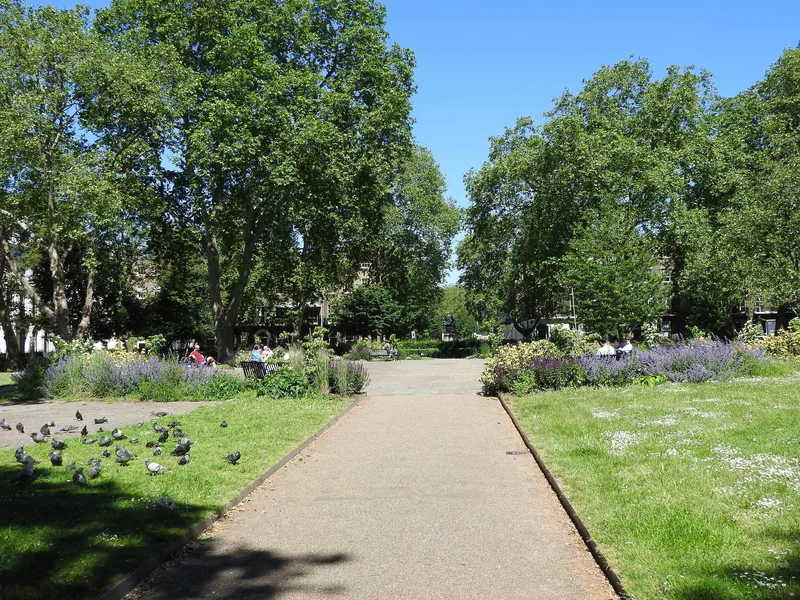
Photo: ClemRutter · CC BY-SA 4.0 · Wikimedia Commons · resized
South Kensington and Hyde Park: museums and space
South Kensington is the classic family base, and for good reason. Three of London's great museums sit within a few minutes of each other and of South Kensington station. The Natural History Museum is free, with Hope the blue whale hanging in the main hall. The Science Museum is free too, but asks visitors to pre-book a free ticket, and its hands-on Wonderlab gallery is paid. The V&A is free and needs no booking.
Hyde Park and Kensington Gardens begin a short walk to the north. In Kensington Gardens, the Diana Memorial Playground reopened in August 2026 after a renewal, with a new galleon to climb on. The water play area is switched off for now because of a hosepipe ban. Entry is free, and only adults supervising children up to the age of 12 are admitted. In September it is open 10:00-18:45, with shorter hours in winter. Our guide to Hyde Park and Kensington Gardens covers the boating lake, the playgrounds and the rest of the park.
The area is residential, clean and quiet in the evening. South Kensington station is not step-free, so families with pushchairs may prefer to use the museums' own entrances from street level and plan journeys through step-free stations. Bayswater and Queensway, on the northern side of Hyde Park, offer many more hotels, including larger chain hotels, and are usually better value. Both are in Zone 1.
Beat the museum queues with a morning start from South Kensington. The Natural History Museum opens at 10:00 and queues build at weekends and in school holidays. If your hotel is nearby, you can be at the door early and go back for a rest at lunchtime.
The South Bank: the river, the Eye and the aquarium
The South Bank is a pleasure to walk with children. A wide riverside path runs from the London Eye past the Southbank Centre towards Tate Modern, with street performers, a skate park under the Southbank Centre and plenty of places to stop. The London Eye and the SEA LIFE London Aquarium sit side by side near Westminster Bridge, and Big Ben is just across the river.
Waterloo station, in Zone 1, has four Tube lines and mainline trains, which makes day trips easy. Hotels here range from large chains to newer hotels near the station. Watch out for rooms close to the railway viaducts, which can be noisy, and check the walking route from the station if you have a pushchair and luggage.
Bloomsbury and King's Cross: squares, Coram's Fields and Harry Potter
Bloomsbury has the British Museum, with free entry to the permanent collection, and a series of leafy garden squares. Its secret weapon for families is Coram's Fields on Guilford Street, a children's park and playground for under-16s, open daily from 09:00 to 19:00 and free. Adults cannot enter without a child, which keeps it relaxed and safe.
King's Cross, a short walk north, is where young Harry Potter fans find the Platform 9¾ photo spot outside the Harry Potter shop in the station. The Warner Bros. Studio Tour is reached by train from Euston, next door, to Watford Junction and a shuttle bus that is included in the ticket. Bloomsbury hotels are usually better value than the West End, but many are in older terraced houses with small rooms and stairs.
Marylebone and Regent's Park: the zoo on your doorstep
Marylebone is a calm, well-kept area north of Oxford Street, with a village-like high street and Regent's Park at its northern edge. The park has playgrounds, a boating lake and ZSL London Zoo on its northern side. Madame Tussauds is next to Baker Street station.
Baker Street is in Zone 1 and served by five Tube lines, including the Jubilee line to Westminster and the South Bank. Hotels here tend to be mid-range to upmarket, and the streets are quiet at night. It is a good choice for families who want a central base without the crowds of the West End.
Greenwich and Stratford: more room outside Zone 1
Greenwich, in Zones 2 and 3, feels like a small town. Greenwich Park has space to run and a playground, the Royal Observatory sits on the hill, the Cutty Sark is by the river, and the National Maritime Museum is free. The DLR and the River Bus link it to central London, and the boat trip itself is a treat for children. The downside is time: Cutty Sark DLR to Westminster takes about half an hour with a change.
Stratford, also in Zones 2 and 3, grew up around the London 2012 Olympic Park. It has large modern hotels, where family rooms can be more generous than in the centre, a huge shopping centre with food courts, and the Olympic Park itself with playgrounds and the London Aquatics Centre for swimming. The Central line reaches Oxford Circus in about 20 minutes. Our guide to the Olympic Park today shows what there is to do.
Hotel rooms, family rooms and apartments
London hotel rooms are often small, especially in older central buildings. A standard double room may not have space for an extra bed or cot, and many hotels only allow a certain number of children in a room. Search for family rooms or connecting rooms specifically, and give the exact ages of your children when you book, because age limits for extra beds and free stays differ between hotels.
When a hotel works best
- Short stays of two or three nights
- Breakfast on site saves the first stress of the day
- A 24-hour reception to help with problems
- Family rooms in modern chain hotels can be good value
When an apartment makes more sense
- Longer stays, when a kitchen and washing machine save money
- Babies and toddlers who nap during the day
- Larger families who would need two hotel rooms
- Children who need a separate bedroom to sleep early
If you rent a flat, remember that renting out a London home as short-term accommodation for more than 90 nights a year needs planning permission. A properly run listing should be within the rules, and a professionally managed serviced apartment is a safer choice for longer stays. Our guide to apartments and short lets explains what to check.
Getting around London with children
London's public transport is good value for families. Children aged 5 to 10 travel free on buses and trams without a ticket, and free on the Tube, DLR, Overground and Elizabeth line when they are with a fare-paying adult. Each adult can take up to four children free. Children aged 11 to 15 can get a Young Visitor discount, added to an Oyster card by staff at a Tube station, which gives 50% off adult pay as you go fares and daily caps for up to 14 days. The child must be present. Our guide to children's fares on London transport covers the details.
That means a couple with two children under 11 pays a maximum of £17.80 a day for unlimited travel in Zones 1-2 (two adult daily caps of £8.90). From Heathrow, the Heathrow Express lets children aged 15 and under travel free with a paying adult, which can make it cheaper for a family than it first appears.
If you use a pushchair, plan journeys through step-free stations. All Elizabeth line stations, all DLR stations and 95 Tube stations are step-free from street to platform, and all buses are wheelchair and pushchair accessible. The TfL Go app and Journey Planner can show step-free routes. Read our guide to step-free travel around London for more.
Buses beat the Tube for small children. Children aged 5 to 10 ride buses free with no card needed, you can see the city from the top deck, and there are no stairs to carry a pushchair down. A hotel on a good bus route can be as useful as one near a station.
Planning your days from your base
Whichever area you choose, plan each day around one area rather than crossing the city several times. Pair South Kensington's museums with Hyde Park, the South Bank with the London Eye and the aquarium, or Greenwich with a boat trip. Our main guide to London with kids has ideas for every age, and our list of city farms and playgrounds helps when children need a break from sightseeing.
Frequently asked questions
What is the best area in London for families with young children?
South Kensington and Bayswater are hard to beat for young children, because Hyde Park, Kensington Gardens and three big museums are all within walking distance. Marylebone near Regent's Park and Greenwich are also good. Choose a hotel close to a station with a direct line to the sights you plan to visit.
Do children travel free on the London Underground?
Children under 11 travel free on the Tube, DLR, Overground and Elizabeth line when travelling with a fare-paying adult, with up to four children per adult. Children aged 11 to 15 pay, but visitors can get a Young Visitor discount of 50% on an Oyster card for up to 14 days.
Is an apartment better than a hotel for a family in London?
For stays longer than three or four nights, or for larger families, an apartment often works better because of the extra space, a kitchen and separate bedrooms. For short stays a hotel family room is simpler. Check that an apartment is properly licensed and that the total price includes all fees.
Are there free playgrounds in central London?
Yes. The Diana Memorial Playground in Kensington Gardens and Coram's Fields in Bloomsbury are both free, and both limit entry for adults who come without a child. Most of the royal parks, including Regent's Park and Greenwich Park, also have free playgrounds, which makes a hotel near a park especially useful.
Sources
- The Royal Parks - Diana Memorial Playground (checked September 2026)
- Coram's Fields - Plan your visit (checked September 2026)
- Natural History Museum - Visit (checked September 2026)
- Science Museum - Visit (checked September 2026)
- Transport for London - Caps and Travelcard prices (checked September 2026)
- Transport for London - Visitor Oyster card and Young Visitor discount (checked September 2026)
- Transport for London - Step-free access (checked September 2026)
- legislation.gov.uk - Deregulation Act 2015, section 44 (checked September 2026)