
Bloomsbury gives you a Zone 1 address, Georgian squares outside the door and the British Museum eleven minutes' walk away, at prices below Covent Garden and Soho. It is also the one central district where you can sleep in a university hall of residence in summer, from about £58 a night for a single room, which is the cheapest legitimate way to wake up in the middle of London.
The area sits between Euston Road in the north, Tottenham Court Road in the west, High Holborn in the south and Gray's Inn Road in the east. It is made of squares: formal eighteenth and nineteenth-century blocks of brick terraces built around private gardens, most of which are now open to anyone. Universities, hospitals, publishers and the British Museum fill the buildings, which is why it is busy by day and quiet by night.
Our neighbourhood guide to Bloomsbury describes the area itself, its museums and its literary history. This page is about using it as a base: which streets, what the buildings are like inside, how to get here from the airport and where the genuinely cheap central rooms are hiding.
Bloomsbury as a base
- Zone
- Zone 1. Daily pay-as-you-go cap £8.90 (2026)
- Nearest Tube stations
- Russell Square and Holborn (Piccadilly), Goodge Street (Northern), Tottenham Court Road (Central, Northern, Elizabeth line), Euston Square
- From Heathrow
- Direct on the Piccadilly line to Russell Square, about 50 minutes, £5.90 at any time of day
- Walk to the British Museum
- 11 minutes from Russell Square
- Summer bargain
- University halls open to visitors from late June to early September, from about £58 a night
- Weak point
- Few good restaurants and almost no nightlife after 23:00
Where Bloomsbury begins and ends
Hotels stretch the name in both directions, so it helps to know the four quarters.
- The museum quarter, around Great Russell Street, Montague Street and Bedford Place, is the prettiest and the dearest. Small hotels in Georgian houses, with the museum railings at the end of the road.
- The university quarter, around Gower Street, Gordon Square and Malet Street, is student territory: halls of residence, bookshops, cheap cafés and a scattering of plain, well-priced hotels.
- The Cartwright Gardens crescent and the streets towards King's Cross hold the largest concentration of small hotels and guest houses in the district, and the lowest prices.
- Lamb's Conduit Street and the east, towards Gray's Inn Road, is the quiet residential end, with independent shops and a couple of good pubs, and the longest walk to a Tube station.
Anything advertised as Bloomsbury that turns out to be north of Euston Road is really Somers Town or King's Cross, and anything west of Tottenham Court Road is Fitzrovia. Both are fine places to stay, but they are not the same district, and the walk to the British Museum is different.
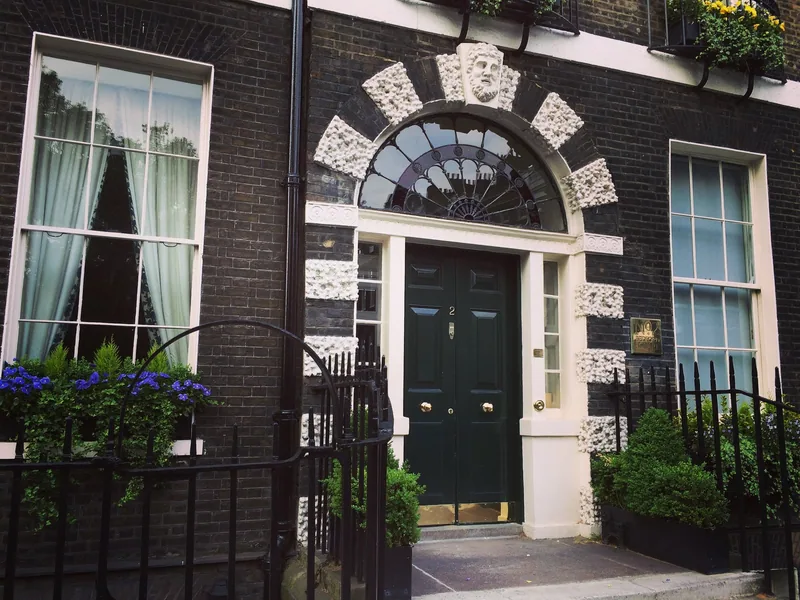
Photo: Stefano Vigorelli · CC BY-SA 4.0 · Wikimedia Commons · resized
The squares, and how to use them
The squares are the reason to stay here rather than somewhere equally central. They give you a green, quiet route to almost anywhere, which in central London is rare.
Russell Square is the largest, with a café and a fountain, and it is the one your hotel is most likely to overlook. Bloomsbury Square, Gordon Square, Tavistock Square, Brunswick Square and Queen Square are all open to the public and all quiet. A few, including Bedford Square, remain private gardens behind railings: you can admire them, but the gate is locked.
Practically, this means you can walk from Euston to Holborn, or from the British Museum to the Foundling Hospital site, almost entirely through gardens. It also means the streets are genuinely dark and quiet at night, which is pleasant if you are sleeping and slightly eerie if you are walking back alone at one in the morning.
University halls: the cheap central rooms most visitors never look at
Bloomsbury is the heart of academic London, and when the students go home the halls of residence are let to the public. This is not a secret exactly, but almost no visitor thinks of it, because the rooms are not listed where hotels are listed.
University College London opens its residences to the general public every summer. For 2026 the season ran from Monday 22 June to Monday 7 September, bookings opened on 6 January, and the published prices started at £58 a night for a single room, rising to about £120 for a single with its own bathroom, all including VAT. Twin rooms started at about £110. Some halls are catered and include breakfast. The University of London runs a similar scheme through its intercollegiate halls, usually from the end of June to the end of August, with a minimum stay of two nights.
What you get is a student bedroom: a single bed, a desk, a wardrobe, a washbasin or a small en-suite shower room, and a shared kitchen down the corridor. What you do not get is housekeeping, a bar, a concierge or anything resembling a hotel lobby. Rooms are mostly singles, and twins are limited, so couples should check carefully.
Summer is the one season when Bloomsbury is cheaper than the suburbs. Because the university terms and the tourist peak do not overlap, the halls come onto the market in late June just as hotel prices reach their highest. A single room at £58 to £70 undercuts almost anything you will find in Zone 4, and it leaves you eleven minutes' walk from the British Museum.
Two things to arrange in advance. Bookings open in January and the best halls fill, so this is not a last-minute option: see our advice on when to book a London hotel. And check the location of the specific hall, because universities own buildings across London, not only in Bloomsbury.
The hotel streets, and what the buildings are like
Most of Bloomsbury's hotels are Georgian or early Victorian terraced houses knocked together and converted. The result is charming from the pavement and variable inside.
Expect narrow staircases, often four or five floors with no lift, and rooms that get smaller as you climb. Expect original sash windows, which are beautiful and let in noise. Expect bathrooms that have been fitted into corners, and the occasional room with no window at all in a rear extension. On the other hand, expect high ceilings, proper proportions and, on the square-facing sides, one of the nicest views from a mid-priced room anywhere in central London.
Three questions before you book: the floor, the lift, and whether the room faces the street or the back. A front room on Bedford Place is worth paying for; a front room on Southampton Row is not. Our guide to bed and breakfasts and guest houses explains what this style of London hotel generally includes.
Arriving: why Bloomsbury is the easy district
The Piccadilly line runs directly from all Heathrow terminals to Russell Square and Holborn, without a change, for £5.90 with contactless or Oyster at any time of day. From the West End the same journey takes about 50 minutes, so allow a little under an hour from the terminal to your hotel door. With luggage and no changes, that is considerably less tiring than a faster train followed by two Tube lines.
The alternatives are worth knowing. Tottenham Court Road, at the western edge of Bloomsbury, is on the Elizabeth line, which reaches Heathrow in under 40 minutes but costs £15.50 from Zone 1. Our comparison of the Heathrow Express and the Elizabeth line and our page on every route from Heathrow into town set out the choices.
If you are arriving from Europe by train, Bloomsbury is the most walkable hotel district to St Pancras: about 21 minutes on foot from Russell Square, or one stop on the Piccadilly line. Our guide to the Eurostar explains the check-in times, which are longer than most people expect.
What you can walk to, with honest times
These are Transport for London's own walking estimates from Russell Square station, which assume a steady pace and stopping at crossings.
| Destination | Walk | Worth walking? |
|---|---|---|
| The British Museum | 11 min | Always. You can go twice in a day, which is how to see it |
| Euston station | 18 min | Yes, unless you have heavy luggage |
| Tottenham Court Road and the Elizabeth line | 18 min | Yes going out, Tube coming back |
| King's Cross and St Pancras | 21 min | Yes, and the route through the squares is pleasant |
| Covent Garden | 23 min | Yes in the evening, and quicker than waiting for the Piccadilly line |
| Oxford Circus | 29 min | Take the bus or the Tube |
The museums within the district are the other reason to be here. The British Museum is free, and so is the Wellcome Collection on Euston Road. The Foundling Museum, on the site of the old Foundling Hospital, charges but is one of the best small museums in London. Staying here means you can drop into one for forty minutes rather than committing a whole morning, which changes how a city break feels.
Evenings, and the district's real weakness
Bloomsbury does not have an evening scene of its own, and the guides that pretend otherwise are doing you no favours. The university empties at six, the offices empty at seven, and by ten the squares are silent.
What it does have is a handful of good old pubs, particularly around Lamb's Conduit Street and the lanes off Holborn, described in our guide to historic pubs in London, and a strong run of bookshops on and around Great Russell Street and Gower Street, covered in the best bookshops in London. For dinner, walk fifteen minutes west into Fitzrovia, or south into Covent Garden, or east into Clerkenwell. All three are better fed than Bloomsbury and all three are a walk rather than a journey.
The theatre argument cuts the other way. Bloomsbury is one of the easiest districts to get home to after a show: from Leicester Square it is two stops on the Piccadilly line or a twenty-minute walk through Covent Garden, and you avoid the fight for a night bus. See our guide to West End theatre for what is on.
Noise: the Euston Road problem
The northern edge of Bloomsbury is Euston Road, a six-lane through route that carries traffic across central London day and night. Hotels on it and on the first fifty metres of the streets leading off it are noticeably noisier than the rest of the district, and the older ones have single-glazed windows.
The same is true, to a lesser degree, of Southampton Row, Theobalds Road and Woburn Place, which are the main north-south bus routes. Judge a Bloomsbury hotel by its street, not by the district: two parallel roads a hundred metres apart can be completely different at three in the morning.
Bloomsbury with children
This is a better family district than its reputation suggests. The squares give small children somewhere to run within a minute of the front door, which is more than most of Zone 1 can offer. Coram's Fields, on Guilford Street, is a large children's playground and city farm on the site of the old Foundling Hospital, and adults are admitted only in the company of a child, which tells you who it is for.
The obstacle is the buildings. Georgian houses rarely have family rooms, lifts or space for a cot, and a pushchair on a five-storey staircase is a daily ordeal. Families are usually better off in the larger, plainer hotels near Euston and King's Cross, or in an apartment. Our guides to where to stay with children and London with kids cover what to look for.
Bloomsbury or King's Cross?
The two districts touch, and visitors regularly choose between them. Bloomsbury is quieter, prettier and closer to the museums and the West End on foot. King's Cross has the Eurostar, more new buildings with lifts and air conditioning, more restaurants and a livelier evening, and it is where the larger, more modern hotels are. Our guide to staying near King's Cross, St Pancras and Paddington makes the case for the station districts.
If you are arriving late by air and leaving early, the balance shifts again, and it can be worth reading our page on staying overnight at a London airport before assuming a central room is the right answer. Otherwise, for a first or second visit built around museums and theatre, Bloomsbury is one of the most sensible addresses in London, and our overview of the best areas to stay shows where it sits against the rest.
Frequently asked questions
Is Bloomsbury a good area to stay in London?
Yes, particularly for a museum-and-theatre trip. It is in Zone 1, walkable to the British Museum, Covent Garden and the West End, quieter at night than Soho, directly connected to Heathrow on the Piccadilly line and generally cheaper than the districts immediately south of it. Its weakness is a thin choice of restaurants and very little nightlife.
Can visitors stay in university halls in Bloomsbury?
Yes, in summer. University College London opens its residences to the public from late June to early September, with 2026 prices from about £58 a night for a single room including VAT, and the University of London lets rooms in its intercollegiate halls from the end of June to the end of August with a two-night minimum. Bookings open early in the year.
How do I get from Heathrow to Bloomsbury?
Take the Piccadilly line directly to Russell Square or Holborn. It costs £5.90 with contactless or Oyster at any time of day, and takes about 50 minutes from the West End, with no changes. The Elizabeth line to Tottenham Court Road is faster but costs £15.50 from Zone 1 and leaves you a walk from most Bloomsbury hotels.
Is Bloomsbury safe at night?
It is a quiet, residential and institutional district with little late-night activity, which most visitors find reassuring. The streets are dark and empty rather than rowdy. The usual central-London sense is enough: stay on lit roads, and be a little more alert along Euston Road and near the stations.
Is Bloomsbury cheaper than Covent Garden?
Usually, for a comparable room, and considerably cheaper than Soho or Mayfair. You are paying less for the same Zone 1 travel and a walk of about twenty minutes to the theatres. The saving is largest in the streets towards King's Cross and smallest around the British Museum itself.
Do Bloomsbury hotels have lifts?
Many do not. The district is built of Georgian and early Victorian terraced houses of four or five storeys, and converting one to take a lift is often impossible. Ask which floor your room is on and whether there is a lift before you book, especially if you have heavy luggage or difficulty with stairs.
Sources
- University College London - UCL Summer Residences (checked September 2026)
- University College London - Summer Residences prices (checked September 2026)
- University of London - Short stays in university halls of residence (checked September 2026)
- Transport for London - Single fare finder (checked September 2026)
- Transport for London - Fare capping (checked September 2026)
- Transport for London - Journey Planner walking times (checked September 2026)
- The British Museum - Plan your visit (checked September 2026)