
Two flights booked on one ticket are a connection; two flights booked separately are two journeys that happen to be near each other. That difference decides how much time you need between London's airports, and it matters far more than which coach or train you choose.
London is served by six airports spread across an area roughly 100 kilometres wide. None of them is close to another, and only one pair has a direct train. Our comparison of what each London airport is good for explains where they all sit; this page is about the gap in the middle, for anyone whose inbound and outbound flights use different ones.
The busiest pairing, Heathrow to Gatwick, has its own detailed guide: see every route between Heathrow and Gatwick for the coach, the rail options and the taxi fare. What follows covers the other pairs, the rules that apply to all of them, and the questions people only think of once they are already standing in an arrivals hall with a suitcase.
Airport-to-airport transfers at a glance
- Only direct train
- Gatwick to Luton Airport Parkway by Thameslink, with no change
- Fastest coach link
- Luton to Heathrow, from 50 minutes
- Slowest published link
- Stansted to Gatwick by coach, 2 hours 45 minutes
- Booked on one ticket
- Your airline's minimum connection time applies and your bags are usually checked through
- Booked separately
- No minimum applies, no bag transfer, and a delay is your problem
The ticket decides everything else
Airlines and airports use the word "connection" narrowly. Heathrow's own guidance is blunt about it: buying two flights in two separate transactions does not make you a connecting passenger. You are an arriving passenger who later becomes a departing passenger, and every step of both processes applies to you.
In practice that means clearing the UK border, waiting at baggage reclaim, travelling across London or around the M25, then queueing at check-in, dropping the bag again and going through security a second time. Heathrow asks departing passengers to be back in the terminal three hours before a long-haul flight and two hours before a short-haul one, and that clock starts after the transfer, not before it.
A single ticket changes the arithmetic completely. The airline quotes a minimum connection time, your bag is normally tagged to the final destination, and if the first flight runs late the airline has to find you another seat. Between two London airports a single ticket is unusual but not impossible, and it is worth checking before you assume you have to self-transfer.
A cheap second flight is not a bargain if it is on a separate booking. Two tickets bought minutes apart on the same website are still two contracts unless the site says otherwise. If the first flight lands late, the second airline owes you nothing, and you buy a new ticket at the airport price.
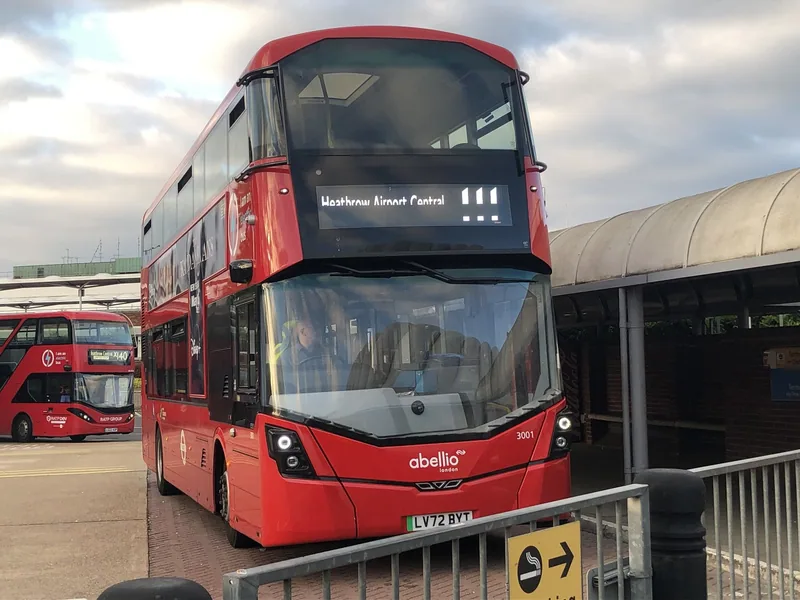
Photo: Pedroperezhumberto · CC BY-SA 4.0 · Wikimedia Commons · resized
Every pair, and how long it really takes
The figures below come from the airports' own published transfer pages, checked in September 2026. Where two airports quote different times for the same coach, both are shown, because the coach calls at different stops depending on the service number.
| Between | Best public transport route | Published journey time | From |
|---|---|---|---|
| Luton and Heathrow | National Express coach 230, 231 or 240, terminal to terminal | From 50 minutes, up to 16 a day | £13.00 |
| Luton and Gatwick | Thameslink train, direct from Luton Airport Parkway | 1 hour 20 to 1 hour 45, plus the DART shuttle | Rail fare varies |
| Luton and Gatwick | National Express coach 230 or A2 | 2 hours 10 minutes, up to 10 a day | £16.80 |
| Luton and Stansted | National Express coach 737 | Luton quotes 1 hour 35; Stansted quotes 2 hours 45 | £16.60 |
| Stansted and Heathrow | National Express coach, hourly | 1 hour 30 minutes | See National Express |
| Stansted and Gatwick | National Express coach, every two hours | 2 hours 45 minutes | See National Express |
| Luton and London City | Thameslink to St Pancras, then Stratford and the DLR | 1 hour 30 to 2 hours, two changes | Rail fare varies |
Two things in that table surprise people. The first is that Luton to Heathrow is the quickest airport-to-airport hop in the whole system, because the coach runs down the M1 and round a short stretch of the M25 rather than through anything. The second is that Gatwick and Luton are joined by one train, with no change at all: southbound Thameslink services run from Luton Airport Parkway through St Pancras International, Blackfriars and London Bridge and carry on to the airport. Our guide to the Luton run and the DART shuttle explains how that last four-minute leg is priced.
Everything else is a coach or a trek across London. If you are going between Stansted and Gatwick, the published coach time of 2 hours 45 minutes is not a worst case; it is the scheduled time, and the M25 can add to it.
Crossing London instead of going round it
Rail routes between the airports almost all funnel through the centre, which is slower than it sounds because you change trains with your luggage. The useful exception is Farringdon, where Thameslink and the Elizabeth line meet on the same concourse. Luton's own transfer guidance sends Heathrow passengers that way: Thameslink south to Farringdon, then the Elizabeth line west, which the airport puts at roughly 75 to 100 minutes in total, plus the DART.
If you do cross the city, remember that the Underground is the hardest part of any airport transfer. Steps, gaps and crowded platforms turn a large suitcase into a real problem, and our advice on taking suitcases on the Underground is worth two minutes before you commit to a route with two changes.
Farringdon is the one interchange that repays the walk. It is the only central station where a Gatwick or Luton train and a Heathrow train share the same building, so you change once rather than twice and you never leave the platform level.
What to do with the bags in between
Self-transfer means your suitcase travels with you all the way. If your gap is long enough to spend a few hours in London, you do not have to drag it round: the big rail termini and a network of shops offer paid storage, and our guide to left luggage in London lists where and what it costs. Victoria Coach Station, which is where most inter-airport coaches to and from the south call, has its own staffed left-luggage office.
Do not count on storing a bag at the airport itself and coming back for it. Charges are per item and per day, opening hours are shorter than the airport's, and the walk from the storage desk to check-in can be long at Heathrow.
The border, the visa and the 48-hour rule
If you leave the airside area at any point, you have entered the United Kingdom, and you need whatever permission that requires. Most visa-free visitors need a UK Electronic Travel Authorisation, which is explained in our guide to UK entry requirements and the ETA.
Travellers who need a visa have two different products to choose from, and picking the wrong one is expensive. GOV.UK sets it out clearly: a Direct Airside Transit visa is for people who change flights without passing border control, and a Visitor in Transit visa is for people who do pass border control and leave the UK within 48 hours. Anyone staying longer than 48 hours, or crossing London to another airport over a full day, needs a Standard Visitor visa instead. Holders of an ETA, a Standard Visitor visa or an EU Settlement Scheme family permit do not need a transit visa at all.
Moving between two London airports always means going through border control, because there is no airside link between them. Plan for that, not for a quick airside walk.
Connections inside one airport
Changing terminals at the same airport is a different problem and a much smaller one. At Heathrow, connecting passengers follow purple signs, use a free shuttle bus that runs every ten minutes between terminals, and go through security again, although liquids up to two litres and large electronics can stay in the bag. Gatwick's North and South terminals are joined by a free shuttle that takes two minutes. Our guides to arriving at Heathrow and Gatwick and its two terminals have the detail.
One trap catches people flying on to Scotland, Northern Ireland or the Republic of Ireland from Heathrow: passengers transferring from an international flight to a UK or Irish one have a biometric image of their face taken before security. It adds a step that a pure international-to-international connection does not have.
When an overnight is the better answer
Some transfers are simply not worth doing at speed. An evening arrival at Stansted with a morning departure from Gatwick is a four-hour journey through a city at the wrong time of day, and the last coaches leave earlier than people expect: the Luton to Gatwick coach's last departure is in the late afternoon, and the Luton to Stansted service finishes before 21:30.
If your gap runs through the small hours, we set out which airport routes genuinely operate through the night, and we compare the hotels beside each London terminal separately. Sleeping in a Heathrow terminal is not an option; the airport says plainly that there is nowhere to do it.
If you decide to use the gap properly and see something, remember that you will need the right to enter the UK and enough time to get back. Our routes into town from Gatwick and Stansted give realistic door-to-door times rather than the airports' marketing figures.
The two airports people forget
London City and Southend rarely feature in transfer plans, but both are easy to reach from the east of the city. London City sits on the Docklands Light Railway in fare Zone 3; from Bank the pay as you go fare is £3.90 at peak and £3.30 at other times, so a transfer from Luton or Stansted ends with a cheap DLR ride rather than an expensive taxi. Our guides to London City Airport and Southend cover the rest.
Southend is the awkward one: contactless and Oyster stop working at Shenfield, so you need a paper or mobile ticket for the last part of the journey from Liverpool Street. Buy it before you board rather than arguing about it on the train.
A sensible margin, written down
Nobody publishes an official minimum for a self-transfer between two London airports, because there is no such thing. Build your own number from four pieces: the time from landing to leaving the terminal, the transfer itself, a margin for delay, and the check-in deadline your second airline sets.
For a short-haul arrival and a short-haul departure between two neighbouring airports, most travellers land on something in the region of four to five hours. Allow longer still for an arrival from another continent, a rush-hour transfer, or two airports at opposite ends of the map. If the sums make you uncomfortable, an overnight stop or a different second flight costs less than a missed departure.
Two last practical points. Coaches to and from Victoria Coach Station and between airports sell out on busy days, so book rather than turn up. And if you are doing this with a pushchair and a toddler, read our guide to flying with children from London first, because the security queue is not the slow part.
Frequently asked questions
Is there a direct train between any two London airports?
Yes, one. Thameslink runs directly between Gatwick Airport and Luton Airport Parkway, through St Pancras International, Blackfriars and London Bridge, in roughly 80 to 105 minutes. At the Luton end you still need the DART shuttle, which takes four minutes, to reach the terminal.
How much time should I leave between flights at different London airports?
There is no official figure, because flights on separate tickets are not a connection. Work backwards from your second airline's check-in deadline, add the transfer time, the time to clear the border and collect bags, and a margin for delay. Most travellers end up with four to five hours as a minimum, and more after a long-haul arrival.
Which transfer between London airports is quickest?
Luton to Heathrow by National Express coach, from 50 minutes, with up to 16 services a day picking up outside the terminal. The slowest published link is Stansted to Gatwick by coach at 2 hours 45 minutes, and that is the scheduled time before any traffic.
Do I need a visa to change airports in London?
You will pass through UK border control, because there is no airside route between London's airports. Visa nationals need a Visitor in Transit visa if they leave the UK within 48 hours, or a Standard Visitor visa for longer. Travellers with a UK Electronic Travel Authorisation do not need a transit visa.
Will my luggage be transferred between London airports?
Only if both flights are on a single ticket and your airline says so. On separate bookings you collect your bag at the first airport, carry it across London and check it in again. Ask the first airline before you travel rather than assuming.
Sources
- Heathrow - Connecting flights (checked September 2026)
- London Luton Airport - Coach connections to other airports (checked September 2026)
- London Luton Airport - Train links between airports (checked September 2026)
- London Stansted Airport - Travel between airports (checked September 2026)
- GOV.UK - Visa to pass through the UK in transit (checked September 2026)
- Heathrow - Security and baggage (checked September 2026)
- Transport for London - Tube and rail fares (checked September 2026)