
Assistance at a London airport is free, it is a legal right rather than a favour, and you book it through your airline at least 48 hours before departure. The airport provides it once you arrive, not the airline.
The formal name in the UK is assisted travel, and it covers far more than a wheelchair. It includes help from the car park or station to the check-in desk, help through the security search, help to the gate, help on and off the aircraft, and help through passport control, baggage reclaim and out to the taxi rank at the other end.
It is available to anyone whose disability or reduced mobility makes any part of that difficult, including people who cannot stand or walk far, people travelling with a mobility aid or an assistance dog, and people with non-visible conditions such as autism or dementia. Our wider guide to getting around London as a wheelchair user covers the city; this page covers the four airports most visitors use, and the rules that sit behind them.
Assisted travel at a London airport
- Cost
- Free. There is no charge for any part of it
- Who to tell
- Your airline, travel agent or tour operator — not the airport
- When
- When you book, or at least 48 hours before departure
- Legal basis
- UK Regulation (EU) No 1107/2006, enforced by the Civil Aviation Authority
- Who it applies to
- Any flight from a UK airport, and flights to a UK airport on a UK or EU airline
- Best rated in London (2025/26)
- Gatwick, Luton, London City and Southend — all "very good"
What the airport must provide, and where its responsibility starts
The Civil Aviation Authority sets out the entitlement plainly: if you have a disability or reduced mobility you are legally entitled to assistance, free of charge, when flying from a UK airport on any airline, or to a UK airport on a UK or EU airline. Similar rights exist across the EU and in the United States. They do not exist everywhere, and some countries charge for the same service, so check the rules at the far end of your journey as well.
Responsibility is split. The departure airport looks after you from a designated arrival point — usually a help point at a car park, bus stop or station — through to the aircraft door. The airline takes over on board. The arrival airport picks you up at the aircraft and takes you as far as a designated exit point, which may include a car park, a train station or a drop-off area.
That split explains a common misunderstanding. When something goes wrong in the terminal, the airport is answerable, even though you booked the help through the airline. When something goes wrong in the cabin, the airline is.
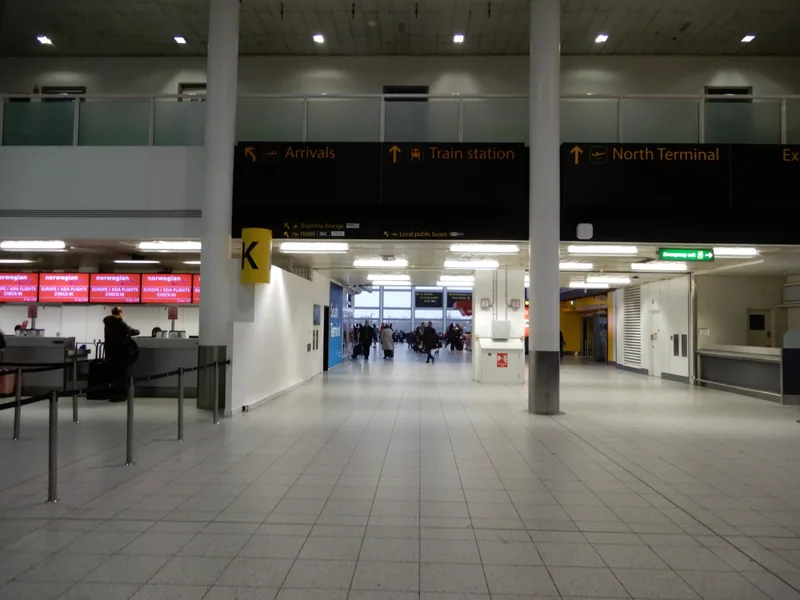
Photo: Sunil060902 · CC BY-SA 4.0 · Wikimedia Commons · resized
The 48-hour rule, and the 36-hour one nobody tells you about
Every airport and every airline asks for 48 hours' notice. That is the CAA's own advice, and Gatwick, Stansted and Luton all repeat it word for word on their own pages.
The performance figures, though, are measured against a different threshold. Airports report their waiting times in two groups: passengers who pre-booked 36 hours in advance, and passengers who did not. A request made 40 hours before departure is late by the airline's advice but counts as pre-booked in the statistics. A request made on the day counts as neither, and the standard the airport is judged against becomes much more relaxed.
There is a second reason to book early even if you are unsure whether you will need help. Gatwick's advice is to book for your worst day rather than your best, because delays, queues and a change in how you feel on the morning are exactly when the service matters. You can always decline the help when you get there.
A late request is not refused, it is just slower. If no notice is given, the airport must still make all reasonable efforts to get you on the flight you hold a booking for. Expect a longer wait, and say so at the help point rather than standing in a queue.
How long you should expect to wait
The waiting-time standards are the same at every UK airport, and they start from the moment you make yourself known to staff, not from the moment you arrive at the airport. They are worth knowing, because they give you something specific to point at if you are left sitting.
| Situation | Standard | Heathrow, winter 2025 |
|---|---|---|
| Departing, pre-booked | 80% within 10 minutes; 100% within 30 minutes | 99.2% to 100% within 10 minutes |
| Departing, not pre-booked | 80% within 25 minutes; 100% within 45 minutes | 99.8% to 100% within 25 minutes |
| Arriving, pre-booked | 80% within 5 minutes; 100% within 20 minutes | 84.1% to 87.3% within 5 minutes |
| Arriving, not pre-booked | 80% within 25 minutes; 100% within 45 minutes | 88.7% to 97.0% within 25 minutes |
The pattern in those numbers holds across the industry. Departures run close to perfect, because the airport knows your flight time and can plan for it. Arrivals are harder: several aircraft land at once, staff are spread across piers, and the 100 per cent target for arriving passengers is the one airports most often miss. If you are connecting or being met, build in the difference.
Which London airport does this best
The CAA scores every UK airport handling more than 150,000 passengers a year and publishes the result each summer. The 2025/26 report, covering April 2025 to March 2026, assessed 28 airports: 19 were rated very good, nine good, and none needed improvement.
| Airport | CAA rating 2025/26 |
|---|---|
| Gatwick | Very good |
| Luton | Very good |
| London City | Very good |
| Southend | Very good |
| Heathrow | Good |
| Stansted | Good |
Do not read too much into the gap. Both ratings are passes, and Heathrow moves far more assisted passengers than the rest combined. But if you are choosing between two similar fares and the assistance matters, the ranking is a real difference, and it is published by the regulator rather than the airports themselves. Our comparison of which London airport suits which trip covers the other factors.
Demand is rising fast. A record 5.9 million passengers used assistance at UK airports in 2025, and requests have grown by almost 116 per cent since 2015 against passenger growth of 24 per cent. That is the context for the queues at the aircraft door.
Where to meet the assistance team at each airport
You are not expected to find a desk on your own. Every airport has help points, usually with a button or a telephone, at car parks, drop-off zones, bus stops and station entrances.
Heathrow has assistance areas in every terminal, both before and after security, and in the arrivals hall. In Terminal 2 the pre-security area is on Level 5 behind check-in Zone A; in Terminal 3 it is on Level 1 above Zones A and B; in Terminal 4 it is in Zone B next to the left-luggage desk; in Terminal 5 it is in the check-in area, with four more areas beyond security near gates A4, A20, B35 and C53. If you cannot find a help point, the team can be called directly on +44 (0)20 8757 2700 for Terminals 2, 3 and 4, or +44 (0)20 8283 6415 for Terminal 5.
Gatwick puts an Assisted Travel reception in the drop-off zone of each terminal, another just before security and another in the departure lounge, so you can join the service at whichever point you start to need it. Help points sit at the bus stops, terminal entrances and short-stay car parks. Some coach stops, particularly at the North Terminal, are a five to ten minute walk from the building.
Stansted contracts its assistance to ABM Aviation. Book through your airline, but if you have a question about the service itself before you travel, Stansted asks you to email the provider directly rather than the airport.
Luton takes the request from your airline in the same way and runs its service with input from local disability organisations, including groups covering autism, sight loss, hearing loss and dementia.
Non-visible disabilities and the sunflower lanyard
All four airports hand out sunflower lanyards free at their assistance desks, and Luton also offers a sticker. The lanyard tells staff that you may need more time or a clearer explanation, without your having to say why.
Be clear about what it does not do. Gatwick states it plainly: the lanyard gives no fast track and no queue jump. Staff will be mindful of you; the queue is still the queue. If you need to avoid queueing altogether, that is a reason to book full assistance rather than to rely on a lanyard.
Airports can also provide identification for use during the security search itself, which is the point in the journey most often reported as difficult.
Assistance dogs, mobility aids and medical equipment
Tell the airline three things when you book: that you are travelling with an assistance dog, that you are bringing an electric wheelchair or mobility aid, and that you have any medical condition or equipment needing extra care. Each of those has to be arranged with the airline, not just noted by the airport, and an electric wheelchair in particular needs its battery type declared.
You should be able to use your own wheelchair right up to the departure gate, and it should be returned to you at the aircraft door on arrival unless there is a specific reason it cannot be. Ask about this in advance if it matters, because practice varies between airlines.
Assistance dogs travel under the same animal health rules as any other dog entering Britain, and those rules are strict and time-bound. Our guide to bringing an animal into the UK sets out the microchip, rabies and tapeworm sequence and the approved routes; an assistance dog is exempt from some airline restrictions but not from the paperwork.
What the staff will not do, and what you would have to pay for
Airline staff are not expected to help with eating, drinking, taking medication or using the toilet. Most aircraft carry an onboard wheelchair so that you can reach the toilet, but the personal care itself is not part of the service. If you need that help, you need to travel with someone who can give it.
There is a separate, paid concierge service at Heathrow called Meet & Assist, sold by several independent companies with prices starting from about £120 (September 2026) and running to well over £200. It is a luxury product, not a substitute for the free legal entitlement, and nobody should be paying for something they are entitled to. If you are being offered it as the only way to get help, you are being sold the wrong thing. Check current prices on Heathrow's own airport services pages.
Nobody should pay for a wheelchair to the gate. The free service covers the whole terminal journey. Paid concierge packages add a private escort and fast-track extras, and they are the only part you can be charged for.
Getting to and from the airport, and into the city
Assistance is separate from the transport that brings you to the terminal, so book that too. National Rail's Passenger Assist covers the train legs, and the assistance team at the airport can meet you at the station or take you to it on arrival. Not all coaches are step-free, although most local buses and National Express services are.
From Heathrow, all four airport stations give you a level route from the carriage out to the pavement, which makes the Elizabeth line the simplest way into central London; our page on every way into London from Heathrow compares the options on price and time. Once you are in the city, our guides to step-free travel across the network and using London transport in a wheelchair explain the turn-up-and-go system, and our page on black cabs and minicabs covers the ramps in London taxis.
Two other pages are worth a look before you travel. Our guide to visiting London with a disability deals with attractions and hotels, and London for older visitors covers the slower version of a sightseeing day. If pacing is your concern, our timing guide to how long the Natural History Museum takes is built around the same question, and families using a pushchair rather than a wheelchair should read getting around London with a pushchair.
If it goes wrong
Complain to the airline or the airport first, in writing, and keep the reference number for your assistance booking. The CAA's role is enforcement rather than first-line complaint handling, but it takes reports about assisted travel and uses them in its annual assessment of each airport. A complaint that names a date, a flight number and a waiting time is worth far more than one that does not.
Our page on complaining and consumer rights in Britain explains the sequence and the tone that works here. If a long connection is part of the problem, our page on what to do with a long layover at Heathrow explains why assistance teams are organised around flight times rather than around people waiting in a concourse.
Frequently asked questions
How far in advance should I book airport assistance in the UK?
Request it when you book your ticket if you can, and at least 48 hours before departure at the latest. Airports are measured on how they treat passengers who gave 36 hours' notice, so anything later than that is counted as a same-day request and may mean a longer wait.
Do I book special assistance with the airport or the airline?
With the airline, travel agent or tour operator. They pass the details to the airport's assistance team. Airlines must offer a free way to request it, though it is not always automatic, so ask for written confirmation and keep it with your booking.
Is special assistance at London airports free?
Yes. Assistance through the terminal, through security, to the gate and on and off the aircraft is free under UK Regulation (EU) No 1107/2006. Paid concierge services exist at Heathrow, starting at around £120, but they are an extra rather than a replacement.
Which London airport is best for passengers needing assistance?
On the CAA's 2025/26 assessment, Gatwick, Luton, London City and Southend were rated very good, while Heathrow and Stansted were rated good. All six passed, and none was judged to need improvement.
Does a sunflower lanyard get me through security faster?
No. The lanyard signals to staff that you may need extra time or a clearer explanation. Gatwick states directly that it does not provide fast track or queue jumping. If you need to avoid queueing, book assisted travel rather than relying on the lanyard.
Sources
- UK Civil Aviation Authority – Your accessibility rights (checked September 2026)
- UK Civil Aviation Authority – How to access help and support (checked September 2026)
- UK Civil Aviation Authority – Airport Accessibility Report 2025/26 ratings (checked September 2026)
- Heathrow – Help in the terminal: assistance areas and help points (checked September 2026)
- Heathrow – PRM service quality performance reports (checked September 2026)
- London Gatwick – Assisted Travel (checked September 2026)
- London Stansted – Requesting assistance (checked September 2026)
- London Luton – Assisted Travel (checked September 2026)