
The Elizabeth line is a fast, modern railway that runs straight across London, from Heathrow and Reading in the west to Abbey Wood and Shenfield in the east, with stops at Paddington, Bond Street, Tottenham Court Road, Liverpool Street and Canary Wharf. For visitors it is the best-value quick link between Heathrow and central London, and a comfortable short cut across the city.
On the map, the Elizabeth line is the thick purple line. It is not part of the Underground, but it works almost like it: you touch in and out with a contactless card or Oyster card, it charges Tube-style fares, and its trains stop at stations that connect with the Tube. The difference is in the size. Its trains are long, air-conditioned and run in wide tunnels deep under the centre, so it feels closer to a suburban train than to the cramped deep Tube lines.
The central section opened in May 2022 and was named after Queen Elizabeth II. This guide explains where it runs, how it compares with the Tube and the Heathrow Express, what it costs, and which stations are useful for sightseeing.
Elizabeth line essentials for visitors
- Colour on the map
- Purple
- Western ends
- Heathrow (Terminals 2 & 3, 4 and 5) and Reading
- Eastern ends
- Shenfield (via Stratford) and Abbey Wood (via Canary Wharf)
- Paddington to Heathrow
- 28 minutes; £14.60 pay as you go
- Zone 1 to Heathrow
- £15.50 pay as you go, at all times (from 1 March 2026)
- Other journeys
- Tube-style fares and daily caps
- Step-free
- All 41 stations, street to platform
Where the Elizabeth line runs
Think of the line as a letter "X" lying on its side. In the west, two branches meet: one from Heathrow and one from Reading, which runs through Slough and Ealing. They join and enter the tunnels at Paddington. The line then runs east under the centre, calling at Bond Street, Tottenham Court Road, Farringdon, Liverpool Street and Whitechapel. After Whitechapel it splits again: one branch goes north-east through Stratford to Shenfield in Essex, and the other goes south-east through Canary Wharf, Custom House and Woolwich to Abbey Wood.
This matters when you board. Trains heading east from the centre go either to Shenfield or to Abbey Wood, and trains heading west go either to Heathrow or to Reading (or end at Paddington or other stations on the way). Always read the destination on the platform display before you get on.
Journey times in the central section are short. TfL's Journey Planner gives these times for a weekday late morning:
| Journey | Time on the train |
|---|---|
| Bond Street to Liverpool Street | 8 minutes |
| Paddington to Canary Wharf | 18 minutes |
| Tottenham Court Road to Abbey Wood | 27 minutes |
| Paddington to Heathrow Terminals 2 & 3 | 28 minutes |
How the Elizabeth line differs from the Tube
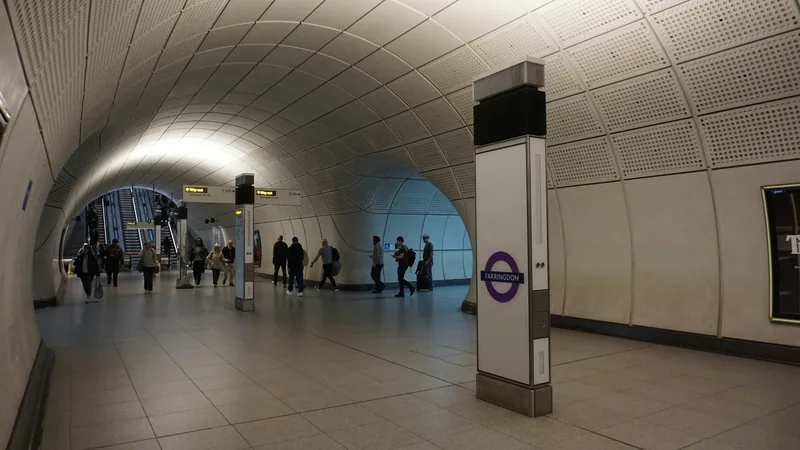
You use the same ticket gates, the same cards and the same journey planners, and TfL shows the line on the Tube map. In practice, there are a few differences a visitor will notice.
- Bigger trains and stations. The trains are much longer than Tube trains, and there is more space for luggage. The platforms are behind glass screen doors in the central tunnels.
- Fewer stops in the centre. Stations are further apart than on the Tube, so the line is fast across the city but less useful for a short hop between two sights.
- Long walks at some stations. Several stations have two entrances far apart. Liverpool Street's platforms reach Moorgate, and Farringdon's reach Barbican. Check which exit you need.
- Mobile signal. The whole line has mobile coverage, including 4G and 5G in the tunnels, so you can check maps on the move (roaming charges from your own provider apply).
- No all-night service. The Elizabeth line is not part of the Night Tube, so plan late journeys with the Night Tube lines or night buses instead.
If you are new to London's rail network, our guide to using the Underground covers the basics that apply to both, from touching in to escalator manners.
Fares: Tube prices with one big exception
Most Elizabeth line journeys cost the same as the Tube for the same zones, and they count towards the same daily and weekly caps. Paddington to Canary Wharf, for example, costs £3.60 at peak times and £3.10 off-peak with contactless or Oyster (fares from 5 July 2026). Our explainer on London's fare zones shows where each station sits.
The exception is Heathrow. Since 1 March 2026, a journey between Zone 1 and Heathrow costs £15.50, for example from Tottenham Court Road. From Paddington it costs £14.60. Peak fares apply at all times on Heathrow journeys that start, end or pass through Zone 1, so travelling at a quiet hour does not make it cheaper.
The good news is that the Elizabeth line to Heathrow is included in the daily cap. On the day you arrive or leave, the most you pay for all your travel in Zones 1-6, including the airport train, is £16.30. If you land in the morning and spend the rest of the day sightseeing by Tube and bus, the extra journeys cost only 80p more than the airport trip itself.
Oyster and contactless both work on almost the whole line. The one gap is between Iver and Reading, where Oyster is not accepted, but contactless is. Our comparison of contactless and Oyster fares explains why most visitors do not need an Oyster card at all.
The Heathrow fare is the same at 06:00 and at 14:00. Unlike most London fares, the Elizabeth line's Zone 1 to Heathrow price never drops to off-peak. There is no saving in waiting for a later train, so take the first one that suits your flight.
Elizabeth line, Piccadilly line or Heathrow Express?
Three rail links connect Heathrow with central London, and the Elizabeth line sits in the middle on both price and speed.
| Option | Fare (adult, pay as you go) | Time | Counts towards cap? |
|---|---|---|---|
| Piccadilly line (Tube) | £5.90 from Zone 1 | About 50 minutes from the West End | Yes |
| Elizabeth line | £15.50 from Zone 1; £14.60 from Paddington | 28 minutes from Paddington | Yes |
| Heathrow Express (Paddington only) | £26.00 | 15 minutes to Terminals 2 & 3 | No |
For a couple starting in Zone 1, the Elizabeth line costs £31.00 in total, the Piccadilly line £11.80, and the Heathrow Express £52.00 from Paddington at the pay as you go fare. The Elizabeth line's real advantage is that it runs direct from stations such as Bond Street, Tottenham Court Road, Farringdon and Liverpool Street, so many visitors avoid a change at Paddington altogether.
Families should do their own sums. Children aged 5 to 10 travel free on the Elizabeth line with a fare-paying adult (up to four per adult). On the Heathrow Express, the operator says children aged 15 and under travel free, which can make it the cheaper choice for a family travelling with children aged 11 to 15. Our full comparison of routes from Heathrow into the centre includes coaches and taxis as well.
Heathrow stations and moving between terminals
The Elizabeth line serves all of Heathrow's operating terminals, but not every train goes to every one. Six trains an hour run to Heathrow. All of them call at Terminals 2 & 3, four continue to Terminal 4 and two go to Terminal 5, which means a train to Terminal 5 only every 30 minutes. If you are flying from Terminal 5 and the next train goes to Terminal 4, take it to Terminals 2 & 3 and change there, or wait for the direct train.
Travel between the terminals on the Elizabeth line is free. Touch your contactless card and you will not be charged, or take a free inter-terminal ticket from a machine. All the Heathrow stations are step-free from the train to the street. Check which terminal your airline uses on the airport's own website before you set off; our guide to Heathrow's terminals and our arrivals guide to Heathrow explain the layout.
Not every Heathrow train stops at Terminal 5. Only two of the six Elizabeth line trains an hour run to Terminal 5, and the others end at Terminal 4. Check the destination on the front of the train and on the platform screen, especially if you are short of time before a flight.
Useful stations for sightseeing and hotels
Beyond the airport, the Elizabeth line links several visitor areas that used to need one or two changes on the Tube.
- Paddington. A major rail terminal with many hotels nearby. Our guide to staying near Paddington and King's Cross weighs up the area.
- Bond Street. For Oxford Street, Mayfair and Marylebone.
- Tottenham Court Road. For Soho, the West End theatres and the British Museum, a short walk away.
- Farringdon. An interchange with Thameslink trains to Gatwick and Luton airports, and close to Clerkenwell and the Barbican.
- Liverpool Street. For the City, Spitalfields and Shoreditch. Old Spitalfields Market and Brick Lane are close by, and Stansted Express trains leave from the mainline station.
- Canary Wharf. London's second financial district, with riverside restaurants and a large shopping centre. See our guide to the Canary Wharf area.
- Custom House. For ExCeL London, the exhibition centre.
Farringdon is also handy if you need to change between airports. The rail route from Gatwick to Heathrow uses Thameslink to Farringdon and then the Elizabeth line, and takes about 1 hour 30 minutes. Our guide to transfers between Heathrow and Gatwick compares it with the coach.
Step-free access and help on the line
All 41 Elizabeth line stations are step-free from the street to the platform. Between Paddington and Woolwich, and at the Heathrow stations, you can also get from the platform into the train without a step. At Custom House, level access to the train is only from the fifth carriage.
You do not need to book help. Staff at Elizabeth line stations offer "turn up and go" assistance: they can take you to the train, arrange a ramp where needed and ask staff at your destination to meet you. You can also book help in advance through TfL's Passenger Assist service. Our guide to accessible transport in London explains both.
For travellers with big suitcases or pushchairs, this makes the Elizabeth line much easier than the older Tube lines, where many stations still have stairs.
Delays, disruption and refunds
The Elizabeth line is generally reliable, but because it shares tracks with other trains on its outer branches, a problem far from the centre can cause delays across the line. Check the live status before an airport journey on TfL's status page, and leave extra time if you have a flight to catch.
If your journey is delayed by 30 minutes or more, you may be able to claim a refund from TfL. Planned engineering work sometimes closes parts of the line, usually at weekends or on public holidays, when replacement buses may run. Services are also reduced or suspended over Christmas, so check TfL's plans if you are travelling on 25 or 26 December.
Frequently asked questions
How much is the Elizabeth line from Heathrow to central London?
A single journey between Heathrow and a Zone 1 station such as Tottenham Court Road costs £15.50 with contactless or Oyster, and £14.60 from Paddington (fares from 1 March 2026). Peak fares apply at all times. The journey counts towards the Zones 1-6 daily cap of £16.30.
Is the Elizabeth line part of the Tube?
Not officially. It is a separate railway run by Transport for London, but it appears on the Tube map in purple, uses the same ticket gates and charges Tube-style fares. You can change between the Elizabeth line and Tube lines at stations such as Paddington, Bond Street and Liverpool Street without a new ticket.
Can I use Oyster on the Elizabeth line?
Yes, on almost the whole line, including to Heathrow. The exception is the stretch between Iver and Reading in the west, where Oyster is not valid but contactless cards and phones are. Contactless and Oyster charge the same fares elsewhere on the line.
Is the Elizabeth line faster than the Heathrow Express?
No. The Heathrow Express takes 15 minutes from Paddington to Terminals 2 & 3, against 28 minutes on the Elizabeth line. But the Elizabeth line costs less, is included in the daily cap and runs direct to stations across central London, so many travellers save time overall by avoiding a change at Paddington.
Does the Elizabeth line run all night?
No. The Elizabeth line is not part of the Night Tube, so trains stop overnight. Late at night, use the Night Tube on Friday and Saturday nights, or night buses such as the N9, which runs from central London to Heathrow.
Sources
- Transport for London - Getting to and from Heathrow on the Elizabeth line (checked September 2026)
- Transport for London - Elizabeth line (checked September 2026)
- Transport for London - Changes to Tube and rail fares from 1 March 2026 (checked September 2026)
- Transport for London - Tube and rail fares (checked September 2026)
- Transport for London - Step-free access (checked September 2026)
- Heathrow Express - Fares and timetable (checked September 2026)
- Transport for London - Unified API (Journey Planner times and fare data) (checked September 2026)