
There is no size limit on luggage on the London Underground and no charge for taking a suitcase. The difficulty is physical: fewer than half of the 272 Tube stations are step-free, several central ones have no lift and no escalator at all, and nobody is going to carry your case. Gloucester Road and Monument are the two stations most likely to defeat a large suitcase, and both of them serve areas full of hotels.
Most visitors meet this problem twice, on the way in from the airport and on the way out. Fifteen minutes spent looking at your two stations beforehand saves a great deal of swearing on a staircase. Our guide to step-free and accessible transport covers the network from the point of view of someone who needs step-free access all the time; this page is about the narrower problem of a heavy bag.
Luggage on London's transport network
- Size or weight limit
- None on the Tube, DLR, Overground or Elizabeth line
- Extra charge
- None, on any TfL service or in a black cab
- Step-free Tube stations
- 95, out of 272
- Step-free elsewhere
- All 41 Elizabeth line stations, every DLR station, every tram stop, more than 60 Overground stations
- Help with bags
- Only as part of a booked Passenger Assist, at 30 listed Tube stations
- Buses
- Every bus is low-floor and step-free, but luggage space is limited
The rules, and the help you will not get
Transport for London does not restrict the size of luggage on the Underground, does not weigh it and does not charge for it. In that respect the Tube is more generous than most metro systems in the world. What it does not offer is any assistance with carrying, unless you have booked it.
Station staff will happily tell you where the lift is, open a wide gate, and hold a barrier while you get a case through. "Turn up and go" assistance, which needs no booking on the Tube, Overground and Elizabeth line, means staff will guide you to the train and meet you at the other end. But help lifting bags is a different service: it is available only as part of Passenger Assist, at 30 listed Tube stations, and it has to be booked at least two hours ahead on 0343 222 2000. Our guide to accessible London explains how that booking works.
In practice, assume you will carry everything you bring, up and down stairs, through crowds, twice. That single assumption changes how people pack, and our notes on what to pack for London are worth reading before you buy the big case.
The stations with no lift and no escalator
TfL publishes the facilities at every station in its own data, and the counts are blunt. These are the central stations where a large case means stairs and nothing else.
| Station | Lifts | Escalators | What that means |
|---|---|---|---|
| Gloucester Road | 0 | 0 | Stairs only, on a Piccadilly line route from Heathrow, in a hotel district |
| Monument | 0 | 0 | Stairs only; the linked walk to Bank adds more of them |
| Covent Garden | 4 | 0 | Lifts or a spiral emergency staircase; long queues for the lifts |
| Russell Square | 3 | 0 | Lifts only, in the middle of Bloomsbury's hotels |
| Hampstead | 4 | 0 | The deepest station on the network; lifts or a very long staircase |
| Lancaster Gate | 2 | 0 | Lifts only, and they are small |
| Camden Town | 0 | 2 | Two escalators for one of the busiest stations in north London |
| Leicester Square | 0 | 6 | No lift at all; escalators plus a flight of stairs to each platform |
Station facility data from Transport for London, checked September 2026. Lift counts include lifts that are not on every route through the station.
Set against those, the easy stations are easy for a reason. Waterloo has 23 escalators, King's Cross St Pancras has 19 escalators and 10 lifts, Westminster has 17 escalators and 5 lifts, Bank has 15 escalators and 5 lifts, and Oxford Circus has 14 escalators. If you can route yourself through one of those with a big case, do.
Gloucester Road is the trap for anyone staying in South Kensington. It is the obvious Piccadilly line stop coming in from Heathrow, it is close to a large number of hotels, and it has neither a lift nor an escalator. With two suitcases, get off at Earl's Court instead, which has four lifts, or stay on to South Kensington and take a taxi for the last few hundred metres.
Lifts are not the same as step-free
A station with lifts is not necessarily step-free. Covent Garden has four lifts and is not on TfL's step-free list, because there are still steps between the lift and the platform. Russell Square is the same. What a lift saves you is the long climb, not every stair.
The reverse also catches people out. A station can be step-free from the street to the platform but not from the platform to the train, because of the gap and the height difference. That is fine with a wheeled case and awkward with a pushchair; our guide to getting around with a pushchair covers the difference.
The reliable way to check is the step-free Tube map and the journey planner's step-free option, both of which TfL publishes and both of which will route you round the bad stations automatically. Do that once, at the hotel, before you set off for the airport.
Which lines are easy and which are not
The pattern is geological. London's oldest lines were built just below the street by digging a trench and roofing it over, so their platforms are near the surface. The deep lines were bored much further down and need lifts or long escalators.
- Easiest: the Elizabeth line, which is step-free from street to platform at every one of its 41 stations, and step-free to the train from Paddington to Woolwich and at Heathrow. If your journey can be made on it, make it on it.
- Also easy: the DLR, where every station is step-free from street to train, and the newer sections of the Jubilee line. Our guide to the DLR and the Overground covers both.
- Usually manageable: the District, Circle, Hammersmith & City and Metropolitan lines, which run near the surface for much of their length.
- Hardest: the Piccadilly, Northern, Central, Bakerloo and Victoria lines, which are deep almost everywhere in the centre. The Piccadilly line is the one that matters most, because it is the cheap route from Heathrow and its trains have narrow doors, small vestibules and no luggage space.
The Piccadilly line deserves the warning it gets. It costs £5.90 from Zone 1, which is a third of the Elizabeth line fare, and with one small bag it is a perfectly reasonable ride. With two large cases in the rush hour it is genuinely unpleasant, and our comparison of the two fast Heathrow trains explains what the extra money buys.
Gates, doors and the practical mechanics
Every gate line has at least one wide gate, usually at the end nearest the staff. It is marked with a wheelchair symbol, and it is meant for anyone who needs the extra width, including people with luggage. Use it rather than wrestling a case through a standard gate, and touch your card on the reader beside it as normal.
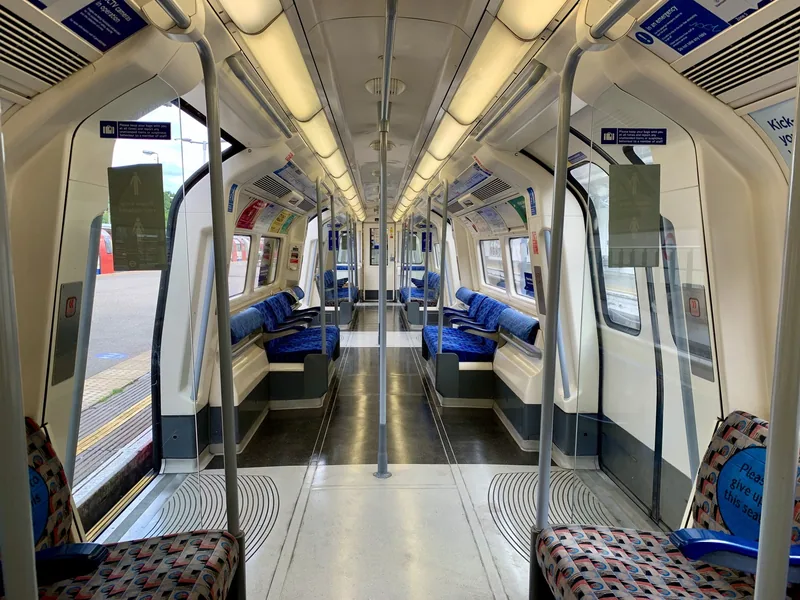
On the train itself, the space beside the doors is where luggage belongs, not the aisle and not a seat. Deep-level Tube carriages have very little room, so stand with the case in front of you and keep hold of the handle: the trains accelerate hard and an unheld suitcase travels. Our page on Tube etiquette covers the unwritten rules around all of this.
Timing matters more than anything else. Between 07:30 and 09:30, and again between 17:00 and 18:30, there is simply no room for a suitcase on a central London train, and staff at some stations will ask you to wait for the next one. Our guide to avoiding the rush hour has the detail, but the short version is to travel between 10am and 4pm if you have any choice.
When to stop using the Tube
Three alternatives are better than a bad Underground journey with bags.
A bus. Every London bus is low-floor and step-free, there are no stairs anywhere in the journey, and the fare is £1.75. Luggage space is limited to the area by the middle doors, which is shared with pushchairs and wheelchairs, so one large case is fine and four are not. Our guide to London's buses explains the routes worth knowing.
A black cab. Licensed taxis in London make no extra charge for luggage or for additional passengers, the floor is flat from the kerb, and the driver will normally help you load. For a short hop between a station and a hotel it is often only a few pounds. Our page on black cabs, minicabs and Uber covers fares and booking.
Your feet. London's central stations sit much closer together than the Tube map suggests, and wheeling a case three streets on a flat pavement beats two flights of stairs and a change. Our guide to walking in London lists the station pairs that are a short walk apart.
Book a hotel near a station with lifts, not near a station with a famous name. If you are choosing between two similar hotels, the one near King's Cross, Westminster, Bank, Stratford or any Elizabeth line station will make both your arrival and your departure easier than the one near Russell Square or Covent Garden. Our guide to staying near the big termini explains the trade-off.
Leaving the bags somewhere instead
The best luggage journey is the one you do not make. On your last day, most London hotels will hold bags after checkout at no charge, and every main railway terminus has a left luggage office. Network Rail lists the Excess Baggage Company at King's Cross, Paddington, Euston, Waterloo and Victoria, with published hours of 07:00 to 23:00 Monday to Friday; weekend hours are not shown, so check on the day. Our guide to left luggage in London covers the storage apps and the alternatives.
If you are travelling on from one of the termini, our overview of London's main railway stations explains which one serves which part of the country, and the three Gatwick trains shows why a main line train with a suitcase is a much easier proposition than the Underground.
Frequently asked questions
Is there a luggage limit on the London Underground?
No. Transport for London does not limit the size, number or weight of bags on the Tube, DLR, Overground or Elizabeth line, and there is no extra charge. The practical limits are the stairs at many stations and the lack of space on trains during the rush hour.
Which Tube stations are worst with a big suitcase?
Gloucester Road and Monument have no lift and no escalator at all. Covent Garden, Russell Square, Hampstead and Lancaster Gate have lifts but no escalators, which means queues. Camden Town has only two escalators for a very busy station, and Leicester Square has no lift.
Will station staff help me carry my luggage?
Not normally. Staff will direct you to lifts, open a wide gate and guide you to the train without any booking. Help with carrying bags is part of Passenger Assist, is available at 30 listed Tube stations only, and has to be booked at least two hours in advance on 0343 222 2000.
What is the easiest line to use with luggage?
The Elizabeth line. All 41 of its stations are step-free from street to platform, the trains are long with wide doors, and it links Heathrow to Paddington, Bond Street, Tottenham Court Road, Farringdon, Liverpool Street and Canary Wharf without a change. The DLR is equally step-free but covers a smaller area.
Can I take a suitcase on a London bus?
Yes. Buses are step-free from the pavement and there is no luggage charge, but the only real space is the area by the middle doors, shared with wheelchairs and pushchairs. One or two cases are fine; a family's worth of luggage is not, and the driver may ask you to wait for a quieter bus.
Sources
- Transport for London Unified API - station facilities data (lifts and escalators by station) (checked September 2026)
- Transport for London - Step-free access (checked September 2026)
- Transport for London - Passenger Assist (checked September 2026)
- Transport for London - Help from staff and turn up and go (checked September 2026)
- Transport for London - Taxi fares, including luggage (checked September 2026)
- Network Rail - station facilities and left luggage (checked September 2026)