
The London Aquatics Centre is the Olympic pool from London 2012, designed by Zaha Hadid, and today anyone can swim there at ordinary public-pool prices. It is in Queen Elizabeth Olympic Park, about 10 minutes' walk from Stratford station, and you book a session online or in the Everyone Active app.
During the 2012 Olympic and Paralympic Games this building hosted swimming, diving and artistic swimming, with seats for 17,500 spectators. After the Games the temporary stands were removed, and the centre opened to the public in March 2014. It now has three pools: the 50-metre competition pool where the Olympic finals were raced, a second 50-metre training pool and a separate diving pool with boards and platforms from 1 to 10 metres.
For a visitor, it is one of the most unusual things you can do in London for the price of a local swim. You use the same lane ropes, starting blocks and touchpads that were used during the Games, under one of the most striking modern roofs in the city. It is also a good plan for a wet day, which London has plenty of.
London Aquatics Centre at a glance
- Operator
- Everyone Active (since 2024)
- Pools
- 50 m competition pool (10 lanes), 50 m training pool, 25 m diving pool
- Price
- Set at local leisure-centre levels; check the current price when booking
- Booking
- Online or in the Everyone Active app (free account needed)
- Building hours
- 06:00-23:00 daily; pool session times vary day by day
- Café
- 09:00-19:00 Monday to Friday, 09:00-17:00 at weekends
- Address
- Queen Elizabeth Olympic Park, London E20 2AQ
- Nearest station
- Stratford, about 10 minutes on foot
Zaha Hadid's wave-shaped building
The architect Zaha Hadid designed the centre in 2004, before London had even won the right to host the Games. Her idea was moving water: the long, curving roof rises and falls like a wave and echoes the rivers that run through the park.
For 2012 the building had two large temporary "wings" of seating on either side, which gave it a rather awkward look. They were taken down after the Games and replaced with glass, and 628 panes now let daylight flood across the pools. The permanent seating holds about 2,500 people, with space for around 1,000 more at major events.
Even if you do not swim, it is worth walking round the outside. The river path beside the building gives a good view of how the roof curves down towards the water. The park's overview of the Olympic venues and how they are used today shows where the centre fits in.
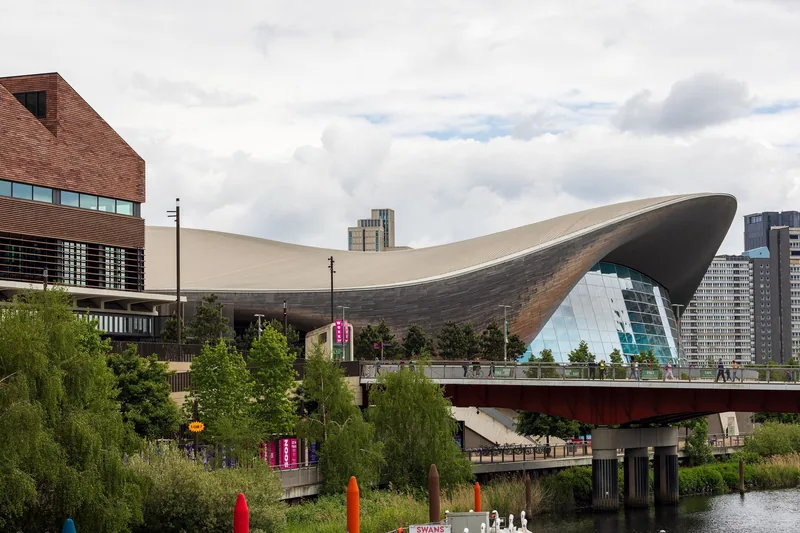
Photo: The wub · CC BY-SA 4.0 · Wikimedia Commons · resized
The three pools and who can use them
Each pool has its own rules, and it matters which one your session is in. The centre sets them because the competition pool is deep and the diving pool is a specialist space.
| Pool | Size and depth | Typical sessions |
|---|---|---|
| Competition pool | 50 m, 10 lanes, 3 m deep | Lane swimming (ages 11+), fitness swims, family sessions with an inflatable |
| Training pool | 50 m, can be split into two 25 m pools; movable floor for shallower water | Family fun swims, lessons, general swimming |
| Diving pool | 25 m, movable floor up to 5 m deep; boards and platforms 1-10 m; water at 28°C | Diving lessons, club training, events |
Rules for the competition pool
This is the pool most visitors want, and it has the strictest rules:
- No children under 11 and no non-swimmers.
- You must be able to swim 100 metres of a recognised stroke.
- Sessions last a maximum of 60 minutes.
- In lane-swimming sessions at least five lanes are open, but not always all ten, because clubs and events share the pool.
The Olympic pool is too deep to stand in. The centre gives the competition pool's depth as 3 metres, and it is reserved for confident swimmers. If you are a nervous swimmer or have younger children with you, choose a session in the training pool, where the floor can be raised.
Rules for children
Children under 8, and non-swimmers aged 9 to 16, must be accompanied in the water by a competent adult swimmer, with no more than two such children per adult. The adult must actively supervise them, and under-8s and non-swimmers must stay in shallow water. The centre strongly recommends armbands or another buoyancy aid for them. These rules are stricter than at some pools abroad, so check them before you promise a swim to the whole family.
Booking a swim as a visitor
You do not need to be a member or live in London. The centre is run by Everyone Active, one of Britain's largest leisure operators, and you book through its system on a pay-as-you-go basis:
- Create a free online profile on the Everyone Active website or in its app. You need an email address.
- Choose London Aquatics Centre, pick a session and pay online. The centre's swimming page links to the timetable and booking.
- On arrival, collect your Everyone Active card at reception and use it to enter.
Session times change every day, because the pools are shared with lessons, clubs, schools and events. Look at the timetable for your exact date rather than assuming a pool will be open at a certain hour. The building itself is open from 06:00 to 23:00, seven days a week, but that does not mean the pools are.
What a swim costs
The park says a swim here costs the same as at local leisure-centre pools. We could not confirm the exact adult price for September 2026, because Everyone Active shows prices only in its booking system. Check the current figure on the centre's activity prices page before you go. Whatever the exact price, it is far cheaper than most paid attractions in London, which makes it a useful choice if you are travelling on a tight budget; our guide to saving money in London has more ideas like this.
Book the evening before you plan to swim. Popular sessions at weekends and in school holidays fill up, and the timetable can change at short notice when the park hosts events. Booking a day ahead lets you plan the rest of your visit around a fixed time.
Family sessions, inflatables and diving
Families with younger children should look for the Family Fun Swim sessions, which are open to all ages, and the Family Swim with Inflatable sessions in the competition pool for children aged eight and over.
On selected dates, often around school holidays, the centre also runs two bigger inflatable events. The Atlantis course is a large obstacle course with slides and climbing walls set up on the Olympic pool, for swimmers aged 8 and over. The Inflatable Disco in the training pool is for children aged 5 and over, and under-8s need an adult with them at a ratio of two children to one adult. On inflatable sessions everyone under 16, and any weaker swimmer, must wear a lifejacket, and goggles are not allowed. Dates are published on the Atlantis and inflatable sessions page.
The diving pool is mainly used for lessons and by the Dive London Aquatics club, which trains here. There is also a dry diving area for practising on land. The open "Dive for all" sessions were listed as currently unavailable in September 2026, so check the timetable before you go if you hope to try the boards. For wider ideas on keeping children busy, see our guide to London for families.
Olympic moments in this pool
Part of the pleasure of swimming here is knowing what happened in 2012. The centre was the stage for every pool event of the Games, from swimming to diving. Michael Phelps won six medals here and became the most decorated Olympian of all time. For the home crowd, Tom Daley took bronze on the 10-metre platform, Rebecca Adlington won bronze in both the 400 m and 800 m freestyle, and Michael Jamieson took silver in the 200 m breaststroke.
The biggest British success came at the Paralympics, where Ellie Simmonds won two gold medals and set a world record in the 400 m freestyle. Since reopening in 2014 the centre has hosted international events such as the 2016 European Aquatics Championships, and it still stages galas and competitions. If an event is on, the pools may be closed to the public, but you may be able to buy a ticket to watch.
Getting to the Aquatics Centre
The centre is at the southern entrance to Queen Elizabeth Olympic Park, so it is the easiest venue to reach. From Stratford station (Central, Jubilee and Elizabeth lines, DLR, Overground and National Rail) walk through Westfield Stratford City, cross Westfield Avenue and follow the path into the park. The walk takes about 10 minutes.
- Stratford International (DLR and Southeastern high-speed trains from St Pancras, about seven minutes): a five-minute walk.
- Hackney Wick (Overground): about 15 minutes on foot.
- Buses: the 339 and 108 stop at the London Aquatics Centre stop on Pool Street, and the D8 also runs past.
- Cycling: there are more than 140 cycle racks outside, and a Santander Cycles docking station nearby.
The centre has its own car park for customers only, and anyone who parks there without using the centre is charged £45. Public transport is simpler. Our guide to the DLR and Overground helps if you are coming from Canary Wharf, Greenwich or Hackney, and the Stratford area guide covers places to eat nearby.
What to bring and other practical points
- Swimwear, a towel and goggles. Plan to bring your own; do not assume towel hire.
- A question about lockers. We could not confirm how the lockers work, so ask at reception when you collect your card.
- Your booking confirmation on your phone, and the email address you registered with.
- Time to spare. Allow 15 minutes before your session to collect your card and change.
- Something to eat afterwards. The café on site is open until 19:00 on weekdays and 17:00 at weekends, and there are more cafés along Aquatics Walk outside.
The centre is registered as an accessible venue and publishes a detailed accessibility guide on its website. For wider advice on getting around, see our guide to London for wheelchair users.
A swim here costs a fraction of the Orbit next door. If you are visiting the park on a budget, a public swim in the Olympic pool gives you a genuine piece of 2012 history for leisure-centre money, and entry to the park, V&A East and the fountains is free.
Other places to swim in London
The Aquatics Centre is indoors and open all year, which makes it the most reliable choice. In summer, London also has some well-known outdoor swimming spots. The Serpentine Lido in Hyde Park usually runs from June to mid-September, with an adult full-day ticket at £8.40. The bathing ponds on Hampstead Heath cost £5.00 for a single swim and become cashless from 1 October 2026. Both are cold, natural water and very different from an Olympic pool, and for a grey day our list of things to do when it rains is a better starting point.
If you are combining a swim with other sights in the park, the ArcelorMittal Orbit and its slide is a five-minute walk away, and the London Stadium stands just beyond it.
Frequently asked questions
Can tourists swim in the London Olympic pool?
Yes. The London Aquatics Centre is a public pool, and anyone can book a pay-as-you-go session. Create a free Everyone Active account online or in the app, book a session and collect your card at reception. You do not need to be a member or a London resident.
How much does it cost to swim at the London Aquatics Centre?
The park says prices are the same as at local leisure-centre pools. The exact price depends on the session and is shown in the Everyone Active booking system, so check the centre's activity prices page before you go.
Can children swim in the Olympic 50-metre pool?
Only from age 11, and only if they can swim 100 metres. The competition pool is 3 metres deep throughout. Younger children can use family sessions in the training pool, where under-8s must be accompanied in the water by an adult.
What are the opening hours of the London Aquatics Centre?
The building is open from 06:00 to 23:00 every day, but pool sessions vary from day to day because of lessons, clubs and events. Always check the swimming timetable for your date.
Is the London Aquatics Centre the pool used in the 2012 Olympics?
Yes. It hosted the swimming, diving and artistic swimming events of the 2012 Olympics and the Paralympic swimming. The competition pool still uses the lane ropes, starting blocks and touchpads from the Games.
Sources
- London Aquatics Centre - Swimming (checked September 2026)
- London Aquatics Centre - Safety rules (checked September 2026)
- London Aquatics Centre - Opening times (checked September 2026)
- London Aquatics Centre - History (checked September 2026)
- London Aquatics Centre - Architecture (checked September 2026)
- London Aquatics Centre - Find us (checked September 2026)
- Queen Elizabeth Olympic Park - London Aquatics Centre (checked September 2026)