
The Docklands Light Railway (DLR) is a network of automated trains in east London that takes you to Greenwich, Canary Wharf and London City Airport, while the London Overground is a set of six suburban lines that circle and cross the city. Both take the same contactless and Oyster fares as the Tube, and both reach places the Underground does not.
Most visitors meet the DLR on the way to Greenwich. Its small trains run mostly above ground on raised tracks through the old docks, so the ride itself is part of the experience. The Overground is more of a local railway. Its orange-edged lines link neighbourhoods such as Shoreditch, Hackney, Hampstead and Richmond without going through the crowded centre.
You pay for both exactly as you do on the Tube: touch in and out with the same card, and every journey counts towards the same daily cap. This guide explains where each network goes, which trips are worth making, and the details that catch visitors out.
DLR and Overground at a glance
- Payment
- Contactless or Oyster, Tube fares and caps
- Bank to Cutty Sark (DLR)
- About 21 minutes; £3.60 peak, £3.10 off-peak
- Bank to London City Airport (DLR)
- About 23 minutes; £3.90 peak, £3.30 off-peak
- Overground lines
- Lioness, Mildmay, Windrush, Weaver, Suffragette and Liberty
- Step-free
- All DLR stations; more than 60 Overground stations
- Night service
- Windrush line on Friday and Saturday nights
What the DLR is and how it works
The DLR opened in 1987 to serve the redeveloped Docklands, and it has since grown into a network of branches across east and south-east London. The trains are computer-controlled, with no driver's cab. A member of staff travels on board to check tickets and help passengers.
Because there is no cab, you can often sit right at the front and watch the track ahead, which children in particular enjoy. The trains are smaller than Tube trains and run mostly on viaducts and at street level, with good views of Canary Wharf's towers and the river.
Most DLR stations have no staff, and at many of them the ticket machines and yellow card readers stand on the platform or at the entrance rather than behind gates, so remember to touch in before you board and touch out when you leave. If you forget, you are charged a maximum fare, and it does not count towards your daily cap.
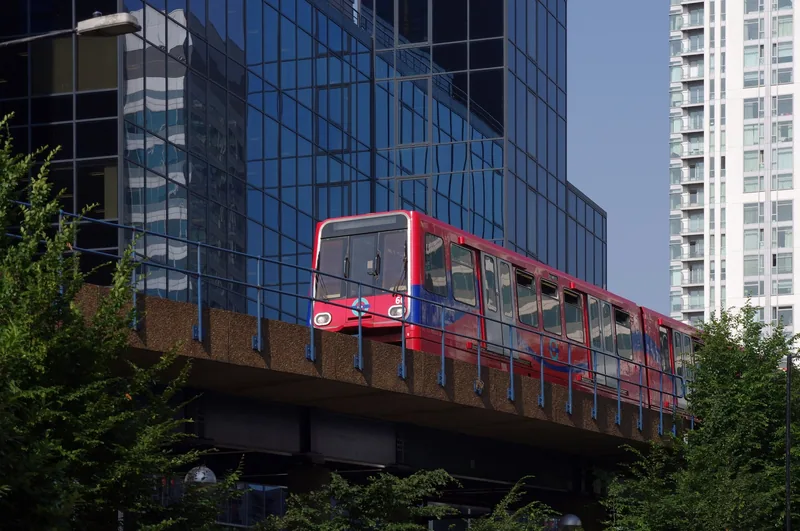
Photo: mattbuck (category) · CC BY-SA 4.0 · Wikimedia Commons · resized
Where the DLR goes
The DLR starts in the City at Bank and Tower Gateway (next to the Tower of London) and at Stratford in the north. From there, branches run to:
- Lewisham, via Canary Wharf, Island Gardens, Cutty Sark and Greenwich. This is the branch for visitors going to Greenwich.
- Woolwich Arsenal, via London City Airport.
- Beckton, via Royal Victoria for the cable car across the Thames.
- Stratford International, near the Olympic Park.
The network can be confusing at first, because trains from Bank and Tower Gateway run on different branches. Check the destination shown on the platform screen, and change at Westferry, Poplar or Canning Town if needed. TfL Go and Journey Planner show the best route.
Several places worth visiting sit right on the line. West India Quay station is three minutes from the free London Museum Docklands. The towers of Canary Wharf and the Isle of Dogs are right next door. Royal Victoria is next to the Royal Docks terminal of the IFS Cloud Cable Car (London Cable Car), which crosses the river to North Greenwich.
Taking the DLR to Greenwich
For most visitors, the DLR's main use is a trip to Greenwich. Take the DLR from Bank towards Lewisham and get off at Cutty Sark (for Maritime Greenwich). The journey takes about 21 minutes and costs £3.60 at peak times or £3.10 off-peak with contactless or Oyster (fares from 5 July 2026). The station is in the centre of Greenwich, a few minutes' walk from the Cutty Sark, the covered Greenwich Market and the riverside.
From Cutty Sark station, the Royal Observatory is a walk up through Greenwich Park (it is closed from 2 November 2026, with the Meridian Courtyard due to reopen in summer 2027, but the park stays open). Our guide to the Royal Observatory and the Cutty Sark has opening times and tips, and the Greenwich neighbourhood guide covers the rest of the area.
For a more memorable route, get off one stop earlier at Island Gardens, on the north bank. From there, the Greenwich foot tunnel runs under the Thames and comes up next to the Cutty Sark, with a classic view of the Old Royal Naval College from the Island Gardens side before you go down.
Go by DLR, return by river bus. A good Greenwich day combines the DLR one way and the Uber Boat river bus the other. The DLR is cheaper and counts towards your cap; the boat is slower and costs extra, but you pass Canary Wharf, Tower Bridge and the City from the water. Fares and piers are in our Thames Clippers river bus article.
The DLR to London City Airport
London City Airport has its own DLR station, in fare Zone 3. From Bank, the journey takes about 23 minutes and costs £3.90 at peak times or £3.30 off-peak with contactless or Oyster. A paper single costs £7.00. Oyster cards are also sold at the airport's DLR station.
The airport station is on the Woolwich Arsenal branch, so check that your train is going the right way. All DLR stations are step-free, which helps with luggage. Our guide to London City Airport covers the terminal and the other ways into town.
The six London Overground lines
The London Overground is run by TfL and uses ordinary rail tracks, mostly above ground. In November 2024 its routes were given separate names and colours, so on the Tube map you will now see six lines, each shown as a double line in its own colour.
| Line | Route | Useful for visitors |
|---|---|---|
| Lioness | Euston - Watford Junction | A slow, stopping route to Watford Junction, where the Harry Potter studio shuttle starts |
| Mildmay | Richmond / Clapham Junction - Stratford | Kew Gardens, Richmond, Hampstead Heath, Camden Road, Hackney, Stratford |
| Windrush | Highbury & Islington - New Cross / Clapham Junction / Crystal Palace / West Croydon | Shoreditch High Street, Hoxton, Whitechapel, Canada Water, Crystal Palace |
| Weaver | Liverpool Street - Enfield Town / Cheshunt / Chingford | Bethnal Green, Hackney Downs, north-east London |
| Suffragette | Gospel Oak - Barking Riverside | Walthamstow and north-east London; mostly local journeys |
| Liberty | Romford - Upminster | A short local shuttle in east London |
You do not need to learn all six. For a short visit, the Mildmay and Windrush lines are the ones that matter most.
Overground trips worth making
The Mildmay line to Kew and Richmond. This line runs across north and west London to Kew Gardens station, a short walk from the Royal Botanic Gardens at Kew, and on to Richmond. The District line also serves both stations, so you can go out one way and back the other. Further east, Hampstead Heath station puts you at the foot of Hampstead Heath and Parliament Hill.
The Windrush line to Shoreditch. Shoreditch High Street and Hoxton stations are in the middle of east London's bar, gallery and street-art district. We cover where to go in Shoreditch and its streets. Further south, the line crosses the Thames to Canada Water and continues to Crystal Palace.
The Weaver line to the east London markets. Trains from Liverpool Street stop at Bethnal Green and Cambridge Heath, both within walking distance of the Sunday flower market on Columbia Road.
Stratford and the Olympic Park. The Mildmay line, the DLR, the Elizabeth line and the Tube all meet at Stratford, next to the Olympic Park and a huge shopping centre. Our Stratford area guide explains what is there.
Watford Junction is quicker from Euston by mainline train. The Lioness line stops at every station on the way to Watford Junction. If you are heading to the Warner Bros. Studio Tour, the faster mainline trains from Euston take about 20 minutes, and Oyster and contactless are valid on them too. The studio shuttle from Watford Junction is included in your tour ticket.
Fares, caps and pink readers
The DLR and the Overground charge the same pay as you go fares as the Tube for the same zones, and they count towards the same daily and weekly caps: £8.90 a day for Zones 1-2, or £16.30 for Zones 1-6. Contactless and Oyster charge the same. Our comparison of contactless and Oyster payment explains why most visitors can simply use their bank card.
When you change between lines outside Zone 1, you may see pink card readers. Touching your card on one tells the system that you took a route that avoided Zone 1, so you pay the cheaper fare. If you do not touch one, you may be charged as if you had travelled through the centre.
Overground trains have walk-through carriages with plenty of standing room. Most of the network stops running around midnight. On Friday and Saturday nights, the Windrush line runs through the night between Highbury & Islington and New Cross Gate as part of the Night Tube. Our guide to the all-night Tube and Overground covers the details.
Step-free access and help from staff
All DLR stations are step-free from the street to the train, with lifts or ramps, which makes the DLR one of the easiest networks for wheelchair users, pushchairs and heavy luggage. Staff are on the trains rather than at the stations, but you can book assistance in advance on 0808 281 6655.
More than 60 London Overground stations are step-free. On the Overground, you can ask for "turn up and go" help from staff without booking, or book in advance through Passenger Assist. How both services work is set out in step-free and accessible transport.
Delays and refunds
TfL offers refunds for delays on both networks, but the thresholds differ. On the DLR you can claim if your journey is delayed by 15 minutes or more. On the London Overground, the delay must be 30 minutes or more. Check the live status of both on TfL's status page before you set off, particularly at weekends when engineering work is more common.
For a broader picture of the network and how these lines fit with the Tube, read our visitor's guide to the Underground.
Frequently asked questions
Does Oyster work on the DLR and the Overground?
Yes. Oyster cards and contactless bank cards or phones work on the whole DLR and London Overground network, with the same fares and daily caps as the Tube. On the DLR, most stations have no gates, so touch in and out on the yellow readers on the platform.
How do I get to Greenwich by DLR?
Take the DLR from Bank towards Lewisham and get off at Cutty Sark (for Maritime Greenwich). The trip takes about 21 minutes and costs £3.60 at peak times or £3.10 off-peak with contactless or Oyster. You can also stop at Island Gardens and walk through the foot tunnel under the Thames.
Is the DLR driverless?
Yes. DLR trains are controlled by computer and have no driver's cab, although a member of staff rides on board to help passengers and check tickets. Many visitors enjoy sitting at the front of the train for the view over Docklands.
Is the London Overground part of the Tube?
No. The Overground is a suburban railway run by Transport for London, mostly above ground on ordinary rail tracks. It appears on the Tube map, uses the same ticket gates and charges the same fares, and journeys count towards the same daily cap, so for a visitor it feels like part of one network.
What are the new London Overground line names?
Since November 2024 the Overground has six named lines: Lioness (Euston to Watford Junction), Mildmay (Richmond and Clapham Junction to Stratford), Windrush (Highbury & Islington to the south London branches), Weaver (Liverpool Street to north-east London), Suffragette (Gospel Oak to Barking Riverside) and Liberty (Romford to Upminster).
Sources
- Transport for London - DLR (checked September 2026)
- Transport for London - New London Overground line names and colours (checked September 2026)
- Transport for London - Fare capping (checked September 2026)
- Transport for London - Step-free access (checked September 2026)
- Royal Museums Greenwich - Getting here (checked September 2026)
- Warner Bros. Studio Tour London - Getting here (checked September 2026)
- Transport for London - Unified API (Journey Planner times and fare data) (checked September 2026)