
An accessible London trip is settled by three decisions taken before anyone boards a train: which step-free station the hotel sits next to, whether you can get through the door of the places you want to see, and where the nearest toilet you can use will be. Transport is the part most visitors worry about, and it is the part that is already largely solved.
London's railways carry wheelchair users well on the newer lines and badly on the oldest ones, and working out which is which takes a guide of its own. The rest of the trip gets far less attention: Victorian hotels with three steps up to the front door, museums whose level entrance is round the side, restaurants where the only toilet is down a staircase, and long gaps between the toilets that have a hoist.
This page is about that rest. It assumes you have read, or will read, our guide to getting around London without stairs, and it deals with the trip as a whole: where to sleep, what to book, what to expect at the door of a building, and what to arrange before you fly.
The decisions that shape an accessible trip
- Base yourself
- Within a few hundred metres of a step-free station, ideally on the Elizabeth line
- Easiest buildings
- The large national museums: free entry, lifts, wide doors, practised staff
- Hardest buildings
- Historic houses, small museums, basement restaurants and Victorian theatres
- Order before you fly
- A Radar key. Delivery takes up to 10 working days
- Find in advance
- The Changing Places toilet nearest each day's plan; they are thinly spread
- Driving
- Rarely worth it. The badge scheme is limited in four central boroughs
- Build in
- A spare hour and taxi money for the day a lift fails
Getting around, in three sentences
The newer the railway, the better it works: every London bus, every DLR station, every tram stop and all 41 Elizabeth line stations are level, while the deep Tube lines are usable only at named stations. Staff at Tube, Overground and Elizabeth line stations will help you board without any booking, and if a lift has failed and no other level route exists, Transport for London pays for a taxi itself. Everything else about the journeys themselves, from the symbols on the map to which carriage to wait beside, belongs to the two transport guides: the step-free overview linked above, and London transport in a wheelchair, which goes through the network line by line.
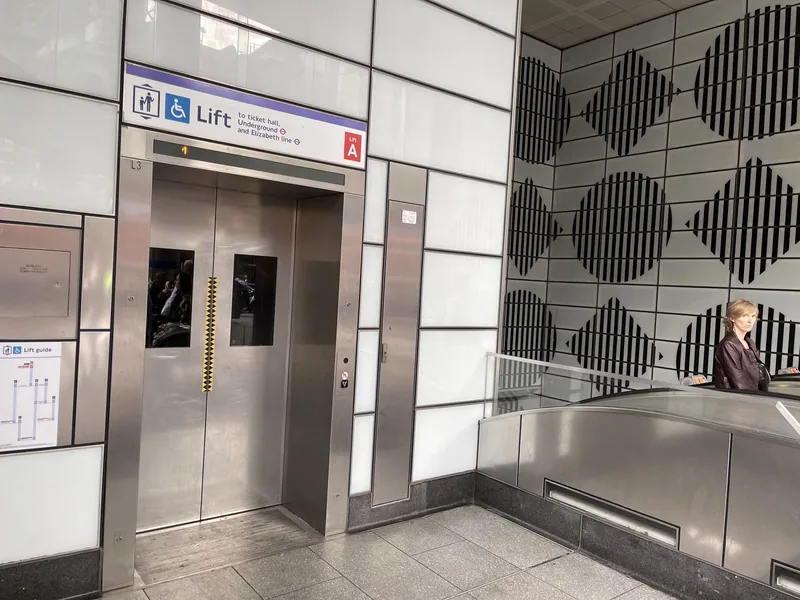
Photo: Turini2 · CC BY-SA 4.0 · Wikimedia Commons · resized
Choosing where to stay
This is the most valuable decision of the trip. A hotel two hundred metres from a step-free station turns London into a city you can move around in. The same hotel a kilometre away, with an interchange in between, turns every outing into a negotiation.
Four stretches of the city make it easy. The Elizabeth line corridor through Paddington, Bond Street, Farringdon, Liverpool Street and Canary Wharf is the strongest, because those stations are level from the pavement to the carriage floor. The eastern half of the Jubilee line, running out towards Stratford, comes next. The South Bank and Greenwich both work because the river boats give you a second way home that does not depend on a lift. Our overview of the best areas to stay compares the neighbourhoods on everything else, and staying near King's Cross and Paddington covers the two areas most visitors arrive in.
Then question the hotel closely, because "accessible" is not a regulated word in a booking listing and British hotels use it loosely. Five questions settle most bookings:
- Is there a step at the street door? Central London hotels are often converted terraced houses, and a single step at the entrance is common and almost never photographed.
- How wide is the bathroom door, in centimetres? Ask for the number rather than for a yes.
- Does the shower have a lip, or is the floor level into it? A "walk-in shower" frequently has a raised edge.
- Is the adapted room on a floor the lift reaches? Some lifts stop short of the top storey, and some hotels have a few steps between the lift and a wing.
- Will they send photographs? A hotel that will not is telling you something.
Ask for the measurement, not the label. A room description means whatever the hotel decides it means, but a door width in centimetres, a photograph of the shower floor and a straight answer about the step at the entrance cannot be fudged. Hotels that answer all three quickly are usually the ones that have thought about the problem.
London rooms are small by international standards even when they have been adapted, and turning space suffers accordingly; our description of what a London hotel room is actually like sets expectations. Book direct rather than through an agent, get the requirements written into the confirmation, and ring a week before arrival to check the room is still held for you.
Getting into the buildings, not just to the door
Reaching a step-free station near an attraction is half the job. The other half is the building, and London's buildings run from excellent to impossible.
The large national museums are the safest default. Entry is free, the lifts work, the doors are wide, the staff deal with access every day, and a wet afternoon disappears inside one without further planning. They are also the buildings most likely to have a Changing Places toilet on the premises.
Entrances need checking, because the level way in is often not the main one. At the Churchill War Rooms it is on Horse Guards Road, by St James's Park, rather than where the queue forms; our guide to the Churchill War Rooms has the opening times and what the visit involves.
Ring the attraction rather than emailing it. Access pages are written once and then left alone, while the person who answers the telephone knows whether the lift is working this week and which door to come to. Ask about the entrance, the internal lifts and the toilets in the same call, and write down the name of whoever answers.
Prices often move in your favour, and most large venues will admit an essential companion free if you arrange it with their access line before you buy. The schemes behind that, and the cards that make them simpler, are set out in our guide for disabled visitors planning a London trip.
Tower Bridge charges a disabled adult £13.50 instead of £18.00, and lets a companion in free. A disabled child pays £6.80. That pattern, under various names, runs through most of London's paid attractions, and it is rarely advertised at the top of the ticket page, so look for the access section or ask at the door. Our guide to Tower Bridge covers the walkways and the engine rooms.
The hard end of the scale is worth naming plainly. Palaces, churches and the smaller house museums were built with spiral stairs, changes of level and floors that cannot be altered. The Sherlock Holmes Museum, for instance, has no step-free access at all and holds only 15 visitors at a time. West End theatres are Victorian as well, and their wheelchair positions are few, fixed and normally arranged with the theatre directly rather than through a ticket site, which means booking earlier than other people do; our guide to West End theatre explains how a run is sold.
Restaurants are the least predictable of all. A ground-floor dining room often keeps its only lavatory in the basement, and the step at the door is seldom mentioned anywhere online. Ask both questions when you reserve a table, and ask for a table near the door rather than accepting whatever comes.
Toilets, and the one thing to order before you fly
Britain keeps a great many of its accessible toilets locked, under a nationwide key scheme. The key is called a Radar key, and the official one comes from Disability Rights UK at £5 plus postage, for people whose disability requires it. Delivery can take up to 10 working days, which is why it belongs on the list of things to do weeks before departure rather than after landing.
A Changing Places toilet, with a hoist and an adult-sized bench, is a different facility from a standard accessible one, and there are far fewer of them. Search the Changing Places Consortium map by postcode before each day out; Transport for London sends visitors to the same map. What those rooms contain, and which London venues have one, is covered on the disability page linked above.
Ordinary public conveniences are a separate problem. Toilets in TfL stations are free to use, but not every station has one and the hours vary, though staff can sometimes open one outside them. The Great British Toilet Map, which lists more than 14,000 publicly accessible facilities, is the most complete search there is, although it is run by a research team rather than by any government body. Our guide to finding a public toilet in London has the rest.
Driving, parking and the Blue Badge
Our advice is not to drive in central London if there is any alternative at all. Traffic is slow, the charges mount up, on-street bays are scarce and the rules change from borough to borough. If you are bringing an adapted vehicle and have no realistic choice, three things matter.
First, the national badge scheme does not carry its full force everywhere. Four central boroughs run their own arrangements instead: Westminster, Kensington and Chelsea, the City of London and part of Camden. Each of them decides its own concessions and reserves a number of bays for visiting badge holders, and the only way to learn which is to ask that borough directly before you travel. Our guide to parking in London explains how bays, lines and red routes work in the rest of the city.
Second, the Congestion Charge discount is generous but not automatic. A badge holder can register for a 100 per cent discount covering up to two vehicles, and there is no requirement to own or drive either of them, but the registration has to be in place before you drive in. Our guide to the Congestion Charge and ULEZ sets out the charges and the hours they apply.
Third, a disabled parking card issued in another country may or may not be recognised here. We could not establish the position from an official English source, and the secondary sites that discuss it disagree with each other, so treat it as unsettled and ask the borough you intend to park in before you rely on it.
Needs other than a wheelchair
Priority seats are marked on every bus, tram, train and Tube carriage, and the convention is that they are given up when somebody asks. Transport for London's free "Please offer me a seat" badge saves you having to ask, but TfL will not post it outside the United Kingdom, so most people flying in cannot get hold of one.
The Hidden Disabilities Sunflower lanyard is recognised at the airports, the main stations and most large attractions. Nobody asks for proof before giving you one. Staff who notice it know to slow down, repeat themselves, or find you a calmer way through a busy hall. It is not a fast-track pass, though, so do not build a plan around it as though it were.
Assistance dogs travel free on every part of the transport network, and a taxi or minicab driver who refuses one, or charges extra for it, is breaking the law rather than being awkward. Deaf, hard of hearing and speech-impaired visitors can reach 999 through Relay UK by dialling 18000; our list of emergency numbers and what to do if something goes wrong has the others worth saving.
Help inside an airport terminal is arranged separately from anything TfL runs, and it is booked in advance rather than requested on the day. Our guide to special assistance at London's airports explains who to contact and when.
Pacing the trip
Plan fewer things each day than a walking visitor would, and plan them closer together. Two sights and a long lunch make a full day if one of the sights is a national museum, because the distances inside those buildings are considerable in themselves.
Leave slack in the afternoon for the lift that is out of service, the bus bay that is already occupied, or the accessible toilet that turns out to need a member of staff with a key. A day with a spare hour in it survives one of those. A day timed to the minute does not.
Weather shapes the plan more than it does for other visitors. Rain makes pavements and dropped kerbs slippery, the wind off the river is strong on the open bridges, and a January afternoon is shorter than it looks because the light goes by four o'clock. Museums, covered arcades and the larger stations make good shelter, and the river boats are enclosed and heated.
If the trip is really about a slower pace rather than wheelchair access in particular, our guide to London for older visitors covers seating, shorter distances and the sights that suit a gentler day.
Frequently asked questions
Where is the best area to stay in London for a wheelchair user?
Anywhere within a short push of a station on the Elizabeth line, which is level from street to carriage at every central station. Paddington, Farringdon, Liverpool Street and Canary Wharf all qualify. The South Bank and Greenwich are good alternatives, because the river boats give you a second route home if a lift goes out of service.
Which London sights are easiest to get into with limited mobility?
The large national museums, because they are free, have lifts, have wide doors and are staffed by people who handle access every day. The hardest are palaces, churches and small house museums, whose spiral stairs and changes of level cannot be altered. Read the venue's own access information about the building itself, not just about the nearest station.
How do I find an accessible toilet in London?
Buy a Radar key before you travel, because a great many of Britain's accessible toilets are kept locked and that key opens them. For a toilet with a hoist and an adult changing bench, search the Changing Places Consortium map by postcode. For ordinary public conveniences, toilets in TfL stations are free and the Great British Toilet Map covers the rest of the city.
Is it worth driving in London with a disabled parking badge?
Usually not. Four central boroughs run their own schemes instead of the national one, on-street bays are scarce, and traffic is slow even when the Congestion Charge has been discounted to nothing. Public transport and taxis will move you around central London more easily than a car will, and they cost less to park.
How many sights can I see in a day in a wheelchair?
Two, realistically, if one of them is a large museum. Distances inside the big buildings are longer than they look, lifts add waiting time, and a broken one can cost an hour. Building a spare hour into every afternoon is what keeps the remainder of the day intact.
Sources
- Transport for London - Public toilets in London, including Changing Places (checked September 2026)
- Changing Places Consortium - Find a toilet (checked September 2026)
- Disability Rights UK - The official Radar key (checked September 2026)
- The Great British Toilet Map - About the map (checked September 2026)
- GOV.UK - The Blue Badge scheme: rights and responsibilities in England (checked September 2026)
- Transport for London - Blue Badges and driving (checked September 2026)
- Transport for London - Please offer me a seat (checked September 2026)
- Tower Bridge - Entry prices and concessions (checked September 2026)