
Notting Hill is a residential area in west London famous for Portobello Road Market, its rows of pastel-painted houses, the Notting Hill Carnival every August bank holiday weekend and the 1999 romantic comedy that carried its name around the world. Come on a Saturday for the full market, or on a weekday morning if you would rather see the streets without the crowds.
The area lies north of Kensington and west of Bayswater, roughly between Notting Hill Gate station in the south and the Westway flyover in the north. Portobello Road runs through the middle, from the smart, quiet streets near Notting Hill Gate down to the more mixed, working-class neighbourhood of North Kensington around Golborne Road.
Visitors often expect a picture-postcard village. The truth is more interesting. Notting Hill is very wealthy in parts, still has large estates of social housing in others, and has a strong Caribbean heritage that shapes its most famous event. This guide covers what to see, when to go and how to make the most of a visit without being caught in the worst of the crowds.
Notting Hill essentials
- Best for
- Markets, antiques and vintage, photography, cafés, relaxed walking
- Stations
- Notting Hill Gate (Central, Circle, District); Ladbroke Grove and Westbourne Park (Hammersmith & City, Circle)
- Market days
- Portobello Road Market trades Monday to Saturday; Saturday is the main day, with antiques
- Carnival 2027
- Sunday 29 and Monday 30 August 2027, free
- Time needed
- Half a day; a full day with Holland Park or Kensington Gardens
From slum to celebrity: a short history
In the early 19th century this was farmland, pig farms and brick kilns. Developers built grand stucco terraces and garden squares in the southern part from the 1840s onwards, but the northern streets decayed into overcrowded housing. By the 1950s much of Notting Hill was run down, with high rents and poor conditions.
Many of the Caribbean migrants who came to Britain after the Second World War, the Windrush generation, found rooms here, often because landlords elsewhere refused to rent to them. In 1958 the area saw serious racist riots. The community's response over the following years included the street festivals that grew into the Notting Hill Carnival, first held in the 1960s.
From the 1980s onwards, the pretty houses attracted wealthier buyers, and by the time the film Notting Hill came out in 1999 the southern part was one of London's most fashionable addresses. North Kensington, just a few streets away, remained much poorer. In June 2017 the fire at Grenfell Tower, at the north-western edge of the area, killed 72 people, and the tower and its memorial remain a place of grief for the community. Please be respectful if you pass nearby.
Portobello Road Market, day by day
Portobello Road Market is the reason most visitors come. It is really several markets in one, spread along roughly a mile of the road, and what you find depends heavily on the day. Kensington and Chelsea Council runs the street market, and the road is closed to traffic during market hours, from 10:00 to 16:00, Monday to Saturday. Our full guide to Portobello Road Market covers stalls, arcades and prices in detail.
| Day | What to expect |
|---|---|
| Monday to Thursday | A small local market: fruit, vegetables and everyday goods. Quiet, and many stalls finish early on Thursday. |
| Friday | The busiest weekday, with more stalls and a wider mix of goods than earlier in the week. |
| Saturday | The full market: antiques at the southern end, then food, fashion and vintage further north. Very crowded from late morning. |
| Sunday | No regular market. Shops and cafés are open, but it is much quieter. |
On Saturdays the southern end, closest to Notting Hill Gate, turns into one of Britain's largest antiques markets, with stalls outside and dealers packed into indoor arcades. Further north, around the junction with Westbourne Park Road and under the Westway flyover, the mood changes to street food, cheap clothes, records and vintage fashion. If vintage is your main interest, our guide to vintage and second-hand shopping in London lists other markets worth combining with this one.
Start at the Notting Hill Gate end before 10:00 on a Saturday. Serious antiques buyers arrive early, and many dealers are set up before the crowds. By late morning the narrow pavements at the southern end are packed and it can take twenty minutes to walk a few hundred metres. Arrive early, walk north with the market, and leave the food stalls for lunch near Ladbroke Grove.
The pastel houses and how to photograph them politely
The brightly painted terraced houses of Notting Hill, in pink, mint green, lemon yellow and sky blue, are some of the most photographed homes in London. You will find them on and around the southern half of Portobello Road, in the side streets between Portobello Road and Ladbroke Grove, and in small cobbled mews tucked behind the main streets.
Remember that these are private homes, not a film set. Photographing the street is fine; climbing onto front steps, sitting on doorsteps, blocking the pavement for photo shoots or peering through windows is not. Early morning light is best for photos and the streets are quieter then, which suits everyone.
Film locations and the Notting Hill myth
The 1999 film Notting Hill put the area on the tourist map. Fans still come looking for the travel bookshop and the house with the blue front door that appear in the film. Both are on or near Portobello Road, and the house is a private home. Walk past by all means, but treat it as someone's front door rather than a photo prop.
More interesting for many visitors is the Electric Cinema on Portobello Road, one of Britain's oldest working cinemas, which opened in the early 20th century and still shows new releases today. Our guide to film locations in London focuses on the Harry Potter films, but it shows how often London streets turn up on screen.
Notting Hill Carnival
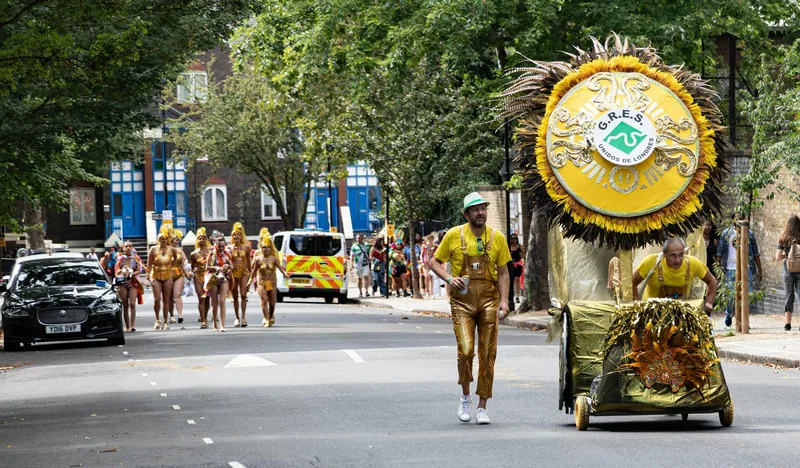
Notting Hill Carnival is one of the largest street festivals in Europe, a celebration of Caribbean culture with steel bands, sound systems, costume parades and food stalls. It takes place over the August bank holiday weekend. The 2026 carnival, the 60th anniversary edition, was held from 29 to 31 August.
For 2027 the organisers list Sunday 29 August (Families and Children's Day) and Monday 30 August (Adults Day), both free to all. The Panorama steel band competition on Saturday 28 August is ticket-only. Our dedicated Notting Hill Carnival guide explains the route, the best areas to watch from and what to bring.
Carnival weekend changes everything in W11. On carnival days the streets are packed from morning to night, some nearby Tube stations may close or run as exit-only, many shops board up their windows and toilets are scarce. If you are not coming for the carnival, avoid Notting Hill that weekend entirely. If you are, keep your phone in a front pocket, agree a meeting point with your group and check TfL's live status page for station closures.
If you are planning a late-summer trip, our overview of what's on in London in August puts carnival alongside the other events of the month.
Westbourne Grove, Ledbury Road and the cafés
East of Portobello Road, Westbourne Grove and Ledbury Road are lined with boutiques, delis, bakeries and brunch cafés. This is Notting Hill at its most polished: independent fashion labels, homeware, flowers and good coffee. Prices are high, but it is a pleasant area to wander on a weekday when Portobello is quiet. For a good cup, see our guide to coffee in London.
North of the Westway, Golborne Road has a different feel. Its stalls are busiest on Fridays and Saturdays, and its cafés and grocers reflect the Portuguese and Moroccan communities who settled here. From the end of the road you can see Trellick Tower, a tall concrete block of flats from the 1970s that is now a listed building and a favourite of architecture fans.
Food in Notting Hill ranges from street stalls on Portobello Road to smart restaurants in the southern streets. For wider choice, our guide to London's best food markets compares Portobello with Borough and the others.
Holland Park, Kensington and green space nearby
Holland Park, about fifteen minutes' walk south-west of Notting Hill Gate, is one of London's most varied small parks. It has woodland paths, peacocks, the ruins of a Jacobean house and the Kyoto Garden, a Japanese garden with a waterfall and koi carp that was a gift from Japan. It is free and makes a peaceful contrast to a busy market day.
At the southern edge of Holland Park, on Kensington High Street, the Design Museum holds exhibitions on architecture, fashion and product design. It is open from 10:00 to 17:00 Monday to Thursday and to 18:00 Friday to Sunday; check ticket prices on its website.
East of Notting Hill Gate, Kensington Gardens is about ten minutes' walk away, with Kensington Palace on its western side. Our guide to Hyde Park and Kensington Gardens suggests routes, and from there it is a pleasant walk south to the museums of South Kensington.
Getting there and the best time to visit
Notting Hill Gate station, on the Central, Circle and District lines, is the best stop for the antiques end of Portobello Road. The Central line runs direct from Oxford Circus, Bond Street and Marble Arch. For the northern end of the market and Golborne Road, use Ladbroke Grove or Westbourne Park, both on the Hammersmith & City and Circle lines. Walking the whole length of Portobello Road from one station to the other takes about 25 minutes without stopping.
On Saturdays, Notting Hill Gate is very busy, and many people find it easier to arrive at Ladbroke Grove and walk south against the flow. Our guide to the Underground explains how the lines connect.
The best time to visit depends on what you want. For the full market, come on a Saturday morning. For photos, cafés and quiet streets, come on a weekday morning. Sunday is calm but has no main market. Evenings are relaxed, with restaurants and pubs busy but no real nightlife.
Reasons to go
- One of the world's best-known street markets
- Beautiful streets and houses for walking and photos
- Easy to combine with Holland Park and Kensington Gardens
- Carnival, if you like big, loud street parties
Things that disappoint
- Saturday crowds can be overwhelming
- Much of the market is ordinary on weekdays
- High prices in the shops and cafés
- Carnival weekend is chaotic if you are not there for it
Frequently asked questions
What day is best for Portobello Road Market?
Saturday is the main market day, when the antiques stalls and arcades open alongside food, clothes and vintage. Friday is the busiest weekday, with more second-hand stalls. From Monday to Thursday the market is small and mostly sells fruit, vegetables and everyday goods, and there is no regular market on Sunday.
Which Tube station is closest to Portobello Road?
Notting Hill Gate (Central, Circle and District lines) is closest to the southern, antiques end of Portobello Road. Ladbroke Grove and Westbourne Park, on the Hammersmith & City and Circle lines, are better for the northern end and Golborne Road.
When is Notting Hill Carnival in 2027?
The organisers give Sunday 29 August 2027 as the Families and Children's Day and Monday 30 August 2027 as Adults Day. Both are free to attend. The Panorama steel band competition on Saturday 28 August is a ticketed event.
Is Notting Hill worth visiting if you are not interested in shopping?
Yes, for the architecture, the pastel houses, the history and a walk to Holland Park or Kensington Gardens. A weekday morning visit focused on the streets and cafés can be more enjoyable than a crowded Saturday for people who dislike markets.
Is Notting Hill a good area to stay in?
It is pleasant and well connected, especially near Notting Hill Gate with the Central line to the West End. Hotels are fewer and often pricier than around Paddington or Bayswater nearby. Our guide to choosing an area to stay compares the options.
Sources
- Royal Borough of Kensington and Chelsea - Portobello Market goes car-free permanently (checked September 2026)
- Notting Hill Carnival - Official site (checked September 2026)
- Notting Hill Carnival - Notting Hill Carnival 2026 (checked September 2026)
- Design Museum - Plan your visit (checked September 2026)
- Transport for London - Live status (checked September 2026)