
London is a very good city for coffee: independent cafés and roasters serve carefully made espresso and filter coffee in almost every central neighbourhood, and big chains fill the gaps on every high street. The drink most associated with the modern London café is the flat white, but you can find everything from a traditional Italian espresso to a slow pour-over.
Many visitors arrive expecting a nation of tea drinkers, and tea is still hugely popular. But London was one of Europe's first great coffee cities in the seventeenth century, and since the early 2000s a new wave of specialist cafés has made coffee a serious part of daily life again. Today you can choose between global chains, long-established Italian-style bars in Soho and independent cafés run by people who roast their own beans.
This guide explains a little of the history, how to order, the difference between the chains and the independents, which neighbourhoods have the best choice, and a few practical points such as tipping, plant milks and paying by card. It names only a handful of long-established businesses, as examples among many.
Coffee in London at a glance
- Signature drink
- The flat white: a small, strong milk coffee with a thin layer of smooth foam
- Cheapest good cup
- Filter or "batch brew" coffee, usually cheaper than espresso drinks
- Best areas for independents
- Soho, Covent Garden, Shoreditch, Clerkenwell, Borough and Bermondsey, King's Cross
- Opening hours
- Early starts on weekdays; many independents close in the late afternoon
- Payment
- Contactless almost everywhere; some cafés are card-only
- Tipping
- Not expected at the counter; a tip jar or card option is voluntary
The coffee houses of seventeenth-century London
Coffee reached England in the middle of the seventeenth century. London's first coffee house is generally dated to 1652, when Pasqua Rosée opened one in St Michael's Alley off Cornhill, in the City. According to the insurance market Lloyd's, coffee quickly became the fashionable drink of the new professional classes, and after the Great Fire of 1666 the coffee houses became places where business was done.
Lloyd's itself began in one of them. Edward Lloyd's Coffee House in Tower Street was first mentioned in the London Gazette in 1688, and it specialised in shipping news for ship owners and captains. Lloyd's says there were more than 80 coffee shops at the time, each a meeting place for a different group of merchants. The modern insurance market grew from that room.
You can still walk the alleys where these coffee houses stood. The lanes between Cornhill and Lombard Street in the City of London keep their medieval pattern, and a short walk there is a good way to picture how small and crowded the original coffee houses were.
From tea back to coffee
Over the eighteenth and nineteenth centuries, tea overtook coffee as Britain's everyday hot drink, and it largely stayed that way until well into the twentieth century. If you want the tea side of the story, our guide to afternoon tea in London covers the ritual.
Coffee never disappeared completely. The Algerian Coffee Stores on Old Compton Street in Soho has sold coffee and tea from the same shop since 1887, and it is still a good place to buy beans. After the Second World War, Italian espresso bars opened in Soho and became meeting places for young Londoners, musicians and night workers. Soho still has a few old-style Italian cafés with counters, mirrors and fast, strong espresso.
A newer chapter began in 1978, when Monmouth Coffee opened its first shop on Monmouth Street in Covent Garden. The company says it has been making filter coffee since then, and it still has shops in Covent Garden, the Borough and Bermondsey. From the mid-2000s a wave of independent cafés, many inspired by the café culture of Australia and New Zealand, made the flat white and carefully sourced beans familiar across the city.
How to order: a short glossary
London cafés use the international espresso vocabulary, with a few local habits. If someone asks "white or black?", they mean with or without milk. "Filter" or "batch brew" means coffee made in larger quantities by dripping water through ground coffee, rather than by an espresso machine.
| Drink | What you get | Good for |
|---|---|---|
| Espresso | A short, concentrated shot of coffee | A quick, strong coffee standing at the counter |
| Macchiato | Espresso "marked" with a spoonful of milk foam | Espresso drinkers who want to soften the taste slightly |
| Cortado | Espresso with a similar amount of warm milk | A small, balanced milk coffee |
| Flat white | A double shot with steamed milk and a thin layer of fine foam, in a small cup | Tasting the coffee through the milk |
| Cappuccino | Espresso with steamed milk and a thicker layer of foam | A lighter, frothier drink |
| Latte | Espresso with a lot of steamed milk, in a large cup or glass | A long, mild milk coffee |
| Americano or long black | Espresso topped up with hot water (a long black is made by adding the espresso to the water) | A black coffee with more volume |
| Filter or batch brew | Coffee brewed by dripping water through grounds | A lighter, often fruitier black coffee, and usually cheaper |
| Pour-over | Filter coffee made by hand, one cup at a time | Trying a particular single-origin bean |
Sizes vary. Independent cafés often serve drinks in one or two sizes only, and a flat white is always small. Chains offer several sizes with their own names. When you order, say whether you are eating in or taking away, because many cafés serve eat-in drinks in cups and glasses.
Ask for the batch brew if you want a cheaper cup. In many independent cafés, the filter coffee kept ready in a flask costs less than an espresso drink, is ready immediately, and is made from the same carefully chosen beans. It is the best-value order in a specialist café.
Chains or independent cafés
You are never far from a coffee chain in central London. The large chains offer consistent drinks, long opening hours, plenty of seating and, in some branches, free Wi-Fi and customer toilets. They are the practical choice early in the morning, late at night, near stations and when you need somewhere to sit for a while. Some chains also sell sandwiches and pastries at prices below sit-down cafés.
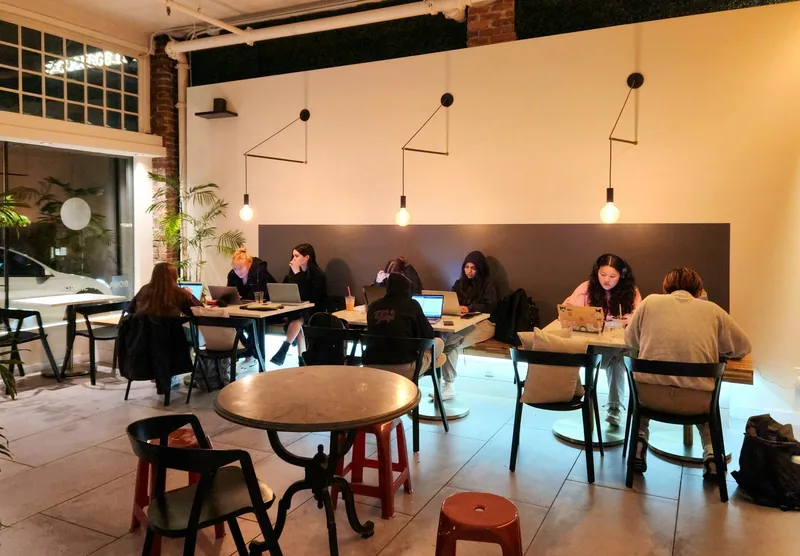
Independent cafés vary more, but at their best they serve much better coffee. Many buy beans from small London roasters, change their single-origin beans with the seasons and train their staff carefully. They are often smaller, busier at breakfast and lunch, and may have few seats. Many close in the late afternoon, so they suit a morning or midday coffee rather than an evening stop.
Why choose an independent
- Better and more varied coffee
- Beans to buy from local roasters
- A sense of the neighbourhood you are in
What to expect
- Fewer seats and more queues at peak times
- Shorter opening hours, often closing in the afternoon
- Customer toilets not always available
If you need a toilet while exploring, do not rely on cafés alone. Our guide to public toilets in London explains where to find free ones.
Neighbourhoods with the best café choice
Soho and Covent Garden combine the old and the new: Italian espresso bars and the Algerian Coffee Stores alongside modern specialist cafés and Monmouth's original shop. It is the easiest area for a good coffee between sights, museums and theatres.
Shoreditch, Hackney and Clerkenwell in the east have the highest concentration of independent cafés, many linked to local roasters. Weekend brunch is popular and queues are common, so arrive early. Our Shoreditch guide covers the area.
Borough and Bermondsey, south of the river near London Bridge, have cafés and roasteries around Borough Market and in the railway arches to the east. A coffee here fits naturally into a morning at the market or a walk along the river; see our guide to Borough and Bermondsey.
King's Cross has many cafés in the redeveloped area north of the station, useful if you are arriving by train or visiting the canal. Bloomsbury, around the British Museum and the universities, has small cafés on its side streets that are quieter than the main road cafés near the museum entrance. See our guides to King's Cross and Bloomsbury.
Paying, tipping and café manners
Almost every café accepts contactless cards and phones, and some no longer accept cash at all, which is lawful in Britain. Carry a card that works for small payments. There is no service charge for counter service. Many card machines suggest a tip; it is entirely voluntary, and not tipping for a takeaway coffee is normal. Our guide to tipping in London explains when a tip is expected.
In small independent cafés, it is polite not to occupy a table for hours with a laptop at busy times, and some cafés ask customers not to use laptops at weekends. If you want somewhere to work, a chain with plenty of seats is usually a better choice.
The rule that licensed premises must provide free tap water on request applies to places licensed to sell alcohol, so it does not necessarily cover a café without a licence. Most cafés will still give you a glass of water if you ask.
Milk, plant milks, decaf and allergens
Almost all cafés offer at least one plant milk, usually oat, and often soy or almond as well. Some charge a little extra for it. Decaffeinated coffee is widely available in chains and in most independent cafés, although some specialist cafés offer it only as espresso.
Cafés, like restaurants, must tell you if the food and drink they serve contain any of the 14 regulated allergens, and milk, soybeans and tree nuts such as almonds are on that list. If you have an allergy, tell the barista, because milk jugs and steam wands can be shared between milks. Some oat drinks are not made from gluten-free oats, so gluten-free drinkers should ask to see the carton; our gluten-free guide explains the labelling rules.
Mention a milk allergy, not just a preference for oat milk. Asking for oat milk tells the barista what you would like; saying you are allergic to cow's milk tells them to use a clean jug and steam wand. The difference matters if you react to small amounts.
Taking London coffee home
Freshly roasted beans make a light, useful souvenir. Most roaster-cafés and specialist shops sell bags of whole beans and will grind them for you if you say how you brew at home, such as for a filter machine, a cafetière (French press) or an espresso machine. Whole beans stay fresh longer than ground coffee. For other ideas, see our guide to London souvenirs worth buying.
If you want to keep costs down across your trip, our guide to cheap eats in London shows how to combine a good coffee with a low-cost breakfast or lunch.
Frequently asked questions
What is a flat white?
A flat white is a small milk coffee made with a double shot of espresso and steamed milk with a thin layer of smooth, fine foam. It is stronger-tasting than a latte because it contains less milk, and it is the drink most associated with London's modern independent cafés.
Do you tip in coffee shops in London?
No, tipping is not expected for counter service in London cafés. Many card machines show a tip option and some cafés have a tip jar, but leaving nothing is normal. A tip is a voluntary thank-you, for example if you have table service or a large order.
Where was the first coffee house in London?
London's first coffee house is generally dated to 1652, when Pasqua Rosée opened one in St Michael's Alley off Cornhill in the City of London. Coffee houses spread quickly, and one of them, Edward Lloyd's in Tower Street, became the origin of the Lloyd's insurance market.
Which area of London has the best cafés?
For the highest number of independent cafés, head to Shoreditch, Hackney or Clerkenwell. For convenience between the main sights, Soho and Covent Garden have both long-established and modern cafés. Borough and Bermondsey are good if you are visiting Borough Market or walking along the river.
Can I pay with cash in London cafés?
Often, but not always. Some cafés are card-only, which is lawful in Britain because a business can choose which payment methods it accepts. Carry a contactless card or phone payment, and check any card fees your bank charges for payments abroad.
Sources
- Lloyd's - Coffee and commerce 1652-1811 (checked September 2026)
- Monmouth Coffee Company - Home page (checked September 2026)
- Algerian Coffee Stores - Home page (checked September 2026)
- Bank of England - What is legal tender? (checked September 2026)
- Food Standards Agency - Food allergy and intolerance advice for consumers (checked September 2026)
- legislation.gov.uk - The Licensing Act 2003 (Mandatory Conditions) Order 2014, Schedule (checked September 2026)