
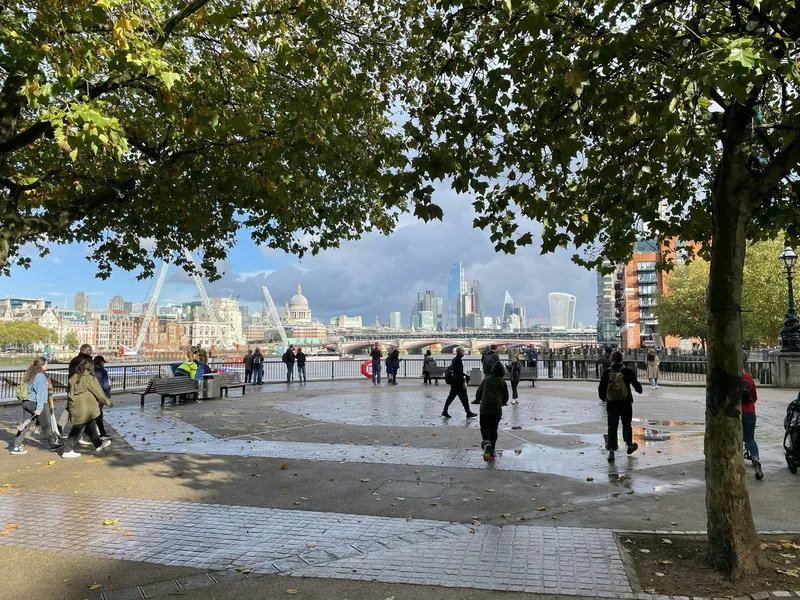
The South Bank is the stretch of riverside on the south side of the Thames opposite Westminster and the City, lined with arts centres, theatres, galleries and the London Eye. A car-free path runs along the water the whole way, so it is one of the easiest and most enjoyable walks in London.
Strictly speaking, "the South Bank" is the area between Westminster Bridge and Blackfriars Bridge, around Waterloo station, where the Southbank Centre, the National Theatre and the London Eye stand. In everyday use, and in this guide, it also includes Bankside to the east, with Tate Modern and Shakespeare's Globe. The riverside path, called the Queen's Walk along much of its length, continues past London Bridge to Tower Bridge. That eastern end belongs to Borough and Bermondsey, which we cover in a separate guide to Borough and Bermondsey.
Until the mid-20th century this was an industrial riverside of wharves, factories and breweries. The 1951 Festival of Britain began its transformation into a cultural quarter, and since the 1990s the walk has become one of the busiest pedestrian routes in the city. Most of it is free to enjoy: the views, the street performers, the book stalls and several major galleries.
The riverside walk in brief
- Route covered here
- Westminster Bridge to London Bridge, about 3 km along the river
- Walking time
- About 45 minutes without stops; allow a half day or more with visits
- Main sights
- London Eye, Southbank Centre, National Theatre, BFI Southbank, Tate Modern, Shakespeare's Globe
- Stations
- Westminster, Waterloo, Embankment, Southwark, Blackfriars, London Bridge
- Cost
- The walk, Tate Modern and the Southbank Centre foyers are free
- Best for
- First-time visitors, families, theatre and art lovers, evening strolls
How the riverside changes through the day
Early in the morning the South Bank belongs to joggers and commuters walking from Waterloo to the City. It is calm and a good time for photographs of Westminster across the water. The attractions open from around 10:00, and by late morning the area around the London Eye and County Hall is crowded with queues, tour groups and street performers.
Afternoons are the busiest time, especially at weekends and in school holidays. The narrow section of path between the London Eye and Waterloo Bridge can slow to a shuffle on sunny Saturdays. The eastern part, around Tate Modern and the Globe, is also busy but has more space.
Evenings are one of the South Bank's strengths. Theatres and concert halls fill up, the bars along the river get lively, and the lit-up buildings across the water look their best. The path stays busy and well lit until late, which makes it a comfortable place to walk after dark. Our guide to the best evening things to do in London has more ideas for after dinner.
The London Eye, SEA LIFE and County Hall
At the western end, next to Westminster Bridge, stands the London Eye, the giant observation wheel opened for the millennium. A rotation in one of its 32 pods takes 30 minutes. Standard tickets cost from £29 online and £39 if you buy on the day, and online prices vary with demand (September 2026). Our London Eye guide explains the ticket types and the best times to ride.
Beside it, the grand former County Hall building houses two popular family attractions. SEA LIFE London Aquarium costs from £28 online and £39 on the day, and a visit takes about 1.5 to 2 hours; see our SEA LIFE guide. The London Dungeon, a theatrical horror show about London's darker history, costs from £27 online and £35 on the day. Its operator recommends it for ages 12 and over and does not admit under-5s.
Walk-up prices on the County Hall strip cost far more. The London Eye, SEA LIFE and the London Dungeon all charge £8-£11 more per adult on the day than their cheapest online price. For a family of four, booking even the night before can save a meaningful sum. Check the official sites rather than buying from people selling tickets on the path.
From Westminster Bridge you have the classic view of the Houses of Parliament and the Elizabeth Tower; our guide to Big Ben and the Elizabeth Tower covers what you can see and visit on the north side. Across the bridge, Westminster has the Abbey and the government buildings.
Southbank Centre, the National Theatre and BFI Southbank
East of the London Eye and Jubilee Gardens is the Southbank Centre, a large arts complex made up of the Royal Festival Hall, the Queen Elizabeth Hall and the Hayward Gallery. The Royal Festival Hall, built for the 1951 Festival of Britain, has large public foyers where you can sit, use the toilets, buy a coffee and sometimes catch a free event. The Hayward Gallery shows paid contemporary art exhibitions.
Beneath the Queen Elizabeth Hall is the undercroft, a covered space that skateboarders have used since the 1970s. Under Waterloo Bridge, the long-running second-hand book stalls set out tables of paperbacks, old maps and prints, a pleasant place to browse. Next door, BFI Southbank is the home of the British Film Institute, with cinemas, a film library and a bar.
Just beyond the bridge, the concrete buildings of the National Theatre stage several productions at once in three theatres. Tickets range widely in price, and some cheaper seats are released for many performances; our guide to cheap theatre tickets in London explains how to find them. The building's foyers, bookshop and riverside terraces are open to the public.
Street food and markets along the way
Behind the Royal Festival Hall, on Southbank Centre Square by Belvedere Road, the Southbank Centre Food Market runs from Friday to Sunday, with stalls selling food from around the world. It is a good lunch or early dinner stop, but it gets crowded around 13:00 and on sunny evenings. Stall line-ups and hours can change, so check the Southbank Centre food market page before you go.
Further east, Gabriel's Wharf is a small cluster of low buildings with independent shops and cafés, next to the tall brick OXO Tower, whose upper floor has a restaurant and bar with a view. The riverside itself has many chain restaurants with outdoor tables; they are convenient rather than special, and prices reflect the location.
For a serious food market, continue past Southwark Bridge to Borough Market near London Bridge, open Tuesday to Sunday. Our full Borough Market guide covers what to eat and when to go, and our round-up of London's food markets compares it with the alternatives.
Bankside: Tate Modern, the Globe and the Millennium Bridge
After Blackfriars Bridge the walk reaches Bankside, dominated by the brick chimney of Tate Modern, a former power station turned into Britain's national gallery of modern and contemporary art. Entry to the collection is free, and exhibitions are paid. It opens Sunday to Thursday 10:00-18:00 and Friday and Saturday 10:00-21:00. The next Tate Modern Lates evening is on 25 September 2026, 18:00-22:00. More in our Tate Modern guide.
In front of Tate Modern, the steel Millennium Bridge crosses the river on a direct line to the dome of St Paul's, a short walk into the City of London. A few steps east is Shakespeare's Globe, a reconstruction of the open-air theatre where many of Shakespeare's plays were first performed. Standing tickets in the yard cost £5 or £10, and every Friday at 11:00 the theatre releases a limited number of £5 standing tickets for the following week online. The 2026 summer season runs until 24-25 October. Read our guide to Shakespeare's Globe before booking.
A £5 yard ticket at the Globe is the cheapest great night out on the river. You stand for the whole performance, and a performance can last close to three hours, and there is no roof over the yard, so bring a waterproof jacket (umbrellas block other people's view). In return you are right at the edge of the stage.
A suggested walk from Westminster Bridge to London Bridge
- Westminster Bridge. Start with the view of Parliament, then walk east past the London Eye and Jubilee Gardens.
- Southbank Centre. Look into the Royal Festival Hall foyers and the skate space, then browse the book stalls under Waterloo Bridge.
- National Theatre and Gabriel's Wharf. Continue past the theatre terraces to the small shops and the OXO Tower.
- Tate Modern. Allow at least an hour inside, or just use the free viewing level.
- The Globe and Southwark Bridge. Pass the theatre and the old Clink prison area on narrow Clink Street.
- London Bridge. Finish at Southwark Cathedral and Borough Market, or continue to Tower Bridge.
Without stops the walk takes around 45 minutes, but most people spend half a day or more. For a wider view of the river, compare the bridges in our walking guide to London's bridges.
Getting there, and seeing the South Bank from the water
Waterloo station (Bakerloo, Jubilee, Northern and Waterloo & City lines, and trains to south-west England) is closest to the London Eye and the Southbank Centre. Westminster is just across the bridge, and Embankment is a short walk over the Golden Jubilee footbridges beside the railway. For Tate Modern, Southwark on the Jubilee line is about 600 metres away and Blackfriars station 300 metres. London Bridge serves the eastern end. All are in Zone 1.
The river is part of the experience. Uber Boat by Thames Clippers stops at London Eye (Waterloo) pier on its main route to the Tower and Greenwich. You can pay with contactless or Oyster, but river fares do not count towards the daily cap: an adult single within the central zone costs £9.90 off-peak or £11.90 peak (fares valid until 31 October 2026). See our guide to the river bus, or compare sightseeing boats in our Thames cruise guide.
Who the South Bank suits, and where it disappoints
At its best
- Car-free, flat and step-free along most of the river path
- Plenty to do for free, including Tate Modern and the Royal Festival Hall foyers
- Lively and well lit in the evening
- Easy to combine with Westminster, the City and Borough
Where it falls short
- Very crowded around the London Eye on sunny weekends
- Many riverside restaurants are chains with location prices
- Exposed to wind and rain with little shelter between buildings
- Hotels here are mostly large chain hotels; streets behind Waterloo are less attractive
Families will find space to run in Jubilee Gardens and plenty of free entertainment from street performers. The river path is mostly flat and step-free, which suits wheelchair users and pushchairs, although it gets crowded. The Imperial War Museum, free to enter, is a 15- to 20-minute walk south of Waterloo; see our Imperial War Museum guide.
Big events on the South Bank
The South Bank is one of the main areas for the New Year's Eve fireworks, which are launched around the London Eye. Since the display became ticketed, you cannot watch from the official riverside areas without a ticket, and for 2026-27 the ticket release date had not been announced when we checked. Our New Year's Eve guide will have the latest. In September, the Totally Thames festival brings river-related events to the area throughout the month.
Frequently asked questions
How long does it take to walk the South Bank?
From Westminster Bridge to London Bridge is about 3 kilometres and takes around 45 minutes without stopping. With visits to Tate Modern, a look inside the Southbank Centre and a meal, most people spend half a day or longer.
What can you do for free on the South Bank?
The riverside walk, Tate Modern's collection, the Royal Festival Hall foyers, the book stalls under Waterloo Bridge, the Millennium Bridge and street performances are all free. The Imperial War Museum, a short walk south, is also free.
Which station is best for the South Bank?
Waterloo is best for the London Eye and the Southbank Centre. Westminster is closest to the western end, Southwark and Blackfriars suit Tate Modern and the Globe, and London Bridge is best for the eastern end and Borough Market.
Is the South Bank safe at night?
The riverside path is busy and well lit in the evenings and is generally considered a comfortable area to walk after dark. As in any crowded place, watch for pickpockets around the London Eye and on the bridges.
Do I need to book the London Eye in advance?
You do not have to, but it is cheaper. Standard tickets cost from £29 online and £39 on the day (September 2026), and online prices change with demand, so booking early usually gives the best price.
Sources
- London Eye - Tickets and prices (checked September 2026)
- SEA LIFE London Aquarium - Tickets and prices (checked September 2026)
- The London Dungeon - General tickets (checked September 2026)
- Tate - Visit Tate Modern (checked September 2026)
- Shakespeare's Globe - £5 Rush (checked September 2026)
- Southbank Centre - Southbank Centre Food Market (checked September 2026)
- Uber Boat by Thames Clippers - Ticket information (checked September 2026)