
An ETA costs £20 per person, including babies, and GOV.UK says the decision usually arrives by email within a day but can take up to three working days. It lasts two years or until your passport expires, whichever comes first. If you forget it, your airline will stop you at the check-in desk, not at the border, and there is no way to buy one faster.
Our guide to UK entry requirements answers the first question, which is whether you need an ETA, a visa or neither, and lists the nationalities and the dates each was added. This page assumes you already know that you need one, and deals with the part that goes wrong: the timing, the money, the photograph, the passport, and what happens at the airport if something has not worked.
One thing to fix in your head before anything else. The ETA is a British scheme and has nothing to do with the European Union's ETIAS. They are different permissions run by different governments, and having one does not help you with the other. Writers and travel agents confuse them constantly.
The numbers that matter
- Fee
- £20 per person, from 8 April 2026. It was £16 before that, and £10 when the scheme began
- Refund
- None, ever. Not if you are refused, not if you made a mistake
- Decision
- Usually within a day; allow up to 3 working days
- Valid for
- 2 years, or until the passport you applied with expires
- Trips
- Unlimited while valid; each stay up to 6 months
- Also covers
- Jersey, Guernsey and the Isle of Man
- Family of four
- £80, and £40 of that is for the children
- Help available
- Webchat only. UK Visas and Immigration cannot help with ETA questions by telephone
Who pays and who does not: the arithmetic nobody warns you about
Every traveller needs their own ETA, and the fee is the same whatever their age. A baby carried on a parent's lap costs £20. Two adults and two children travelling from Madrid, Toronto or Osaka pay £80 before they have booked a seat, and a family of six pays £120.
That is a real line in a trip budget for a large family, and it is worth knowing early, because the fee is not refundable and not transferable. It is also worth knowing that it buys two years: if you come back within that window, nobody pays again. Our page on how much a trip to London costs puts it beside the other fixed costs.
Three groups pay nothing because they need no ETA. British and Irish citizens travel on their own passports; a person holding both British and Irish nationality cannot get an ETA at all and should simply travel on one of those passports. Anyone whose UK immigration status is already settled by a visa or by leave to remain is covered by that instead, and does not add an ETA on top. And people who live in Ireland and travel to Britain from Ireland, Guernsey, Jersey or the Isle of Man do not need one, though anyone aged 16 or over must carry original proof issued by the Irish government, such as an Irish driving licence, an Irish Residence Permit or a medical card.
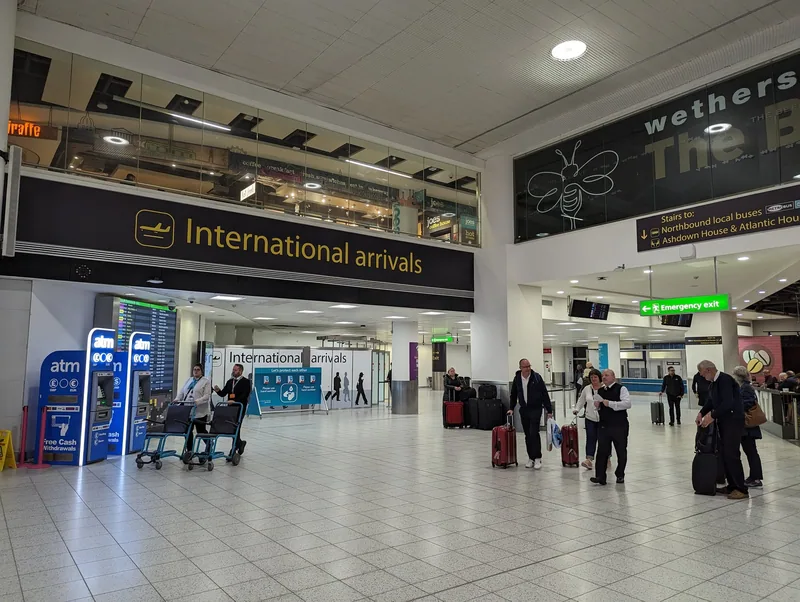
Photo: David Wheatley · CC BY-SA 4.0 · Wikimedia Commons · resized
When to apply: the honest timeline
Both halves of the official answer matter, and the phrase is "working days", so a Friday application can reach Wednesday before you have an answer.
- When you book the flight is the right moment. There is no advantage to waiting and no expiry to worry about except your passport's.
- Two weeks out is comfortable. Enough room to be refused, understand why, and apply again.
- Three working days out is the official minimum and leaves no margin.
- The night before is a gamble. Most applications are decided quickly, but an application that needs a human being to look at it will not be.
If you have applied for several people at once, expect the decisions to arrive separately: GOV.UK states plainly that you may get them at different times. One approval email in a family of four is not an approval for the family.
If nothing has arrived after three working days, check your junk folder before you contact anybody. GOV.UK asks you to do exactly that, because the approval email is the commonest thing to be filtered. After that, webchat is the only route: UK Visas and Immigration will not discuss an ETA on the telephone.
The photograph, which is what actually delays applications
The application needs a photograph of the face of the person applying, taken or uploaded during the process, and GOV.UK warns in plain terms that an application may be delayed or rejected if the photo does not meet the rules. That single sentence explains most of the horror stories.
The app route uses your phone's camera to scan the passport and then your face, which is the easier way and the one to use if you can. The online form needs a photo of the passport and a photo of the face, taken separately, which is where people get caught by shadows, glasses, hats and a background that is not plain.
There is one rule about applying for other people that surprises families. In the app, you can only apply for someone else if they are physically with you. If you are applying for a partner in another city or a grandparent in another country, you must use the online form instead.
What arrives, and what you have to carry
You get an email containing a 16-digit ETA reference number. You do not have to print it, and you do not have to show it at the airport or the border: the ETA is linked electronically to the passport you applied with, and GOV.UK says you only need to show your passport when you travel.
Take that seriously in both directions. Travel on the same passport you applied with, and no other. If you have two nationalities and two passports, the one you used for the ETA is the one that works at the gate. If you renew your passport before the trip, your ETA does not follow you to the new book; check the GOV.UK ETA page for what to do rather than assuming.
You can check whether you have a valid ETA, and when it expires, at GOV.UK's ETA checking service. It is worth doing a week out, particularly if you applied months ago and have changed passport since.
What happens if you forget
The failure point is the airline, not the British border. Carriers check travel permissions before boarding, so a passenger without a valid ETA is turned away at the check-in desk or the gate, in their departure city, hours before they would have reached the United Kingdom.
There is no emergency or express service. GOV.UK states that you cannot get a faster decision by applying through another website or app, and that you must wait for the approval email before travelling. If you are at the airport without one, the practical position is that you apply on the spot and hope it is decided within the hour, which it often is and sometimes is not. That is not a plan; it is a last resort.
An approved ETA is also not a guarantee of entry. Border Force officers still decide at the border, and GOV.UK says as much on the front page of the scheme. For anyone with a criminal record, or a previous refusal of entry to the UK, GOV.UK points towards the Standard Visitor visa route rather than the ETA. That is worth reading twice if it applies to you: a refusal at the border is a far worse outcome than a slow visa application.
Copycat ETA websites are the one scam GOV.UK warns about by name. The official routes are the UK ETA app from Google Play or the App Store, and a page whose address begins www.gov.uk. Anything else charges more for the same £20 form and cannot make it faster. Our page on common tourist scams covers the rest.
Changing planes in London, and the rule that trips people
If you stay airside and never pass through border control, you do not need an ETA. If you pass through border control, you are entering the country and you do.
In practice that turns on your ticket and your bags rather than your intentions. Collecting a checked bag and re-checking it means going through the border. So does moving between airports, which is why the journey described in our guide to transferring between Heathrow and Gatwick always needs one. So does an overnight stay, even in a hotel attached to the terminal, as our page on staying overnight at a London airport explains. And so, obviously, does going into town for six hours, which our guide to a long layover at Heathrow is built around.
If you are not certain whether your connection is airside, GOV.UK's advice is to ask the airline, and that is the right advice: the airline holds your itinerary and is the party that will stop you boarding.
The ETA and the EU's ETIAS are not the same thing
The UK ETA is a British permission to enter the United Kingdom and the Crown Dependencies. ETIAS is a European Union scheme for visa-free travellers entering the Schengen area. Neither substitutes for the other, and a London trip that continues to Paris or Brussels may eventually need both.
ETIAS has been described by the European Commission as scheduled to start in the last quarter of 2026, with the exact date to be announced. Because no date has been confirmed, we are not going to print one. If your plan involves crossing to the continent, read the European Commission's own page close to your departure, and see our guide to Eurostar from London to Paris for what the border process at St Pancras is like today.
What the ETA does not let you do
It is permission to visit, and the limits are specific. You can stay up to six months at a time, for tourism, seeing family and friends, business meetings, a short course of study and certain permitted paid engagements. You cannot work for a UK company or as a self-employed person beyond those narrow exceptions, claim public funds, live in the UK by making frequent successive visits, or marry or register a civil partnership, which needs a different visa altogether.
It does not affect what you may bring with you: alcohol, tobacco, food and cash limits are separate, and our guide to UK customs allowances sets them out. Nor does it affect medicines, which have their own rules and paperwork, covered in bringing medicines to Britain.
And it does not give you healthcare. Visitors who are not exempt are charged for NHS hospital treatment, which is why the NHS advises travel insurance for stays under six months; see healthcare for visitors. Once that is all settled, our list of what to book before you go covers the next set of decisions.
Frequently asked questions
How much does a UK ETA cost in 2026?
£20 per person, from 8 April 2026, including babies and children. It was £16 before that date and £10 when the scheme started. There is no refund after you apply, whether you are refused or simply made a mistake in the form.
How long does a UK ETA take to be approved?
GOV.UK says most decisions arrive by email within a day, but you should allow up to three working days. If several people applied together, the decisions can arrive at different times. Check your spam folder before contacting UK Visas and Immigration, which handles ETA queries by webchat only.
Do I need to print my ETA?
No. The ETA is linked to the passport you applied with, and GOV.UK says you only need to show your passport when you travel. Keep the email with its 16-digit reference for your own records, and travel on that same passport.
What happens if I arrive in the UK without an ETA?
In practice you will not arrive, because airlines check before boarding and will refuse you at the departure airport. There is no express service and no other website can speed up a decision. Applying at the airport sometimes works within the hour, but it is a last resort rather than a plan.
Is the UK ETA the same as the EU's ETIAS?
No. The ETA is British and covers the UK, Jersey, Guernsey and the Isle of Man. ETIAS is a European Union scheme for the Schengen area, described by the European Commission as scheduled for the last quarter of 2026 with no confirmed date. Holding one does nothing for the other.
Does an ETA guarantee I will be let into the UK?
No. GOV.UK states that an ETA does not guarantee entry, and a Border Force officer still decides at the border. Anyone with a criminal record or a previous refusal of entry is advised on GOV.UK to consider applying for a Standard Visitor visa instead.
Sources
- GOV.UK - Get an electronic travel authorisation (ETA) to visit the UK (checked September 2026)
- GOV.UK - Apply for an ETA (checked September 2026)
- GOV.UK - Check if you have an ETA (checked September 2026)
- Home Office - Immigration and nationality fees from 8 April 2026 (checked September 2026)
- Immigration Rules - Appendix Electronic Travel Authorisation (checked September 2026)
- European Commission - The differences between EES and ETIAS (checked September 2026)