
Eurostar trains leave London St Pancras International for Paris Gare du Nord, and most take 2 hours 16 minutes. Book early for the lowest fares (from £39 one way in Standard), arrive at St Pancras about 75 minutes before departure, and bring a valid passport: all border and security checks happen in London before you board.
The Eurostar is a high-speed train that runs through the Channel Tunnel between England and mainland Europe. From London it goes direct to Paris, Lille, Brussels, Rotterdam and Amsterdam. For most visitors it is the easiest way to add Paris to a London trip, because the trains run from the centre of one city to the centre of the other.
It is not quite like catching an ordinary train, though. Because the journey crosses an international border, you go through ticket gates, a security scan and passport control before you reach the platform. That is why you need to arrive well ahead of time, and why the rules on documents matter more than the timetable.
London to Paris by Eurostar in brief
- Departs from
- London St Pancras International, King's Cross
- Arrives at
- Paris Gare du Nord
- Journey time
- 2 hours 16 minutes on most trains; up to 2 hours 37 minutes
- Fares
- From £39 one way in Standard class (limited availability)
- Arrive at St Pancras
- 75 minutes before departure (Standard and Plus); 45 minutes (Premier)
- Gates close
- 30 minutes before departure (Premier: 15 minutes)
- Luggage
- 2 bags up to 85 cm long plus 1 small item; no weight limit
- If you miss it
- £44 to be rebooked on the next train (Standard and Plus)
How the Eurostar service from London works
Every Eurostar from London leaves from St Pancras International, the red-brick station on Euston Road next to King's Cross. Our guide to London's main railway stations shows how it fits alongside the other big terminals. There are no other London stations for Eurostar, so if a booking site offers you a different departure point, check it carefully.
The train runs at high speed through Kent, under the Channel and across northern France. There is no change of train and nothing to do at the border during the journey itself. When you arrive at Gare du Nord you simply step off and walk out of the station, because your passport was already checked in London.
Paris is the busiest route, but the same terminal serves the other destinations. If you are planning a longer European trip, you can travel out to one city and back from another. This page covers the service itself: fares, classes, the border, luggage and what happens when things go wrong. If you want to squeeze Paris into a single day instead, our separate plan for Paris for the day by Eurostar works out which departures leave you enough hours to make it worth the fare.
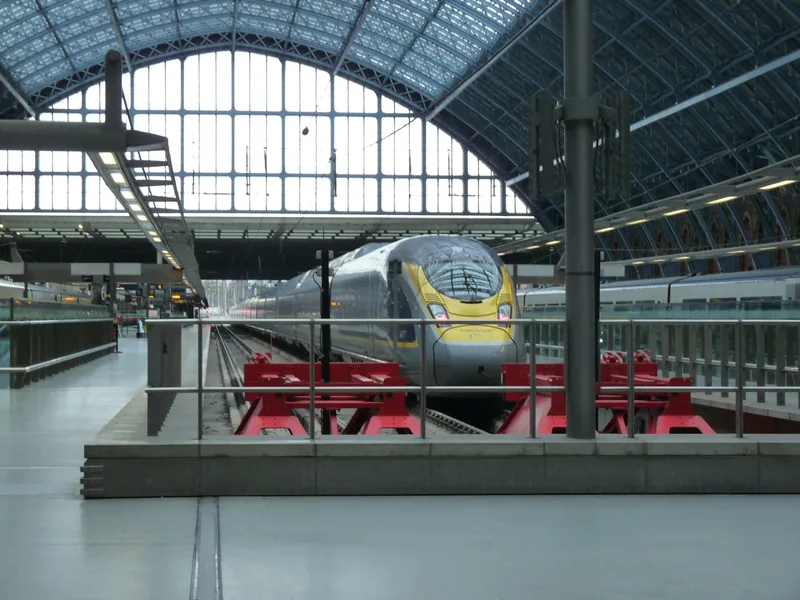
Photo: Smiley.toerist · CC BY-SA 4.0 · Wikimedia Commons · resized
Standard, Plus or Premier: choosing a class
Eurostar sells three classes. The train and the journey time are the same in each. What changes is the space, the food, how flexible your ticket is and how early you are asked to turn up.
| Class | One way from | What you get | Arrive at St Pancras | Luggage |
|---|---|---|---|---|
| Eurostar Standard | £39 | The lowest fares. Café carriage for snacks and drinks | 75 minutes before | 2 bags + 1 small item |
| Eurostar Plus | £70 | More space, and a light meal served at your seat | 75 minutes before | 2 bags + 1 small item |
| Eurostar Premier | £245 | Lounge access, priority ticket gates and a fuller meal on board | 45 minutes before | 3 bags + 1 small item |
Those are the lowest London to Paris prices Eurostar advertises for each class, and the gap between them is wide. For most leisure travellers, Standard is the sensible choice: the trip is only a little over two hours, and you can bring your own food. Plus is worth it if the price gap on your date is small, or if you want to work at a table in more comfort.
With Premier, the meal is not what you are paying for. You are paying for the later arrival time, the lounge, the priority lane at the gates and the boarding guarantee described below. A business traveller who might be held up by a meeting gets real value from that. A family of four almost never does.
Booking tickets and finding the cheaper fares
Book on the official Eurostar London to Paris page or in the Eurostar app. Prices change with demand, like airline fares, so the cheapest seats go first. Eurostar advertises fares from £39 one way in Standard, subject to availability.
The fare is the fare. Eurostar states that there are no extra fees for choosing a seat, for booking in advance or for your luggage allowance. That makes it simpler to compare with a flight, where the headline price often grows once bags are added. One fee does exist, though: a booking made by telephone or at a station counter costs £12 per transaction in Standard and Plus, so use the website or the app.
Eurostar's page also describes a last-minute offer: you pick the travel date, Eurostar picks the train time, and you pay a lower fare in return. It suits travellers who do not mind whether they leave in the morning or the afternoon. Tickets across the whole network are now released at the same moment rather than route by route, so watching one route for an early release no longer gains you anything.
Changing or cancelling
According to Eurostar's conditions for Standard and Plus tickets, you can exchange your ticket free of charge up to 1 hour before the original departure, paying any difference if the new train costs more. If the new fare is cheaper, the difference is not refunded, and a ticket exchanged less than 7 days before departure becomes non-refundable whatever happens afterwards. You cannot change your destination, only the date and time.
A refund is possible 7 days or more before travel for a fee of £25 per person for each leg, which is £50 per person to cancel a return outright. Premier tickets are far more forgiving: they can be exchanged or refunded with no fee up to 48 hours after the departure time you booked. Premier also carries a boarding guarantee, which lets you take any other available train on your day of departure without paying the fare difference. Read the current conditions on Eurostar's site before you book, because fare rules can change.
Your ticket stays locked until you enter passport details. Eurostar asks every passenger to submit Advance Passenger Information (API), which includes your passport details, before the ticket can be collected. Do it in the app or on the website soon after booking, not in the queue at St Pancras. Frequent travellers can save the details in a Eurostar account.
Passports, the UK ETA and the EU's new border checks
This is the part of the trip where visitors most often get caught out. Leaving London, you are entering France and the Schengen area. Coming back, you are entering the United Kingdom again. Different rules apply to each direction, and they are run by different governments.
Leaving London: the EU side
You need a valid passport. Eurostar's travel document page says that UK passport holders need a passport issued less than 10 years before the date they enter the EU, and valid for at least 3 months after the date they leave. Non-EU visitors of other nationalities should check the same rules for their own passport before booking. Babies and small children need their own passports too, even when they are travelling on a parent's ticket.
The EU's Entry/Exit System (EES) has been fully operational in all Schengen countries since 10 April 2026, according to the European Commission. It applies to non-EU nationals on short stays, including British and American visitors, whatever their age. At registration, your passport details are recorded and your fingerprints and a facial image are collected. Eurostar says EES is free, needs no application, and that registration happens at your departure station on the day. Its recommended arrival times already allow for it. EU citizens are not registered in EES.
The EU's separate travel authorisation, ETIAS, has not started yet. The European Commission says it is scheduled for the last quarter of 2026 and that the exact date will be announced. Until the EU confirms a date, you do not need to apply for it. When it does begin, visa-free non-EU travellers such as US and UK citizens will need to apply online before they travel.
Coming back: the UK side
Many visitors who do not need a visa must hold a UK Electronic Travel Authorisation (ETA) to enter the UK, including when they return from Paris by train. It costs £20 and is valid for 2 years, or until your passport expires, for any number of trips. If you already got one for your London holiday, it also covers your return from Paris. EU citizens need a passport rather than a national ID card to enter the UK, unless they hold settled or pre-settled status. The details, and the list of nationalities that are exempt, are in our guide to entry requirements for visitors to Britain.
ETA and ETIAS are two different permissions. The ETA is the UK's scheme, paid to the UK government, for entering Britain. ETIAS is the EU's scheme for entering the Schengen area, and it has not started. Apply only through the official GOV.UK service or app for the ETA; GOV.UK warns that other websites may charge more.
Getting to St Pancras International
St Pancras shares an Underground station with King's Cross, called King's Cross St Pancras. It is served by the Northern, Piccadilly, Victoria, Circle, Hammersmith & City and Metropolitan lines, which makes it one of the best-connected places in the city. Our visitor's guide to the Underground explains how to use them. Thameslink trains stop at St Pancras too, which helps if you are coming from Gatwick or Luton.
If you are travelling with heavy bags, a taxi from most of central London is straightforward, although traffic on Euston Road can be slow at rush hour. See our guide to black cabs, minicabs and Uber for typical fares, and our note on taking luggage on the Tube if you are weighing up the cheaper option. Many travellers avoid the question altogether by staying close by: hotels near King's Cross, St Pancras and Paddington are covered separately, as is the neighbourhood itself if you find yourself with a spare hour.
If you need assistance, arrange it with Eurostar when you book; the recommended arrival time for accessible travel is 60 minutes before departure. For the journey across London to the station, read our overview of step-free travel in London.
What happens between the ticket gates and the platform
Allow the full recommended time. Eurostar says to arrive at the time shown on your ticket and not just before the gates close, and it warns that queues are possible on peak days. A full train carries up to 894 people, and they all pass through the same three checks. The departure process at St Pancras works like this:
- Ticket gates. Scan the QR code on your ticket, on paper or in the app, at the Eurostar entrance. Everyone in a group scans separately. If the machine prints you a fresh ticket, keep it: your seat has been changed. Premier passengers and members of the top Club Eurostar tiers have a priority lane on the far right as you face the gates.
- Security. Your bags go through an X-ray scanner, much like at an airport, although there are no strict liquid limits. Belts, smartwatches, phones and loose change go in a tray; laptops and tablets can stay in the bag, which is one of the few ways this is quicker than flying.
- Passport checks. UK exit officers look at your passport first, then the French authorities check it for entry to the Schengen area. This is also where EES registration takes place for non-EU travellers.
- Departure lounge. After the checks you wait here until your train is called.
- Boarding. When the departure board shows your platform, go up to the train and find your coach and seat number.
Gates close 30 minutes before departure for Standard and Plus, and 15 minutes for Premier. After that you will not be allowed through, even if the train has not left.
Inside the departure lounge at St Pancras
The lounge is smaller and plainer than the station above it, and that catches people out. St Pancras has a long parade of shops and restaurants on the upper concourse, but once you are through the gates your choices shrink to a Pret A Manger, a tax-free shop, a bureau de change, cash machines that dispense both euros and pounds, and toilets with baby-changing facilities. Buy lunch before you go through, not after.
Eurostar trains leave from platforms 5 to 10, and boarding is announced around 20 minutes before departure, so there is no reward for standing by the escalator early. Premier travellers and Carte Blanche and Étoile members can use the Eurostar Premier Lounge, which opens two hours before departure and sits next to the information desk, to the right after the French passport check.
If something goes wrong with a booking, the Eurostar Service Centre is opposite the ticket gates, before you go through. It opens at 04:30 on weekdays, 05:15 on Saturdays and 06:45 on Sundays, and closes at 19:45 every day. That Sunday opening time is worth knowing if you have an early Sunday train and a problem to sort out. If you need to leave bags before a late departure, the staffed and self-service options around the big terminals are in our guide to storing luggage in London.
Luggage rules on London routes
Luggage is one of the Eurostar's advantages over flying. Adults in Standard and Plus can bring 2 pieces of luggage and 1 small item of hand luggage, such as a handbag or a small backpack. Premier passengers can bring 3 pieces plus 1 small item, and children 1 piece plus 1 small item. There is no strict limit on liquids either, so toiletries can stay in full-size bottles and there is no need for a clear plastic bag. Some restrictions on alcohol apply, and you may bring your own food on board.
On routes to and from London, each bag can be up to 85 cm long. There is no weight limit: the rule is simply that you must be able to carry your bags yourself. Folded pushchairs and prams travel free and go in the luggage rack.
Anything bigger must be booked in advance through the Registered Luggage Service, which on London routes runs only on selected trains between London and Paris and between London and Brussels, with a 30 kg limit per item. Eurostar's guide prices for a one-way London to Paris trip booked more than 48 hours ahead are from £35 for an additional bag, from £45 for sports equipment and from £60 for an oversized item. Check the Eurostar luggage page for the maximum dimensions before you pack, because items above them can cost extra at the station.
Taking a bike to Paris
You can take a bike, but the London to Paris rules are stricter than the ones between London and Brussels. On the Paris route the bike must be taken apart and packed in a bike box or a purpose-made bike bag before you hand it over; only the Brussels trains accept a fully assembled bike. You drop it at the luggage area before departures and collect it from the platform at the other end, and nobody provides a trolley, so bring only what you can carry.
The service costs from £45 each way when you book more than 48 hours ahead, and from £60 inside 48 hours. It also runs on a limited list of trains: leaving London, any departure between 08:01 and 15:31, and leaving Paris, any departure between 11:13 and 18:13. That rules out the first train of the morning and the last one at night, which is the detail most cycling plans come unstuck on.
A folding bike is much simpler. If it is no more than 85 cm long and carried in a cover that hides the whole frame, it counts as ordinary luggage and costs nothing. Electric scooters, hoverboards and electric unicycles are not allowed at all, and a lithium battery carried separately from its e-bike is refused as well. You cannot charge an electric bike at the stations or on board. Before you commit, our guide to taking a bike on London transport covers the rules at the London end, and cycling in London explains whether you need your own bike here at all.
Travelling with children
Children under 4 travel free in all three classes, provided they sit on an adult's lap. You can still buy them a seat if you want the space, which is worth doing if you are travelling alone with a small child, have more than one, or want to use a car seat. Everybody, at any age, needs their own passport.
For children aged 4 to 11 the discount depends on when you travel: fares in Standard and Plus are around 30 per cent cheaper on peak trains, and roughly 30 to 50 per cent cheaper off-peak. Premier has no child discount at all, which is another reason it rarely suits families. A child's ticket follows the exchange and refund conditions of the accompanying adult's ticket.
On board, every train has baby-changing facilities, and staff at the café carriage will warm a bottle for you, although no baby food is sold. A folded pushchair rides free on top of your luggage allowance. Eurostar does not run a family boarding lane, but its assistance team can help you through the station if you are pregnant or travelling alone with a young child; book that at least 24 hours ahead. For the London end of the trip, see our guide to children's fares on London transport and our practical notes on getting around with a pushchair.
Delays, cancellations and missing your train
Eurostar pays compensation when a train arrives 60 minutes or more late. You choose between an e-voucher and cash, and the e-voucher is always worth more. The figures below are a share of the cost of the affected leg, not of the whole return.
| Delay on arrival | As a Eurostar e-voucher | As a cash refund |
|---|---|---|
| 60 to 119 minutes | 30% | 25% |
| 120 to 179 minutes | 60% | 50% |
| 180 minutes or more | 75% | 50% |
Wait at least 24 hours before claiming, so that Eurostar's systems have the delay on file, and claim within 3 months. Most bookings can be dealt with through Manage your booking on the Eurostar website. An e-voucher is valid for 12 months from the date of the delayed train.
If the train is cancelled outright, or announced before departure as more than 60 minutes late, and you decide not to travel, you again have 3 months to ask for a refund, an exchange or a voucher for the unused ticket. Eurostar will consider reimbursing the cost of getting there another way by rail, coach or ferry, but only if it told you your options within 100 minutes of the scheduled departure and you did not wait for the next Eurostar. If a connecting SNCF or SNCB service is the one that failed, that operator handles the claim, not Eurostar.
Turning up late costs £44, not the whole ticket. Miss the gates and Eurostar may refuse to board you, but if you reach the ticket office before your booked train was due to leave, staff will put you on the next available service for a £44 fee in Standard or Plus, subject to space. That concession depends on getting there in time, so if you are running late, head for the ticket office rather than the platform.
On board and arriving at Gare du Nord
Seats are allocated, so find your coach number on the ticket before you walk along the platform. In Standard there is a café carriage selling snacks and drinks, while Plus and Premier passengers are served at their seats.
Set your watch forward an hour as you pull in: French time runs ahead of British time all year. Gare du Nord sits in the north of central Paris, with Métro and RER lines beneath it and several bus routes outside. Because the border checks were done in London, you can walk straight out of the station.
Coming back from Paris to London
The return process runs in reverse, and it takes longer. Eurostar recommends arriving at Paris Gare du Nord 75 to 90 minutes before departure in Standard and Plus, and 45 to 60 minutes in Premier. Gates close 30 minutes before departure. Your passport is checked twice again, by the French authorities and then by UK Border Force, and a biometric passport may let you use the ePassport gates instead of a booth. Make sure your ETA has been approved before you leave London.
Shopping in Paris? Some of what you buy cannot legally come home with you at all, and the allowances for the rest are tighter than many visitors assume. Alcohol, tobacco, the value of ordinary goods and the food that is banned outright are all covered in our guide to British customs allowances.
If you are visiting London for the first time and arriving by Eurostar, you can buy a Visitor Oyster card on board trains to London. Compare it with contactless payment first, using our review of whether the Visitor Oyster card is worth it.
Eurostar or a flight to Paris?
On price alone a cheap flight can sometimes beat the Eurostar, but once you add the cost and time of reaching an airport outside London, the bag fees and the security queue, the train usually wins between the two city centres. You also keep your phone signal, your full-size toiletries and your legroom. Our overview of London's airports shows how far out most of them are. Flying makes more sense if you live near an airport, are heading to the south of France, or find a very cheap fare on a day when Eurostar is expensive.
For a door-to-door timing exercise, our sister site Viamo compares Eurostar against flying between the two cities. Coaches also run to Paris from Victoria Coach Station; they take much longer but can be cheaper at short notice.
Frequently asked questions
How early should I get to St Pancras for the Eurostar?
Eurostar recommends arriving 75 minutes before departure for Standard and Plus, 45 minutes for Premier, and 60 minutes if you are using accessible travel assistance. Gates close 30 minutes before departure (15 minutes for Premier), and you will not be let through after that.
What happens if I miss my Eurostar?
Your ticket is only valid on the train you booked. If you get to the ticket office before that train was due to depart, Eurostar can rebook you on the next available service for a £44 fee in Standard or Plus, if there is space. Premier tickets carry a boarding guarantee instead, at no extra charge.
How much compensation do I get if the Eurostar is delayed?
A delay of 60 to 119 minutes on arrival is worth 30 per cent of the affected leg as an e-voucher or 25 per cent as cash. From 120 minutes it rises to 60 or 50 per cent, and from 180 minutes to 75 or 50 per cent. Claim within three months, and wait a day before you start.
Is there a luggage weight limit on the Eurostar?
No. Standard and Plus passengers can take 2 bags up to 85 cm long and 1 small item, with no weight limit, as long as you can carry them yourself. Extra or oversized items on London routes must be booked through the Registered Luggage Service and weigh 30 kg or less.
Do children pay full price on the Eurostar to Paris?
No. Under-fours travel free on an adult's lap, and children aged 4 to 11 get roughly 30 per cent off in Standard and Plus on peak trains, and up to about 50 per cent off at quieter times. Eurostar Premier has no children's discount, so a family is usually better off in Standard.
Can I take food and drink on the Eurostar?
Yes. Eurostar says there are no restrictions on bringing your own food, and there is no strict limit on liquids, although some alcohol restrictions apply. Standard class has a café carriage, and Plus and Premier include a meal served at your seat.
Sources
- Eurostar - When to arrive at the station (checked September 2026)
- Eurostar - Fares, fees and conditions (checked September 2026)
- Eurostar - Refunds and compensation for delays and cancellations (checked September 2026)
- Eurostar - Luggage allowance (checked September 2026)
- Eurostar - Bikes on board (checked September 2026)
- Eurostar - Travelling with babies and toddlers (checked September 2026)
- Eurostar - London St Pancras station guide (checked September 2026)
- Eurostar - Travel documents (checked September 2026)
- European Commission - Main differences between EES and ETIAS (checked September 2026)
- GOV.UK - Apply for an electronic travel authorisation (ETA) (checked September 2026)