
If you fall ill or get hurt in London, a pharmacy, the NHS 111 helpline or an urgent treatment centre can deal with most problems, and A&E is there for serious emergencies. Emergency care in A&E is free for everyone, but visitors from outside the UK can be charged 150% of the NHS rate for hospital treatment after that, so travel insurance is not optional.
Britain's public health service is called the NHS (National Health Service). For people who live in the UK, most of it is free when they use it. Visitors can use the same doctors, pharmacies and hospitals, but the rules on who pays are different, because free NHS hospital care depends on where you normally live, not on your nationality or your passport.
In practice, a short illness on holiday rarely goes near a hospital. This guide explains each service in the order you are most likely to need it, and what you may be asked to pay.
Medical help in London at a glance
- Life-threatening emergency
- Call 999 (112 also works); free
- Urgent, but not life-threatening
- Call 111 or use 111.nhs.uk; free
- Minor illness or medicine questions
- Any pharmacy, no appointment needed
- Sprains, cuts, suspected broken bones
- Urgent treatment centre; no GP registration needed
- A&E departments
- Open 24 hours a day, every day; A&E services are free to everyone
- Hospital care for non-exempt visitors
- Charged at 150% of the national NHS rate
- NHS prescription charge (England)
- £9.90 per item (September 2026)
How the NHS treats short-term visitors
The NHS decides who pays for hospital care by residence. To get free hospital treatment you must be "ordinarily resident" in the UK, which for most people from outside Europe means living here with settled immigration status. A tourist on a two-week trip is not ordinarily resident, so the hospital can charge for treatment that is not on the free list.
Several services are free to everyone, whatever their home country. According to the NHS and the government's migrant health guide, these include A&E services (at an A&E department, walk-in centre, minor injuries unit or urgent care centre), the NHS 111 advice line, GP and nurse consultations, family planning (not abortion or infertility treatment), diagnosis and treatment of most infectious diseases including sexually transmitted infections, COVID-19 testing and treatment, and treatment for conditions caused by torture, female genital mutilation, domestic violence or sexual violence.
The important limit is that "free A&E" covers the emergency department itself. If you are admitted to a ward as an inpatient, or asked back for a follow-up outpatient appointment, charges apply unless you are exempt. That is where a hospital bill for a visitor can become large.
If you are still planning your trip, our guide to UK entry rules and the ETA covers the paperwork side. Note that visitors travelling with an ETA or a visitor visa do not pay the Immigration Health Surcharge, which is only for visas of more than six months, and so they have no prepaid NHS cover.
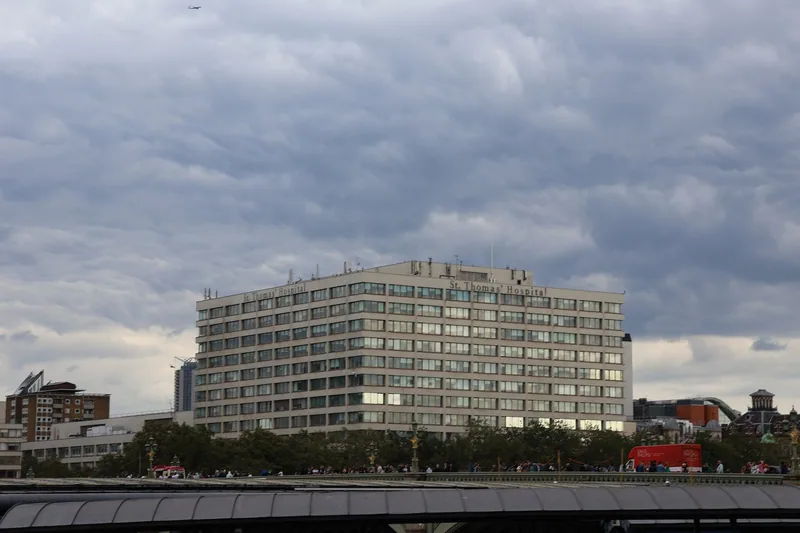
Photo: DiscoA340 · CC BY-SA 4.0 · Wikimedia Commons · resized
Choosing the right service for your problem
The NHS asks everyone to use the service that matches the problem. This table, based on the NHS descriptions of each service, is a simple starting point.
| Situation | Where to go | Appointment? |
|---|---|---|
| Cold, cough, hay fever, upset stomach, questions about a medicine | Pharmacy | No |
| Sore throat, earache in a child, suspected urine infection, infected insect bite | Pharmacy (Pharmacy First service) | No, but phone ahead to check |
| Not sure how serious it is, or it is night-time | NHS 111 by phone or online | No |
| Sprain, suspected broken bone, cut that may need stitches, high temperature, rash | Urgent treatment centre | Walk in, or book through 111 |
| Chest pain, stroke symptoms, severe bleeding, serious accident, breathing problems | Call 999 or go to A&E | No |
| Ran out of your regular medicine | 111 online emergency prescription service, or a pharmacy | No |
Keep the key numbers somewhere other than your phone as well. Our page on emergency numbers and what to do when things go wrong lists them in one place, including the police and lost property.
Pharmacies: the first stop for minor illness
London has pharmacies (often called chemists) on almost every high street. You can walk in without an appointment and ask to speak to the pharmacist, who is a trained health professional. They can advise on coughs, colds, sore throats, ear infections, aches and pains, and suggest medicines you can buy without a prescription. If they cannot help, they will tell you to see a GP or go elsewhere.
Since 31 January 2024, most pharmacies in England can also give prescription medicine for a set list of conditions without you seeing a doctor. This is called Pharmacy First. The conditions and age limits are:
- impetigo (age 1 and over)
- infected insect bites (age 1 and over)
- earache (ages 1 to 17)
- sore throat (age 5 and over)
- sinusitis (age 12 and over)
- urinary tract infections (women aged 16 to 64)
- shingles (age 18 and over)
Seven infections can be treated at the pharmacy counter. For the conditions above, a pharmacist can often supply the medicine you would otherwise need a doctor's prescription for. The NHS suggests contacting the pharmacy before you go, because not every branch offers the service, and a visitor may be asked to pay.
Opening hours vary a great deal. Some central pharmacies stay open late, while small local ones may close early on Sundays. Use the NHS pharmacy finder with the postcode of your hotel, or ask NHS 111. Shops in general open shorter hours on Sundays, as our guide to Sunday and bank holiday opening explains.
If you have run out of a medicine you take regularly, the NHS says a pharmacy can provide certain emergency medicines even without a prescription, but you may need to pay. The 111 online emergency prescription service can also send a request to a local pharmacy for a limited supply. Bring the original packaging or your home prescription, so the pharmacist can see exactly what you take.
NHS 111: advice by phone or online
NHS 111 is the number to call when you need medical help quickly but it is not a life-threatening emergency. Calls to 111 are free, and you can also use the website 111.nhs.uk or the NHS App. If your foreign mobile has trouble connecting to 111, the website asks the same questions. Deaf and hard-of-hearing callers can use text relay on 18001 111.
You answer questions about your symptoms, and 111 tells you where to go. Depending on the answers, you might be told to call 999, go to an urgent treatment centre, see an out-of-hours GP, wait for a callback from a nurse, see a pharmacist or look after yourself at your hotel. It can also book you a time at an urgent treatment centre, which saves waiting without knowing if you will be seen.
A few details are useful for visitors:
- 111 online is for people aged 5 and over. For a child under 5, call 111 instead.
- 111 online can help with dental problems, including finding an emergency dentist where one is available. Ask about the cost before any dental treatment.
- For urgent mental health help, call 111 and choose the mental health option. The Samaritans also listen confidentially on 116 123.
A phone that works in the UK makes all of this easier. If you are deciding between roaming and a local SIM, see our guide to staying connected in the UK.
Urgent treatment centres for sprains, cuts and fevers
Urgent treatment centres (UTCs) are the middle step between a pharmacy and A&E. They deal with problems that need attention the same day but are not life-threatening: sprains and strains, suspected broken bones, cuts, vomiting, rashes, high temperatures and similar complaints. Many can do X-rays, blood tests and ECG heart tracings on site.
You do not need to be registered with a GP or have a UK address to use one, which makes them ideal for visitors. You can walk in, or book a time through NHS 111 online. The government's list of services that are free for overseas visitors includes urgent care centres and minor injuries units.
If you are travelling with children, a UTC is often a better place than A&E for a feverish toddler or a fall in the playground. Our family guide to London has more on travelling with young children.
A&E and calling 999 in a real emergency
A&E (accident and emergency, also called the emergency department) is for serious injuries and life-threatening emergencies, such as chest pain, a stroke, severe bleeding, breathing difficulties or a serious road accident. A&E departments are open 24 hours a day, every day. For these situations, call 999 and ask for an ambulance.
When you call 999, the operator answers with "Emergency, which service?". Say "ambulance", then give the location (a postcode, street name or nearby landmark), explain what has happened and give a contact number. The NHS points out that calling 999 does not always mean an ambulance is sent: you may be told to make your own way to A&E or be seen somewhere else. The NHS also says you should not drive yourself to A&E.
At A&E you register at reception, then a doctor or nurse assesses how urgent your case is. This is called triage, and the most seriously ill patients are seen first, and the NHS warns that you will likely have to wait for some time with a less urgent problem. Bring any medicines you take. If you need help in another language, including British Sign Language, ask for an interpreter.
For a less serious problem, a black cab is a simple way to reach a hospital; our guide to taxis, minicabs and ride apps explains the options.
Seeing a GP as a temporary patient
A GP (general practitioner) is a family doctor working in a local surgery. GP and nurse consultations are free to everyone, including visitors. If you are in an area for more than 24 hours and less than three months, you can ask to register with a practice as a temporary patient. The practice decides whether to accept you.
Even if a practice refuses to register you, a GP must give treatment that is immediately necessary free of charge for up to 14 days. For a short trip, 111 or a UTC is usually quicker than finding a surgery with a free appointment.
There is one detail about prescriptions. The government's migrant health guide says that if a GP treats you as a private patient, any prescription is private too and you pay the pharmacy's price for the medicine. If the GP accepts you as an NHS patient and gives you an NHS prescription, the normal NHS charge applies, which in England is £9.90 per item. Items, not prescriptions: three medicines on one form means three charges.
What a visitor from outside the UK may pay
For hospital treatment that is not on the free list, overseas visitors who are not exempt are charged 150% of the national NHS rate. Hospitals must ask for the full estimated cost in advance, unless that would delay treatment a clinician considers urgent or immediately necessary. In that case you are treated first and asked to pay afterwards.
Most London hospitals have staff, often called overseas visitors managers, who check whether patients have to pay. They may ask where you normally live and whether you have travel insurance. Tell them early if you have insurance, because many insurers want to be contacted before or during the treatment, not afterwards.
Unpaid hospital bills can follow you to the border. According to the NHS, unpaid NHS debts of £500 or more that remain outstanding for two months are reported to the Home Office, and this may affect future UK immigration applications. If you receive a bill you cannot pay at once, contact the hospital and ask about a payment plan rather than ignoring it.
Card payments and currency are covered in our guide to paying for things in London, and our breakdown of what a London trip costs helps you budget for insurance.
Cover for EU, Norwegian, Swiss, Australian and New Zealand visitors
Some visitors have partial cover through agreements between the UK and their home country. The details depend on nationality and residence, so check the NHS page for your situation before you travel.
| Where you come from | What the NHS says (September 2026) |
|---|---|
| EU countries | A valid EHIC (European Health Insurance Card) or Provisional Replacement Certificate covers medically necessary treatment during a temporary stay, including care for pre-existing conditions and routine maternity care, but not a trip made to give birth or get treatment. Planned treatment needs an S2 form. Without these documents you may be charged 150%. |
| Norway | Norwegian residents and citizens can get medically necessary care by showing a valid Norwegian passport. |
| Switzerland | You can use an EHIC only if you are eligible for one in Switzerland, which depends on nationality and status. |
| Iceland and Liechtenstein | Visitors may be charged 150%. Only stays that began by 31 December 2020 were covered. |
| Australia | Residents of Australia are covered for immediate medical treatment only. |
| New Zealand | Citizens living in New Zealand are covered only for treatment needed promptly for a condition that arose or got worse after arrival, not routine monitoring. |
| USA, Canada and most other countries | No general agreement: expect to pay for hospital care beyond A&E and the free services. |
The NHS table of reciprocal agreements dates from 2016, so check with your own health authority as well. Even with an EHIC, insurance still matters, for example for a flight home.
Travel insurance and medicines to pack
The NHS advises visitors staying less than six months to have personal medical or travel insurance. For travellers from the USA, Canada or Asia in particular, a few nights in a London hospital could cost far more than the whole holiday. Check that it covers pre-existing conditions you have declared.
Keep the insurer's assistance number next to your passport. Save it in your phone and write it on paper too. Most policies have a 24-hour line that you, or a hotel receptionist, should call as soon as you need more than a pharmacy, because some insurers only pay for treatment they have approved.
Pack enough of any regular medicine for the whole trip plus a few extra days, in the original labelled packaging, with a copy of the prescription or a letter from your doctor. Some medicines and substances are restricted at the UK border, so check our guide to what you can bring into Britain if you carry anything unusual.
Travellers with a disability can find practical help in our guide to accessible London, and visitors with coeliac disease or food allergies in our guide to gluten-free dining in London.
Our advice for first-time visitors to London helps you pace your days, and our look at staying safe in London covers the other common worries.
Frequently asked questions
Is healthcare free for tourists in London?
Partly. A&E services, NHS 111, GP consultations and a few other services are free to everyone. Hospital treatment after you are admitted, and follow-up appointments, are charged to non-exempt overseas visitors at 150% of the NHS rate, so you need travel insurance or cover such as a valid EHIC.
Can a tourist see a doctor in London without registering?
Yes. You can walk into an urgent treatment centre without being registered with a GP or having a UK address. You can also ask a GP practice to accept you as a temporary patient if you are in the area for between 24 hours and three months, although the practice can refuse.
How much does a prescription cost in London?
An NHS prescription in England costs £9.90 per item. You pay that charge if a GP accepts you as an NHS patient and gives you an NHS prescription. If you were seen privately, the prescription is private too, and the pharmacy charges its own price for the medicine.
Can I call NHS 111 from a foreign mobile phone?
Calls to 111 are free. If calling from a foreign mobile is difficult, the website 111.nhs.uk works for anyone aged 5 or over and asks the same questions about symptoms. For children under 5, the NHS says to call 111 rather than use the website.
Do EU citizens still need an EHIC in the UK?
Yes. EU visitors should bring a valid EHIC or a Provisional Replacement Certificate. It covers medically necessary treatment during a temporary stay. Without it, a hospital may charge 150% of the NHS rate. Norwegians use their passport instead of an EHIC.
Sources
- NHS - How to access NHS services in England if you are visiting from abroad (checked September 2026)
- NHS - Visitors from outside the EEA (checked September 2026)
- NHS - Visitors from EU countries, Norway, Iceland, Liechtenstein or Switzerland (checked September 2026)
- GOV.UK - NHS entitlements: migrant health guide (checked September 2026)
- NHS - How pharmacies can help (checked September 2026)
- NHS - When to use NHS 111 online or call 111 (checked September 2026)
- NHS - When to go to A&E (checked September 2026)
- NHS - NHS prescription charges (checked September 2026)