
Book the last slot of the day if you want the shortest wait and the best light, and the first slot of the day if you want a clean photograph of the Houses of Parliament. Those are the two hours the London Eye itself recommends for a quieter ride, and the choice between them comes down to which direction you most want to look.
One thing to clear up first. The operator does not publish a higher price for sunset rides. It prices by how much capacity is left, and says outright that rates rise as your date approaches, so a popular slot booked late costs more than an unpopular slot booked late. That is not the same thing as a sunset surcharge, and it means an early booking for a sunset slot can be cheaper than a next-day booking for a wet Tuesday lunchtime.
Our main guide to the London Eye covers the prices, the ticket types and whether the wheel is worth it at all. Here we deal only with the hour you choose.
The hours that decide it
- One rotation
- 30 minutes, non-stop, in one of 32 capsules
- Summer and weekend hours
- Generally 10am to 8.30pm, May to September, and at weekends and on school and public holidays
- Quiet autumn weekday
- As short as 11am to 6pm, as on the September 2026 weekdays we checked
- Last entry
- Typically 30 to 45 minutes before closing
- Your ticket time
- The time you may join the queue, not the time you board
- Peak wait
- Up to 45 minutes from your slot time
- Rescheduling
- Free up to one hour before your slot, on tickets bought online
- Closed
- Christmas Day, and all of January for maintenance
Closing time moves by two and a half hours
Before choosing an hour, find out what the hours are on your date, because the difference between a summer Saturday and a quiet autumn Tuesday is enormous.
The operator's own guidance is that the wheel generally runs from 10am to 8.30pm at weekends and during school and public holidays, and that in the warmer months from May to September it extends to the same 10am to 8.30pm. On the weekdays we checked in late September 2026 the published hours were 11am to 6pm, with the river cruise running 10.45am to 4.45pm.
That is a shorter day by two and a half hours at one end and an hour at the other. If you have read somewhere that the Eye is open until 8.30pm and you plan a post-dinner ride in November, you may find the last capsule left three hours earlier. The daily hours are published on the London Eye's own opening times page, and they are the only version worth trusting.
Check the hours for your exact date, not the season. Published opening times on this attraction are set day by day, and a midweek autumn day can close at 6pm while the Saturday either side of it runs to 8.30pm. Last entry is typically 30 to 45 minutes before that, so the final bookable slot is earlier still.
Your ticket time is not your boarding time
This is the detail that ruins more plans than the weather. The time printed on a standard ticket is when you are allowed to join the queue. At peak times the operator says the wait from that point can be up to 45 minutes.
It works in the other direction too. You will not be let into the queue before your booked slot, so turning up an hour early buys you nothing except an hour on the South Bank. Standard tickets go to Entrance A and Fast Track tickets to Entrance F.
For planning purposes, treat a standard ticket as an appointment with a variable tail. A 6pm slot on a July Saturday may mean boarding at 6.40pm and stepping off at 7.10pm. A 6pm slot on a wet Wednesday in February may mean boarding at 6.05pm.
What you actually see at each hour
The wheel stands on the South Bank with Westminster directly across the river to the west, and the City, St Paul's and The Shard away to the east and north-east. The sun therefore moves across your view in a way that decides what photographs well.
| Time | The light | What it suits |
|---|---|---|
| First slot of the day | Sun low in the east, behind you as you look at Westminster | The clearest photographs of Parliament and the bridges; the emptiest capsules |
| Late morning | High and flat | Distance. Haze is usually lowest and the long view towards the west is at its best |
| Early afternoon | Overhead, few shadows | Nothing in particular, and the longest queues of the day |
| Late afternoon | Sun to the west, behind Westminster | The City skyline to the east, which is lit from the side and looks its best now |
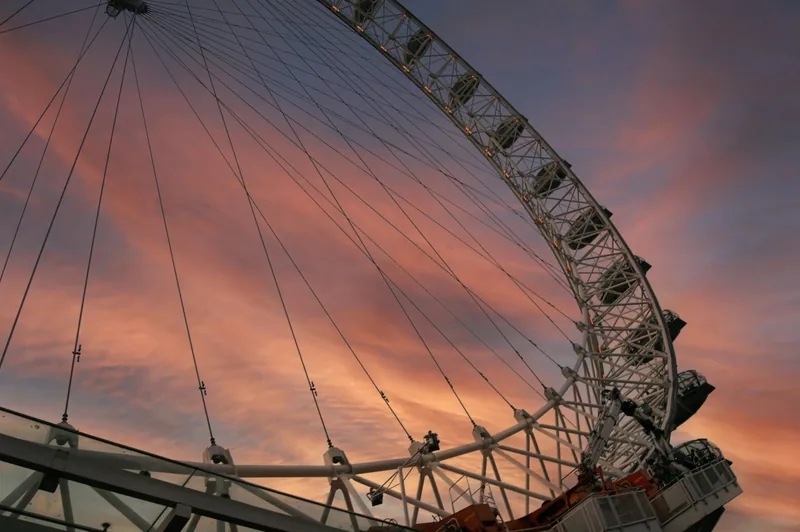
| Around sunset | Low and warm, straight into your eyes across Parliament | Atmosphere rather than detail. The most requested slot of all |
| After dark | Artificial only | The bridges, the lit buildings and the traffic on the river. Underrated, and often the quietest |
Photographers tend to regret the sunset slot and enjoy the first one. Everyone else tends to do the opposite. Both are right: a sunset ride is a better half hour, and a morning ride produces better pictures, because the glass curves and a low sun in front of you throws reflections across every frame.
Which side of the capsule to stand on
Capsules are shared with up to 24 other people and the wheel does not stop, so position matters more than it sounds.
The first third of the rotation gives you Westminster and the river at close range. The top gives you the whole of central London, and this is where everyone crowds to the same side. The last third comes down facing the South Bank and Jubilee Gardens.
The practical advice is to take your Westminster photographs in the first five minutes, while people are still settling, and then move to the eastern side for the top of the turn, when half the capsule has moved west. On a clear morning the eastern view towards the City is the one most people forget to look at.
When the queue is shortest
The operator's answer is consistent across its pages: come early in the morning or later, towards closing time. Weekends and school holidays bring the longest waits.
That leaves three genuinely quiet windows.
- The first hour of the day. Shortest queue, best light for Parliament, and the fewest school groups. The drawback is that in winter the first slot may be before the haze has lifted.
- The last hour of the day. Almost as quiet, with the bonus that in summer this is also the sunset hour, which is why it is the one slot where quiet and popular collide.
- Any weekday in term time, outside the summer. The whole day is calmer, and the difference between 10am and 4pm largely disappears.
The window to avoid is the middle of the day at a weekend or in a school holiday, which is when the up-to-45-minute wait is most likely to be a real 45 minutes.
A last-slot booking gives you two attractions for one queue. In winter the last capsule of the day goes up after dark, so you get the night view at the standard daytime price and the shortest wait of the day. It is the single best value hour on the wheel between November and February.
The clocks move the answer twice a year
Because the interesting hours are tied to the sun rather than the clock, the best slot shifts through the year. British Summer Time ends on Sunday 25 October 2026 and begins again on Sunday 28 March 2027.
In late December the sun sets just before 4pm, so a 3.30pm slot is the sunset ride and a 5pm slot is a night ride. In late June it sets after 9pm, which is later than the wheel is open, so no slot is a true sunset ride and the last capsule of the day gives you a long golden evening instead. Between those extremes the sunset hour moves by roughly two hours a month in spring and autumn.
That has a second consequence worth planning for. From late autumn to early spring, the night view is available at ordinary afternoon slots, which are cheaper to find and easier to combine with the rest of a day. Our guide to the best time to visit London sets out the wider seasonal picture, and our page on London after dark has more for the evening.
The weather beats the clock
None of the above survives low cloud. On a misty day the view from the top can shrink to a few hundred metres, and the wheel runs anyway.
The useful counterweight is the free rescheduling on tickets bought online, available until sixty minutes before the slot itself. That turns a booking into an option rather than a commitment: if the forecast turns, move the slot rather than spending £29 on the inside of a cloud. Our page on London's weather explains what each season tends to throw at you.
Two practical notes. Screenshot the ticket or put it in your phone's wallet, because the crowds around Westminster Bridge play havoc with mobile signal. And groups of more than 28 may be split across pods, so agree who is riding with whom before you join the queue rather than at the boarding platform.
January, Christmas Day and the dates with no answer
There is no best hour on a day the wheel is not turning. The London Eye confirms that it shuts on Christmas Day and for annual maintenance through the whole of January.
That January closure catches people who come for the new year and assume the wheel behind the fireworks is open the following week. It is not. If you are in London in January, the free Sky Garden and the paid View from The Shard are the substitutes, and our list of free viewpoints across London covers the ones that cost nothing at any time of year. Our side-by-side of London's viewing platforms sets out which view each one buys.
On 31 December the wheel is the backdrop to the city's ticketed fireworks rather than a ride you can book; see our page on New Year's Eve in London for how that evening works.
Fitting the slot into the rest of the day
A 30-minute rotation plus a queue is an hour of your day, and it sits on a stretch of riverside with plenty either side of it.
An early slot leaves the whole day free, and the walk east along the South Bank is the natural continuation. A late slot pairs well with a free evening opening elsewhere: the National Gallery is ten minutes away over the Hungerford footbridge and stays open late on Fridays, and the other evening options are listed on our page about museums that open late. If money is the constraint, our budget guide to the city is a better starting point than a £29 half hour.
If the wheel is one of several timed attractions in a single day, do the arithmetic before you book. A sunset slot and a three-hour castle visit will not both fit into one afternoon, as our breakdown of Tower of London timings makes clear. Smaller places are easier to slot in, such as the reburied Roman temple near Bank, which needs an hour, or a rainy morning at the Natural History Museum. A river cruise from the same pier starts at £15.50 online; the operators are compared on our page about cruising the Thames.
Frequently asked questions
What is the best time of day to go on the London Eye?
The operator recommends early morning or shortly before closing for the shortest waits. For photographs, the first slot of the day is better, because the sun is behind you as you look at Westminster. For atmosphere, the last slot wins, and in winter it is also the night view at the ordinary price.
Do sunset tickets on the London Eye cost more?
The London Eye does not publish a separate sunset price. It says prices vary with available capacity and rise as the visit date approaches, so a popular slot booked at the last minute will cost more than a quiet one. Booking early is what secures the lowest rate, whatever the hour.
How long is the wait at the London Eye?
Your ticket time is when you may join the queue, not when you board. At peak times the operator says the wait can be up to 45 minutes from that point. On a quiet weekday outside the school holidays it may be only a few minutes. You cannot enter the queue before your slot.
What time does the London Eye close?
Generally 8.30pm at weekends, on school and public holidays and from May to September, but on quieter autumn weekdays it can close at 6pm. Entry typically stops 30 to 45 minutes before closing. Always check the published hours for your own date.
Is the London Eye worth doing after dark?
Yes, and it is usually the quietest ride of the day. The lit bridges, the buildings along the river and the traffic below make a very different view from the daytime one. Between November and February the last slot of the day gives you this at the standard price.
Sources
- The London Eye - Opening times, seasonal hours and last entry (checked September 2026)
- The London Eye - Information and FAQs, including how time slots work (checked September 2026)
- The London Eye - When you arrive, entrances and queuing (checked September 2026)
- The London Eye - General admission tickets and prices (checked September 2026)
- GOV.UK - When do the clocks change (checked September 2026)