
Arrive for the 9.30am opening, and make it a Tuesday, Wednesday or Thursday. Westminster Abbey stops taking sightseers at 3.30pm from Monday to Friday and at 3pm on Saturday, and it does not open for sightseeing on Sundays at all, so it behaves like a morning attraction rather than an all-day one.
That short day is the single fact that decides when you should go. Almost every other big London sight lets you turn up after lunch and still get your money's worth. Here, an afternoon plan can leave you paying a full adult price for forty minutes inside a building that needs at least ninety.
Our main guide to Westminster Abbey covers what is inside, what a ticket costs and how to attend a service. This page is only about timing: which hour, which day, which month, and what the last hour of the day is actually like.
When the Abbey is open to visitors
- Monday to Friday
- Doors 9.30am, last visitors out by 3.30pm
- Saturday
- Doors 9.30am, half an hour shorter at the end
- Sunday, Christmas and Easter
- Worship only, free, no sightseeing
- Calmest hours
- Tuesday to Thursday before noon, and the first hour after opening
- Busiest hours
- Late morning and early afternoon, worst at weekends and in school holidays
- Time you need
- 1½ to 2 hours for the highlights; add an hour if you go up to the Galleries; 3 hours or more at an unhurried pace
- Cellarium Café
- 8am to 4pm on visiting days
- Abbey Shop
- 9.15am to 6.30pm on visiting days, and on Sundays
Six hours is the whole visiting day
Count it out. From Monday to Friday the doors are open for six hours. On Saturday it is five and a half. That is less than the Natural History Museum, less than the time the Tower of London asks of you, and less than the cathedral at the other end of the river, which starts letting people in at 8.30am and keeps going until the late afternoon. We compare the two churches directly in our guide to St Paul's or Westminster Abbey.
If you have seen an older guidebook promising a late Wednesday opening at the Abbey, ignore it. The hours published on the Abbey's own site are the same on every weekday.
There is also no re-entry. Once you walk out, your ticket is finished, so the café, the shop and the Cloisters all have to fit inside the same visit. Ask one of the Abbey Marshals first if you think you may need to step outside.
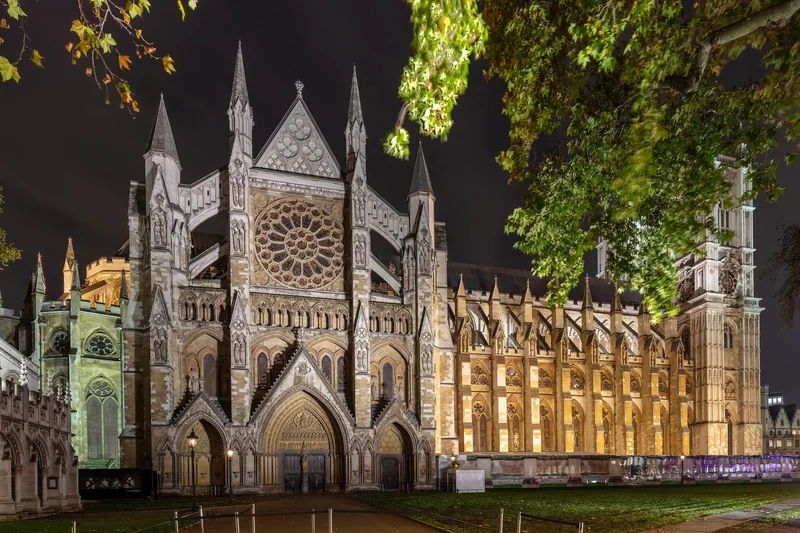
Photo: Diego Delso · CC BY-SA 4.0 · Wikimedia Commons · resized
What each arrival time buys you
Tickets are sold as timed slots. These are our judgements of what each slot feels like in practice, based on the Abbey's own description of its quiet and peak periods.
| You arrive | What the building is like | What you can realistically do |
|---|---|---|
| 9.30am | Quietest slot of the day. Poets' Corner and the shrine are almost empty for the first twenty minutes | Everything, unhurried, including the Galleries and a coffee afterwards |
| 10.30am | Filling steadily. Coach groups have arrived | Everything, but you will queue at the narrow points |
| Noon | Peak. A said communion service runs at 12.30pm in the Nave | The full route, with crowds, and a gap while the service is on |
| 1.30pm | Still busy, starting to ease | The church and the Cloisters. The Galleries become a rush |
| 2.30pm | Thinning out fast | Poets' Corner, the shrine, the nave. Not a full visit |
A 2.30pm slot is not a visit, it is a look. With closing at 3.30pm you have under an hour, and staff begin steering people towards the exit before that. If the only slot left on your chosen day is mid-afternoon, move the Abbey to another day rather than buying it.
The 12.30pm service, and other interruptions
The Abbey is a working church all day, not only at the famous evening service. A said Holy Communion is held in the Nave at 12.30pm on weekdays, and Morning Prayer and an early communion happen before the doors open to visitors.
When a service is on, some or all areas can close to sightseers. The Abbey's rule is sensible and worth knowing in advance: if you are already inside, you are welcome to stay and join in, or to sit quietly and listen. You are not thrown out, but you cannot wander.
Larger special services close the building completely, sometimes at short notice. If that happens to your booking, the Abbey contacts ticket holders to arrange a refund or another date. That is a good reason to book directly rather than through a reseller.
Tuesday to Thursday, and why Saturday is the weakest day
The Abbey's own visitor advice names Tuesday, Wednesday and Thursday mornings before noon as the calmest stretch of the week, and the hour straight after opening as the calmest of all. Weekends and school holidays are the other end of the scale.
Saturday is the day we would drop first. It is half an hour shorter, it is a weekend, and it is the day people who are working all week choose. Monday and Friday sit in between: busier than midweek, but with the full six hours.
If your trip is short and the Abbey has to compete with everything else, our three-day itinerary puts it in the first morning and builds the rest of the day around it. The same logic applies to a two-day weekend, where the Abbey and Sunday do not mix. If the royal sights are the reason you came and you only have room for one big one, we also weigh up the Tower of London against Windsor Castle.
Sunday: closed to sightseers, open to everyone
There is no sightseeing at all on a Sunday, nor on the great religious holidays such as Easter and Christmas Day. This catches out more visitors than any other rule about the building, and no ticket exists that gets round it.
What you can do instead is join a congregation, free and without a ticket, entering by the Great West Door. In a typical Sunday, taken from the Abbey's published weekly list, the pattern runs: Holy Communion at 8am, a sung morning service at 10am, Sung Eucharist at 11.15am, Evensong at 3pm, an organ recital in the Nave at 5pm, and a further service at 6pm in St Margaret's Church next door.
Sunday is the Abbey's free day. The 3pm Evensong and the 5pm organ recital both cost nothing and both fill the building with sound. You will sit in one place and you cannot photograph anything, but you will hear the Abbey doing the thing it was built for, which a ticketed morning does not give you.
Because Sunday closes so much of Westminster to the visitor, it pays to plan the whole day around it. Our guide to a Sunday in London and our notes on bank holidays and opening hours explain what else shuts.
Evensong, and picking the right evening
On weekdays and on Saturdays the sung evening service is at 5pm, an hour and a half after sightseeing has finished. On Sundays it is at 3pm. It is free and it is not ticketed. Nobody reserves you a seat, so the Abbey asks worshippers to turn up in good time.
Saturday is the one day where the gap works nicely. Sightseeing ends at 3pm, which leaves two hours to eat somewhere in Westminster or walk through St James's Park before coming back for the 5pm service.
Look up who is singing before you choose an evening. The Abbey publishes its services a week at a time, with the choir named for each one. Some evenings are sung by the Abbey's own choir, some by visiting choirs and school choirs, and on a few days the 5pm slot is said Evening Prayer rather than a sung service. It is a two-minute check that changes what you hear.
If choral music is the reason you are coming, our overview of classical music in London names the other churches where a choir sings most days of the week, several of them within walking distance.
The 11am problem: the guard change and the Abbey
The Changing of the Guard at Buckingham Palace normally starts at 11am on Monday, Wednesday and Friday, a fifteen-minute walk away through the park. Visitors routinely try to fit both into one morning, and it rarely works.
An Abbey visit that starts at 9.30am cannot be cut short at 10.40am without losing half of it. A guard change that finishes towards noon drops you at the Abbey door at the busiest hour of its day. Our advice is to give each of them a morning: the Abbey on a quiet midweek day, the ceremony on another. The dates are not fixed from month to month, so check the timings in our guide to the Changing of the Guard and confirm them on the Household Division's calendar before you build a day around either.
Parliament is the easier neighbour. The Palace of Westminster stands across the road, the Elizabeth Tower is in the same view, and both can absorb whatever is left of your afternoon once the Abbey has shut.
Months, holidays and the weather
The Abbey does not publish visitor numbers by month, so treat the seasonal picture as the same one that applies to the rest of central London: July and August are the peak, the UK school holidays push weekday crowds up to weekend levels, and the quiet weeks fall in the middle of winter. We break the year down month by month in when to visit London, and London in the school holidays lists the weeks to work around.
Two small seasonal points matter here specifically. In midwinter the building is dark by mid-afternoon, and the stained glass and the Galleries are worth more in the morning light. And on a wet day every visitor in Westminster has the same idea at once, so rain pushes the late-morning peak higher rather than lower. If it is pouring and the Abbey is full, there are drier options nearby in our wet-weather round-up.
Booking a slot, and getting through the door
Booking costs nothing extra, whether you do it online or at the desk. Some tickets are usually held back for the door, but the Abbey's own advice is to book first, and a ticket bought in advance carries priority entry when the building is busy. Missed your slot? Say so at the entrance rather than joining the end of the line.
Everyone passes a security check at the entrance, and what you are carrying decides how long that takes. Bags may be no bigger than 40 by 30 by 20 centimetres. Wheels are refused whatever the size of the case, and nothing can be stored on site. The Abbey points visitors towards Charing Cross and Victoria instead, both a walk away; our guide to left luggage at London's stations lists the opening hours, which are shorter than most people expect.
The last practical point is the floor. It is uneven in places, you will be standing for most of two hours, and the Abbey recommends flat, comfortable shoes. Arriving at opening is easier on the legs than arriving at noon, because you spend less of the visit standing still in a queue.
Frequently asked questions
What time should I arrive at Westminster Abbey?
Aim for the 9.30am opening. The Abbey says the hour straight after the doors open is the quietest of the day, and arriving then gives you the full six hours if you want them. The next best option is around 1.30pm, once the lunchtime peak has passed, but that leaves too little time for the Galleries.
Which day of the week is quietest at Westminster Abbey?
Tuesday, Wednesday and Thursday, before noon. The Abbey names those mornings as its calmest period. Weekends and school holidays are the busiest, and Saturday is also half an hour shorter than a weekday, closing to visitors at 3pm.
Can you visit Westminster Abbey on a Sunday?
Not as a sightseer. On Sundays and on religious holidays the Abbey opens for worship only. Everyone is welcome at the services, which are free and need no ticket, including Evensong at 3pm and an organ recital in the Nave at 5pm, but you cannot walk around the chapels or visit the Galleries.
How late can you enter Westminster Abbey?
Visiting ends at 3.30pm from Monday to Friday and at 3pm on Saturday, and staff start clearing the building before those times. Treat anything after about 1.30pm as a partial visit, and check the Abbey's entry times page for your date, because some days close early for services.
Is Westminster Abbey worth visiting in winter?
Yes, and the crowds are thinner from January onwards. The trade-off is daylight: the building is at its best when the windows are lit from outside, so a winter visit is a stronger argument than ever for the 9.30am slot rather than a mid-afternoon one.
Sources
- Westminster Abbey - Frequently asked questions (checked September 2026)
- Westminster Abbey - Plan your visit (checked September 2026)
- Westminster Abbey - Opening times and prices (checked September 2026)
- Westminster Abbey - Services and times (checked September 2026)
- Westminster Abbey - The Queen's Diamond Jubilee Galleries (checked September 2026)
- The Household Division - Changing the Guard calendar (checked September 2026)