
The Natural History Museum in South Kensington is free, open every day from 10:00 to 17:50, and famous for Hope, the blue whale skeleton hanging in the main hall, and for its dinosaur gallery. Book a free entry ticket to be sure of getting in quickly, especially at weekends and in school holidays.
This is London's museum of the natural world: animals, plants, rocks, minerals, fossils and meteorites, housed in a huge Victorian building on Cromwell Road that looks almost like a cathedral. The galleries themselves cost nothing. You pay only for special exhibitions, food and the shop.
It is also one of the most visited places in London, and for families it is often the first museum on the list. That popularity brings queues outside and crowds in the dinosaur gallery. This guide explains what to see, which entrance to use, how the free tickets work and what is closed this autumn, so you spend your time with the whale and the dinosaurs rather than on the pavement.
Natural History Museum in brief
- Price
- Free for the galleries; exhibitions are paid
- Booking
- Not required; a free entry ticket guarantees entry
- Opening hours
- Daily 10:00-17:50, last entry 17:30
- Closed
- Friday 9 October 2026 (all day) and 24-26 December
- Nearest Tube
- South Kensington (Piccadilly, District and Circle lines), about 5 minutes; not step-free
- Address
- Cromwell Road, London SW7 5BD
- Best for
- Families, dinosaur fans, anyone with a free morning in South Kensington
What makes this museum different
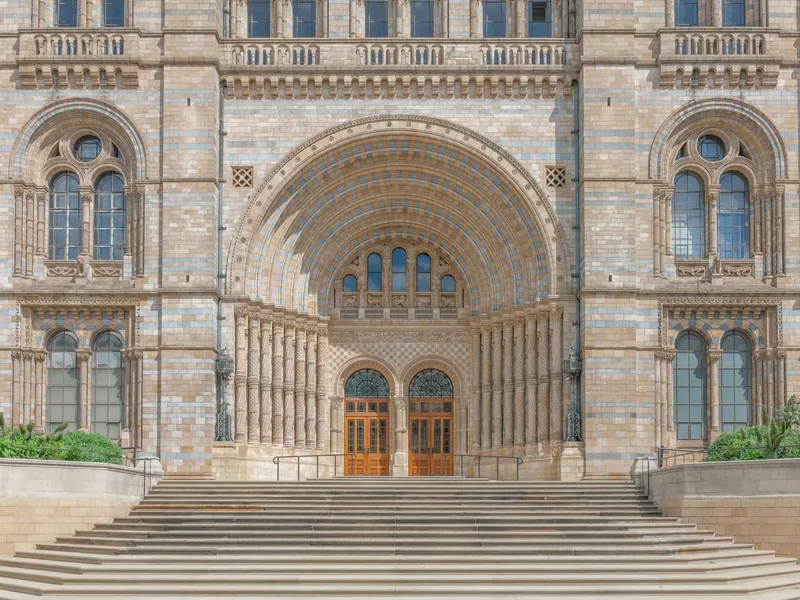
The building was designed by Alfred Waterhouse and opened in 1881. Look closely at the walls and columns as you walk in: they are covered in terracotta animals and plants, and the painted ceiling of the main hall shows plants from around the world. In our view the building is as much a reason to come as anything in the display cases.
Inside, the museum is organised into large galleries grouped by theme: dinosaurs and fossils, the animal kingdom, and the Earth itself (volcanoes, earthquakes, minerals and gemstones). There are also gardens outside, a quiet wing for the museum's scientific collections, and a changing programme of paid exhibitions. The museum is also a working research institution with millions of specimens behind the scenes.
One practical point: the museum's own accessibility page says the historic building has no air conditioning, and you will likely meet crowds. On a hot August afternoon, with hundreds of school children, it can feel tiring. Bring water and plan breaks in the gardens.
Hope the blue whale and Hintze Hall
You enter the main building through the Central Entrance on Cromwell Road straight into Hintze Hall, the great central hall. Hanging from the ceiling is Hope, a 25-metre blue whale skeleton, diving towards you with its jaws open. It replaced the famous plaster cast of a Diplodocus in 2017 and has become the symbol of the museum. The blue whale is the largest animal that has ever lived, and seeing its size above your head is the moment most people remember.
Around the hall are other star specimens, each chosen to tell a story: an American mastodon, an Atlantic blue marlin, a rock as old as the solar system and a 122-129-million-year-old Mantellisaurus, one of the most complete dinosaur fossils found in the UK. Walk up to the balconies for the best view down onto Hope and a closer look at the painted ceiling.
The museum offers a free audio tour of Hintze Hall narrated by Sir David Attenborough. It is one of 24 free audio guides that you play on your own phone, so bring headphones.
The Dinosaurs gallery and the roaring T. rex
The Dinosaurs gallery is on the ground floor of the Central Building, to the left of Hintze Hall as you enter. It follows a one-way route, much of it on a raised walkway above the skeletons, and ends with a life-size animatronic Tyrannosaurus rex that moves and roars. The real fossils here include part of the first T. rex skeleton ever discovered, the first skeleton of Iguanodon known to science, the skull of a Triceratops and the armoured Scolosaurus.
Because it is one way and so popular, the dinosaur gallery can have its own queue inside the museum at busy times. Go straight there when the doors open at 10:00, or leave it until after 16:00 when many families have gone home.
The animatronic T. rex is switched off until 25 September. The museum says the roaring T. rex is closed to the public from 7 to 25 September for its annual service. The rest of the Dinosaurs gallery stays open, but if the moving dinosaur is the highlight for your children, plan your visit from 26 September.
Other fossil galleries are much quieter and just as good for older children: Fossil Marine Reptiles, with the giant sea creatures that lived while dinosaurs ruled the land, Fossils from Britain, and Human Evolution in the East Wing. In the Earth Hall you meet the most complete Stegosaurus skeleton ever found, and outside in the gardens stands Fern, a bronze Diplodocus.
Volcanoes, earthquakes and the Earth Hall
The East Wing, next to Exhibition Road, is about how the planet works. Its centrepiece is the Earth Hall with a giant metal globe sculpture: an escalator carries you up through the middle of it to the upper floors. From there you walk down through a series of galleries on the Earth's surface, its treasures and its restless forces.
The best known of these is Volcanoes and Earthquakes. Its earthquake simulator recreates a small Japanese supermarket during the 1995 Kobe earthquake: you stand among the shelves while the floor shakes and film shows what happened outside. Expect a line at busy times. The same gallery shows casts of victims of the eruption of Vesuvius in AD 79, lava bombs and the heat suits used by volcano scientists.
Nearby, Earth's Treasury shows gemstones and minerals, and the Vault in the Central Building displays some of the most precious specimens, including a piece of the Winchcombe meteorite, the first meteorite fall recovered in the UK for 30 years. The Minerals gallery still has its original oak display cases from 1881.
Free entry tickets and how to beat the queue
Entry is free and you do not have to book. However, the museum says that during weekends and school holidays you may have to queue to get in, and that holders of a free entry ticket, an exhibition ticket or a membership skip the queue. So the free ticket is the simplest way to avoid waiting. Book it on the official visit page for a time slot and arrive within it. Bags may be searched on arrival, and sharp objects such as knives and scissors may be confiscated.
There are three entrances, and choosing the right one matters:
| Entrance | Where | Good to know |
|---|---|---|
| Central Entrance | Cromwell Road, reached through the East Gate at the corner of Cromwell Road and Exhibition Road | Leads straight into Hintze Hall and Hope; step-free with a ramp; the most photographed and usually the busiest |
| East Entrance | Exhibition Road | Leads to the Earth galleries; not step-free, but a lift runs from the lobby; may close to manage crowds at busy times |
| West Entrance | Queen's Gate (West Gate) | Open daily until 17:00; the museum's pages differ on whether it is step-free, so ask staff if this matters |
A timed ticket on a school-holiday Saturday saves the longest wait. The free entry ticket costs nothing and guarantees entry, while walk-up visitors can queue outside in all weathers. If you forgot to book, the West Entrance on Queen's Gate is worth trying before it closes at 17:00, as it is easy to overlook.
Staff in green and blue uniforms can help you skip the entry queue if someone in your group has access requirements. A small number of manual wheelchairs can be borrowed free from the cloakrooms on a first-come, first-served basis. Note that some lifts in the Darwin Centre and the Mammals Hall were out of order when we checked; the museum keeps a current list on its galleries and map page.
A half-day plan for a family visit
The museum is large and children tire fast. This plan covers the favourites in about three hours with one break.
- 10:00, Dinosaurs gallery. Go straight left from Hintze Hall before the queue builds.
- 10:45, Hintze Hall and Hope. Look up at the whale, then climb to the balcony for the view.
- 11:15, Mammals and the blue whale model. In the North Wing, the Mammals Hall has mammoths, a giant elk and a blue whale model.
- 12:00, lunch. Use one of the museum cafés or eat a packed lunch in the gardens in good weather.
- 13:00, Earth Hall and the escalator. Ride up through the globe.
- 13:30, Volcanoes and Earthquakes. Queue for the earthquake simulator, then walk down through Earth's Treasury.
If your children are younger than school age, cut the plan in half and add the gardens, where there is a pond, the evolution timeline of ancient rocks and the bronze Diplodocus. Note that the Creepy Crawlies gallery has closed and will reopen as a new permanent family gallery. For more ideas, see our guide to London with children and the list of free playgrounds and city farms for a run-around afterwards.
Paid exhibitions and evening events
Alongside the free galleries, the museum runs ticketed exhibitions. In September 2026 these included Jurassic Oceans: Monsters of the Deep, Our Story with David Attenborough, and a mixed-reality experience called Visions of Nature. Prices and dates are on the museum's exhibitions page. Exhibition tickets also give queue-free entry to the museum.
The museum also runs special events outside normal hours, such as Dino Snores sleepovers for children and adults (from 18:30 to 10:00 the next morning), early-morning dinosaur tours and evening events for adults. Our round-up of evening openings at London museums compares these with other late events.
Getting to South Kensington and the museum tunnel
The nearest Tube station is South Kensington, on the Piccadilly, District and Circle lines, about five minutes on foot. The station itself is not step-free. From the station, a long pedestrian subway (tunnel) runs under Exhibition Road to the museums, and the museum says it gives step-free access to the Central Entrance through the Subway Gate. It is useful in rain and avoids crossing busy roads with children.
Gloucester Road station (Piccadilly, District and Circle) is about 12 minutes from the Central Entrance and seven minutes from the West Entrance. Piccadilly line upgrade works continue through 2026 and 2027, so check TfL's major works page before you travel. If you need lifts and ramps all the way, our step-free travel guide explains the options, and our page on children's fares on London transport shows who rides free.
There is no car park for visitors and street parking is limited. A few Blue Badge spaces on site can be booked by phone, and there are more on Exhibition Road. Santander Cycles docking stations are on Exhibition Road and Thurloe Place.
Combining it with the Science Museum and the V&A
The Natural History Museum sits at the southern end of Exhibition Road, with the Science Museum directly behind it and the Victoria and Albert Museum across the road. All three are free. Trying to do all three in one day is a mistake for most people, especially with children: two is realistic, and one done properly is often better.
A good pairing for families is this museum in the morning and the Science Museum next door after lunch, since Wonderlab and the space gallery suit children who have had enough of fossils. Adults who prefer design and art should cross to the V&A instead. Our guide to the South Kensington area covers cafés and streets nearby, and Hyde Park and Kensington Gardens are a ten-minute walk north for a picnic.
If you are planning several days of sightseeing, our list of free London museums and the wider museums and galleries section help you choose. On a wet day this museum fills fast, so read our tips for rainy days in London and book your slot early. Families choosing a base should look at where to stay in London with kids, since South Kensington itself is one of the options.
Frequently asked questions
Is the Natural History Museum in London free?
Yes. All the permanent galleries, including Hope the blue whale, the dinosaurs and the earthquake simulator, are free for everyone. Only special exhibitions and some events are paid. A free entry ticket is not required but guarantees entry and lets you skip the queue.
How long is the queue at the Natural History Museum?
It varies a lot. On weekdays in term time you may walk straight in, while weekends and school holidays can bring long waits outside. The museum says visitors with a free entry ticket, an exhibition ticket or a membership skip the queue, so booking a slot is the best way to avoid it.
Is the blue whale still at the Natural History Museum?
Yes. Hope, the 25-metre blue whale skeleton, hangs in Hintze Hall, the main hall you enter from Cromwell Road. You can see her from the ground floor or look down on her from the balconies above.
How long should I spend at the Natural History Museum?
Plan for about three hours to see the main highlights, including the dinosaurs, Hintze Hall, the mammals and the volcanoes and earthquakes gallery. Families with young children often find two hours plus a break in the gardens is enough.
When is the Natural History Museum closed?
It is open every day except 24-26 December. In 2026 it is also closed all day on Friday 9 October for a charity gala. The animatronic T. rex is closed for servicing from 7 to 25 September 2026.
Sources
- Natural History Museum - Visit (opening times, tickets and queues) (checked September 2026)
- Natural History Museum - Galleries and Museum map (gallery closures and maintenance works) (checked September 2026)
- Natural History Museum - Getting here (entrances and transport) (checked September 2026)
- Natural History Museum - Dinosaurs gallery (checked September 2026)
- Natural History Museum - Volcanoes and Earthquakes gallery (checked September 2026)
- Natural History Museum - Access at South Kensington (checked September 2026)