
Piccadilly Circus is the busy road junction in London's West End where five famous streets meet, known around the world for its giant curved advertising screen and the small winged statue that almost everyone calls Eros. It is free, open at all hours and best seen after dark, and it makes an ideal starting point for exploring Soho, the theatres and the shops of Regent Street.
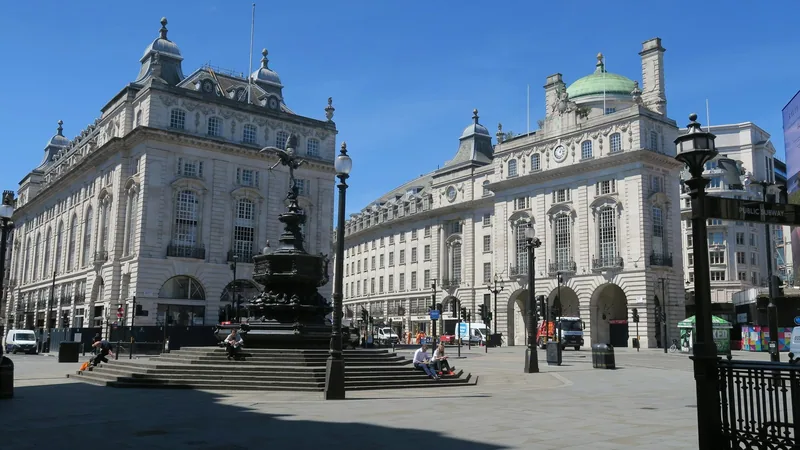
Despite the name, there is no circus here. In London a "circus" is a round open space where several streets meet, from the Latin word for a circle. Piccadilly Circus was laid out in 1819, when the architect John Nash built Regent Street to link the royal parks with the new houses to the north. Today the junction is no longer round: traffic flows around one side, and a paved open area on the other side holds the statue and its fountain.
Most visitors pass through rather than stay. That is the right approach: you come for ten minutes of lights and people-watching, take a photo, and walk on into one of the neighbourhoods that start right here. This guide explains what you are looking at and where to go next.
Piccadilly Circus in brief
- What it is
- A road junction and public square in the West End
- Cost
- Free, open 24 hours
- Tube station
- Piccadilly Circus (Bakerloo and Piccadilly lines), exits directly onto the junction
- The screen
- Piccadilly Lights, a curved digital screen of around 780 square metres
- The statue
- Shaftesbury Memorial Fountain (1893), topped by a figure known as Eros
- Best time
- After dark for the lights; early morning for empty photos
- Time needed
- 10-20 minutes on its own
The streets that meet at Piccadilly Circus
Piccadilly Circus makes most sense once you know which road leads where. Standing by the statue, you can reach five different parts of the West End within a few minutes' walk.
- Regent Street curves north towards Oxford Circus, lined with flagship shops.
- Piccadilly runs west towards Green Park, past grand hotels, bookshops and the Royal Academy of Arts.
- Shaftesbury Avenue heads north-east through the heart of theatreland, with Soho on one side and Chinatown on the other.
- Coventry Street leads east to Leicester Square, a short walk away.
- Haymarket and Lower Regent Street run south towards Trafalgar Square and St James's.
The name Piccadilly itself is often traced to "piccadills", the stiff decorated collars of the early 17th century. A tailor who made them is said to have built a house nearby, which locals nicknamed Piccadilly Hall, and the name stuck to the road.
The screens: from light bulbs to a curved digital wall
The advertising screens are the reason most people come. Illuminated advertising has been part of Piccadilly Circus since 1908, when the first electric signs went up on the buildings around the junction. For most of the 20th century they were a patchwork of separate neon and light-bulb signs from different brands, and they became one of the best-known images of London at night.
Today the separate signs have been replaced by one large, curved ultra-high-definition screen, known as Piccadilly Lights. Its owner, the property company Landsec, describes it as the largest advertising screen in Europe, at around 780 square metres.
The screen does more than show adverts. It can react to live information such as the weather and passing traffic, and in recent years it has used forced-perspective 3D effects that make images appear to leap out of the building. It is also used for cultural moments, charity campaigns and live broadcasts, so on some evenings you may see art or sport instead of brands.
The best view of the screen is from the statue steps. Stand by the fountain and look across the traffic towards the screen. From there the whole curve of the screen fits into one photo, with red buses and black cabs passing in front of it.
The statue everyone calls Eros
The winged archer balanced on one foot above the fountain is one of the most photographed statues in London, and most people get its name wrong. The monument is officially the Shaftesbury Memorial Fountain, unveiled in 1893 to honour the 7th Earl of Shaftesbury, a Victorian politician who campaigned against child labour and for better conditions for the poor.
Its sculptor, Alfred Gilbert, meant the figure to represent Anteros, the brother of Eros in Greek mythology, who stands for selfless love rather than romantic love. That suited a memorial to a man known for his charity. Londoners saw a winged boy with a bow, however, and called him Eros, and the name has stuck ever since. The figure was one of the first statues cast in aluminium, which was then a new and expensive metal.
The steps around the fountain are one of London's classic meeting points. They are usually crowded with people sitting, eating and taking photos, especially in the evening. Please do not climb on the fountain itself: it is a delicate Victorian monument, and sitting on the steps is as close as you should get.
When to visit: day, evening and late at night
Piccadilly Circus is busy from morning until late at night. How it feels depends a lot on when you go.
| Time | What to expect |
|---|---|
| Early morning (before about 8am) | The quietest time, with few people on the square. Best for clean photos of the statue. |
| Daytime | Shoppers, tour groups and heavy traffic. The screen is visible but less striking in daylight. |
| Evening | The screen at its most impressive, with theatre crowds arriving from about 7pm. Busy but lively. |
| Late night at weekends | Crowds leaving bars and clubs. Fun for some, but keep a closer eye on your belongings. |
In November and December, Regent Street's Christmas lights hang over the road just north of the junction, and the walk from Piccadilly Circus to Oxford Circus becomes one of the best free Christmas sights in London. Our guide to Christmas in London covers the other displays.
Getting to Piccadilly Circus
Piccadilly Circus station, on the Bakerloo and Piccadilly lines, has several exits that bring you up directly around the junction. The station is in Zone 1. A single journey within Zone 1, for example from Oxford Circus, cost £3.10 at peak times and £3.00 off-peak with contactless or Oyster in September 2026.
For many short trips it is quicker to walk. Leicester Square is about five minutes away on foot, and Oxford Circus, Covent Garden and Trafalgar Square are all within 10 to 15 minutes. Our guide to when walking beats the Tube shows which journeys are not worth taking underground.
Many bus routes pass through or near the junction, and at weekends the Piccadilly line runs through the night as part of the Night Tube, which is useful after a show or a late meal; see our page on which lines run all night. Check step-free access before you travel if you use a wheelchair or have heavy luggage, as not every central station has lifts.
Staying safe in the crowds
Piccadilly Circus is well policed and generally safe, but, like all crowded tourist spots, it attracts pickpockets and phone thieves. According to City Hall, mobile phone theft in London fell from 81,365 in 2024 to around 71,391 in 2025, and robberies in key West End hotspots were down 46%. That is progress, but phones are still the main target.
- Do not stand at the kerb holding your phone out towards the road. Phone thieves on bikes and scooters work busy junctions like this one.
- Keep bags zipped and in front of you when crossing in a crowd or standing to watch the screen.
- Be wary of anyone who approaches with a petition, a "free" bracelet or an offer of cheap show tickets.
- Only buy theatre tickets from the theatre box office, the official booth in Leicester Square or reputable websites.
Our full guide to safety, scams and pickpockets in London explains the common tricks and what to do if something is stolen.
Keep your phone on the pavement side at the junction. The kerbs around Piccadilly Circus are among the places where phones are snatched from people filming the screen. Step back from the road, hold your phone with both hands, and put it away as soon as you have your photo.
Theatres and the discount ticket booth
Piccadilly Circus sits at the western edge of theatreland. The Criterion Theatre stands on the junction itself, and Shaftesbury Avenue, which starts here, has several of the West End's large theatres in a row. Our guide to West End theatre explains how the shows, seats and prices work.
If you want to see a show tonight, walk five minutes east to The Official London Theatre Ticket Booth, formerly known as TKTS, in the Clocktower building on the south side of Leicester Square. It is run by the Society of London Theatre and opens Monday to Saturday 10.30am-6pm and Sunday 11am-4pm, with the same deals also sold online. For more ways to save, see our advice on cheap theatre tickets.
Where to go next from Piccadilly Circus
The real value of Piccadilly Circus is how many good places start here. You could spend a whole day within a 15-minute walk.
North and east: Soho, Chinatown and Covent Garden
Behind the screens lies Soho, a tight grid of narrow streets full of restaurants, bars and small shops. Across Shaftesbury Avenue is Chinatown, good for a quick and affordable meal. Keep walking east past Leicester Square and you reach Covent Garden with its market hall and street performers.
North and west: Regent Street and Oxford Street
Regent Street is one of London's grandest shopping streets, with its long curved terraces of shops, and it leads straight to Oxford Circus and Oxford Street. Along Piccadilly you will find Fortnum & Mason, famous for its tea and hampers and for afternoon tea, and Hatchards, one of the oldest bookshops in the city; our guide to London's bookshops has more.
South and west: St James's, the parks and the palace
South of Piccadilly lie the elegant streets of Mayfair and St James's, with Jermyn Street's shirt-makers and old-fashioned shops. Walk west along Piccadilly to Green Park and cross it to reach Buckingham Palace in about 20 minutes. Or head south down Haymarket to Trafalgar Square and the National Gallery.
A free West End loop starts at the fountain. Walk from Piccadilly Circus down Haymarket to Trafalgar Square, through Leicester Square and Chinatown, back along Shaftesbury Avenue and through Soho to Regent Street. It takes about an hour at a gentle pace, costs nothing and shows you the heart of the West End.
Practical needs nearby
If you need a toilet, the department stores, large bookshops and cafés nearby are often the easiest option; our guide to finding a public toilet in London explains the free alternatives. For cheap food, Chinatown and the side streets of Soho are much better value than the chain restaurants directly on the junction.
Frequently asked questions
Why is it called Piccadilly Circus?
"Circus" is the old word for a round open space where several streets meet, from the Latin for circle. "Piccadilly" is usually traced to "piccadills", decorated collars sold by a 17th-century tailor who lived nearby. The name has nothing to do with a circus show.
Is the statue at Piccadilly Circus really Eros?
Not officially. The statue is part of the Shaftesbury Memorial Fountain of 1893, and its sculptor, Alfred Gilbert, intended it to represent Anteros, the brother of Eros, as a symbol of selfless love. Londoners have called it Eros for more than a century, and that is the name you will hear.
Are the Piccadilly Circus screens on all the time?
The screen runs through the day and evening, but it is most impressive after dark, when the colours stand out against the night sky. Its owner uses it for adverts, cultural moments and live broadcasts, so what you see changes throughout the day.
What is the nearest Tube station to Piccadilly Circus?
Piccadilly Circus station, on the Bakerloo and Piccadilly lines, has exits right around the junction. Leicester Square and Green Park stations are also within a short walk, and the whole area is easy to explore on foot.
Is Piccadilly Circus worth visiting?
It is worth a short stop, especially in the evening when the screen is lit, but it is not a place to spend hours. Treat it as a meeting point and gateway to Soho, Chinatown, the theatres and Regent Street, all of which are within a few minutes' walk.
Sources
- Landsec - Piccadilly Lights: The Screen (checked September 2026)
- Landsec - Piccadilly Lights home page (checked September 2026)
- Society of London Theatre - The Official London Theatre Ticket Booth (checked September 2026)
- Mayor of London - Crackdown on mobile phone theft (17 February 2026) (checked September 2026)
- Transport for London - Single fare finder (checked September 2026)
- Transport for London - Night Tube (checked September 2026)