
Trafalgar Square is London's main public square, free to visit at any hour, with Nelson's Column and its four bronze lions in the middle, the National Gallery along the north side and the Fourth Plinth, where a new contemporary sculpture appears every two years. Since 10 September 2026 the plinth has held Lady in Blue by Tschabalala Self.
The square sits at the point where Westminster, the West End and the Strand meet, which makes it one of the easiest places in London to find and a natural meeting point. Charing Cross station has an exit on the square itself. From here, Whitehall runs south to Parliament, The Mall runs south-west to Buckingham Palace, and the theatres and restaurants of the West End start a few streets to the north.
It is also a stage. The Mayor of London manages the square and uses it for free festivals, and it has a long tradition as a place for rallies and protests, usually at weekends. This guide explains what the monuments mean, what is happening on the square this autumn and how to fit it into a day of sightseeing.
Trafalgar Square in brief
- Cost
- Free, open 24 hours
- Named
- 1830, after Nelson's victory at the Battle of Trafalgar in 1805
- Nelson's Column
- Erected 1843; lions by Sir Edwin Landseer added 1867
- Fourth Plinth now
- Lady in Blue by Tschabalala Self, unveiled 10 September 2026
- On the north side
- The National Gallery (free; daily 10am to 6pm, Fridays until 9pm)
- Public toilets
- West side, base of the central staircase; 10am to 8pm, 20p, contactless accepted
- Nearest station
- Charing Cross (Bakerloo and Northern lines, and National Rail)
How a royal stable yard became a national square
From the 14th to the 17th centuries, most of the ground here was the courtyard of the Great Mews, the royal stables serving Whitehall Palace. In 1812 the architect John Nash began planning a new route from Charing Cross to Portland Place and wanted an open cultural space at its southern end.
The site was officially named Trafalgar Square in 1830. Work on the National Gallery began in 1832, and in 1838 Sir Charles Barry, who also designed the new Houses of Parliament, presented a plan for the square that included a memorial to Nelson and two fountains. Nelson's Column went up in 1843 and the fountains followed in 1845.
The biggest modern change came in 2003, when the road along the north side was closed to traffic. The north terrace now joins the square directly to the National Gallery, with the wide central staircase that most people sit on today.
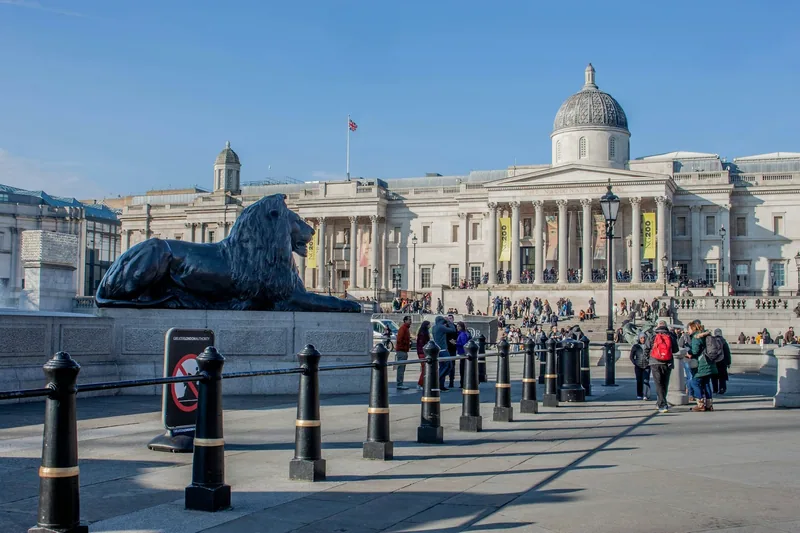
Nelson's Column and the four lions
Admiral Horatio Nelson was killed at the Battle of Trafalgar in 1805, in the victory that gave the square its name. The column was designed by William Railton, and the statue at the top, sculpted by E. H. Baily, is five metres tall. It stands on a bronze platform made from old guns from the Woolwich Arsenal foundry. Around the base, four bronze panels show scenes from Nelson's battles.
The four lions were designed by Sir Edwin Landseer and added in 1867, more than twenty years after the column. They are the most photographed part of the square, and you will often see people climbing on them for pictures. Be aware that the square's byelaws say nobody may climb on a statue or plinth without written permission from the Mayor, and the bronze can be slippery and high, so we would stay on the ground, especially with children.
The column is Grade I listed and inspected every two years. During recent conservation, restorers were able to repair the statue with Craigleith sandstone, the original material, after a supply was found in a building being restored in Edinburgh.
The Fourth Plinth and Lady in Blue
There are four plinths at the corners of the square. Three carry bronze statues from the 19th century: King George IV on horseback in the north-east corner, and the generals Sir Charles Napier and Sir Henry Havelock at the southern corners. The fourth, in the north-west corner, stood empty for many years.
Since 1998, when the Royal Society of Arts started the idea, it has been used for temporary works by contemporary artists, and a new sculpture is now installed every two years. An independent Fourth Plinth Commissioning Group chooses the works, and the public is invited to comment on the shortlist. It has become one of the best-known public art commissions in the world.
The current work, Lady in Blue by the New York artist Tschabalala Self, was unveiled on 10 September 2026. It is the 16th commission and shows a young woman striding through the city, a contemporary "everywoman" meant to reflect many of today's Londoners. It is made of bronze, with the dress painted a strong blue and the jewellery in the colour of lapis lazuli. It follows Mil Veces un Instante by Teresa Margolles, and the next work, by Andra Ursuţa, is planned for 2028.
Lady in Blue is part of a free sculpture trail this month. The new plinth work is one of the highlights of London Sculpture Week, running from 19 to 27 September 2026, which links it with Frieze Sculpture, Sculpture in the City, East Bank and The Line. It is a good excuse to see public art across the city without paying a penny.
Fountains, busts and the smallest police box
The two fountains date from 1845; the mermaids, dolphins and tritons were added later. They operate on most days. The byelaws forbid bathing in them or entering the fountain bowls, however hot the day.
Look along the north wall below the terrace for bronze busts of three admirals of the 20th century, Beatty, Jellicoe and Cunningham. Nearby are the Imperial Measures, set into the wall in 1876 so that surveyors could check lengths such as feet, yards, perches and chains. They were moved when the central staircase was built, and there is information about them outside the café.
On the south-east corner is what City Hall calls probably the smallest police box ever built. A lamp stood here from 1826, and in 1926 Scotland Yard added a telephone line and light so officers could call for help. Today it is used for storage, but it is a fun detail to hunt for.
The National Gallery and other neighbours
The long building on the north side is the National Gallery, home to one of the world's great collections of European paintings. General admission is free, and it is open daily from 10am to 6pm and until 9pm on Fridays. The Sainsbury Wing, which reopened in May 2025, is now the main free entrance. You can walk in without a ticket, or book an optional free ticket for faster entry. Our guide to visiting the National Gallery has more on the collection and the entrances, and the National Portrait Gallery is just around the corner.
The church with the tall spire on the north-east corner is St Martin-in-the-Fields. Admiralty Arch, in the south-west corner, leads onto The Mall and a straight walk to Buckingham Palace. South along Whitehall you pass the government buildings and reach Parliament Square and Big Ben.
Events and festivals on the square
The square hosts cultural celebrations, rallies and demonstrations, commercial events and filming, all arranged through City Hall. Many of the cultural festivals are free and need no ticket.
- Diwali on the Square: the Mayor's annual Diwali celebration takes place on Sunday 25 October 2026, from 1pm to 7pm. It is free and there is no need to book. Our guide to London in October lists other events that month.
- Lunar New Year: in 2026 the main celebration was held on Sunday 22 February in Chinatown and Trafalgar Square, free of charge. The 2027 date for London had not been announced when we checked; Lunar New Year itself falls on 6 February 2027. See our guide to Chinatown, a few minutes' walk away.
- Christmas: each year a large Christmas tree, a gift from the city of Oslo, stands in the square during December. Our Christmas in London guide covers the season.
- Rallies and protests: these happen frequently, especially at weekends. They are usually peaceful, but they can make the square crowded and noisy.
For what is on during your visit, check the events pages on the official Trafalgar Square page from City Hall.
Rules, facilities and staying safe
Trafalgar Square has its own byelaws. The one visitors notice most is the ban on feeding the pigeons: nobody except people acting for the Mayor may feed birds or scatter food for them. Cycling, skateboarding, roller skating, riding a scooter, playing an instrument and using amplified sound all need written permission from the Mayor, and flying model aircraft is not allowed.
The café and the lift from the north terrace are out of action. In September 2026, City Hall said the Café on the Square was closed and the lift from the north terrace was unavailable while it undergoes essential maintenance. If you use a wheelchair, ask a Heritage Warden for the best step-free route between the terrace and the square. The public toilets on the west side, at the foot of the central staircase, remain open from 10am to 8pm and cost 20p (contactless accepted), with an accessible toilet and baby change.
Heritage Wardens in uniform are on the square 24 hours a day and can answer questions and help during events. Security staff patrol and CCTV is in operation. As in any crowded place, keep your phone and wallet secure; our guide to safety and pickpockets in London has practical advice. For toilets elsewhere in the city, see our public toilets guide.
Getting to Trafalgar Square
Charing Cross Underground station (Bakerloo and Northern lines) is the closest, with an exit directly on the square, but it is not step-free. Leicester Square, Piccadilly Circus and Embankment stations are all a few minutes' walk away. For step-free access, City Hall suggests Westminster station, about ten minutes' walk, or Charing Cross main-line station, around 325 metres away, which has a step-free route to the square.
Many buses pass the square, including routes 3, 6, 9, 11, 12, 15, 23, 87, 88, 91, 139 and 176. A single bus fare with contactless or Oyster is £1.75 until 1 November 2026, when it rises to £1.85; our guide to London buses explains the Hopper fare, which gives you unlimited bus journeys within an hour for one fare.
A walking route from the square
Trafalgar Square is best used as the start of a walk, since so much is close by. This loop takes most of a day if you go inside everything, and our guide to walking in London shows how often it beats the Tube in this area.
- Start with an hour or two in the National Gallery, which opens at 10am.
- Walk north-east into Covent Garden for lunch and street performers.
- Head west through Leicester Square, where the Official London Theatre Ticket Booth sells same-day theatre deals (see our guide to cheap theatre tickets), to Piccadilly Circus.
- Return to the square through the late afternoon, then walk down The Mall and through St James's Park, ending at Westminster.
Everything on this route that is not a shop or restaurant is free, which is why the square appears in our list of free things to do in London.
Frequently asked questions
What is on the Fourth Plinth in Trafalgar Square now?
Lady in Blue by Tschabalala Self, unveiled on 10 September 2026. It is the 16th Fourth Plinth commission: a bronze figure of a young woman striding through the city, with a dress painted blue. A new work is installed every two years, and the next, by Andra Ursuţa, is planned for 2028.
Is it free to visit Trafalgar Square?
Yes. The square is a public space, open 24 hours and free to enter. The National Gallery on its north side is also free, and many of the festivals held on the square, such as Diwali on the Square, are free with no booking needed.
Can you climb the lions in Trafalgar Square?
Many people do, but the square's byelaws say nobody may climb on any statue or plinth without written permission from the Mayor. The bronze lions are high and can be slippery, so we recommend taking your photos from the ground.
Why can't you feed the pigeons in Trafalgar Square?
Feeding birds is banned under the Trafalgar Square byelaws. Only people acting on behalf of the Mayor may feed birds or scatter food for them on the square, so leave your sandwich crumbs in the bin.
What is the nearest Tube station to Trafalgar Square?
Charing Cross, on the Bakerloo and Northern lines, has an exit on the square, but it is not step-free. For step-free access, use Charing Cross main-line station, about 325 metres away, or Westminster station, around ten minutes' walk.
Sources
- Mayor of London - Trafalgar Square (checked September 2026)
- Mayor of London - Visiting Trafalgar Square (checked September 2026)
- Mayor of London - Lady in Blue unveiled on London's Fourth Plinth (checked September 2026)
- Mayor of London - Diwali on the Square 2026 (checked September 2026)
- Mayor of London - Trafalgar Square byelaws (checked September 2026)
- The National Gallery - Plan your visit (checked September 2026)