
Southern runs direct from London Victoria to Eastbourne in 1 hour 23 to 1 hour 27 minutes, twice an hour, and an Off-Peak Day Return was £43.90 in late September 2026. Beachy Head, the high chalk headland at the western end of the town, is reached on foot from the seafront in about an hour and a quarter or by a seasonal bus. The walk is the reason to come: the town on its own is half a day, and the clifftop turns it into a full one.
Eastbourne is a Victorian resort with a three-mile promenade, a pier, a bandstand and rather more flowerbeds than seems necessary. It sits at the point where the South Downs run into the sea, so the western end of the seafront simply stops being a town and starts being a hill.
That hill is Beachy Head, and the chalk continues west from it past the old Belle Tout lighthouse to Birling Gap and the Seven Sisters. Our guide to the Seven Sisters covers that stretch, the clifftop walk to Exceat and the cliff-edge safety advice in full. This page is about Eastbourne and the headland above it: the train, the climb, and what the town is for.
Eastbourne and Beachy Head: the numbers
- From
- London Victoria, direct (also from London Bridge with a change)
- Journey time
- 1 h 23 min to 1 h 27 min out, 1 h 31 min to 1 h 34 min back
- Frequency
- Twice an hour on weekdays and Saturdays
- Off-Peak Day Return
- £43.90; Anytime Day Return £46.20 (National Rail, September 2026)
- Oyster and contactless
- Not valid. Buy a ticket
- Station to seafront
- About ten minutes on foot, downhill
- Pier to Beachy Head clifftop
- About three miles on foot, an hour and a quarter uphill (our estimate)
- Cost to visit the cliffs
- Free
- Verdict
- Worth a day if you walk. Half a day if you do not
The train, and the week the direct trains disappear
The normal service is a direct Southern train from Victoria, twice an hour, taking 1 hour 23 to 1 hour 27 minutes out and 1 hour 31 to 1 hour 34 minutes back. There is no change and nothing to think about.
Except when there is. When we checked several consecutive mornings at the end of September 2026, every outward departure on two of those dates required a change and took 1 hour 52 minutes or more, while the direct trains ran normally on the surrounding days. Engineering work on this line regularly removes the through service for a weekend or a week at a time without removing it from the fare. Check your actual date in the journey planner rather than trusting a published journey time, including ours.
At £43.90 for an Off-Peak Day Return this is not a cheap day out, and the Anytime version is only £2.30 more, which tells you how little the off-peak discount is worth on this route. Children aged 5 to 15 get 50% off Off-Peak fares and any National Railcard gives an adult a third off. Two Advance singles booked ahead can beat the return if you are willing to be tied to named trains: see our guide to buying British train tickets and our page on railcards worth buying as a visitor.
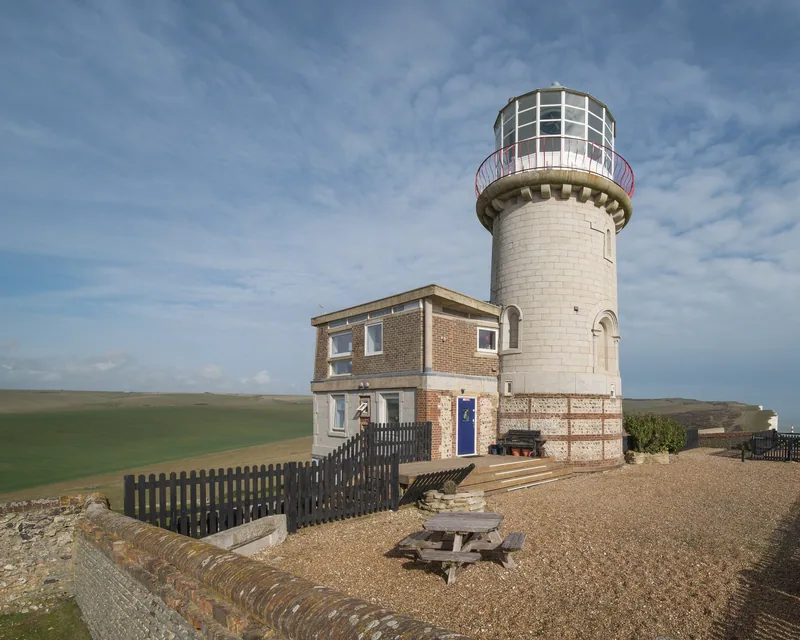
Photo: Arild Vågen · CC BY-SA 4.0 · Wikimedia Commons · resized
From the station to the sea
Eastbourne station sits at the top of Terminus Road, and the walk down to the pier takes about ten minutes on a straight pedestrianised shopping street. Turn right at the bottom for the pier and the bandstand, or left for the Redoubt and the quieter eastern end.
The promenade runs for about three miles in a shallow curve on two levels, with a lower walk close to the shingle and an upper one behind the flowerbeds. Walk west. The buildings get grander, then smaller, then stop, and the path begins to climb at Holywell, where a small area of chines and tamarisk marks the last of the town.
Walking up to Beachy Head
This is the best thing in Eastbourne and it costs nothing. From the pier to the Beachy Head clifftop is roughly three miles, and our estimate is an hour and a quarter at a steady pace, with the last half of it a continuous climb on grass. Eastbourne is also the eastern end of the South Downs Way, the hundred-mile national trail that finishes in Winchester, so the route is waymarked and busy with walkers in both directions.
What you get at the top is a view back over the whole town and forward along the white cliffs to Belle Tout and the Seven Sisters beyond. Below you, Beachy Head Lighthouse stands on the shore at the foot of the chalk: Trinity House built it in 1902, its tower is 33 metres high and its light sits 31 metres above mean high water, with a range of 16 nautical miles. From the clifftop it looks like a toy, which is the only honest way to convey how high you are standing.
The chalk at Beachy Head gives no warning before it goes. There are no fences along most of this clifftop, the grass runs right to the drop, and the edge is regularly undercut from below. Stay at least five metres back, keep children and dogs close, and take photographs from well inside the path. The Samaritans can be reached free on 116 123 at any hour, and their signs are on this clifftop for a reason. In an emergency on the cliffs or the shore, call 999 or 112 and ask for the coastguard; our page on emergency numbers in the UK explains how those calls work.
The bus, and when it actually runs
If you would rather not walk up, the seasonal 13X operated by Brighton & Hove Buses is the route that goes over the top, serving Beachy Head and Birling Gap. According to the National Trust it runs daily from June to September and on Sundays in winter, and at other times the nearest stop is at East Dean, a mile and a half from Birling Gap along a road with no pavement.
The Coaster routes 12, 12A and 12X run along the A259 inland instead, linking Eastbourne, East Dean, Seven Sisters Country Park, Seaford and Brighton. Towner's own visit page puts a day ticket on that route at £3.50 and describes the journey from Eastbourne to the Seven Sisters as about 30 minutes. Timetables change with the season, so check Brighton & Hove Buses for your date before you plan a walk that depends on a bus at the far end.
Walk up and ride back, not the other way round. The climb from Eastbourne is a pleasure with fresh legs and a slog at the end of the day, and the descent on tired knees is harder than it looks. If the 13X is running, walk out along the clifftop and catch it back into town. If it is not, turn round at Belle Tout and come down the way you went up rather than committing yourself to Birling Gap with no bus.
Towner Eastbourne, which is free
The town's serious gallery is at Devonshire Park on College Road, about fifteen minutes from the station on the western side of the centre, in a white block wrapped in a painted mural. Entry to the gallery is free, and it opens Tuesday to Sunday and every bank holiday Monday, 10:00 to 17:00, with the café open 10:00 to 16:00 on the same days.
It holds the largest public collection of work by Eric Ravilious, the watercolourist who painted these Downs in the 1930s, which makes it the right place to visit either side of the clifftop walk rather than instead of it. There is a very large lift to all floors, assistance dogs are welcome, and the pay-and-display car park on College Road is 100 metres away with blue badge spaces, with a drop-off area immediately outside the building.
The buses 12, 12A, 12X, 13X, 3, 98 and 99 all stop near it, which makes Towner a practical first or last stop on a day that also involves the coast road.
The rest of the town, honestly assessed
Eastbourne is a resort built for a different kind of holiday and it has not pretended otherwise. The pier, the bandstand with its summer concerts, the carpet bedding along the front and the Victorian hotels are the point, and they are either exactly what you want from an English seaside town or completely not.
The beach is shingle, steeply banked, with groynes dividing it into bays. It is comfortable to sit on and awkward to walk on, and there is sand only at low tide in places. Our comparison of the seaside in a day from London explains what each of these coasts is actually made of, and Eastbourne does not come top for sand.
What it does have is the Downs at the end of the street, which no other resort within ninety minutes of London can offer. That is the argument for coming here rather than to Brighton, which has more to do and no hill.
What to wear, and the weather on the top
The clifftop is high and fully exposed, and reliably colder and much windier than the promenade below, let alone than London. Bring a windproof layer even in July, and shoes with grip: the chalk paths turn slippery after rain and the grass is slick with dew until mid-morning.
Our advice on what to pack for London is the starting point, and our page on London weather explains how little the capital's forecast tells you about the coast. In poor visibility the walk loses its entire purpose, so keep it as a fine-weather plan and have the gallery and the promenade as the wet-weather version.
Combining it, and where to go instead
The natural pairing is west along the cliffs: walk from Eastbourne over Beachy Head to Birling Gap, then pick up the Seven Sisters route or the Coaster bus. That makes a long day and needs the bus timetable to cooperate, but it is the finest coastal walking within reach of London.
Eastbourne also has direct trains along the coast to Hastings, so Hastings and Battle can be reached from here rather than from London if you are staying over. Inland, Lewes and Arundel are on the same network and make a different kind of Sussex day. Eastbourne station is step-free, and our guide to step-free transport in London covers getting to Victoria. The full list of options is under day trips from London.
Frequently asked questions
How long is the train from London to Eastbourne?
One hour 23 to 1 hour 27 minutes direct from London Victoria on a normal day, with two trains an hour, and 1 hour 31 to 1 hour 34 minutes coming back. Engineering work occasionally forces a change and adds half an hour, so check your own date in the journey planner.
How do you get from Eastbourne to Beachy Head?
On foot along the promenade and then up the cliff path, about three miles from the pier and an hour and a quarter at a steady pace, or on the seasonal 13X bus, which the National Trust says runs daily from June to September and on Sundays in winter. There is no station at Beachy Head.
Is it free to visit Beachy Head?
Yes. The clifftop, the paths and the views cost nothing, and so does Towner Eastbourne down in the town. You pay only for the train, any bus, food and car parking, which makes this one of the better-value days out from London once the fare is paid.
How close can you get to the edge at Beachy Head?
Stay at least five metres back. Most of this clifftop has no fence, the grass runs to the drop and the chalk is undercut from below, so the edge can collapse without warning even where the ground looks firm. Keep children and dogs close and photograph from inside the path.
Is Eastbourne worth a day trip from London?
Yes, if you walk. The climb to Beachy Head and the view along the cliffs are the reason to make the journey, and they are free. If you plan to stay on the promenade, Eastbourne is a pleasant half day and at £43.90 return the fare is hard to justify on its own.
Sources
- National Rail Enquiries - London Victoria to Eastbourne, times and fares (checked September 2026)
- National Rail Enquiries - Off-Peak and Super Off-Peak tickets and discounts (checked September 2026)
- Towner Eastbourne - Your visit: admission, opening times, access and buses (checked September 2026)
- Trinity House - Beachy Head Lighthouse (checked September 2026)
- National Trust - Birling Gap and the Seven Sisters, including the 13X bus (checked September 2026)
- Brighton & Hove Buses - Coaster and 13X timetables (checked September 2026)