
You do not have to live in Britain to buy a railcard. Six of the nine national railcards are sold online to visitors as a digital card, on production of a passport, and each takes a third off most rail fares. Three of those six, all of them age-based, can also be loaded onto an Oyster card, which drops the off-peak daily cap in Zones 1 and 2 from £8.90 to £5.90. Whether that is worth £35 depends almost entirely on whether you are taking day trips.
A railcard is a discount card, valid for one or three years, that gives roughly a third off most National Rail fares in Great Britain. It is not a ticket and not a travel pass: you still buy tickets, and the railcard makes them cheaper. Our guide to buying UK train tickets explains the ticket types the discount applies to, and how contactless and Oyster charging works covers the daily and weekly caps that this page builds on rather than repeats.
The question this page answers is narrower: which railcards can a visitor actually buy, what do they save, and is the sum worth doing.
Railcards a visitor can buy (September 2026)
- 16-25 Railcard
- £35 for one year, £80 for three. Works on Oyster
- 26-30 Railcard
- £35 for one year. Works on Oyster
- Senior Railcard (60 and over)
- £35 for one year, £80 for three. Works on Oyster
- Two Together Railcard
- £35 for one year. Does not work on Oyster
- Family & Friends Railcard
- £35 for one year, £80 for three. Does not work on Oyster
- Network Railcard
- £35 for one year, London and the South East only. Does not work on Oyster
- What you need to buy one
- A valid passport, UK driving licence or EEA national identity card, and a digital photograph
Which ones you can buy without living in the UK
Each railcard has its own website, and each of the six above answers the same question the same way: yes, visitors to Britain can buy online, provided you choose the Digital option rather than a plastic card. A plastic card has to be posted to a UK address; a digital one is downloaded into the Railcard app on your phone, and in most cases is usable immediately.
Three of the nine national railcards are effectively closed to ordinary visitors. The Disabled Persons Railcard requires documented eligibility. The Veterans Railcard is for people who have served in the British armed forces or as Merchant Mariners on defined operations. The 16-17 Saver is for 16 and 17-year-olds and is a half-price card rather than a third-off one, which makes it a different product.
Two more points that catch people out. The digital card lives in the Railcard app, which needs iOS 14 or Android 7 or later, and can be stored on up to two devices. And you cannot travel on a discounted ticket until the railcard is actually in your possession, so buy it before you buy the tickets, not afterwards.
You can buy a Two Together, Senior or Family & Friends Railcard at Gatwick, Stansted, Luton Airport Parkway and Manchester Airport stations, but not at Heathrow. There is no railcard counter at Heathrow's stations, so if you arrive there and want a plastic card rather than a digital one, you will have to buy it at a staffed station in town.
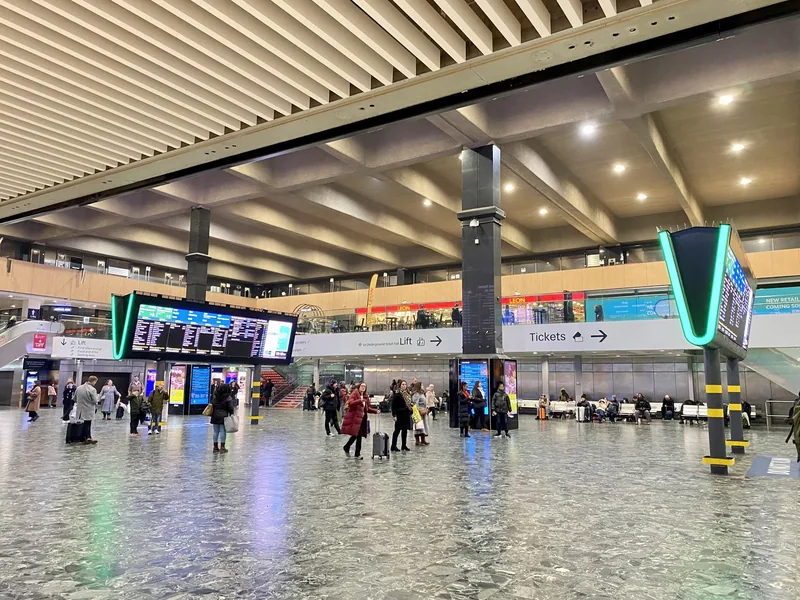
Photo: No Swan So Fine · CC BY-SA 4.0 · Wikimedia Commons · resized
Which one fits you
| Railcard | Who it is for | The catch |
|---|---|---|
| 16-25 | Anyone aged 16 to 25, plus mature students in full-time education | £12 minimum fare on journeys starting 04:30 to 09:59, Monday to Friday, except in July and August and on public holidays |
| 26-30 | Anyone aged 26 to 30 | £12 minimum fare applies to weekday morning journeys |
| Senior | Anyone aged 60 and over | Not valid in the morning peak between two stations inside the London and South East area |
| Two Together | Two named people aged 16 or over who always travel together | Both names are on the card and both must be on the train; valid from 09:30 Monday to Friday |
| Family & Friends | Up to 4 adults travelling with up to 4 children aged 5 to 15 | 1/3 off adults and 60% off children, but not valid in the morning peak inside London and the South East |
| Network | Anyone 16 or over, for travel in London and the South East only | Discount applies from 10am Monday to Friday, with a £13 minimum fare on weekdays |
For most visitors the choice is simple. Travelling as a couple, take Two Together. Travelling with children, take Family & Friends. Under 31 or over 59, take the age-based card, because it is the only kind that also works on Oyster. If none of those fit and you are only doing day trips in the South East, the Network Railcard is the fallback.
The one that works on Oyster
This is where London differs from the rest of Britain. Transport for London lets you add certain railcards to an Oyster card, after which you pay a third less for off-peak pay as you go journeys on the Tube, DLR, London Overground, Elizabeth line and National Rail services in London, and a lower off-peak daily cap applies.
The railcards TfL accepts are the 16-25, 26-30, Senior, HM Forces and Veterans cards, all of which give a third off off-peak pay as you go and cheaper Off-Peak Day Travelcards. The Disabled Persons Railcard is more generous still, giving a third off at peak times as well. The Two Together, Family & Friends and Network railcards cannot be added to Oyster at all; they only reduce the price of paper Off-Peak Day Travelcards.
| Zones | Standard off-peak daily cap | With a railcard on your Oyster | You save |
|---|---|---|---|
| Zones 1-2 | £8.90 | £5.90 | £3.00 a day |
| Zones 1-3 | £10.50 | £6.95 | £3.55 a day |
| Zones 1-4 | £12.80 | £8.50 | £4.30 a day |
| Zones 1-5 | £15.30 | £10.15 | £5.15 a day |
| Zones 1-6 | £16.30 | £10.85 | £5.45 a day |
Two conditions matter. The discount is off-peak only, so a single journey started between 06:30 and 09:30 or between 16:00 and 19:00 on a weekday is charged at the full rate and puts you back on the standard cap for that day. And the railcard has to be physically shown to a member of staff, who then sets the discount on the card.
Getting the discount onto the card
You need three things: a standard Oyster card, the railcard itself, and a staffed counter. Take both to a Tube station ticket window, an Oyster Ticket Stop in a newsagent, or one of a short list of Overground and Elizabeth line stations, and ask for the railcard discount to be set.
The Overground stations that can do it are Barking Riverside, Bethnal Green, Cambridge Heath, Clapham High Street, London Fields and Wandsworth Road. The Elizabeth line stations that can do it include Paddington, Canary Wharf, Woolwich, Custom House, Ealing Broadway, Hayes & Harlington, Southall, West Ealing, West Drayton, Ilford and Romford, generally from 10.00 to 15.00 on weekdays and longer at some of them at weekends. Any Tube station is easier.
A Visitor Oyster card will not take a railcard discount. The railcard operators say the Oyster card must be registered in your name, and a Visitor Oyster card cannot be registered. If you want the discount you need a standard Oyster card, bought in London for a non-refundable £10.50. Add that to the £35 railcard and you are £45.50 down before you have saved anything.
Also remember that the discount is tied to the railcard's expiry date. If you renew the railcard, you have to have the discount set on the Oyster card again. Our review of the Visitor Oyster card explains the differences between the two kinds of card.
Does it pay for itself? The honest arithmetic
Start with the £45.50 you have spent on the card and the Oyster. On London travel alone, a 16-25, 26-30 or Senior railcard saves £3.00 a day if you reach the Zones 1-2 cap entirely off-peak. Over a six-day trip that is £18.00. You are still £27.50 short.
The saving on longer journeys is what closes the gap, because a third off a £30 off-peak return is £10 in a single afternoon. Two or three day trips and the card is paid for; none, and it is not.
| Trip | What the railcard does |
|---|---|
| Six days of off-peak Tube travel, Zones 1-2 | Saves about £18 if you hit the cap each day |
| Off-peak return to Oxford, Brighton or Windsor | A third off each fare, per person |
| Gatwick Express, Stansted Express or Heathrow Express | A third off; the airport expresses are covered by the national railcards |
| Off-Peak Day Travelcard, Zones 1-6 | £11.00 with a railcard instead of £16.60 |
| Anytime Day Travelcard bought with a ticket into London from outside Zone 9 | A third off, subject to a £23.60 minimum fare |
The airport lines are the underrated part. A railcard takes a third off Gatwick Express, Stansted Express and Heathrow Express tickets, which are otherwise among the most expensive short journeys in Britain. Our comparisons of Heathrow Express against the Elizabeth line and of the three Gatwick trains show where that saving lands.
If you are not taking day trips, a railcard is the wrong purchase, and our guide to saving money in London has better ideas. The same is true of sightseeing passes, which we weigh up in is the London Pass worth it.
The restrictions that quietly remove the saving
Every railcard has a morning restriction, and they are not the same as each other.
- 16-25 and 26-30: a minimum fare of £12 applies to journeys starting between 04:30 and 09:59 Monday to Friday. Below that, you pay £12 rather than the discounted fare. The 16-25 minimum does not apply on public holidays or throughout July and August.
- Network: the discount only applies from 10am Monday to Friday, with a £13 minimum fare on weekdays, and only inside the Network Railcard area, which runs roughly from Oxford and Cambridge down to the south coast.
- Two Together: valid from 09:30 Monday to Friday, and both named holders must travel together for the whole journey.
- Senior and Family & Friends: not valid in the morning peak between two stations inside the London and South East area. Peak times vary by route, so check before you buy the ticket.
None of these apply at weekends or on public holidays, which is why railcards suit leisure travellers. Planning your day trips to leave London after 10am is the single easiest way to keep the discount, and our notes on avoiding the rush hour make the same point for a different reason.
What a railcard does not cover
Railcard discounts do not apply to season tickets, Eurostar, or most Underground and DLR tickets bought as paper tickets. The Two Together Railcard is explicit that it gives nothing on Oyster pay as you go fares in London. Nor do railcards reduce bus fares, which are a flat £1.75 and outside the whole system.
If you plan to travel widely in Britain rather than around London, compare a railcard with a BritRail pass, which is sold only to people who do not live in the UK and which covers National Rail services including the Gatwick and Heathrow express trains, but not the Underground, trams or Eurostar. Our guide to London's main railway stations explains which terminus serves which part of the country, and Travelcards and railcard discounts covers the paper-ticket side.
Finally, children under 5 travel free on National Rail, and children aged 5 to 15 already get 50% off most fares without any railcard. A Family & Friends Railcard improves that to 60% and adds a third off the adults, which is where its value lies. Our guide to children's fares in London covers the city side of that.
Frequently asked questions
Which railcards can visitors to Britain buy online?
Yes. The 16-25, 26-30, Senior, Two Together, Family & Friends and Network railcards can all be bought online by visitors, provided you choose the digital version rather than a plastic card posted to a UK address. You need a valid passport, UK driving licence or EEA national identity card and a digital photo.
Which railcard can be added to an Oyster card?
The 16-25, 26-30, Senior, HM Forces and Veterans railcards can be added, giving a third off off-peak pay as you go fares and a lower off-peak daily cap. The Disabled Persons Railcard also works at peak times. Two Together, Family & Friends and Network railcards cannot be added to Oyster.
How much does a railcard save on the Tube?
With the discount on your Oyster card, the off-peak daily cap in Zones 1 and 2 falls from £8.90 to £5.90, a saving of £3.00 a day. In Zones 1 to 6 it falls from £16.30 to £10.85. The discount applies only to off-peak journeys, so a weekday morning trip puts you back on the standard cap for that day.
Is a railcard worth buying for a short trip to London?
Only if you are taking day trips out of the city. The card costs £35, and you also need a standard Oyster card at £10.50 to use the discount on the Tube, because a Visitor Oyster card cannot be registered. Tube savings alone rarely cover that; a third off two or three longer rail journeys usually does.
Can I use a railcard on Heathrow Express or Gatwick Express?
Yes. The national railcards give a third off Heathrow Express, Gatwick Express and Stansted Express tickets. It is one of the most useful discounts on the card, because those services are expensive and are not covered by Transport for London's daily caps.
Sources
- National Rail - Railcards, prices and eligibility (checked September 2026)
- Transport for London - National Railcard discounts and where to add them (checked September 2026)
- Transport for London - Railcard fares and caps (PDF) (checked September 2026)
- 16-25 Railcard - travel times, minimum fares and Oyster (checked September 2026)
- Two Together Railcard - what the discount does not cover (checked September 2026)
- Network Railcard - area, minimum fares and time restrictions (checked September 2026)
- Senior Railcard - buying from outside Great Britain (checked September 2026)