
The cheapest UK train tickets are usually Advance fares, which are bought ahead for one specific train and cannot be refunded. If you need flexibility, Off-Peak tickets for travel after the morning rush cost less than Anytime fares, and a £35 railcard, such as the Two Together or 16-25 Railcard that overseas visitors can buy online, takes a third off most fares.
Britain's railways are run by several train companies, but they share one ticketing system. A ticket from London to Oxford or Edinburgh is priced by that system, and the same journey can cost very different amounts depending on when you buy, when you travel and how flexible you need to be. Buying on the day at the station, at the busiest time, is almost always the most expensive way to travel.
The good news is that the rules are logical once you know them. This guide explains the main ticket types, when each one is the best buy, how railcards and split tickets work, and where visitors can buy tickets without paying more than they need to.
UK rail fares: key rules for visitors
- Advance tickets
- Usually on sale up to 12 weeks ahead; one train only; non-refundable
- Off-Peak hours
- Generally from 09:30 Monday–Friday in cities and large towns; all day at weekends and on bank holidays
- Railcards
- Most cost £35 for 1 year; usually 1/3 off
- Children 5-15
- 50% off most fares
- Children under 5
- Free on most journeys (without a reserved seat)
- Penalty fare
- £100 plus the full single fare; £50 plus the fare if paid within 21 days
The three main ticket types in plain terms
Almost every ticket you will be offered falls into one of three families. The difference between them is simple: the less flexible the ticket, the cheaper it is.
| Ticket type | Which trains | Price level | Refund if you change your mind |
|---|---|---|---|
| Advance | Only the date and train printed on the ticket | Lowest | No (change possible for up to £10 plus any fare difference) |
| Off-Peak / Super Off-Peak | Any train at permitted times on the route | Middle | Yes, up to 23:59 the day before; admin fee of no more than £5 |
| Anytime | Any train, any time, on the route | Highest | Yes, up to 23:59 the day before; admin fee of no more than £5 |
Most tickets are sold as singles (one way) or returns. On the National Rail journey planner and on train company websites, all the valid types for your journey appear side by side, so you can compare them before you pay.
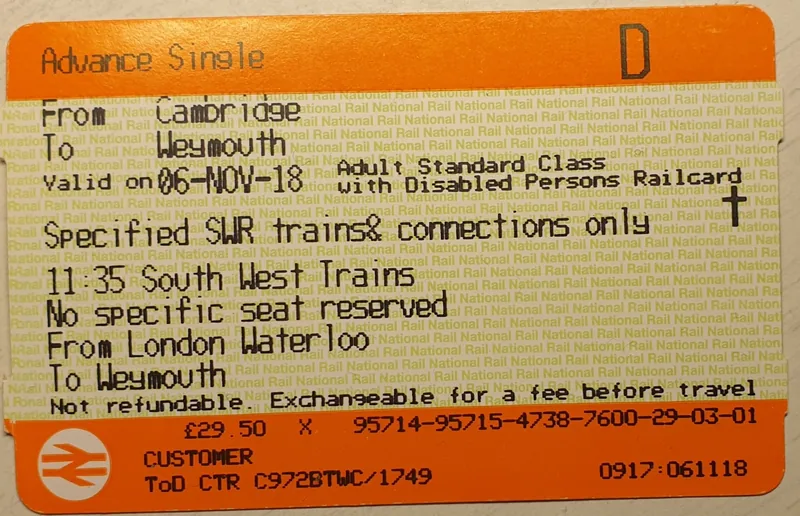
Photo: Silas S. Brown · CC BY-SA 4.0 · Wikimedia Commons · resized
Advance fares: cheapest if you can commit
Advance tickets are the best value for longer journeys. According to National Rail, they usually go on sale up to 12 weeks before travel, and on many routes they are still available on the day, sometimes up to 10 minutes before departure. They are sold in limited numbers, so the cheapest ones go first. National Rail says half a million Advance tickets under £10 are released every week.
The catch is that an Advance ticket is valid only on the date and train shown. Miss that train and the ticket is no longer valid. You can change it before the journey is due to start, but you may pay a £10 fee plus any difference in price. Advance tickets are not refundable unless the train is delayed or cancelled and you decide not to travel.
All Advance tickets are singles. For a return trip you buy two, one each way, which also lets you mix: an Advance ticket out on a fixed morning train, and a flexible Off-Peak single home if you are not sure when you will be finished. Not every service offers seat reservations, but the longer the journey, the more likely you can reserve one when you book.
Twelve weeks out is when the cheap seats appear. If you already know your dates for a trip to Edinburgh, York or Manchester, check fares as soon as Advance tickets go on sale. National Rail's Advance Booking Dates page shows how far ahead each route is open.
Off-Peak and Super Off-Peak: flexible and cheaper
Off-Peak tickets let you take any train on your route, as long as you travel at quieter times. National Rail says off-peak hours generally begin at 09:30 Monday to Friday in cities and large towns, and at 09:00 elsewhere. Weekends and bank holidays are off-peak all day. Evening restrictions may also apply on some routes, and the times you can travel are shown when you buy.
Where a route has two off-peak fares, the cheaper one with more restrictions is called Super Off-Peak. Each ticket carries a restriction code that tells you exactly when it is valid. If in doubt, look it up with the National Rail ticket guidance and its Ticket Validity Finder.
Off-Peak Day tickets are valid only on the date shown. Off-Peak Returns are valid for one month, although the outward journey must be on the date shown. If you travel at a restricted time by mistake, you will have to pay the difference between your ticket and an Anytime fare.
For most visitors, Off-Peak is the natural choice for Canterbury, a day in Oxford, Cambridge by train or a day at the seaside in Brighton: you avoid the commuter crush, you do not need to pick a train home, and the fare is much lower than Anytime.
Anytime tickets: when flexibility is worth the price
Anytime tickets have no time restrictions, and you can break your journey at stations along the route. National Rail says Anytime Singles are valid for travel within 2 days of the date shown, and most Anytime Returns are valid for 5 days on the outward part and 1 calendar month on the return.
They are the most expensive option, so buy one only if you really must travel in the morning peak, or if your plans are genuinely uncertain. For business travellers or anyone with a fixed early meeting outside London, the extra cost can be worth it.
Split ticketing: allowed, and sometimes cheaper
Split ticketing means buying two or more tickets that together cover your journey, instead of one through ticket. For a train that runs from station A through B to C, you might buy A to B and B to C. National Rail confirms this is allowed under section 14 of the National Rail Conditions of Travel.
The rules are simple. The train must stop at the station where your tickets change, to let passengers on and off. You usually do not need to leave the train. You must carry all the tickets, and any railcard used, for the whole trip, and travel at times that are valid for each ticket. If you reserved seats, you may need to change seats at the point where the tickets change.
Split tickets are not always cheaper, split ticketing is not available for every service or ticket type, and National Rail does not offer a split-ticket search itself. Whatever combination you find, compare its total with the through fare on the National Rail planner before buying.
Railcards a visitor can actually buy
A railcard is a discount card that usually gives one third off most fares for a year. National Rail lists nine types, and most cost £35 for one year. The question for visitors is which ones you are allowed to buy and whether you will spend enough to recover the cost.
Two railcards are clearly open to overseas visitors. The Two Together Railcard and the 16-25 Railcard can both be bought online as a digital card on your phone. The Two Together card can also be bought at the railway stations at Gatwick, Stansted and Luton Airport Parkway, but not at Heathrow.
| Railcard | Who it is for | 1-year price | Main conditions |
|---|---|---|---|
| Two Together | Two named adults travelling together | £35 | Both must travel together; not valid 04:30–09:29 Monday–Friday (except public holidays) |
| 16-25 | Ages 16 to 25, and mature students | £35 (£80 for 3 years) | £12 minimum fare Monday–Friday 04:30–09:59 |
| 26-30 | Ages 26 to 30 | £35 | Check eligibility and time rules on the railcard website |
| Senior | Age 60 and over | £35 (£80 for 3 years) | Check eligibility and time rules on the railcard website |
| Family & Friends | Up to 4 adults with up to 4 children | £35 (£80 for 3 years) | 1/3 off adult fares and 60% off child fares |
The maths is easy, and our wider guide to London on a budget uses the same logic. A railcard costing £35 that saves one third pays for itself once you spend £105 on fares in a year. A couple planning three or four day trips from London, or one long journey such as London to Edinburgh and back, will often reach that. For a single short trip it will not.
The Two Together card is useless when you travel apart. Both people named on the card must travel together for the whole journey, or the discounted tickets are not valid. And it cannot be added to an Oyster card, so it gives no discount on the Tube.
Some railcards, including the 16-25, 26-30 and Senior cards, can be added to an Oyster card by station staff for one third off off-peak pay as you go fares in London. Our guide to Travelcards and railcard discounts in London explains how that works.
Children, families and groups
Children aged 5 to 15 get 50% off most tickets, including Advance, Off-Peak and Anytime fares. National Rail says children under 5 travel free on most journeys, but they may only use a seat not needed by a fare-paying passenger. If you want a reserved seat for a child under 5, buy a child ticket. Check the rules with the train company, as they can vary.
The Family & Friends Railcard is designed for groups with children: it gives one third off adult fares and 60% off child fares. For a family of four making even one long return journey, it can be the single best saving on offer. For children's fares on the Tube and buses, which follow different rules, see our guide to children's fares on London transport.
Where and how to buy tickets
You can buy train tickets on the National Rail website or app, on any train company's website or app, at station ticket offices and at ticket machines. National Rail's own planner shows times and fares for every operator.
Always buy before you board. On many routes, travelling without a valid ticket can lead to a penalty fare of £100 plus the full single fare, reduced to £50 plus the fare if paid within 21 days. If the ticket office was closed and the machine broken, you should buy a ticket on board (where possible) or at the first opportunity.
Where contactless and Oyster replace a ticket
Within London, you often do not need a paper ticket at all. Pay as you go with contactless or Oyster works on most National Rail services within Zones 1-9, and on some routes beyond. Trains to Gatwick Airport accept both, but contactless and Oyster are not valid south of Gatwick, and they are not valid to Windsor either. Our explainer on Oyster, contactless and fare caps covers where each works, and our guide to visiting Windsor Castle explains the train options there.
Leaving from the right station matters as much as the ticket. London has several big terminals, each serving a different part of the country: Paddington for Bath and the west, King's Cross for Edinburgh and the north-east, and Euston for Manchester and the north-west. Our guide to London's main railway stations shows which one you need.
BritRail passes for overseas visitors
A BritRail pass gives unlimited travel on National Rail services for a set number of days. It is sold only to people who do not live in the UK: anyone who has lived in Britain for the last 6 months or more is not eligible, and proof of foreign residency may be requested. Passes come as Consecutive (every day in a row) or Flexi (a number of days within a longer period).
The Great Britain pass covers National Rail services, including Heathrow Express and Gatwick Express. It does not cover the Eurostar to Paris, the London Underground or trams, and the BritRail London Plus Pass does not include the Tube. A pass suits visitors planning several long journeys in a short time. For a trip based in London with a couple of day trips, Advance or Off-Peak tickets with a railcard usually cost less. Check current prices on the official BritRail site and compare them with your planned fares.
When your train is late or cancelled
If your train is delayed or cancelled and you choose not to travel, you can get a full refund from the retailer, with no fee. If you do travel and arrive late, you may be able to claim compensation from the train company. Many companies take part in Delay Repay, a nationwide scheme. The minimum delay and the amount you get back depend on the company and your ticket, so check the train company's website and claim online or by post.
For longer journeys, the route guides on our sister site Viamo, such as London to Edinburgh by train, coach and air, compare journey times and options. And if your budget is very tight, compare the train with a coach from Victoria Coach Station, especially when booking at short notice.
Frequently asked questions
How far in advance can I buy UK train tickets?
Advance tickets usually go on sale up to 12 weeks before travel, according to National Rail, and on many routes they are still sold on the day. Off-Peak and Anytime tickets can be bought at any time before you travel, so you can wait until your plans are fixed if flexibility matters more than price.
Can tourists buy a UK railcard?
Yes. Overseas visitors can buy the Two Together Railcard and the 16-25 Railcard online as digital railcards. The Two Together card is also sold at Gatwick, Stansted and Luton Airport Parkway stations, but not at Heathrow. Most railcards cost £35 for a year and give one third off most fares.
Is split ticketing legal in the UK?
Yes. National Rail confirms that split ticketing is allowed under section 14 of the National Rail Conditions of Travel. The train must stop at the station where your tickets change, and you must carry all the tickets and follow the conditions of each one.
What happens if I miss the train on an Advance ticket?
An Advance ticket is valid only on the train shown, so if you miss it the ticket is normally no longer valid and you will need a new one. You can change an Advance ticket before your journey starts, for a fee of up to £10 plus any difference in fare.
Can I buy a train ticket on board?
You should buy before you board. On many routes, travelling without a ticket can mean a penalty fare of £100 plus the full single fare. If the ticket office and machines at your station were not working, buy on board where possible or at the first opportunity.
Sources
- National Rail - Advance tickets (checked September 2026)
- National Rail - Off-Peak and Super Off-Peak tickets (checked September 2026)
- National Rail - Anytime tickets (checked September 2026)
- National Rail - Split train tickets (checked September 2026)
- National Rail - Railcards (checked September 2026)
- Two Together Railcard - Can visitors to Britain buy the Two Together Railcard? (checked September 2026)
- National Rail - Penalty fares (checked September 2026)
- BritRail - Eligibility and conditions of use (checked September 2026)