
London's public transport is more accessible than its Victorian Tube tunnels suggest: every bus has a ramp and a wheelchair space, every DLR station and all 41 Elizabeth line stations are step-free, and about a third of Tube stations have step-free access. TfL staff will also help you on the Tube, Overground and Elizabeth line without any booking, including laying ramps and meeting you at your destination.
"Step-free" means you can get from the street to the platform, and sometimes onto the train, without using stairs or escalators. That is done with lifts, ramps and level surfaces. It matters for wheelchair users, but also for anyone with a pushchair, heavy luggage, a walking aid or a health condition that makes stairs hard.
The catch is that step-free access is uneven. The newer parts of the network, such as the Elizabeth line and the DLR, were built with it from the start. Many older Tube stations in central London still have only stairs and escalators. So the answer for visitors is to plan each journey in advance with TfL's tools, and to know what help you can ask for on the day.
Step-free travel in London at a glance
- Tube
- 95 step-free stations, more than a third of the network
- Elizabeth line
- All 41 stations step-free from street to platform
- DLR and trams
- All stations and stops step-free
- London Overground
- More than 60 step-free stations
- Buses
- All low-floor, with a ramp and a wheelchair space
- Black cabs
- All have a wheelchair ramp
- Staff help on the Tube
- Turn up and go, no booking needed
What the wheelchair symbols on the Tube map mean
The standard Tube map marks step-free stations with a wheelchair symbol, and the colour tells you something important. A blue symbol means step-free access from the street to the train: there is only a small step and gap, and most people, including most wheelchair users, can board without help. A white symbol means step-free from the street to the platform only. There is a larger step and gap between the platform and the train, and you will need a boarding ramp.
For more detail, TfL publishes a Step-free Tube guide (PDF). It shows, station by station, the height of the step and the width of the gap, which interchanges are step-free, and which stations keep ramps. You can download it from TfL's wheelchair access and avoiding stairs page. TfL also publishes a map showing where the tunnels are, which helps people who find being underground difficult.
New step-free stations keep being added. Knightsbridge became step-free in April 2025, Colindale in December 2025 and Northolt in September 2026, so a map printed a few years ago will be out of date.
Planning a step-free journey
The simplest tool is TfL Go, the free TfL app, or the Journey Planner on the TfL website. Both let you ask for step-free routes. In Journey Planner, choose "accessibility and other travel options" and then "I need step-free access from street to the train", or the street-to-platform option if you are happy to use a ramp. The planner will avoid stations and interchanges that do not meet your choice, even if the route takes longer.
Plan the return journey as well. A station can be step-free in one direction and not in the other, and interchanges between lines are a common weak point. Check on the day, too: lifts are sometimes out of service for repairs, and the TfL status pages show this.
A broken lift does not leave you stranded. If you arrive at a Tube, Elizabeth line or Overground station and the lift is out of service, staff will help you find another step-free route. If there is no reasonable alternative, TfL will book an accessible taxi at its own cost to take you to another step-free station or to your destination station within Greater London.
Help from staff: turn up and go
On the Tube, the London Overground and the Elizabeth line you do not need to book help in advance. Tell a member of staff at the station, or press the information button on a help point, and say where you are going. Staff will take you to the train, lay a ramp if one is needed, and contact your interchange and destination stations so that someone meets you there. They can also push a manual wheelchair.
Staff will go with you to a lift but do not travel in it with you. They meet you at the lift exit on the correct floor. If you need help and the station entrance has a queue, for example at a busy time or during disruption, you should not have to wait outside: tell a member of staff.
Booking help in advance with Passenger Assist
If you prefer to arrange help ahead of time, you can use Passenger Assist. Book at least two hours before you travel by phone on 0343 222 2000 (24 hours a day, except Christmas Day), online, or in the Passenger Assistance app. It covers the Overground, the Elizabeth line and 30 listed Tube stations. Help with luggage is only available as part of Passenger Assist at those stations. On the DLR, assistance can be booked on 0808 281 6655. Details are on TfL's Passenger Assist page.
Ramps, mini ramps and "Board here" signs
Where a station is step-free to the platform but not to the train, staff use a boarding ramp. These are available on Tube, Overground and Elizabeth line services, and staff are trained to use them. At your destination, a member of staff will be waiting on the platform with a ramp to help you off.
Mini ramps cover the small step and gap that remain at some "street to train" stations. They help people using mobility aids with small or swivel wheels. TfL lists 69 Tube stations with mini ramps, including King's Cross St. Pancras, London Bridge, Green Park, Canary Wharf, Heathrow and the Jubilee line platforms at both Westminster and Waterloo. Ask staff to lay one down.
Some platforms have a raised section, called a platform hump, that gives level access to one part of the train. Look for a "Board here" sign on the back wall of the platform, and sometimes on the ceiling or floor. The best door depends on the line and the direction: on the Victoria line it is carriages 4 and 5 in both directions, while on the Piccadilly line it is carriage 5 going east or north and carriage 2 going west or south. TfL's page lists every line.
Some parts of the network have level access along the whole platform: the Jubilee line east of Westminster, the entire DLR, and new stations on the London Overground.
The Elizabeth line, DLR and Overground
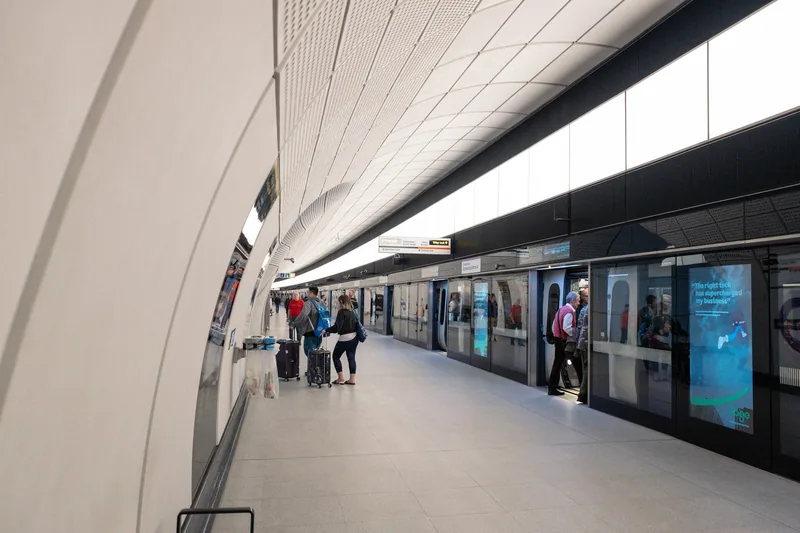
The Elizabeth line is the most accessible way to cross central London. All 41 stations are step-free from the street to the platform, and from Paddington to Woolwich, and at Heathrow, there is level access onto the trains as well. At Custom House, level access is from the fifth carriage only. At other stations, such as those further out to Reading or Shenfield, staff will lay a boarding ramp.
Each Elizabeth line train has four dedicated wheelchair spaces, with alarm buttons, in the fifth carriage close to the doors. If you need step-free access, board at carriage 5.
Every DLR station is step-free from street to train, which makes the DLR a good choice for Canary Wharf, Greenwich and London City Airport. Most DLR stations have no staff, but staff ride on the trains. More than 60 Overground stations are step-free. Our guide to the DLR and the Overground covers both networks.
Buses: the most accessible option for short trips
Every London bus route uses low-floor buses with a ramp and a dedicated space for one wheelchair user. The bus can also be lowered ("kneel") to reduce the step from the pavement. If the driver has not lowered it and you need them to, ask. Drivers are expected to pull in close to the kerb.
Wheelchair and mobility scooter users travel free on London's buses and trams. Companions and carers pay the normal fare, which is £1.75 until 1 November 2026, when it rises to £1.85. Whether your scooter is suitable for buses is something TfL's travel mentoring service can advise on. Our guide to London's buses explains routes, stops and how to pay.
Each bus has only one wheelchair space. The law gives it to a wheelchair user first, so a buggy sitting in it has to fold or move, and the driver will say so. If another wheelchair user has the space, you wait for the next bus, so allow extra time at busy hours and on popular routes through the centre.
Taxis, the river and the cable car
All black cabs have a wheelchair ramp, and most also have an intermediate step and a seat that swivels out, which helps people who can walk a little. Ask the driver to use them. Some minicabs are wheelchair accessible, but not all, so say what you need when you book. Our guide to black cabs, minicabs and Uber has fares and booking advice.
All Uber Boat river bus boats are wheelchair accessible, and all piers are step-free except Cadogan, Wandsworth Riverside Quarter and London Bridge City. The IFS Cloud Cable Car (London Cable Car) is step-free at both ends, making it one of the easier ways to get a view over the Thames.
Step-free routes to the sights, the airports and the Eurostar
Some of the busiest sightseeing stations are not step-free, so it helps to know the alternatives. South Kensington, the closest station to the Natural History Museum, is not step-free. The V&A suggests Knightsbridge, about 14 minutes' walk away, as its step-free option. For the National Gallery, the gallery points to Charing Cross main-line station, about 200 metres away, as a step-free route.
Two other well-known destinations need a second look. Tower Hill, about five minutes from the Tower of London, is step-free as far as the street, although the fortress beyond it is a collection of medieval buildings and several parts have steps that cannot be taken out. At Kew Gardens, the station is 500 metres from the Victoria Gate but only one of its two platforms is step-free, the one for trains towards the centre, so the journey home has to be planned separately from the journey out.
At the airports, all Heathrow stations are step-free from train to street, and the Elizabeth line gives level access there. That makes it the easiest rail route from Heathrow into central London for many wheelchair users. Our comparison of Heathrow transfer options sets out the fares and journey times.
Leaving by train for the continent changes the timings rather than the route. Eurostar asks passengers who have booked accessible travel to be at St Pancras 60 minutes before departure, instead of the 75 minutes it asks of Standard and Plus passengers, and the gates still close half an hour before the train goes. Our guide to Eurostar from London covers check-in and what happens at the gates.
Late nights, railcards and days when things go wrong
The Night Tube runs to exactly the same step-free stations as the daytime service, and those stations are staffed for as long as trains are running, so asking for help at two in the morning works the same way it does at two in the afternoon. Help points on most platforms and in all ticket halls connect you to staff at stations where nobody is in sight.
Fares are worth a moment too. A UK Disabled Persons Railcard can be loaded onto an Oyster card by station staff, and it then takes a third off pay as you go fares at every hour of the day, peak included. That is unusual: most railcard discounts on Oyster apply only off-peak, so this one is worth carrying if you have it.
Disruption falls harder on a step-free journey than on any other, because there are fewer ways round it. Lifts are taken out of service at short notice, and a weekend closure for engineering work can remove a whole step-free corridor rather than a single station. Check the route again on the morning you travel, and check it once more before you set off back. On days when the Tube is on strike, assume the plan has to be rebuilt around buses and the river instead.
Everything that happens away from the network is covered elsewhere. Our guide to accessible London deals with hotels, toilets, parking with a Blue Badge and getting into the buildings themselves, and London transport in a wheelchair goes line by line, door by door, and through what to do when a lift has failed.
Frequently asked questions
Is the London Underground wheelchair accessible?
Partly. 95 Tube stations, more than a third of the network, have step-free access, and many of these have level or near-level boarding. Many older central stations still have only stairs and escalators, so plan your route with TfL Go or Journey Planner using the step-free options.
Do I need to book assistance on the Tube?
No. On the Tube, the Overground and the Elizabeth line you can simply ask staff at the station, and they will help you to the train, lay a ramp and arrange for someone to meet you. If you prefer, you can book through Passenger Assist at least two hours in advance.
Are London buses accessible for wheelchair users?
Yes. Every London bus route uses low-floor buses with a ramp and a dedicated wheelchair space, and buses can be lowered to the kerb. Wheelchair and mobility scooter users travel free on buses and trams, while companions pay the normal fare.
What do the blue and white wheelchair symbols on the Tube map mean?
A blue symbol means step-free from the street to the train, with only a small step and gap. A white symbol means step-free from the street to the platform only, with a larger step and gap, so you will need staff to lay a boarding ramp.
Is the Elizabeth line step-free from Heathrow?
Yes. All Heathrow stations are step-free from street to train, and the Elizabeth line has level boarding at Heathrow and at all stations from Paddington to Woolwich. Board at carriage 5 for the dedicated wheelchair spaces.
Sources
- Transport for London - Wheelchair access and avoiding stairs (checked September 2026)
- Transport for London - Ramps at stations (checked September 2026)
- Transport for London - Priority seating and other features on board (checked September 2026)
- Transport for London - Help from staff (checked September 2026)
- Transport for London - Passenger Assist (checked September 2026)
- Transport for London - Accessibility: fares and tickets (checked September 2026)
- Transport for London - Step-free access (checked September 2026)
- Transport for London - DLR (checked September 2026)