
Every Heathrow terminal has a multi-faith prayer room, several of them with wudu facilities, and Gatwick's permanent prayer rooms are open around the clock in both terminals. In the city itself the two mosques most visitors use are the London Central Mosque beside Regent's Park and the East London Mosque on Whitechapel Road, and both welcome people who are not Muslim.
London has one of the largest Muslim populations of any Western European city, which shows up in ordinary ways: halal meat in supermarket chillers, prayer rooms in shopping centres, mosques on high streets in half the boroughs. None of it is signposted for visitors, though, and the official websites of the big museums are quiet on the subject.
This page is the practical layer: where prayer space exists and when it is open, how a mosque visit works, what wudu is realistically possible in a city of locked public toilets, and what changes during Ramadan. For the food, our guide to halal food in London covers certification, the areas and what to ask in a restaurant.
Prayer facilities at a glance
- Heathrow
- Multi-faith prayer rooms in every terminal, before and after security. Wudu at T3 arrivals, T4 (both rooms), T5 check-in Zone A, T5A and T5B
- Gatwick
- Permanent chapel and prayer rooms in North and South terminals, open 24 hours. Temporary room after security in North Terminal, 04:00–22:00, no washing facilities
- London Central Mosque
- 146 Park Road, NW8 7RG, at the edge of Regent's Park
- East London Mosque
- 82–92 Whitechapel Road, E1 1JQ. Entrance 3 for men, Entrance 4 for women
- Westfield Stratford City
- Multi Faith Room on the first-floor World Food Court balcony, Mon–Sat 12 noon–9pm, Sun 12 noon–6pm
- Mosque tours
- Free at the East London Mosque; charged at the Islamic Cultural Centre (£60–£140 by group type and size)
- Next Ramadan
- Expected to begin around 8 February 2027, subject to the sighting of the moon
The airports, terminal by terminal
Heathrow provides a multi-faith prayer room in every terminal, and publishes the locations. In Terminal 2 they are after security, near Gate A21 and beside Gates B34 and B35. Terminal 3 has one after security near Gate 24 and a second in the arrivals hall on Level 1. Terminal 4 has one before security on the Mezzanine Level and one after security near Gate 4. Terminal 5 has a room at check-in Zone A, one after security near Gate A8, and further rooms in the satellites near Gate B34 and Gate C52.
Wudu facilities are not in all of them. Heathrow lists ablution facilities at the Terminal 3 arrivals room, both Terminal 4 rooms, the Terminal 5 check-in room, and the Terminal 5A and 5B rooms after security. The rooms hold sacred texts and religious items in cupboards, which you are welcome to use and asked to return. They are shared spaces used by people of many faiths, so a group praying together should leave room for others.
At Gatwick the permanent chapel and prayer rooms in both terminals are open 24 hours a day, seven days a week: on the third floor in the South Terminal, and on the first floor at the far end of the self-service check-in area in the North Terminal, both before security. There is also a temporary multi-faith room after security in the North Terminal, near the lounges, open from 04:00 to 22:00, with Qibla marked and a separate space for women, but with no washing facilities in that room. Plan wudu before you go through security there. Our guides to Heathrow and Gatwick cover the rest of the arrival.
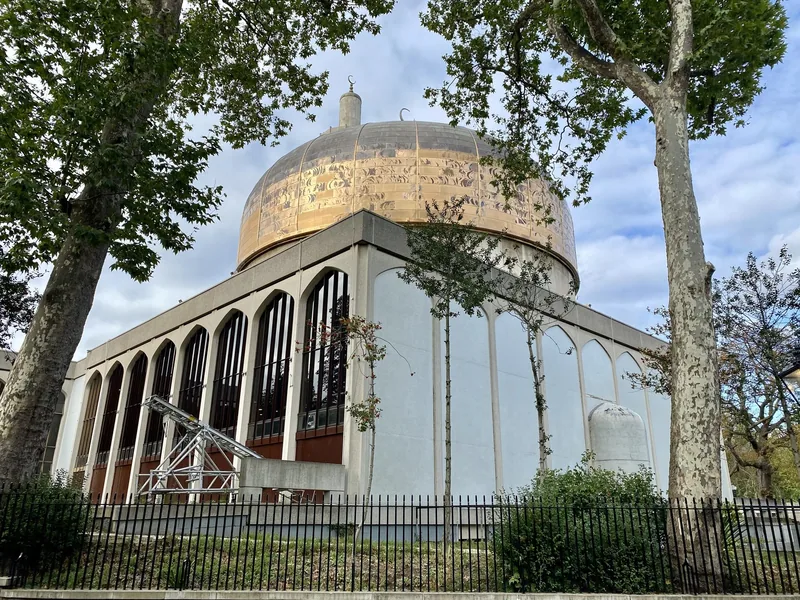
Photo: No Swan So Fine · CC BY-SA 4.0 · Wikimedia Commons · resized
The two mosques most visitors go to
The London Central Mosque, run by the Islamic Cultural Centre, stands at 146 Park Road, NW8 7RG, on the western edge of Regent's Park, with its gold dome visible from the boating lake. It is the most central large mosque in London and the easiest to combine with an ordinary day of sightseeing. The Centre publishes a prayer timetable for the year on its website.
The East London Mosque on Whitechapel Road is the bigger institution and the one embedded in a community rather than in a park. The complex has several parts: the mosque itself at 82–92 Whitechapel Road (E1 1JQ), the London Muslim Centre next door at number 46, and the Maryam Centre around the back at 45 Fieldgate Street. For daily prayers, Entrance 3 leads to the men's prayer area and reception, and Entrance 4 to the women's.
Getting there is straightforward and driving is not: the mosque says there is no visitor parking and that roadside parking nearby is extremely limited. Aldgate East and Whitechapel stations are both a short walk, buses 25, 205 and 254 stop on Whitechapel Road, and there are Santander Cycles docking stations nearby. Our guide to Whitechapel and the East End covers what else is on that street.
Visiting a mosque when you are not Muslim
Both mosques take visitors, but they organise it differently, and the difference matters if you are on a short trip.
The East London Mosque runs free guided tours. School and college groups are normally taken Tuesday to Thursday from 10.30am; university and adult groups on Tuesday and Thursday afternoons. Groups are usually up to 30 people and a tour runs about an hour and a half. Booking is through the mosque's own form and dates fill quickly. If you turn up without a booking, the advice is to ask the visits team or reception whether a tour is possible that day, which depends on staff availability. Tours are free, though donations are welcomed.
The Islamic Cultural Centre organises visits through its education department, on Mondays to Thursdays, in slots at 10.15am, 12 noon and 1.30pm, lasting about an hour. These are charged: the published fee structure runs from £60 for a primary or secondary group of up to 30, through £80 to £120 for A level and college groups, to £100 to £140 for university groups, according to size. Book at least two weeks ahead; the Centre aims to reply within 72 hours, and its visits office is open Monday to Thursday, 10am to 4pm.
The etiquette is the same in both. Shoes come off before the prayer halls, and there are racks outside. The East London Mosque's published dress code asks visitors to avoid see-through or low-cut clothing, to have sleeves below the elbow and skirts, dresses or shorts below the knee, and for women to cover the head and chest with a scarf; the mosque can lend one. No food or drink in the prayer halls, no smoking or vaping anywhere in the buildings, and personal photographs are fine as long as you do not photograph people praying. All of the tour route is wheelchair accessible.
Do not book a tour for a Friday. Jumu'ah fills both mosques completely, and a visitor tour would be in the way. Tuesday to Thursday is what both institutions offer, and it is the right advice regardless of the timetable.
Prayer rooms in shops, stations and museums
Away from the airports and the mosques, provision is patchy and rarely advertised.
The clearest example is Westfield Stratford City, which runs two rooms. The Multi Faith Room, staffed by volunteers from Faith Space London, is on the balcony at the back of the first-floor World Food Court, open Monday to Saturday from 12 noon to 9pm and Sunday from 12 noon to 6pm. A second space, the Rest & Faith Space, is on the second floor near Nandos, open Monday to Thursday from 12 noon to 6pm. Both are described as being for guests of all faiths. Our page on Westfield Stratford and White City covers the centres themselves, and Stratford the area.
The large national museums are the gap. None of them publishes a prayer room on its visitor information pages, and we could not confirm one at the British Museum, the V&A or the Science Museum. In practice the information desk at a big museum can usually direct you to a quiet room or a first-aid room if you ask, but it is not a service you can plan a prayer time around. Assume you will be praying outside, in a park or a quiet corner, and take a mat.
Stations are worse. There is no network of prayer rooms across the Underground or the main termini, and the chaplaincies that exist serve staff. The honest advice is to treat the airports and the mosques as the fixed points and everything in between as improvisation.
Wudu when there is nowhere to do it
This is the practical problem nobody writes about. London has few public toilets, many of the surviving ones charge, and washing feet in a basin in a busy café is at best awkward.
Three things help. First, the airports and the mosques are the only places where facilities are designed for it, so use them when you pass through. Second, the large department stores, the big museums and the main-line stations have the roomiest and cleanest toilets in central London, usually with an accessible cubicle that gives you space and a door; our guide to public toilets in London maps where they are. Third, many visitors carry wudu socks or use a small bottle, which removes the problem entirely.
Timing helps too. In midwinter, Zuhr and Asr fall close together in the early afternoon and Maghrib is before five, so a whole day of prayers can be arranged around your hotel and one stop in between. In midsummer the day is long, Isha is very late, and a mosque visit in the middle of it is the simplest plan.
Friday prayers as a visitor
Both central mosques are extremely busy for Jumu'ah, and both run on a timetable that shifts through the year. Check the timetable on the mosque's own website for the week you are there rather than relying on an app's default calculation, which may use different conventions.
Arrive well before the khutbah. At the East London Mosque the overflow reaches into the London Muslim Centre and beyond on a busy week, and Whitechapel Road outside is crowded for an hour afterwards. At Regent's Park the congregation spills across the forecourt. Neither is a problem, but neither is a place to arrive five minutes late with luggage.
If you are staying in the centre and want somewhere smaller, most London high streets have a mosque, and many are in converted buildings you would walk past without noticing. Ask at a halal butcher or restaurant; it is a normal question and you will get a straight answer.
Ramadan in London, and why 2027 is the easy version
Ramadan moves about eleven days earlier each Gregorian year. The 1448 Ramadan is expected to begin around 8 February 2027, although the start depends on the sighting of the new moon and mosques confirm it only a day or two beforehand.
A February Ramadan in London is about as gentle as it gets. The days are short, sunset is in the late afternoon, and the gap between the pre-dawn meal and iftar is far shorter than it is when Ramadan falls in June, when it is still light after nine in the evening. If you have a choice of years, a winter Ramadan is much easier to travel in.
Practically, the mosques extend their hours. During Ramadan the London Central Mosque has opened daily from 10am until the end of Taraweeh prayers, and in recent years it has reopened in the small hours for Tahajjud during the last ten nights. Check the current year's notice on the Centre's website, since the exact arrangements change.
The restaurant side of the month, including which streets stay open late for iftar, is covered in our guides to Brick Lane and London's curry scene and Middle Eastern food on Edgware Road. Expect central London to carry on entirely as normal during the day; nobody will comment on you not eating.
Eating, drinking and the things nobody warns you about
Three small traps catch visitors regularly. The first is alcohol in food rather than in glasses: wine in sauces, beer in batter, liqueur in desserts, and alcohol used to flambé. Ask specifically rather than asking whether a dish is halal, which some staff will answer as a question about meat only.
The second is the pub. Pubs in Britain are community spaces as much as drinking places, they serve a lot of food, and many now keep a serious range of alcohol-free drinks; our guide to drinking without alcohol explains what to order and how the labelling works. There is no obligation to drink, and no one will find it odd. The wider rules on where alcohol may be consumed are in alcohol laws and drinking in public.
The third is gelatine, which turns up in sweets, desserts and some medicines. Our guide to Turkish food in London covers a cuisine where this is rarely a worry and the standard is consistently high.
Dress, questions and what the law says
London is used to religious dress and you will see every version of it on an ordinary Tube carriage. Hijab, niqab and thobe attract no attention in most of the city, and certainly none in the centre or the east.
Britain's Equality Act 2010 makes religion or belief a protected characteristic, which means a shop, hotel, restaurant or transport operator may not refuse service or treat you worse because of your faith or your dress. If something goes wrong, the route is to complain to the business first and then to the relevant regulator or the police if it amounts to a crime; our page on complaining, returning and consumer rights explains how that works in practice.
On manners, the British norms are the ones in our guide to British etiquette, and they apply to everyone. If you are visiting other places of worship while you are here, the same courtesies travel: our page on the Neasden temple sets out a dress code and photography rules that will look familiar. Two small practical notes: prayer-time apps drain a battery quickly, so read our guide to charging your phone in London; and a summer Ramadan in a hot spell is genuinely hard work, which London in a heatwave addresses.
Frequently asked questions
Are there prayer rooms at Heathrow Airport?
Yes. Heathrow provides multi-faith prayer rooms in every terminal, both before and after security, and publishes the locations by gate. Wudu facilities are available at several of them, including the Terminal 3 arrivals room, both Terminal 4 rooms and three of the Terminal 5 rooms.
Can non-Muslims visit a mosque in London?
Yes. The East London Mosque runs free guided tours, normally on Tuesday to Thursday, with groups booked in advance and individuals asked to enquire at reception on arrival. The Islamic Cultural Centre at Regent's Park runs charged educational visits Monday to Thursday in three daily slots.
What should I wear to visit a London mosque?
The East London Mosque asks visitors to avoid see-through or low-cut clothing, to have sleeves below the elbow, and to keep skirts, dresses and shorts below the knee. Women are asked to cover the head and chest with a scarf, and the mosque can lend one. Shoes come off before the prayer halls.
Where can I pray in central London between sights?
There is no network of public prayer rooms in central London and the large national museums do not publish one. The reliable options are the two big mosques, the prayer rooms at Westfield Stratford City, and the airports. Otherwise a park or a quiet corner with a mat is what most visitors use.
When is Ramadan in London in 2027?
It is expected to begin around 8 February 2027, but the start is confirmed by the sighting of the new moon and may move by a day. Check with a London mosque rather than relying on a calendar app. A February Ramadan means short fasting days compared with a summer one.
Sources
- Heathrow Airport - Multi-faith prayer rooms and wudu facilities (checked September 2026)
- London Gatwick - Our chapel and prayer rooms (checked September 2026)
- East London Mosque - Guided tours, dress code and visitor guidelines (checked September 2026)
- East London Mosque - Our location, entrances and transport (checked September 2026)
- Islamic Cultural Centre and London Central Mosque - Educational visits and fees (checked September 2026)
- Westfield Stratford City - Multi Faith Prayer Room (checked September 2026)
- Equality Act 2010, section 10: religion or belief (checked September 2026)