
Regent's Park is a large, free Royal Park on the northern edge of central London, known for its rose gardens, boating lake, open-air theatre and London Zoo. Primrose Hill, just across the road to the north, is a grassy hill with one of the best free views of the London skyline.
The two are managed together by The Royal Parks charity, but they feel very different. Regent's Park is neat and elegant, laid out in the early 19th century by the architect John Nash for the Prince Regent, the future George IV, with formal gardens, tree-lined avenues and Regency terraces around its edges. Primrose Hill is simpler: open grass, a few paths and a summit where people sit to look at the city.
You can see the best of both in half a day on foot, and it costs nothing unless you hire a boat, see a play or visit the zoo. A good plan is to enter from Baker Street or Regent's Park station, walk north through the gardens and finish on top of Primrose Hill, ideally late in the afternoon when the light on the skyline is softer.
Regent's Park and Primrose Hill in brief
- Entry
- Free
- Regent's Park gates
- Pedestrian gates open at 5am and close at dusk (8pm in mid-September 2026)
- Primrose Hill
- Open 24 hours, except during occasional planned closures
- Size
- About 166 hectares, plus Primrose Hill
- Nearest Tube stations
- Regent's Park (Bakerloo line), Baker Street, Great Portland Street, Warren Street; Chalk Farm (Northern line) for Primrose Hill
- Highlights
- Queen Mary's Gardens, the boating lake, the Open Air Theatre, London Zoo, the view from Primrose Hill
- Managed by
- The Royal Parks, a registered charity
How the park is laid out
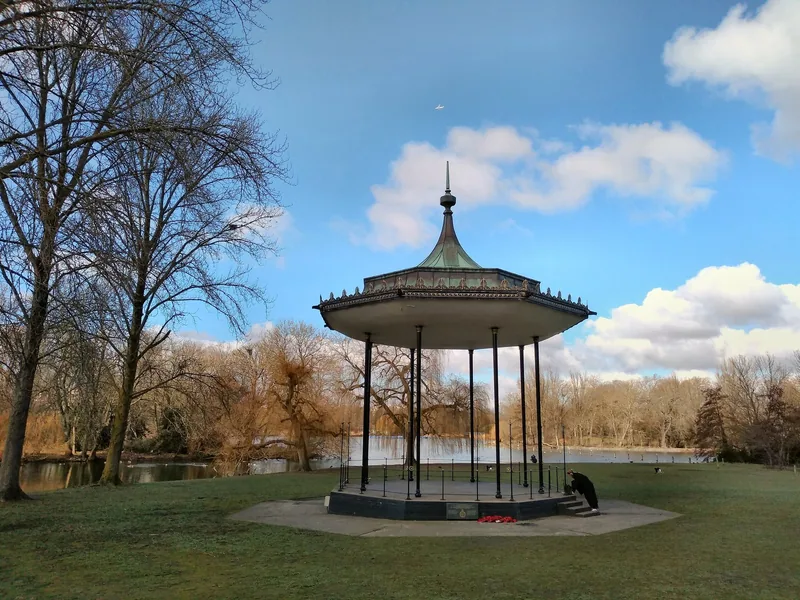
Regent's Park is roughly round, with two ring roads inside it. The Outer Circle runs around the edge, lined by Nash's terraces. The Inner Circle is a smaller ring in the middle that encloses Queen Mary's Gardens and the Open Air Theatre. From the south-east, a long straight avenue called the Broad Walk runs north past the formal Avenue Gardens towards London Zoo.
The boating lake lies on the western side, near Hanover Gate. London Zoo fills the northern edge, and Primrose Hill lies beyond it, on the other side of Prince Albert Road. The park also contains The Hub, which the Royal Parks describes as London's largest outdoor sports area.
The land was once part of a royal hunting ground taken by Henry VIII, known as Marylebone Park. It stayed a royal chase until 1646. John Nash, architect to the Crown and a friend of the Prince Regent, turned it into the park you see today.
Queen Mary's Gardens and the roses
Queen Mary's Gardens, inside the Inner Circle, are the reason many people come. The gardens were named after the wife of George V and opened to the public in 1932, and the rose garden was completed in 1934. The Royal Parks describes it as London's largest collection of roses, planted in 85 single-variety beds, one of which holds a rose called 'Royal Parks'.
The Royal Parks' own pages give different totals for the number of roses (8,000 on one page, 40,000 on others), but the effect is the same: in early summer the air is heavy with scent and the beds are full of colour. Its advice is to visit in the first two weeks of June for the best blooms. Outside rose season there are still seasonal borders, a Mediterranean border, shrubberies with hidden benches and an ornamental lake.
Dogs are not allowed in Queen Mary's Gardens, the Avenue Gardens or St John's Lodge Garden. Picnics are welcome in the park generally, but barbecues are not.
Come in the first fortnight of June for the rose garden at its peak. That is the Royal Parks' own advice for Queen Mary's Gardens. If you are in London earlier, the Avenue Gardens are at their best in spring, with cherry blossom and thousands of tulips.
The quieter gardens most visitors miss
Several smaller gardens are worth the detour. St John's Lodge Garden, entered from the Inner Circle through an arbour of clematis and honeysuckle, was designed by Robert Weir Schultz to be "fit for meditation" and is one of London's finest surviving Arts and Crafts gardens. The lodge itself is a private home, but the main garden is open to the public.
The newest addition is the Queen Elizabeth II Garden, two acres created on the site of a former plant nursery to commemorate the late Queen. Its main entrance is on the Broad Walk next to the Espresso Bar. Many of the plants have a link to her life, including lily of the valley, which was in her coronation bouquet, and there is a pond with a pergola at the southern entrance.
At the Charlbert Gate entrance there is a Winter Garden planted to look its best in the cold months, and near the tennis courts a Community Wildlife Garden grows flowers chosen to attract insects and birds. The Royal Parks says more than 120 species of bird are seen in the park each year, and that it has London's only breeding population of hedgehogs.
Boating on the lake
The Boathouse near Hanover Gate hires rowing boats, pedalos and electric pedalos from late March to October. You can walk up and book on the day. It opens at 11am on weekdays and 10am at weekends, and closes at 6.30pm from June to September and at dusk in October.
| Boat hire (Regent's Park) | Peak | Off-peak |
|---|---|---|
| Adult, 60 minutes | £13.45 | £9.00 |
| Child 3-15, 60 minutes | £6.50 | £5.50 |
| Family (2 adults, up to 3 children), 60 minutes | £36.00 | £24.00 |
| Adult, 30 minutes | £10.40 | £6.70 |
| Electric pedalo, 30 minutes (per boat) | £48 | - |
Off-peak means 11am to 1pm on weekdays and 10am to 12pm at weekends. Every boat must carry an adult aged 18 or over, babies under 12 months are not allowed, and children under 12 must wear a buoyancy aid, which is provided free. Alcohol is not allowed on the boats or the jetty. There is also a small children's boating pond, open at weekends from May and daily in school holidays. Prices and times are from the Royal Parks boating page (September 2026).
An evening at the Open Air Theatre
The Regent's Park Open Air Theatre was founded in 1932 and is the oldest professional, permanent outdoor theatre in Britain. It has 1,240 seats in a wooded setting inside the Inner Circle, and watching a play here as the sky darkens is one of the great London summer experiences.
The season is short. In 2026 the last play was the musical CATS, running from 25 July to 19 September, followed by a Live Music Week from 22 to 27 September. The 2027 season had not been announced when we checked on 17 September 2026. Tickets are sold on the Open Air Theatre website.
Bring something warm for the second half, even in July; our page on London weather and what to pack explains how quickly evenings cool down. If you cannot get tickets, our guide to West End theatre covers the indoor alternatives.
Open Air Theatre tickets for 2027 are not on sale yet. The 2026 season ends in late September and the next programme had not been published in mid-September 2026. If a summer play is a priority for your trip, sign up for the theatre's mailing list and book as soon as the season is announced.
London Zoo and the canal on the northern edge
ZSL London Zoo occupies the northern edge of the park and describes itself as the world's oldest scientific zoo. It is the park's biggest paid attraction. Prices depend on the day: an adult ticket booked online before 10am on the day, including the optional 10% donation, runs from £30.50 on an off-peak weekday to £38.00 on a peak day, and gate prices are higher. Our full London Zoo guide explains the four price tiers and how to pay less.
The Regent's Canal runs along the northern edge of the park, right past the zoo. According to the Canal & River Trust, it passes the zoo's huge aviary on its way from Little Venice to Camden. The towpath makes a lovely walk: head east and you reach Camden Lock and Camden Market, or west towards the narrowboats of Little Venice. There is more on the waterway on the Canal & River Trust's Regent's Canal page.
Primrose Hill and its protected view
Primrose Hill is separated from Regent's Park by Prince Albert Road and the zoo. It was bought from Eton College in 1841 to give the people of north London more open space, and it once had a lively reputation for duels and prize fights. Today it is where locals come to picnic, run and watch the sun set.
The summit is almost 63 metres above sea level and is one of London's protected viewpoints, which means new buildings are not allowed to block the view and the trees on the slope are kept low. On a clear day you look south over the zoo and Regent's Park to the towers of the City and beyond. The York stone edging at the top carries a line by William Blake about seeing "the spiritual sun" on Primrose Hill.
On the slope stands "Shakespeare's Tree", an oak first planted in 1864 for the 300th anniversary of Shakespeare's birth and replaced in 1964. There is a café on the hill, and the playground was due to reopen after improvement works. Unlike the main park, Primrose Hill is normally open around the clock, although the Royal Parks has installed gates so that it can close the hill when necessary.
Primrose Hill after dark is a local ritual, not a tourist show. The hill stays open when Regent's Park's gates have shut, and the lit skyline is a fine sight. It is a residential area, so keep noise down, take your rubbish home and stick to the main paths back to Chalk Farm or Camden.
For other places to look out over the city without paying, see our round-up of the best free viewpoints in London, which compares Primrose Hill with Parliament Hill on Hampstead Heath a little further north.
Sport, playgrounds and places to eat
Regent's Park is an active park. The Hub has grass pitches for football, rugby and cricket, there is a 385-metre cinder running track, and The Courts offer tennis, padel and netball. Children have four playgrounds to choose from, including the Gloucester Gate Playground with a 50-metre zip wire, an accessible roundabout and raised sandpits.
There are seven main cafés: Regent's Bar & Kitchen, The Broad Walk Café, The Espresso Bar, The Waterside Café by the boating lake, The Hub Café, the Primrose Hill Café and the Park Sports Café. For a family day out, our guide to London with children has more ideas nearby.
Cycling is allowed on marked routes such as the Broad Walk, the Inner Circle and Chester Road, but not on smaller paths, and pedestrians always have priority. The park is also home to Frieze London, a major contemporary art fair; its dates are published on the fair's own website.
Getting there and a walking route through both parks
The Royal Parks lists Regent's Park station (Bakerloo line), Great Portland Street (Circle line) and Warren Street (Northern and Victoria lines) as the closest Tube stations, each a few minutes' walk from the park. Baker Street, a big interchange, is close to the south-west corner and the boating lake. Euston and Marylebone mainline stations are both less than 15 minutes' walk away. For Primrose Hill, Chalk Farm on the Northern line is the nearest station.
A good route takes two to three hours with stops:
- Start at Baker Street and enter by Clarence Gate. Walk past the boating lake.
- Cross into the Inner Circle for Queen Mary's Gardens and St John's Lodge Garden.
- Leave by the east side and walk north along the Broad Walk, past the Avenue Gardens and the Queen Elizabeth II Garden.
- At the top of the Broad Walk, pass the zoo and cross Prince Albert Road to Primrose Hill.
- Climb to the summit, then walk down to Chalk Farm station or on to Camden Town for food.
Walking is often the quickest way to link these places; our guide to getting around London on foot explains when it beats the Tube.
What else is nearby
The streets south of the park belong to Marylebone, one of central London's most pleasant areas for independent shops and cafés. Baker Street is home to the Sherlock Holmes Museum, and Madame Tussauds is right next to the station, so it is easy to combine a museum with an afternoon in the park.
North-west of the park, in St John's Wood, are Lord's Cricket Ground and the famous Abbey Road zebra crossing. If you prefer a larger, livelier park with a lake for swimming, Hyde Park and Kensington Gardens are a short Tube ride away.
Frequently asked questions
Is Regent's Park free to visit?
Yes. Regent's Park and Primrose Hill are both free to enter. You pay only for extras such as boat hire, sports courts, cafés, the Open Air Theatre and London Zoo, which charges for entry and sits inside the park's northern edge.
What time does Regent's Park close?
The pedestrian gates open at 5am and close at dusk, so closing time changes through the year; in mid-September 2026 it was 8pm. Primrose Hill is normally open 24 hours. Check the Royal Parks website for the current week's times and any temporary closures.
When are the roses best in Regent's Park?
The Royal Parks recommends the first two weeks of June for the best blooms in Queen Mary's Gardens. Roses continue to flower through the summer, but early June is when the beds are fullest and the scent is strongest.
How do I get from Regent's Park to Primrose Hill?
Walk north up the Broad Walk to the top of the park, pass London Zoo and cross Prince Albert Road. Primrose Hill starts on the other side. The walk from the middle of the park takes about 20 minutes, and the climb to the summit is short but steep.
Can you see St Paul's Cathedral from Primrose Hill?
The summit gives a wide view south across central London, and on a clear day you can pick out the main towers of the City and many famous buildings. The view is protected, so no new building may block it, and the Royal Parks keeps the trees on the slope low for the same reason.
Sources
- The Royal Parks - The Regent's Park and Primrose Hill FAQs (checked September 2026)
- The Royal Parks - Queen Mary's Gardens (checked September 2026)
- The Royal Parks - Primrose Hill (checked September 2026)
- The Royal Parks - Gardens in The Regent's Park (checked September 2026)
- The Royal Parks Sport & Leisure - Boating in The Regent's Park (checked September 2026)
- Regent's Park Open Air Theatre - What's on (checked September 2026)
- ZSL London Zoo - Tickets (checked September 2026)
- Canal & River Trust - Regent's Canal (checked September 2026)