
BAPS Shri Swaminarayan Mandir in Neasden is a carved stone Hindu temple in north-west London, open to the public free of charge from 9am to 6pm. Two rules decide whether your visit happens at all: a strict dress code, and a complete ban on cameras inside the complex. Read both before you set off, because visitors are turned away at the door every week for getting them wrong.
Everything else about a visit here is generous. There is no ticket, no booking, free parking, a free guide if one is available, and a vegetarian restaurant across the car park. It is also a functioning place of daily worship rather than a monument, which shapes the rest of this page.
Before you leave the hotel
- Dress code
- Tops must cover shoulders, chest, navel and upper arms. Leg-wear must be at least below knee-length. This applies to everyone, in all areas of the complex
- Cameras
- Not allowed inside. Deposit them at the Baggage Cabin in the car park
- Bags
- Only palm-sized purses and wallets may be carried in
- Shoes
- Removed on entering any part of the Haveli complex. Racks are provided
- Opening
- Usually 9.00am to 6.00pm all year, including bank holidays
- Address
- Pramukh Swami Road, Neasden, London NW10 8HW
The dress code, in specific terms
The temple's published wording is precise, and it is stricter than the vague "dress modestly" you may have read elsewhere. Tops must cover the shoulders, the chest, the navel and the upper arms. Leg-wear must reach at least below the knee.
In practice that rules out vest tops, short-sleeved shirts that stop above the elbow are fine but sleeveless ones are not, and it rules out shorts, short skirts and cropped tops for everyone regardless of gender. Leggings under a knee-length garment are the usual solution for visitors caught out in summer. The management states openly that it reserves the right to refuse admission to anyone inappropriately dressed.
If you are visiting in August with a day bag of summer clothes, pack a light long-sleeved layer and long trousers or a long skirt for this trip. Our guide to what to pack for London covers the weather; this is the one place where the packing decision is about admission rather than comfort.
Cameras go in the Baggage Cabin, not in your pocket. The temple allows small purses and wallets inside and nothing else. Cameras and large bags must be left in the vehicle or deposited at the Baggage Cabin in the car park before you enter. Phones may be carried but must be silenced and must not be used to take pictures or video anywhere inside.
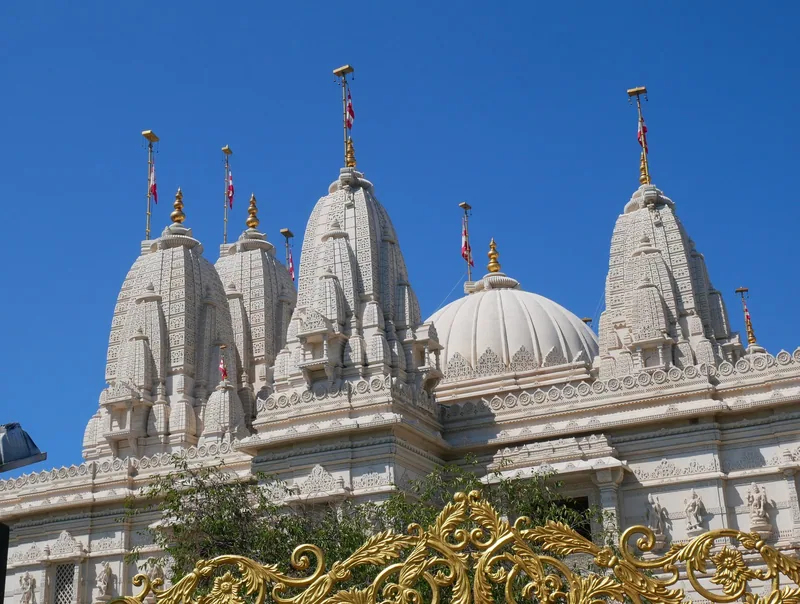
Photo: Doyle of London · CC BY-SA 4.0 · Wikimedia Commons · resized
Photography: what is allowed and where
You may take photographs and videos with a mobile phone, for personal use only, from ground level outside the Mandir and the Haveli. That covers the exterior, the courtyard and the front garden, which is where the building looks most impressive anyway.
No photography or filming is allowed inside either building. There are no exceptions for the atriums, the sanctum or the exhibition. Postcards and photographs of the interiors are sold in the Souvenir Shop, which is the temple's answer to the obvious complaint. Requests for any non-personal use go to the media address listed on the temple's website.
The temple also notes that its management may carry out photography or video recording that features visitors, and holds the rights to that material.
What you see, in the order you see it
Visitors arrive through the gate on Meadow Garth and get their first full view of the temple from the courtyard. Entry is through the Haveli, the wooden building beside the stone temple, up a flight of steps with a carved balcony and portico above; there is a wheelchair ramp on the left.
After a short security check you reach the reception foyer. Ask at the Information Desk whether a volunteer guide is available: the temple offers them to groups of nine or fewer, subject to availability, and a guide transforms the visit for anyone with no background in Hinduism.
Beyond the foyer are two sky-lit atriums, carved from floor to ceiling. Upstairs in the stone temple is the Maha-Mandap, the great hall under a carved cantilever dome, where the shrines hold images of Bhagwan Swaminarayan and other deities including Krishna and Radha, Rama and Sita, Shiva and Parvati, and Hanuman and Ganesh. The shrines are not open all day: see the timings below.
On the lower floor sits the "Understanding Hinduism" exhibition, about 3,000 square feet of displays and traditional craftwork, with an eleven-minute film on the temple's construction and consecration. Outside again, the garden at the front is worth ten minutes when the weather allows; it closes in bad weather and on days of special observance.
Timings that decide what you actually see
The building is open from 9am to 6pm, but the shrines are open for darshan, the viewing of the sacred images, only at set times. Turn up in the middle of the afternoon on a weekday and you will find them closed.
| What | When |
|---|---|
| Mandir and Haveli open | 9.00am–6.00pm, usually all year including bank holidays |
| Murti darshan (shrines open) | 9.00–11.00am, 11.45am–12.15pm, and 4.00–6.00pm. From 3.30pm at weekends and on bank holidays |
| Rajbhog Arti | 11.45am daily, about 10 minutes |
| Abhishek | 9.30am–12 noon and 4.00–6.00pm; the ritual takes about 15 minutes |
| Exhibition | 9.00am–6.00pm |
The single best time to arrive is about 11.15am. That gets you into the Maha-Mandap while the shrines are open, and puts you in place for the 11.45am arti, the ceremony in which lighted wicks are waved before the images to a sung prayer. Separate seating arrangements apply during the arti, and visitors are asked to follow them. Timings are subject to change for festivals and special services, sometimes at short notice, so check the temple's timings page the day before.
What it costs
Entry to the Mandir and the Haveli is free. The temple charges no admission and sells no tickets.
The "Understanding Hinduism" exhibition carries what the temple calls a nominal charge: £2 per adult and £1.50 for children aged 6 to 16 and senior citizens, as listed on its group visits page in September 2026. For booked groups, the temple offers a free option of about an hour and a half comprising a welcome address, a video presentation and a guided tour, or a two-hour version that adds the exhibition.
Parking is free for cars. Coach parking is very limited and coach passengers are asked to alight outside the temple. For more of London at no cost, see our list of free things to do in London.
The rest of the rules, briefly
- No food or drink anywhere on the premises. Discard chewing gum before you enter.
- No smoking on the premises, including the car parks. Bins are provided at the gates.
- No sharp or incendiary items, including knives, matches and lighters.
- Do not touch the carvings. The marbled areas of the Mandir are quiet zones.
- Visitors aged 16 or under must be accompanied by a responsible adult at all times.
- No pets. Assistance dogs are looked after by a volunteer in a quiet place while the visitor is given a personal chaperon.
- Costume and fancy dress are not appropriate here, as at any place of worship.
None of this is difficult, and staff are patient with people who arrive not knowing. Our guide to British etiquette for visitors covers general expectations; the rules here are the temple's own and go further.
Getting to Neasden, which takes longer than you think
The temple is in north-west London, roughly forty minutes from the centre, and no station is on its doorstep.
| Station | Line | Walk |
|---|---|---|
| Stonebridge Park | Bakerloo line and London Overground | About 15–18 minutes |
| Neasden | Jubilee line | About 20 minutes |
| Harlesden | Bakerloo line and London Overground | About 20 minutes, or bus 206 or 224 |
Buses 206 and 224 stop on Brentfield Road directly outside the temple; from Harlesden you board at Stop HC on Winchelsea Road and get off at Stop K. Routes 112, 611, 232 and 18 serve the wider area. Our guides to London buses and the Overground explain how to combine them, and this is one journey where the bus genuinely beats the walk in bad weather.
Allow at least two hours on site, which the temple itself recommends, plus travel. That makes it a half-day rather than an hour squeezed between other things.
Eating, and what else is nearby
Shayona, at the far end of the car park opposite the temple, serves vegetarian Indian food; prior booking is advised for groups, on 020 8965 3365. There is a delicatessen selling Indian sweets and snacks on the way to it, and an adjoining grocery shop. Since no food or drink may be brought onto the temple premises, this is where lunch happens. Our guides to vegan and vegetarian London and Indian food in London put it in context.
Wembley is a short bus ride away if you want to pair the trip with a stadium tour, and Westfield at White City is on the same side of town. Our guide to Ealing and west London covers the wider area.
For the other great religious interiors in this guide, see Westminster Abbey and St Paul's Cathedral, both of which charge to enter. The British Museum has the objects; this has the practice. Diwali is celebrated publicly in central London each autumn, and our guide to London in October covers those events.
Visiting with children or with limited mobility
Children are welcome, and anyone aged 16 or under must have a responsible adult with them at all times. The rules about quiet, not touching the carvings and no food apply to them as much as to adults, so this suits calm, curious children better than restless ones; our family guide to London has more on what works at what age.
There are ramps for wheelchair access and a lift inside the Mandir, and wheelchairs are provided subject to availability. Anyone wanting more detail should read the temple's accessibility page or ask at the booking office on 020 8965 2651, Monday to Friday from 9am to 5pm. Our overview of accessible London covers the journey there.
For the rest of this section of the guide, see landmarks and historic buildings.
Frequently asked questions
Is Neasden Temple free to visit?
Yes. There is no admission charge to the Mandir or the Haveli and no ticket to buy. The "Understanding Hinduism" exhibition carries a nominal charge, listed as £2 per adult and £1.50 for children aged 6 to 16 and senior citizens (September 2026).
What should I wear to Neasden Temple?
Tops must cover the shoulders, chest, navel and upper arms, and leg-wear must be at least below knee-length. This applies throughout the complex and to all visitors. The management can refuse admission to anyone dressed inappropriately, so bring a long-sleeved layer and long trousers or a long skirt.
Can you take photographs at Neasden Temple?
Only outside. Personal photographs and videos may be taken with a mobile phone from ground level outside the Mandir and Haveli. Cameras may not be brought inside at all and must be left in your vehicle or at the Baggage Cabin. No photography or filming is permitted inside either building.
What is the best time to visit?
Arrive around 11.15am. The shrines are open for darshan until 12.15pm, and the Rajbhog Arti ceremony takes place at 11.45am and lasts about ten minutes. Shrines are closed between 12.15pm and 4pm on weekdays, or 3.30pm at weekends and on bank holidays.
How do I get to Neasden Temple by public transport?
Stonebridge Park (Bakerloo line and Overground) is a 15 to 18 minute walk, and Neasden (Jubilee line) about 20 minutes. Buses 206 and 224 stop on Brentfield Road right outside the temple, which is the easier option from Harlesden or Wembley.
Sources
- BAPS Shri Swaminarayan Mandir, London - Visitor guidelines (checked September 2026)
- BAPS Shri Swaminarayan Mandir, London - Timings (checked September 2026)
- BAPS Shri Swaminarayan Mandir, London - Things to see and do (checked September 2026)
- BAPS Shri Swaminarayan Mandir, London - Getting here (checked September 2026)
- BAPS Shri Swaminarayan Mandir, London - Group visits (checked September 2026)