
London has no single network of public toilets, but you are rarely far from one: TfL station toilets and the toilets at the big Network Rail terminals are free, the free national museums all have them, and department stores, shopping centres and borough "community toilet" partners fill most of the gaps. A few council and other non-TfL facilities still charge, so carry a card.
Visitors are often surprised by how hard it can be to find a toilet in central London. Street toilets are thin on the ground, Tube trains and London buses have none on board, and plenty of Underground stations have no customer toilets at all. The good news is that the places tourists spend most of their time, such as museums, railway terminals and big shops, usually have clean facilities that cost nothing.
This guide explains who runs London's toilets, which ones are free, how to find the nearest one on your phone, and what disabled visitors and parents with small children should know before they set out.
Finding a toilet in London: key points
- TfL station toilets
- At some stations only; free; some are inside the ticket gates
- Network Rail stations
- Free at all 20 stations Network Rail manages, with accessible toilets at every one
- Could cost money
- Some non-TfL facilities, such as certain council-run toilets
- Best map
- The Great British Toilet Map (toiletmap.org.uk), plus TfL's toilet map PDF
- Accessible toilets
- Many are locked with a Radar (National Key Scheme) key
- Changing Places
- Search the Changing Places Consortium map by postcode
- On board
- No toilets on Tube trains or London buses
Who provides toilets in London
Toilets in London are run by many different organisations, which is why there is no single answer to "where is the nearest one?". Transport for London (TfL) provides customer toilets at some of its stations. Network Rail runs the toilets at the large railway terminals it manages. The 32 boroughs and the City of London each decide what they provide on their own streets, and some pay local businesses to let the public use their toilets.
On top of that, museums, department stores, shopping centres, supermarkets, cafés and pubs all have toilets of their own. Some welcome everyone, and some are meant for customers. Knowing which type of place is likely to help is more useful than hunting for a street toilet.
Planning your first visit? Our guide for first-time visitors covers the other practical basics that catch people out on day one.
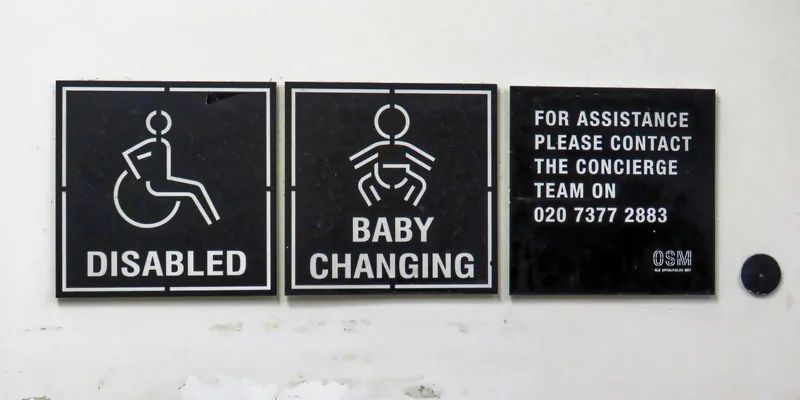
Photo: Acabashi · CC BY-SA 4.0 · Wikimedia Commons · resized
Toilets at Tube and TfL stations
TfL provides customer toilets at some stations, not all of them. Its official line is clear on price: "TfL toilet facilities are free to access, but some non-TfL managed facilities may be chargeable." If you see an old guide that says Tube toilets cost 50p, ignore it.
There are three things to know before you rely on a station toilet:
- Opening hours vary. TfL says staff can give access outside those hours, so ask at the ticket hall if the door is locked.
- Some are inside the ticket gates. TfL says you will need to tap in and out at the gateline to reach them, so they work best when you are about to travel anyway.
- Many stations have none. Check the TfL list before you count on a particular station, especially in the West End.
TfL publishes a toilet map as a PDF and a more detailed list of customer toilets with opening times, accessible toilets and baby-changing spaces. Both are linked from its public toilets page. Save them to your phone, because mobile signal underground is still patchy on many sections. Our guide to using the Underground explains touching in and out if the gates are new to you.
A gateline toilet can cost you a fare if you are not travelling. If the toilet is behind the barriers and you only need the loo, ask a member of staff how to reach it before you touch in. An unfinished or odd-looking journey on your card can be charged in ways that are hard to predict.
The big railway terminals: free and usually well kept
The large mainline stations are some of the most reliable places to find a toilet in central London. Network Rail says the toilets at all 20 stations it manages itself are free to use, and that every one of those stations has accessible toilets. In London these include Victoria, Waterloo, Paddington, London Bridge, Charing Cross, Cannon Street and Liverpool Street, and Network Rail's station pages show where the toilets are at King's Cross and Euston too.
Look near the main concourse and follow the signs. At King's Cross, for example, the station page shows toilets next to platform 9 and on the mezzanine level. Paddington has stoma-friendly toilet facilities on platform 12, and several London terminals have RoomMate devices in the accessible toilets, which give an audio description of the room for blind and partially sighted people.
St Pancras International, next door to King's Cross, is run by a different company (HS1), so check its own website for facilities. Our overview of London's main railway stations explains which terminal serves where, and it is worth knowing if you are passing through one anyway.
Museums and galleries: the tourist's best friend
The national museums are free to enter for their permanent collections, and all the large ones have toilets, often with baby-changing and accessible cubicles. In South Kensington, the Natural History Museum, the Science Museum and the V&A sit side by side, and in the West End the National Gallery and the National Portrait Gallery are at Trafalgar Square.
Entry rules differ slightly. The V&A says you don't need to book, and the National Gallery has walk-up entry. The Natural History Museum does not require booking, although a free ticket guarantees entry. The Science Museum now asks visitors to pre-book a free ticket, so it is less useful for a sudden stop. Bags may be searched at the entrance, and queues build at weekends and in school holidays.
Our list of London's free museums doubles as a map of reliable, free toilets across the centre. If you plan your sightseeing so that you pass one every couple of hours, the problem mostly solves itself.
Department stores, shopping centres and supermarkets
TfL itself points visitors towards shops: supermarkets, DIY stores and department stores often have accessible toilets. On and around Oxford Street, the large department stores have customer toilets on their upper or lower floors. They are generally tolerant of shoppers who stop in, but the toilets can be a long walk from the entrance, and some are not signposted from the ground floor.
Large shopping centres are another safe bet, as toilets there are for everyone who comes through the doors. Our guide to Liberty, Selfridges and the other department stores can help you plan a shopping day with regular breaks.
The Community Toilet Scheme
Some boroughs run a Community Toilet Scheme, where local businesses such as pubs, cafés and shops agree to let the public use their toilets without buying anything. TfL describes it as a way to provide "clean, safe and accessible public toilets in more convenient locations" in some boroughs. Look for a "community toilet" sticker in the window. Which businesses take part changes often, so check the borough's own website.
Cafés, pubs and restaurants
Most cafés, pubs and restaurants keep their toilets for customers. In practice, buying a coffee or a soft drink is the polite way to use one, and it rarely costs much more than a paid public toilet would. Some chain cafés put a code on the receipt that opens the toilet door.
Pubs are often more relaxed, especially in the afternoon when they are quiet, but it is good manners to ask at the bar first. Our guide to pub manners for visitors explains how ordering works if you decide to stay for a drink, and our pick of good coffee in London gives you places where a stop is a pleasure rather than a chore.
Parks and open spaces
The large central parks have public toilet blocks, usually near cafés, playgrounds and main gates. They can close earlier than the park itself, particularly in winter when the parks close earlier, and the queues at popular spots can be long on sunny weekends and during events. Not all park and council toilets are free: TfL's own note that "some non-TfL managed facilities may be chargeable" applies here, so check the sign at the door and carry a contactless card as well as a few coins.
If you are spending a day in Hyde Park and Kensington Gardens, note where the toilets are on the park map when you arrive. The same applies to the Regent's Park and Hampstead Heath, where distances between facilities are longer than they look.
Apps and maps that find the nearest toilet
The most complete source is the Great British Toilet Map, which describes itself as the UK's largest database of publicly accessible toilets, with more than 14,000 facilities. It is run by Public Convenience, a small team that began the project at the Royal College of Art's Helen Hamlyn Centre for Design. It is not a government service, although TfL links to it. You can filter by features such as accessible toilets and baby-changing, and it shows opening hours where known.
TfL also suggests simply typing "toilet finder" into your phone's app store. Many London boroughs publish toilet lists on their websites too, including Westminster, Camden, the City of London, Kensington and Chelsea, Southwark, Lambeth, Hackney and Newham. The quality of these lists varies, and some are hard to read on a phone.
A working data connection makes all of this easier. Our guide to SIM cards, eSIMs and roaming explains your options if your home plan is expensive in the UK.
Accessible toilets, Radar keys and Changing Places
Many accessible toilets in Britain are locked with a Radar key, part of the National Key Scheme (NKS). Disability Rights UK says toilets with NKS locks are found in shopping centres, pubs, cafés, department stores, bus and train stations and many other places. At King's Cross, for example, one of the accessible toilets needs a Radar key and another does not.
Disability Rights UK sells the genuine key for £5 (September 2026), VAT-free for disabled people who need it, or £6 with VAT, plus a £1.75 postage contribution. It aims to deliver within 10 working days, so order well before your trip. In places where toilets are locked, staff can usually open them if you do not have a key.
Changing Places toilets are larger rooms with a hoist, a changing bench and more space for a carer. They are separate from standard accessible toilets. TfL recommends the Changing Places Consortium's map, which you can search by postcode or town and which shows access arrangements and opening hours. For step-free routes between them, see our guide to step-free travel on London transport and our wider guide to London for wheelchair users.
Order a Radar key before you fly. At £5 for eligible disabled visitors, the genuine key opens thousands of locked accessible toilets across Britain, so you are not left waiting for a member of staff to find the right person with a key.
With babies and small children
Baby-changing rooms are standard in museums, department stores, shopping centres and the big stations, and the TfL toilet list marks which station toilets have them. Many are in accessible toilets or separate family rooms rather than in the women's toilets, so dads and other carers can use them too.
If you need to feed a baby on the move, TfL says it wants parents to feel comfortable breastfeeding or bottle feeding on public transport, and that it is illegal for anyone to ask a person breastfeeding to stop or to leave a public place. Our family guide to London has more on pushchairs, fares and child-friendly sights.
Potty-training children need a plan for the Tube. There are no toilets on Tube trains or London buses, and a trip across the centre can take 40 minutes or more with changes. Use the toilet before you leave a museum or café, and look up toilets along your route in advance.
Building toilet stops into a sightseeing day
The easiest approach is to plan your day around places with good facilities. A morning at the Tower of London or Westminster can be followed by lunch in a café, a free museum in the early afternoon and a department store or station on the way back to your hotel. Each gives you a clean toilet without any searching.
Big outdoor events are a different matter. On days such as the Notting Hill Carnival or New Year's Eve, the crowds are huge and any toilet queue can be long. Go before you set off, drink sensibly, and know where the nearest station toilet is if you are near a large terminal.
Frequently asked questions
Are public toilets free in London?
Many are. TfL says its station toilets are free, and Network Rail says toilets at all 20 stations it manages are free. Museums, department stores and shopping centres do not charge either. Some non-TfL facilities, such as certain council-run toilets, may charge a small fee, so carry a card or coins.
Do London Underground stations have toilets?
Some do, but many central Tube stations have none. Where there are toilets, opening hours vary and some are inside the ticket gates. TfL's toilet map and its detailed customer toilet list, both on the TfL public toilets page, show which stations have them and when they open.
Can I use the toilet in a pub or café without buying anything?
Toilets in cafés, pubs and restaurants are generally for customers, so buying a drink is the polite approach. Businesses that display a "community toilet" sign are part of a borough scheme and let the public use their toilets without buying anything.
What is a Radar key and can visitors buy one?
A Radar key opens accessible toilets fitted with National Key Scheme locks across Britain. Disability Rights UK sells the genuine key for £5 to disabled people who need it (£6 with VAT), plus postage. Order early, because delivery can take up to 10 working days.
Are there toilets on London buses and Tube trains?
No. London buses and Tube trains have no toilets on board, so use one before you travel. On longer trips, the large railway terminals and museums along your route are the most reliable places to stop.
Sources
- Transport for London - Public toilets in London (checked September 2026)
- Network Rail - Free toilets at Britain's biggest railway stations (checked September 2026)
- Network Rail - London King's Cross station facilities (checked September 2026)
- Great British Toilet Map - About (checked September 2026)
- Disability Rights UK - The official Radar key (checked September 2026)
- Changing Places Consortium - Find a Changing Places toilet (checked September 2026)
- Transport for London - Travelling while pregnant or with a buggy (checked September 2026)