
Brick Lane in East London is Britain's best-known curry street, lined with restaurants run mainly by Bangladeshi families, but it is only one part of London's South Asian food scene. For a wider choice and often better cooking, look also at the Punjabi grill houses of Whitechapel, the South Indian and Sri Lankan cafés of Tooting and the Punjabi restaurants and sweet shops of Southall.
In Britain, "curry" is a loose word for a huge range of dishes from India, Pakistan, Bangladesh and Sri Lanka, usually served with rice or bread. The classic British "curry house" developed its own menu in the second half of the twentieth century, with dishes such as korma, madras, vindaloo and chicken tikka masala that are adapted to British tastes and are not always found in South Asia in the same form. Alongside these, London now has restaurants cooking regional food much closer to home cooking in Lahore, Chennai, Jaffna or Amritsar.
This guide explains how that happened, what each area is like, how to choose a restaurant without being pulled in by a doorway salesman, and how to read the menu if you have never eaten British-style curry before.
London's curry areas at a glance
- Brick Lane
- Bangladeshi-run curry houses, bagel bakeries, Sunday market; Aldgate East or Shoreditch High Street
- Whitechapel
- Pakistani and Punjabi grill houses; Whitechapel or Aldgate East
- Tooting
- South Indian, Sri Lankan and Pakistani food; Tooting Broadway or Tooting Bec (Northern line)
- Southall
- Punjabi restaurants, sweet shops and street snacks; Southall (Elizabeth line)
- Drummond Street
- South Indian vegetarian cafés close to Euston station
- Mayfair and the West End
- Upmarket Indian restaurants, including one of the oldest in Britain
How curry came to London
South Asian food has been sold in London for more than two centuries. In 1810 Sake Dean Mahomed, a traveller and entrepreneur from Bengal, opened the Hindoostanee Coffee House near Portman Square, generally described as the first Indian restaurant in London. It did not last, but the idea did. Veeraswamy on Regent Street opened in 1926 and describes itself as the city's oldest surviving Indian restaurant, still trading on the first floor overlooking the street.
The big change came after the Second World War. Migration from South Asia increased sharply after the partition of India in 1947, and many new arrivals settled in the East End and in west London near the factories and Heathrow. In the East End, men from the Sylhet region of what is now Bangladesh, many of whom had worked as seamen, opened cafés and restaurants. By the 1970s and 1980s Bangladeshi families ran most of the "Indian" restaurants in Britain, and Brick Lane became the symbol of that trade.
Chicken tikka masala, a creamy tomato dish built on the tandoori chicken of Punjab, became so popular that a former foreign secretary, Robin Cook, called it a true British national dish in a 2001 speech. Where exactly it was invented is still argued over, which tells you something about how British curry evolved: in many kitchens at once, for British customers.
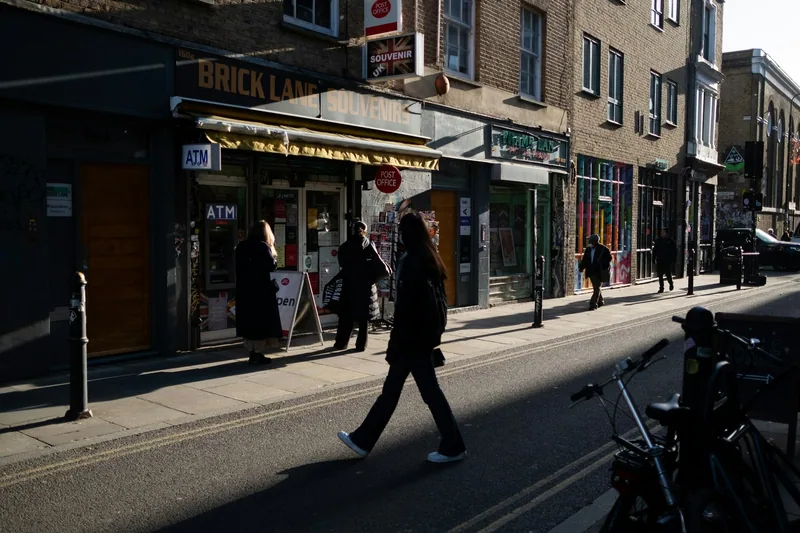
Brick Lane: a street with three histories
Brick Lane runs north from Whitechapel to Shoreditch through Spitalfields. Few streets in London show the layers of migration so clearly. On the corner of Fournier Street stands Brick Lane Mosque (Jamme Masjid). According to the London Museum, it was built in 1744 as a church for the Huguenots, the French Protestant refugees who worked in the local silk trade. It became a Wesleyan chapel about fifty years later, housed the Spitalfields Great Synagogue from 1898 to 1975, and was then sold to the local Bangladeshi community and converted into a mosque.
The Jewish East End has not completely gone from the food. At the northern end of the street, bagel bakeries still sell salt beef and cream cheese bagels, and the London Museum describes one of them, Beigel Bake, as an institution on Brick Lane. The southern end of the street is the part known for curry houses, and the local council ward is called Spitalfields and Banglatown. The street name signs are in both English and Bengali.
Many visitors combine a meal here with a walk around the markets. On Sundays the old Truman Brewery and the streets around it fill with stalls, and Columbia Road Flower Market is a short walk away. See our guide to Spitalfields and the Brick Lane markets for days and times, and our Shoreditch neighbourhood guide for what lies to the north.
Choosing a restaurant on Brick Lane
The curry houses on Brick Lane sit side by side and compete hard for passing trade. It is common for staff to stand in the doorway and offer passers-by a discount, a free drink or a free starter. Some of these offers are genuine, but a doorway promise is not a guide to quality, and the restaurants with the hardest sell are not usually the ones with the most regular customers.
- Read the full menu first. Check the prices of rice, bread and side dishes, which add up quickly, and look for any service charge.
- Look at who is eating there. A restaurant with local families and groups of regulars is a better sign than an empty room with a keen doorman.
- Check the hygiene rating. The Food Standards Agency rates food businesses from 5 to 0 after council inspections; search any restaurant on the food hygiene ratings site before you go.
- Ask about alcohol. Some restaurants in the area do not sell alcohol. Some of those allow you to bring your own, and some charge for opening it. Ask before you arrive with a bottle.
Get any doorway discount confirmed before you sit down. If someone on the pavement promises you a percentage off or a free bottle of wine, ask them to confirm it with the person who will bring your bill. A verbal offer made in the street is easily "forgotten" by the end of the meal.
Brick Lane is also on the route of many evening history walks, including the Jack the Ripper tours that end in Whitechapel and Spitalfields. A curry after a walk is a popular combination, so restaurants get busy after about 8pm on Fridays and Saturdays.
Whitechapel's Punjabi and Pakistani grill houses
A few minutes' walk south-east of Brick Lane, the streets around Whitechapel Road have a different style of restaurant. Many are Pakistani or Punjabi, and the food centres on the tandoor and the grill: lamb chops, seekh kebabs, tandoori chicken and slow-cooked karahi dishes brought to the table in the pan they were cooked in. Rooms are often large, loud and busy with groups and families.
Tayyabs on Fieldgate Street is one of the best-known. It says it has been serving Punjabi food since 1972 and invites customers to bring their own bottle. The East London Mosque, whose purpose-built building opened on Whitechapel Road in 1985, is at the centre of the area, and many restaurants and butchers here serve halal meat. If that matters to you, our guide to halal food in London explains how certification works and what to ask.
Whitechapel station is served by the Elizabeth line, the District and Hammersmith & City lines and the London Overground. That makes it quick to reach from the West End: see our guide to the Elizabeth line.
Tooting: South Indian and Sri Lankan cooking
Tooting, in south London, has been home to large South Asian communities for decades, and Upper Tooting Road and the streets near Tooting Broadway station are lined with restaurants, sweet shops, grocers and sari shops. The mix is different from the East End. Alongside Pakistani grills you find South Indian and Sri Lankan Tamil cafés, where the menu is built on rice and lentils rather than on meat.
Look for dosa (large, thin, crisp pancakes of fermented rice and lentil batter, served with coconut chutney and a lentil broth called sambar), idli (soft steamed rice cakes), and vada (savoury lentil doughnuts). Sri Lankan restaurants add hoppers (bowl-shaped pancakes, sometimes with an egg cooked inside) and kothu roti (chopped flatbread stir-fried with vegetables, egg or meat on a griddle, which you will hear being chopped from the street). Many of these dishes are vegetarian by tradition, and they are among the best-value meals in London.
Tooting Broadway and Tooting Bec stations are on the Northern line, with direct trains from central London; use the TfL Journey Planner for the time from your hotel. The area has covered markets and a large common, so it is easy to make an afternoon of it. Our guide to the Underground explains the Northern line's two central branches, which both continue to Tooting.
Southall: Punjab in west London
Southall, in the borough of Ealing, has one of the largest Punjabi communities in Britain, and its main street, The Broadway, feels unlike anywhere else in London. Sikh, Hindu and Muslim families from Punjab and East Africa settled here from the 1950s, and the shops sell everything from wedding jewellery and fabric to fresh sugar cane juice.
The food is Punjabi home cooking in its many forms: chole bhature (spiced chickpeas with puffed fried bread), sarson ka saag with makki di roti (mustard greens with cornmeal flatbread), tandoori grills, and rich lentil dishes. Sweet shops sell trays of barfi, jalebi and gulab jamun, often by weight. Street stalls sell samosas, pakoras and paan, a betel-leaf preparation eaten after meals.
Southall is a quick trip now that the Elizabeth line stops there. Trains from Paddington, Bond Street and Tottenham Court Road run straight to Southall, and it is within the same pay as you go daily cap as the rest of your Zones 1-4 travel, so an afternoon there may add little or nothing to your transport costs.
Other places to look
Drummond Street, just west of Euston station, has had South Indian vegetarian restaurants and snack bars for decades. It is handy if you are arriving or leaving by train from Euston or King's Cross.
Wembley and Harrow in north-west London, especially the area around Ealing Road near Alperton station, are known for Gujarati vegetarian food and sweet shops. East Ham, on the District and Hammersmith & City lines, has a strong South Indian and Sri Lankan presence along its High Street North.
The West End has the most expensive and ambitious Indian restaurants, several of them in Mayfair and St James's. These cook refined regional dishes with tasting menus and wine lists. If you want one special Indian meal, book one of these for lunch, when prices are usually lower than in the evening.
Reading a British curry-house menu
If you have never eaten in a British curry house, the menu can look confusing, because many dishes are defined by their sauce and heat level rather than by a main ingredient. You usually choose a sauce and then a protein, such as chicken, lamb, prawn or vegetable.
| Dish | What it usually is | Heat |
|---|---|---|
| Korma | Creamy sauce, often with ground almonds or coconut | Mild |
| Tikka masala | Grilled pieces in a creamy tomato sauce | Mild to medium |
| Bhuna | Thick, dry-fried sauce of onion, tomato and spices | Medium |
| Jalfrezi | Stir-fried with peppers, onions and fresh green chilli | Medium to hot |
| Madras | Red, chilli-heavy sauce | Hot |
| Vindaloo | Very hot, often with vinegar and potato | Very hot |
| Biryani | Rice cooked with meat or vegetables, usually served with a curry sauce on the side | Mild to medium |
| Dal, saag, aloo gobi | Lentils, spinach, potato with cauliflower; common vegetable sides | Mild to medium |
Poppadoms (thin, crisp discs) with a tray of chutneys usually arrive before the meal and are charged separately. Naan bread is baked in the tandoor; rice is ordered by the portion, and one portion is often enough for two people with bread. Heat levels vary between restaurants, so if you are unsure, order one milder dish to share.
Allergies, diets and asking the right questions
Curry-house food often contains ingredients that matter for allergies. Kormas and many creamy sauces use ground nuts, including almonds and cashews. Ghee (clarified butter), cream and yoghurt are common, so dairy is widespread. Naan and other breads contain wheat. Under food law, restaurants must tell you if a dish contains any of the 14 regulated allergens, either in writing or by telling you where to find the information. Ask before ordering, and be clear about what you cannot eat.
For vegetarians, South Asian food is one of the easiest cuisines in London, and our guide to vegan and vegetarian eating covers it in more depth. Gluten-free diners should be careful with breads, some batters and shared fryers: see our gluten-free guide before you order.
Service charges work as in other London restaurants: they are common in sit-down places and often discretionary. Our guide to tipping explains what is expected. For more budget ideas across the city, see cheap eats in London, and for Britain's own classic dishes, our guide to traditional British food.
Frequently asked questions
Is Brick Lane still the best place for curry in London?
It is the most famous, and it is worth seeing for its history and atmosphere. For the food alone, many Londoners prefer the grill houses of nearby Whitechapel, or travel to Tooting or Southall, where restaurants cook mainly for local South Asian families and the choice of regional dishes is wider.
What is the nearest station to Brick Lane?
Aldgate East (District and Hammersmith & City lines) is closest to the southern, curry-house end. Shoreditch High Street on the London Overground is closest to the northern end with the bagel bakeries and the Sunday market. Liverpool Street is about a ten-minute walk away.
Can I bring my own alcohol to a curry house?
Only if the restaurant allows it. Some restaurants in East London do not sell alcohol and invite customers to bring their own, sometimes with a charge for opening bottles. Others are licensed and do not allow it. Always ask before you arrive.
Which curry is the mildest?
Korma is usually the mildest dish on a British curry-house menu, followed by tikka masala. Remember that korma often contains ground nuts, so tell the staff if you have a nut allergy and ask them to confirm the ingredients.
Is the food on Brick Lane halal?
Many restaurants in Brick Lane and Whitechapel say their meat is halal, but not all do, and standards of certification differ. Ask the restaurant directly and, if certification matters to you, ask which body certifies its meat supplier.
Sources
- London Museum - A history of London's mosques (checked September 2026)
- London Museum - What is London Tastes? (checked September 2026)
- Veeraswamy - Home page (history of the restaurant) (checked September 2026)
- Tayyabs - Home page (checked September 2026)
- Food Standards Agency - Food allergy and intolerance advice for consumers (checked September 2026)
- Food Standards Agency - Food Hygiene Rating Scheme (checked September 2026)