
Edgware Road is the Middle Eastern high street of central London: Lebanese grills, bakeries turning out flatbread all day, juice bars, patisseries and pavement terraces where people sit with coffee and shisha long after the rest of Zone 1 has gone quiet. It is one of the few places in the centre where you can order a full meal at one in the morning.
The road runs north from Marble Arch for about two kilometres, and the relevant stretch is the first kilometre, between Marble Arch and the Marylebone flyover. Lebanese, Egyptian, Iraqi, Syrian, Iranian and Gulf communities have all left something on it, and the restaurants are not all interchangeable.
Most visitors experience it as somewhere they walked past on the way to Hyde Park. It repays going deliberately, at the right time of day, which for this street is late.
Edgware Road at a glance
- Where
- Edgware Road W2 and W1, from Marble Arch northwards
- Stations
- Marble Arch (Central line, Zone 1) at the south end. Two separate stations share the name Edgware Road: one on the Bakerloo line, one on the Circle, District and Hammersmith & City lines. Both Zone 1
- Best time
- After 21:00. Many kitchens and cafes are busiest between 23:00 and 02:00
- Alcohol
- Several of the biggest restaurants serve none at all, for religious reasons
- Shisha
- Only outdoors, under English smoke-free law. Terraces are heated in winter
- Halal
- Very widely available; ask the restaurant which body certifies its supplier
The two Edgware Road stations, and why it matters
London has two Underground stations called Edgware Road, about 150 metres apart on opposite sides of the road, with no connection between them inside the barriers. One serves the Bakerloo line. The other is on the Circle line, shared with District and Hammersmith & City services. An app that tells you to change at Edgware Road is telling you to walk out of one station, cross a busy road and go into another.
For the restaurants, either works, as does Marble Arch on the Central line for the southern end. Our guide to the London Underground covers the other places where the map is misleading, and the Night Tube matters here because the Central line runs through the night on Friday and Saturday, which is exactly when this street is at its best.
What to order at a Lebanese restaurant
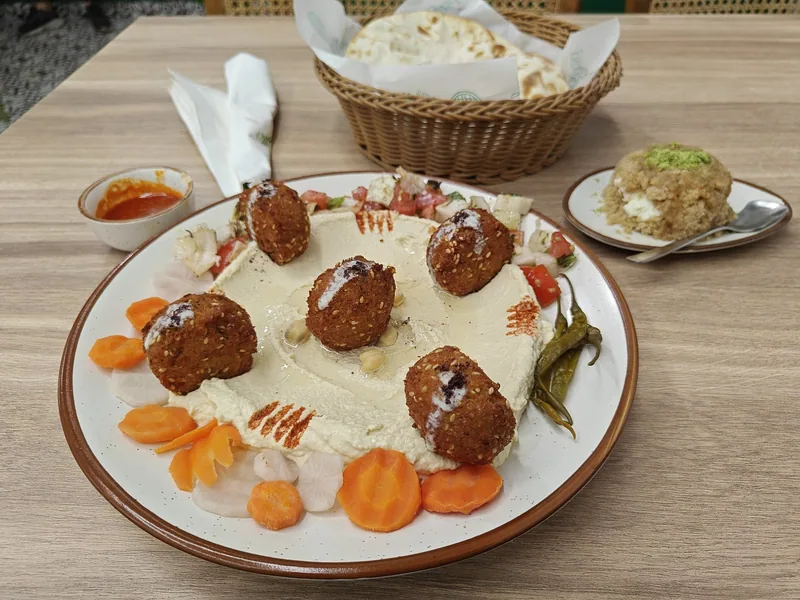
A Lebanese meal is built around mezze, a spread of small dishes eaten with bread, followed by grilled meat if you still want it. Ordering four or five mezze between two people and one grill to share is a better meal than a starter and a main each.
| Dish | What it is |
|---|---|
| Hommos | Chickpeas blended with tahini, lemon and garlic, with olive oil poured into a well in the middle |
| Moutabal | Aubergine roasted over flame, then blended with tahini. Smokier than hummus and often better |
| Tabbouleh | Mostly parsley, with a little cracked wheat, tomato, lemon and mint. Not a grain salad |
| Fattoush | Salad with crisp fried bread and sumac |
| Kibbeh | Torpedo-shaped shells of cracked wheat filled with spiced minced lamb and fried |
| Falafel | Ground chickpeas and herbs, fried to order. Ask when they were made |
| Manakish | Flatbread baked with za'atar and oil, or with cheese. Breakfast food, sold all day |
| Shish taouk | Marinated chicken from the charcoal grill, with garlic sauce |
| Mixed grill | Lamb cubes, chicken and minced kofta, enough for two |
| Knafeh | Hot cheese under shredded pastry in syrup, eaten with a spoon |
The garlic sauce that comes with grilled chicken is toum, an emulsion of garlic and oil, and it is far stronger than it looks. Use a small amount unless you have no plans for the rest of the evening.
Order the bread situation before you order food. Flatbread is brought hot from the oven and is the cutlery for most of the mezze. Some restaurants include it, some charge per basket and some serve it only with certain dishes. A glance at the menu answers it, and knowing means you will not order a side of chips you do not need.
Bakeries, juice bars and the cheap end
The expensive way to eat here is a full mezze spread with table service. The cheap way is better value and often more fun.
- Bakeries. Manakish baked to order, spinach and cheese pastries, sfiha topped with minced lamb. Eaten standing up or carried away, and priced like a sandwich rather than a meal.
- Shawarma counters. Meat carved from a vertical spit into flatbread with pickles, garlic sauce and chips. Open latest of all.
- Juice bars. Fresh pomegranate, mango, avocado and mixed juices made in front of you, plus milkshakes thick enough to stand a spoon in.
- Patisseries. Baklava, maamoul and nut pastries sold by weight from the counter. Ask for a mixed box of 250g and you have dessert for four.
Maroush, which has run Lebanese restaurants on and around Edgware Road for decades, operates at several points on the scale from a counter to a sit-down dining room, and it is a reasonable first stop if you want to see the range in one place. It is one of many, and the smaller family-run rooms further north are where regulars go. Our page about eating cheaply in the city applies the same principle elsewhere.
Shisha, and the rules that govern it
Shisha is tobacco smoked through a water pipe, and it is a large part of why the terraces here are full at midnight. English law bans smoking in enclosed and substantially enclosed premises, which has been the case since July 2007 and applies to shisha exactly as it applies to cigarettes. That is why the pipes are always outside, under awnings that must be open on enough sides to count as outdoors.
Two practical consequences. Terraces are heated, so winter is not a problem. And shisha is charged per pipe, at prices that can be higher than a round of drinks, so ask before ordering. Our page on smoking and vaping rules in the UK covers the legislation, including the changes that take effect from 2027.
Check the shisha price and the service charge before the pipe is lit. Prices are not always printed, charcoal changes may be billed separately, and many places add a service charge on top. None of this is a scam, but the bill on a table of four can be much larger than people expect. Ask for the price per pipe when you order.
Alcohol, and the restaurants that do not serve it
Several of the best-known restaurants on this street sell no alcohol at all, and do not allow it to be brought in. Others are fully licensed. If wine matters to your evening, check before you sit down rather than after.
What you drink instead is worth having in its own right: mint lemonade blended with ice, jallab with pine nuts, ayran, and Arabic coffee with cardamom served in small cups. Turkish tea and mint tea appear on most menus. See drinking without alcohol in London for more, and alcohol laws in London for where you may drink in public nearby.
When the street comes alive
Edgware Road runs on a different clock from the rest of central London. Bakeries open early. The middle of the afternoon is quiet. From about 21:00 the terraces fill, and the busiest hours in summer are between 23:00 and 02:00, when families with children are still out and the grills are still lit.
Ramadan changes everything. Through the fasting month, kitchens are quiet by day and extremely busy from sunset, and tables for iftar need booking. The dates move each year. Our page about where to find halal food covers Ramadan and Eid across the city.
For other late options across London, see late-night food, and for the other great late street, the Turkish grills of Green Lanes and Dalston. The difference is that Edgware Road is in Zone 1 and you can walk home from it.
What else is nearby
Its southern end lies two minutes from Marble Arch and the north-east corner of Hyde Park, which makes an afternoon walk and an early dinner an easy pairing. Marylebone lies to the east, with a very different character a few streets away, and Paddington and Bayswater to the west, where Queensway carries another run of Middle Eastern and Chinese restaurants.
Oxford Street begins at Marble Arch, so a late meal here is a natural end to a shopping day. If you are staying near Paddington, this is the closest good eating to the station: see staying near Paddington.
Practical notes
- Bookings. Large restaurants take them and need them at weekends. Counters and bakeries do not.
- Groups. Mezze suits six people better than two, and most restaurants here are set up for family tables.
- Vegetarians. Very well served. Half the mezze list contains no meat. See vegan and vegetarian London.
- Allergies. Sesame, in tahini, is in a great many dishes, and nuts appear in pastries and rice dishes. Ask, and see the Food Standards Agency guidance below.
- Tipping. A discretionary service charge is common. Our page on tipping and service charges explains what you are expected to do about it.
Frequently asked questions
Where is the Middle Eastern part of Edgware Road?
The first kilometre north of Marble Arch, in W1 and W2. Marble Arch station on the Central line serves the southern end. Two separate Underground stations share the name Edgware Road. One is on the Bakerloo line; the other is on the Circle line, which it shares with District and Hammersmith & City services. Both sit towards the top of the main restaurant stretch.
How late does Edgware Road stay open?
Later than almost anywhere else in central London. Many kitchens serve past midnight and shawarma counters later still, with the busiest hours between 23:00 and 02:00 in summer. Individual licences vary, so check the restaurant if you are relying on it after 01:00.
Can you smoke shisha indoors in London?
No. English law makes enclosed and substantially enclosed public premises smoke-free, and that covers water pipes as well as cigarettes. Shisha on Edgware Road is served on outdoor terraces, which are heated in winter. Prices are per pipe and are often not printed on the menu, so ask first.
Do Edgware Road restaurants serve alcohol?
Some do and some do not. Several of the larger and better-known Lebanese restaurants serve none at all and do not permit customers to bring their own. Fresh juices, mint lemonade, ayran and Arabic coffee are what most tables drink instead. Check before you sit down.
Is the food on Edgware Road halal?
Most of it is, but standards of certification differ between suppliers and there is no single national scheme. If it matters to you, ask the restaurant directly which body certifies its meat. Our separate page about halal eating sets out what British certification means in practice and the question to put to a restaurant.
Sources
- Health Act 2006, section 2 - smoke-free premises in England (checked September 2026)
- Tobacco and Vapes Act 2026, section 1 - changes in force from 1 January 2027 (checked September 2026)
- Transport for London - Night Tube lines and nights of operation (checked September 2026)
- Maroush - Lebanese restaurants in London (checked September 2026)
- Food Standards Agency - Food allergy and intolerance advice for consumers (checked September 2026)