
A British train ticket tells you six things: the stations it runs between, the route you may take, the ticket type (which decides the times you may travel), the dates it is valid, any railcard discount, and a two-character restriction code that sets the exact off-peak rules. If the train you board does not match all six, the ticket is not valid on that train, and you can be asked to pay the difference.
Paper tickets in Britain are small orange-and-cream cards with a magnetic stripe on the back, printed at ticket offices and machines; e-tickets on your phone carry a barcode instead. The information is the same on both. This page goes through it field by field, because the small print is where visitors with the right destination and the wrong ticket get caught. If some of the words are new, our glossary of British transport words explains them.
For choosing and buying a ticket in the first place, start with our guide to buying UK train tickets. Journeys inside London on Oyster or contactless need no paper ticket at all; our Oyster and contactless guide covers those.
What is printed on a British rail ticket
- From and To
- The stations, or a group such as London Terminals
- Route
- The way you may travel: no route named means any permitted route; otherwise a named route, a "not via" or a train company
- Ticket type
- Anytime, Off-Peak, Super Off-Peak or Advance, and Single, Return or Day Return
- Class
- Standard or First
- Dates
- The date the ticket starts, and for returns the last date it is valid
- Adult or child, and railcard
- Who may use it, and any railcard discount applied
- Restriction code
- Two characters, looked up at nationalrail.co.uk followed by the code
- Advance tickets only
- The specific train, and often a seat reservation
The orange ticket, field by field
The layout varies a little between ticket machines and ticket offices, but every paper ticket carries the same fields. This is what each one means in practice.
| Field | Example | What it tells you |
|---|---|---|
| Class | STD | Standard Class. First Class tickets say so |
| Ticket type | OFF-PEAK RTN | The times you may travel (with the restriction code) and whether there is a return part |
| Adult / Child | ONE / NIL | How many adults and children the ticket covers |
| Start date | 21 NOV 26 | The date you may start the outward journey |
| Valid until | A date, or a period | The last day for the return part |
| From / To | LONDON TERMINALS / CAMBRIDGE | Where the ticket starts and ends |
| Route | ANY PERMITTED | Which way you may go |
| Railcard | A railcard type, if used | That you must carry that railcard |
| Restriction code | Two characters, such as 1A | The exact off-peak rules for this ticket |
An e-ticket on your phone shows the same details on screen next to the barcode, and the National Rail Conditions of Travel make it your responsibility to be able to show it when asked. If your battery is the weak point, read our page on what to do if your phone dies with your ticket on it.
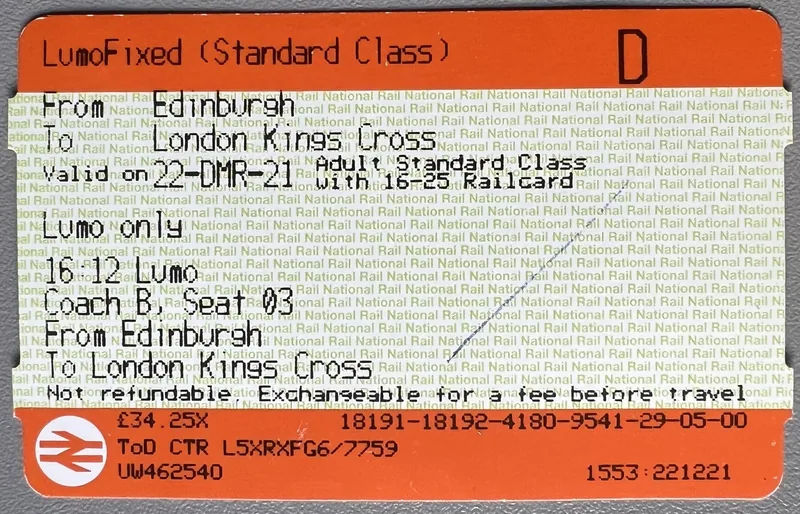
From and To, and what London Terminals means
The stations printed are where the ticket starts and ends. Many tickets to and from the capital do not name a single London station but say London Terminals, which lets you use whichever London terminus your route arrives at. For a town with trains from two London stations, Cambridge for example, the route printed decides which of them you may use.
Watch for a small cross symbol (+) or dagger (†) in the route. National Rail's ticket terms say it means the fare includes crossing London between main-line stations by the Underground, the DLR or Thameslink, for example from Victoria to Paddington. The Underground accepts the ticket until 04:29 the morning after its last day of validity, but only to change trains: you cannot break your journey at a Tube station on the way. Which terminus serves which part of the country is on our page about London's main railway stations.
The route: Any Permitted, named routes and "not via"
The route line is the most misunderstood part of the ticket. National Rail's rule is that a ticket may show a route or train company that you must use. If it shows none, you may use any permitted route, which National Rail describes as all reasonable routes for the journey, including direct trains and suitable connections. The full list of valid routes for every journey is in the National Routeing Guide, which sits behind the journey planner.
A route that names something restricts you. "Via" a place means you must travel through it. "Not via" a place, such as Not London, means you must not. A train company's name means only its trains are valid, which is how cheaper fares on slower operators work, and Southeastern prints "Plus High Speed" on tickets that include its faster trains via St Pancras. If you get on a train that runs a different way, you are treated as travelling without a valid ticket for that train. The rules behind this are in the Conditions of Travel, which our page on conditions of carriage and the railway byelaws summarises.
The same two stations can have several prices because of the route line. A cheaper ticket between London and a town in Kent or the Midlands may be valid only on one company's trains or only by the slower line. Check the route before you board the first fast train that appears on the departure board.
The ticket type and when you may travel
Four ticket types cover almost every journey a visitor makes. Anytime tickets are fully flexible on time. Off-Peak and Super Off-Peak tickets are cheaper and valid only at quieter times. Advance tickets are cheapest of all but valid only on the train printed on them. Advance fares are released in batches, and our page on when train tickets go on sale explains the timing; here is how the type changes what the rest of the ticket means.
National Rail's general guide is that off-peak hours begin at 09:30 on weekdays in cities and large towns and at 09:00 elsewhere, and that Saturdays, Sundays and bank holidays count as off-peak all day. That is only a rule of thumb. The real times for your journey are in the restriction code.
The type also says how long the ticket lasts. A Day Return is valid on the date printed and until 04:29 the next morning, and the whole journey must be finished by then. An Off-Peak Return lets you come back on any day within one calendar month. Advance tickets are singles, valid only on the booked train, although disruption changes that: if your train is cancelled, our guide to a cancelled airport train sets out which other trains you may use. Our page on getting the last train back to London deals with the evening end of a day return.
The restriction code, and how to look it up
The restriction code is a two-character code, letters or numbers, printed on most Off-Peak and Super Off-Peak tickets. National Rail publishes the meaning of every code: type nationalrail.co.uk/ followed by the code into a browser, and it takes you to a page listing the days, the outward and return times, any easements and any seasonal changes.
Code 1A, used on Greater Anglia off-peak tickets, is a good example of how much detail one code holds. On weekdays it is valid on trains timed to arrive at Liverpool Street before 04:30 or after 09:59, and on return trains leaving Liverpool Street after 09:29, except to Ipswich and beyond in part of the evening peak. It then lists named early trains that are allowed anyway, and says the evening restriction is lifted in school holidays. None of that fits on a ticket, which is why the code exists.
If you board a train at a time when your Off-Peak ticket is not valid, National Rail's terms say you pay the gap between your fare and the cheapest fare valid on that train, and in some cases a penalty fare as well. Our page on penalty fares and ticket inspectors explains when that applies and how to appeal.
Look up the code before the morning, not at the barrier. The code is printed on the ticket and on the confirmation of an online booking. Checking it the night before tells you which morning trains are allowed and, on many routes, which evening trains out of London are not.
The railcard field, and the card you must carry
If you bought the ticket with a railcard discount, the ticket shows the railcard type. The Conditions of Travel require you to show and, if asked, hand over the railcard along with the ticket; without it you are treated as not holding a valid ticket. A railcard may be held on your phone if the app lets staff inspect it. Some railcards also carry their own time limits or minimum fares on top of the ticket's restriction code. Our guide to railcards a visitor can buy lists them.
Seat reservations are not tickets
A seat reservation is a separate thing from the ticket, and on paper it often comes as a separate card. It reserves a seat on one train; it does not let you travel. Condition 3.3 is plain: unless you have a reservation, your ticket does not entitle you to a seat, and at busy times you may have to stand. You may have one reservation per person for each train in your journey, normally bookable up to two hours before departure.
On an Advance ticket the reservation is often printed on the ticket or the e-ticket itself. On an Off-Peak or Anytime ticket you may sit in any unreserved seat on any valid train, and reserved seats are usually marked with a label or display showing where the reservation starts.
Two parts, two cards: keep both
A paper return often comes as two cards, an outward and a return. National Rail's terms are blunt: the outward part is valid only when accompanied by the unused return part of the same ticket. Keep both together until you have finished the outward journey. If you lose the return part, you have lost your ticket home.
Many journeys also print a separate receipt and sometimes a reservation, so a family can end up with a dozen pieces of card. Before you go through the barrier, put each person's ticket, return and reservation together, with the railcard if one was used.
Breaking your journey on the way
Most tickets let you stop off. Condition 16 of the National Rail Conditions of Travel says that, where break of journey is allowed, you may start, break and resume a journey at any intermediate station on a valid route, as many times as you like within the ticket's validity, and you may also finish before the destination printed. Advance tickets do not allow a break of journey. Some longer-distance Off-Peak Returns do not allow one on the outward journey, and where that is so, the restriction code says so.
That rule is what makes some combined day trips cheap. A single Off-Peak return from London to Cambridge, for example, can normally cover a morning at Audley End and Saffron Walden on the way, as long as the restriction code allows it. Breaking a journey on the Underground while crossing London is not allowed, except to change trains. For a first day out of London by train, the New Forest from Waterloo is a good place to try all of this.
Frequently asked questions
What does "Any Permitted" mean on a train ticket?
It means no particular route or train company is required. You may use any reasonable route for the journey, including direct trains and suitable connections, as set out in the National Routeing Guide. The journey planner on National Rail only shows routes that are permitted for the ticket you are buying.
How do I find out what my ticket's restriction code means?
Type nationalrail.co.uk/ followed by the two-character code, such as nationalrail.co.uk/1A, into a browser. National Rail's page for that code lists the valid days and times for the outward and return journeys, any exceptions, and any seasonal variations.
Is a seat reservation the same as a train ticket?
No. A reservation only reserves a seat on one train; you still need a valid ticket to travel. Without a reservation, your ticket does not guarantee a seat, and at busy times you may have to stand.
What happens if I lose the return half of my ticket?
The outward part of a return is only valid with the unused return part of the same ticket, so losing it usually means buying a new ticket home. Lost paper tickets are generally replaced only in limited circumstances, so keep both parts together.
Can I get off a train before my destination and continue later?
On most Anytime and Off-Peak tickets, yes: you may break and resume the journey at intermediate stations within the ticket's validity. Advance tickets do not allow it, and some long-distance Off-Peak Returns forbid it on the outward journey, which the restriction code will tell you.
Sources
- National Rail - National Rail Conditions of Travel (from 30 July 2026) (checked November 2026)
- National Rail - Buying a ticket: routeing information and ticket validity (checked November 2026)
- National Rail - Off-Peak Return terms and conditions (checked November 2026)
- National Rail - Off-Peak Day Return terms and conditions (checked November 2026)
- National Rail - Restriction code 1A (checked November 2026)
- National Rail - Anytime tickets terms and conditions (checked November 2026)