
The New Forest is one of the easiest country days out from London: direct trains from Waterloo reach Brockenhurst in 1 hour 30 to 1 hour 39 minutes, and the station is inside the National Park, with ponies on the village roads and a cycle hire centre in the station car park. Book ahead and an Advance return can cost about £53; the walk-up Off-Peak return was £64.20 in November 2026. It is worth a day on its own. Beaulieu and its motor museum are a different day.
The New Forest is not a forest in the modern sense. It is a former royal hunting ground of heath, bog, old woodland and grassy lawns between Southampton and Bournemouth, and most of it is unfenced. The ponies, cattle and donkeys that wander across it, and in autumn the pigs, are not wild. They belong to local people called commoners, who hold ancient rights to graze animals on the open forest, and their grazing is what keeps the landscape open.
This page is about doing it without a car. If you want a short country walk closer to London first, our page on Box Hill and the Surrey Hills is under an hour from the city; for families, our day trips that work with children puts the New Forest in context.
The New Forest by train at a glance
- Train
- Waterloo to Brockenhurst direct, 1 hour 30 to 1 hour 39 minutes, roughly every 30 minutes (South Western Railway, sampled for November 2026)
- Rail fare
- Off-Peak return £64.20; Advance returns from £52.90 on our sample (National Rail, November 2026)
- Bike hire
- Hire centre in the south-side car park of Brockenhurst station
- Cycle routes
- More than 100 miles of waymarked routes, much of it traffic-free (Forestry England)
- Verderers' Court
- Open Court normally on the third Wednesday of the month at 10:00, at The King's House, Lyndhurst. Next dates: 18 November 2026; December is committee only and there is no August court (Verderers, checked November 2026)
- Pannage (pigs out on the forest)
- 14 September to 29 November in 2026, unless extended
- Bus to Lyndhurst
- New Forest Breezer 86, Lymington-Brockenhurst-Lyndhurst-Totton
Brockenhurst: getting off the train in the National Park
Brockenhurst is on the main line from Waterloo to Bournemouth and Weymouth, and fast trains stop there. The fastest services on our Saturday sample took 1 hour 30 minutes, leaving Waterloo at 08:35 and 09:35; others took a few minutes longer. Our Waterloo station guide covers the departure boards and where the platforms are.
The Off-Peak return is the flexible choice: valid on off-peak trains, with the return journey allowed within a month. Advance tickets are cheaper but tie you to particular trains, which matters if you are on a bike and the weather turns. Our guide to reading a British train ticket explains what each line on the ticket means, and a railcard takes a third off most Off-Peak fares.
Step out of the station and you are already in the forest. Ponies graze the verges in Brockenhurst village and walk along the roads, and householders, not the commoners, are responsible for fencing the animals out of their gardens. Within ten minutes on foot you can be on open heath or in the woods.
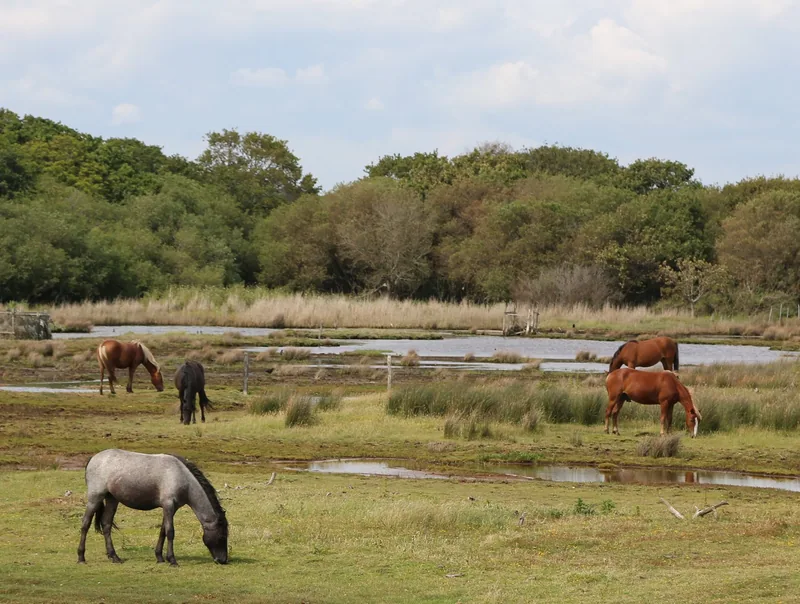
Photo: Geni · CC BY-SA 4.0 · Wikimedia Commons · resized
The ponies belong to someone
Every pony, cow, donkey and pig you see is owned by a commoner. The commoners' rights are regulated by the Verderers, a court set up in its present form by the New Forest Act of 1877, though records of Verderers in the forest go back to the 13th century. The Verderers employ Agisters, who look after the animals out on the forest.
The New Forest Code, published by the National Park Authority, is short and firm: keep your distance from the animals, do not feed or touch them, keep dogs under close control and park only in car parks. Ponies that learn to expect food from people come to the roads and get hit by cars. The Verderers also point out that feeding pigs or any livestock with catering waste or kitchen scraps is illegal, because of the risk of African swine fever.
Do not stroke the foals. They look tame and they are not pets. A mare will kick or bite to protect a foal, and a pony fed once by hand will start approaching the next visitor. If you find a sick or injured animal, call the Verderers' office on 023 8028 2052 in office hours, or 0300 067 4600 outside them. If an animal is hit on the road, call 999.
Autumn: drifts and pigs on the forest
Autumn is when the commoning year is most visible. Each year the ponies are rounded up from horseback in a series of drifts so that they can be checked. The drifts run through September, October and November at different places across the forest, and the car parks and cycle routes near each one are closed while it happens. The Verderers publish the dates and the closures on their website.
Pannage is the other autumn sight. Commoners with the right of pannage turn their pigs out to eat the fallen acorns, beech mast and chestnuts. Pigs can eat acorns safely, whereas too many are poisonous to ponies and cattle, so the pigs help the other animals. In 2026 the season ran from 14 September and was due to end on 29 November, unless the Verderers and Forestry England agreed an extension. Seeing a pig in a village street is normal in those weeks.
Cycling from the station
For most visitors without a car, a bike is the best way to see the forest in a day. Forestry England looks after more than 100 miles of waymarked cycle routes, much of it gravel track away from public roads. The hire centre is in the car park on the south side of Brockenhurst station, so you can be riding within minutes of getting off the train. Book ahead at weekends and check its opening hours out of season.
The rules are simple but they matter. Off-road cycling is only allowed on the waymarked network, marked with wooden posts. The narrow paths made by animals are off limits, because riding them damages the heath. Forestry England also warns that ponies and cattle use the roads and tracks all year, so be ready to stop. Download the Forestry England cycle map before you set off, as mobile signal comes and goes under the trees.
A half-day loop from Brockenhurst on the waymarked tracks, with a stop for lunch back in the village, is the right size for most people. Stronger riders can head north-west towards the ornamental drives and the woods around Bolderwood. If you are hiring bikes for children, ask the hire centre which loops are flattest and furthest from roads.
Bolderwood and the deer: what has changed
Bolderwood, off the Ornamental Drive about two miles north-west of Emery Down near Lyndhurst, was long known for its deer sanctuary and viewing platform, and many older guides still send visitors there to watch the deer being fed. Forestry England now says there is no longer a deer sanctuary or feeding station at Bolderwood. The woods, the walking trails and the cycle trail are still there, and you may well see deer, but there is no organised viewing.
Bolderwood has a long royal history: Forestry England dates the earliest record of a royal hunting lodge there to 1325, in the reign of Edward II. It is a car park with trails rather than a visitor centre, and fires and barbecues are banned. For deer you are more likely to see on a day trip without a long ride, our page on the autumn deer rut in Richmond and Bushy Park covers the herds inside London.
Lyndhurst, the Verderers and Alice Liddell
Lyndhurst, about four miles north of Brockenhurst, is the forest's administrative capital. Bus 86, the New Forest Breezer, links the two, and cyclists can reach it on the lanes. The Verderers sit at The King's House in the High Street (Historic England's list entry still calls it the Queen's House).
The Court of Verderers traces its origins to the 13th century, and its Open Court is public. It meets in the Verderers' Hall normally on the third Wednesday of each month: a closed committee at 09:30, then the Open Court from 10:00, when members of the public may address the Verderers on any matter relevant to the management of the forest. Arrive before 10:00. There is no court in August, and the December meeting is committee only.
Up the hill is the parish church of St Michael and All Angels, built in 1858-68 to designs by William White in red, yellow and white brick. Historic England lists it at Grade I, mainly for the interior: an east window by Edward Burne-Jones, a fresco of 1864 by Frederic Leighton behind the altar, and stained glass of 1862 by Morris and Company in the south transept, which the list entry calls some of their best. In the churchyard is the grave of Alice Hargreaves, born Alice Liddell, the girl for whom Lewis Carroll wrote Alice's Adventures in Wonderland.
A Verderers' Wednesday makes the trip. If your dates allow, go on the third Wednesday of the month: take an early train, the bus from Brockenhurst to Lyndhurst for the 10:00 Open Court, then cycle or walk in the afternoon. It is free, and it is the one place where you can watch the forest's medieval system of government still at work.
Why Beaulieu is a different day
Beaulieu, with its abbey ruins, palace house and the National Motor Museum, is in the New Forest but not on the railway. Despite the name, Beaulieu Road station is out on the heath several miles from the village, and reaching the village by public transport from Brockenhurst takes planning. The National Park Authority's open-top New Forest Tour runs each summer on three hop-on, hop-off routes; check whether a route serves Beaulieu on your date. Combining Beaulieu with a day in Brockenhurst eats most of the day. Treat it as a separate trip, or hire a car.
Lymington, at the end of the branch line from Brockenhurst, is the port for ferries to the Isle of Wight; our Isle of Wight day trip uses the same line. Winchester is a stop on the way from Waterloo and makes an easy half-day on the return journey, and the steam lines of Hampshire are on our Watercress Line page.
A day that works
Take a train from Waterloo at about 08:30 and you are in Brockenhurst by 10:00. Hire bikes from the station, ride a waymarked loop for three or four hours, return the bikes and have tea in the village before a train back at about 17:00. In autumn, add the drifts and the pigs; on a third Wednesday, start with the Verderers in Lyndhurst. Back in London by early evening.
Other long days out in this batch: the miniature railway and shingle at Dungeness, or a Jacobean house and two mazes at Audley End and Saffron Walden.
Frequently asked questions
How long is the train from London to the New Forest?
Direct trains from Waterloo to Brockenhurst take between 1 hour 30 and 1 hour 39 minutes and run roughly every half hour. Brockenhurst station is inside the National Park, so you can start walking or cycling as soon as you arrive.
Who owns the New Forest ponies?
Every pony is owned by a commoner, a local person with the right to graze animals on the open forest. The Verderers regulate those rights and employ Agisters to look after the animals. The ponies are not wild, but they are not tame either, and the New Forest Code asks visitors not to feed or touch them.
Can you hire bikes at Brockenhurst station?
Yes. There is a cycle hire centre in the car park on the south side of the station. Book ahead at weekends and in summer, and check opening hours in winter. Forestry England's waymarked network of more than 100 miles starts close by.
Can the public attend the Verderers' Court?
Yes. The Open Court sits in the Verderers' Hall at The King's House in Lyndhurst, normally on the third Wednesday of each month from 10:00, except in August and December. Members of the public may address the Verderers on matters relevant to the management of the forest.
Can you still see the deer being fed at Bolderwood?
No. Forestry England says there is no longer a deer sanctuary or feeding station at Bolderwood. You can still walk the trails there and may see deer, but there is no organised viewing.
Sources
- Verderers of the New Forest - Court dates (checked November 2026)
- Verderers of the New Forest - New Forest pannage season 2026 (checked November 2026)
- Verderers of the New Forest - Pony drifts October and November 2026 (checked November 2026)
- New Forest National Park Authority - The New Forest Code (checked November 2026)
- New Forest National Park Authority - Sustainable travel (checked November 2026)
- Forestry England - Cycling in the New Forest (checked November 2026)
- Forestry England - Bolderwood (checked November 2026)
- Historic England - Church of St Michael and All Angels, Lyndhurst, list entry 1094725 (checked November 2026)