
London has no single central railway station. Instead, about a dozen main-line terminals stand around the edge of the centre, and each one mainly serves one direction: King's Cross for the north-east and Scotland, Euston for the north-west, Paddington for the west, Waterloo for the south-west, Victoria and London Bridge for the south, Liverpool Street for the east. The Tube and the Elizabeth line link them, so changing stations is straightforward, but you need to allow time for it.
The pattern goes back to the 19th century, when separate railway companies each built their own line into London and stopped at the edge of the built-up city. The result is still with us. If you are travelling from Edinburgh to Brighton, or from Oxford to Paris, you arrive at one London station and leave from another.
For a visitor, the key is simply to know which station your train uses before you set off, and to allow enough time to cross the city. This guide lists the main stations, what each one serves and how to get between them, with tips on luggage, step-free access and the stations that are worth seeing in their own right.
Which London station serves where
The table below shows the main stations, the parts of Britain (and Europe) they serve, and the Underground lines you can change to. Train companies and routes can change, so always check the station on your ticket or booking.
| Station | Main destinations | Tube and Elizabeth line |
|---|---|---|
| King's Cross | North-east England and Scotland: Peterborough, York, Leeds, Newcastle, Edinburgh; Cambridge | Circle, Hammersmith & City, Metropolitan, Northern, Piccadilly, Victoria |
| St Pancras International | Eurostar to Paris and Brussels; East Midlands (Leicester, Nottingham, Sheffield); Luton Airport; high-speed trains to Kent; Thameslink to Gatwick and Brighton | Same station complex as King's Cross (King's Cross St Pancras Tube) |
| Euston | North-west England, the Midlands and Scotland: Birmingham, Manchester, Liverpool, Glasgow; Watford Junction | Northern, Victoria; Euston Square (Circle, Hammersmith & City, Metropolitan) nearby |
| Paddington | Heathrow Airport; the west of England and Wales: Oxford, Bath, Bristol, Cardiff, Devon and Cornwall | Bakerloo, Circle, District, Hammersmith & City, Elizabeth line |
| Marylebone | Chiltern trains towards Oxford and Birmingham | Bakerloo |
| Waterloo | South-west England: Windsor, Richmond, Hampton Court, Southampton, Portsmouth, Salisbury | Bakerloo, Jubilee, Northern, Waterloo & City |
| Victoria | Gatwick Airport (including Gatwick Express), Brighton and the south coast, parts of Kent | Victoria, Circle, District |
| London Bridge | Thameslink to Gatwick and Brighton; trains to Kent, Sussex and south-east London | Jubilee, Northern |
| Liverpool Street | Stansted Airport; East Anglia and Essex: Cambridge, Colchester, Norwich, Southend | Central, Circle, Hammersmith & City, Metropolitan, Elizabeth line |
| Charing Cross and Cannon Street | Kent and south-east London; Cannon Street also for Greenwich | Charing Cross: Bakerloo, Northern. Cannon Street: Circle, District |
| Fenchurch Street | Essex towns along the Thames estuary | No Tube in the station; Tower Hill (Circle, District) and Tower Gateway (DLR) are a short walk away |
Two things surprise many visitors. First, King's Cross and St Pancras are separate stations, but they stand side by side and share one Underground station. Second, a few destinations are served from more than one terminal: Oxford from both Paddington and Marylebone, Cambridge from both King's Cross and Liverpool Street, and Gatwick from Victoria, London Bridge and St Pancras.
King's Cross and St Pancras: the northern gateway
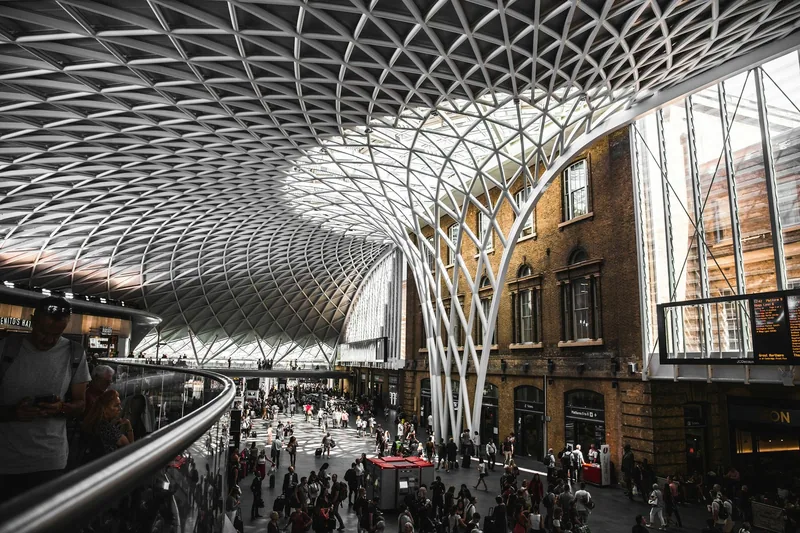
These two neighbouring stations on Euston Road handle a large share of long-distance and international travel. King's Cross is the terminus of the East Coast Main Line to York, Newcastle and Edinburgh, and also has direct trains to Cambridge. It is home to the Platform 9¾ photo spot from the Harry Potter books and films, just outside the Harry Potter Shop in the station; our guide to Harry Potter locations in London has the details.
St Pancras International, next door, is the home of Eurostar. Trains to Paris and Brussels leave from the upper level, and passport and security checks take place before boarding, so Eurostar recommends arriving 75 minutes before departure in Standard and Plus, and 45 minutes in Premier. Our guide to Eurostar from London to Paris explains check-in and luggage rules. East Midlands Railway trains, including the Luton Airport Express, use the upper level as well, while Thameslink trains stop on the lower level.
The Victorian station building, with its great iron-and-glass train shed and red-brick hotel front, is one of London's finest, and it is worth arriving early just to look around. For a platform-by-platform tour, our sister site Viamo has a detailed guide to St Pancras station. The area behind both stations has been rebuilt with canalside squares, shops and restaurants; see our King's Cross neighbourhood guide.
King's Cross and St Pancras are not the same station. They share a Tube station and are only a road apart, but they have separate platforms, departure boards and ticket gates. Check which one is printed on your ticket; allow at least 10 minutes to walk between them with luggage.
Euston: trains to the north-west and Scotland
Euston, a short walk west along Euston Road from King's Cross, is the London end of the West Coast Main Line to Birmingham, Manchester, Liverpool and Glasgow. Overnight sleeper trains to Scotland also leave from here. The station area is a large building site because of work on the new HS2 high-speed railway, so follow the signs carefully when walking to and from the station.
Euston is also where you catch the London Overground's Lioness line and other trains to Watford Junction, the station for the Warner Bros. Studio Tour. The studio says Watford Junction is about 20 minutes from Euston, and Oyster is valid there.
Paddington and Marylebone: the west
Paddington is the main gateway to the west of England and Wales. Great Western Railway trains run to Bath in around 1 hour 20 minutes and to Oxford in around 1 hour (the fastest in 52 minutes). Paddington is also the starting point for Heathrow: the non-stop Heathrow Express takes 15 minutes to Terminals 2 and 3, and the Elizabeth line takes 28 minutes at a lower fare. Our guide to getting from Heathrow to central London compares the options.
Marylebone is one of the smallest and calmest London terminals. Chiltern Railways trains run from here to Oxford in as little as 1 hour 12 minutes, and also to Birmingham. If you are planning a day out, our guide to an Oxford day trip compares the two routes.
Waterloo, Victoria and London Bridge: the south
Waterloo, south of the river near the London Eye, serves south-west London and south-west England. It is the station for Windsor and Eton Riverside, Richmond and Hampton Court, and for longer trips to Southampton, Portsmouth and Salisbury, the nearest city to Stonehenge. Note that Oyster and contactless are not valid on the trains to Windsor.
Victoria is the main station for Gatwick Airport and Brighton. The Gatwick Express runs non-stop from here twice an hour and takes 30 minutes; see our Gatwick guide for fares. Victoria Coach Station, the terminal for long-distance coaches, is about 300 metres away; our guide to Victoria Coach Station explains how to get there with luggage.
London Bridge, next to the Shard and Borough Market, is a busy through station. Thameslink trains call here on their way from St Pancras to Gatwick and Brighton, and there are frequent trains to Kent, Sussex and south-east London, including Greenwich. For the coast, see our Brighton day trip guide.
Liverpool Street and the east
Liverpool Street, on the edge of the City of London, serves Essex and East Anglia. The Stansted Express runs from here every 15 minutes and takes 48 minutes to the airport; contactless is accepted on it, but Oyster is not. Trains to London Southend Airport also start here. Our Stansted Airport guide covers fares and times.
Liverpool Street is also a major stop on the Elizabeth line, which runs east–west under central London and connects it directly with Paddington, Farringdon, Tottenham Court Road and Bond Street. Our Elizabeth line guide explains how to use it.
The smaller City terminals, Fenchurch Street and Cannon Street, mainly serve commuters, but Cannon Street is handy for trains to Greenwich, and Blackfriars, a Thameslink station whose platforms stretch across the Thames, gives you a river view while you wait.
How to get between London's stations
Most transfers between terminals are simple on the Underground or the Elizabeth line. The table below shows direct connections; for anything else, use the TfL Journey Planner or the TfL Go app, which also shows step-free routes.
| From | To | Direct connection |
|---|---|---|
| King's Cross / St Pancras | Euston | Victoria or Northern line, one stop; or a short walk along Euston Road |
| King's Cross / St Pancras | Victoria | Victoria line |
| King's Cross / St Pancras | Paddington or Liverpool Street | Circle or Hammersmith & City line |
| St Pancras | London Bridge, Blackfriars, Gatwick | Thameslink train |
| Euston | Waterloo | Northern line (Charing Cross branch) |
| Paddington | Waterloo | Bakerloo line |
| Paddington | Liverpool Street | Elizabeth line |
| Waterloo | London Bridge | Jubilee line |
| Liverpool Street | Victoria | Circle line |
Two stations work as useful interchanges in the middle. Farringdon connects Thameslink trains with the Elizabeth line, which is the route the Gatwick Airport website suggests for travelling from Gatwick to Heathrow by rail in about 1 hour 30 minutes. Bank and Monument, in the City, link several Tube lines and the DLR.
Pay for these connections with a contactless card or Oyster. A Tube journey inside Zone 1 costs £3.10 at peak times and £3.00 off-peak (September 2026), against £7.00 for a paper single. Our guide to the London Underground explains how to find your line and platform.
With heavy bags, a taxi between stations can be good value. The Tube can be crowded, and some stations have long corridors and stairs. For a family with large cases, a black cab between two nearby terminals often costs little more than four Tube fares; black cab fares start at £4.40, and a one-mile trip in the daytime costs about £8.40 to £13.
Allowing enough time for a connection
If you are changing from one long-distance train to another in London, treat it as two separate journeys. The Tube ride between two well-connected terminals may only be a few stops, but walking through large stations, finding the right platform and waiting for a train all add time. As a rule of thumb, we would allow at least an hour between trains, and more with luggage, children or an Advance ticket that is valid only on one train. For Eurostar, add the 75-minute check-in time on top.
Advance train tickets are only valid on the train shown, and a missed connection because you misjudged a London transfer is your problem, not the railway's. Our guide to buying UK train tickets explains the difference between Advance, Off-Peak and Anytime fares.
Luggage storage and step-free access
Several major stations have left luggage offices run by the Excess Baggage Company, including nine London terminals: King's Cross, St Pancras, Paddington, Euston, Waterloo, Victoria, Liverpool Street, London Bridge and Charing Cross. The operator's own branch list gives 07:00 to 23:00 at all nine, seven days a week, and publishes prices when you book. Network Rail's station pages show Monday to Friday only, which is a gap in its data rather than a weekend closure. At Victoria Coach Station, TfL runs its own left luggage service. Our guide to left luggage in London has more options.
Step-free access varies. All 41 Elizabeth line stations are step-free from street to platform, which makes Paddington, Liverpool Street and Farringdon easier with wheelchairs, buggies and heavy bags. Many Tube stations are not. TfL staff give "turn up and go" help on the Tube, Overground and Elizabeth line without booking, and TfL's Passenger Assist service can be booked at least 2 hours ahead. For long-distance trains, ask the train company about assistance when you book. Our guide to step-free transport in London explains the details.
Frequently asked questions
What is the main train station in London?
There is no single main station. London has about a dozen main-line terminals, each serving a different part of Britain. The busiest for visitors are King's Cross and St Pancras (north and Eurostar), Paddington (west and Heathrow), Waterloo (south-west), Victoria (Gatwick and Brighton) and Liverpool Street (east and Stansted).
Are King's Cross and St Pancras the same station?
No. They are two separate main-line stations standing side by side on Euston Road, with separate platforms and departure boards. They share one Underground station, King's Cross St Pancras, and it takes a few minutes to walk between them.
Which London station do trains to Scotland leave from?
Trains to Edinburgh on the east coast route leave from King's Cross, while trains to Glasgow on the west coast route leave from Euston. Overnight sleeper trains to Scotland also leave from Euston. Check your ticket, because both stations serve Scotland.
How long does it take to change stations in London?
The Tube or Elizabeth line ride between two well-connected terminals is often only a few stops, but walking through large stations, crowds, stairs and luggage all add time. If you have separate train tickets, we would allow at least an hour, and more for Eurostar because of its check-in time.
Can I use contactless to travel between London stations?
Yes. Contactless cards, phones and Oyster cards work on the Tube, the Elizabeth line and most trains within London. A single Tube journey in Zone 1 costs £3.10 at peak times, much cheaper than a £7.00 paper ticket.
Sources
- Eurostar - Check-in (checked September 2026)
- Transport for London - Getting to and from Heathrow on the Elizabeth line (checked September 2026)
- Stansted Airport - Getting to and from by train (checked September 2026)
- Gatwick Airport - Train (checked September 2026)
- Great Western Railway - London to Oxford (checked September 2026)
- South Western Railway - Trains to Windsor Castle (checked September 2026)
- Network Rail - Our stations (checked September 2026)
- Transport for London - Help from staff (checked September 2026)