
Shepherd's Bush Market trades Monday to Saturday, 9am to 6pm, and is closed all day Sunday. Aim to arrive before four o'clock: the fabric arches and the fishmongers start clearing up in the last hour, and a Saturday afternoon in the fourth hour is when the stock is thinnest.
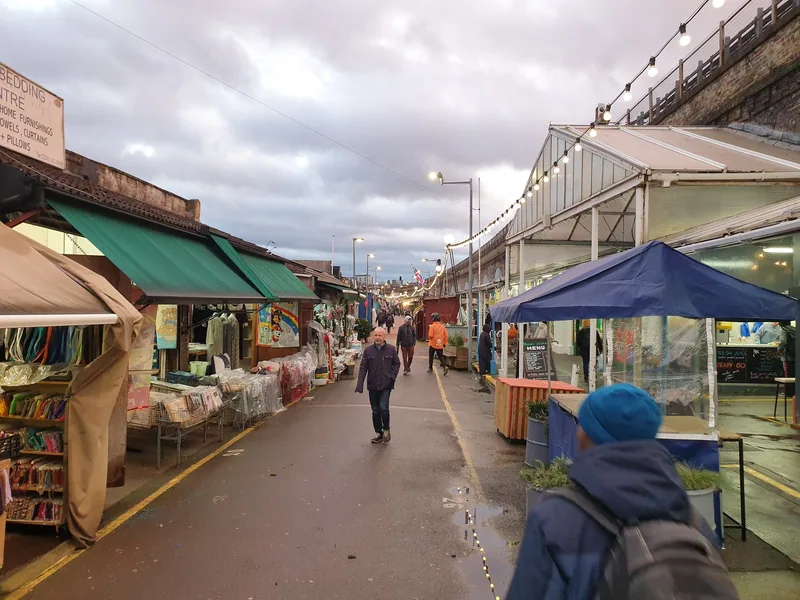
The market fills a long strip of ground beside and under the railway viaduct between the Uxbridge Road and Goldhawk Road, in west London. It is a working local market rather than a visitor attraction, which is precisely why it is worth an hour: nothing about it has been arranged for you.
Our guide to Shepherd's Bush and White City covers the area, the five stations and where the good food is. This page is about the market itself: when it opens, how old it actually is, who owns it, and what the building work next door will and will not do to it.
Shepherd's Bush Market at a glance
- Days and hours
- Monday to Saturday, 9am to 6pm. Closed Sunday
- Address
- Uxbridge Road, London W12 8DF, with entrances on the Uxbridge Road and Goldhawk Road
- Cost
- Free to walk in
- Nearest stations
- Shepherd's Bush Market and Goldhawk Road, one at each end, both on the Circle and Hammersmith & City lines
- Owner
- Yoo Capital, which took a controlling 75.5% interest in September 2020; U+I retains 24.5%
- Listed?
- No. Neither the market nor the viaduct arches appear in the National Heritage List for England
There are two markets called Shepherd's Bush Market, and only one of them is this one
This catches people out, and it is not their fault. Hammersmith and Fulham Council's own market pages set it out: the original market has entrances on the Uxbridge Road and Goldhawk Road just east of the railway bridges, while the entrance to the New Shepherd's Bush Market is further west along the Uxbridge Road. Both are privately run, by different operators, and they are a few minutes apart.
The original is the one with the arches, the fabric and the century of history. The newer market, postcode W12 7JA, is a separate business trading the same days. If you have been sent an address or a set of opening hours from a listings site and the postcode does not begin W12 8, you are being pointed at the other one.
1914, 1915, 1918: how old the market is depends on who you ask
The market's own history pages say that on 30 June 1914 a man named John Crowe invited costermongers to set up stalls on Railway Approach. The arches themselves were older: businesses had been trading under them since 1863, when the viaduct was built, among them furniture dealers, a coal office, a printer's, a horse butcher's and an undertaker's parlour, and the existing traders were not pleased about their new neighbours.
Crowe's market lasted less than a year. It closed in 1915 so the ground could be used for billeted troops, and it was restarted in 1918 when soldiers returning from the Western Front were offered stalls. That is why the dates on offer disagree: the current owner's investment pages describe the market as "originally established in 1918", one page of the market's own site calls it a 108-year history, and another headlines it as 110 years. All three are defensible depending on which start you count. The honest summary is that stalls first appeared in the summer of 1914 and the market as a continuous business dates from 1918.
One more date is worth carrying round with you. In February 1944, during the Little Blitz, a flying bomb hit the market and destroyed six shops; the traders had it open again within days. The arches you walk between are therefore a patchwork of 1860s brick, post-war repair and later infill, which is part of why the market looks nothing like a heritage attraction.
One shop here has not moved since the market's own history was set down. Ellis's Pet Stores appears in that history among the traders of the 1950s, complete with the talking macaw, and the market says it is still in exactly the same spot. It is the simplest measure of how little this market has been rearranged.
What is actually on sale, and what it is good for
Do not come expecting souvenirs. The market sells what west London households buy: fresh produce, spices, halal butchery, fish, hardware, luggage, watch repairs, shoe repairs, hats, and a long run of dress fabric sold by the yard. It is one of the better places in London for African wax print, brocade and lace, and there are tailors alongside who will make something from what you buy.
That makes it useful for a specific kind of visitor rather than a general one. If you sew, or you want a length of cloth as the thing you take home, an hour here beats an afternoon in the West End and costs a fraction as much. If you want coffee and a gift shop, go somewhere else. Our guide to London markets by day of the week puts this one alongside the alternatives, and Ridley Road in Dalston is the closest thing to it on the other side of London.
Check branded goods carefully before you pay. Hammersmith and Fulham Council has signed the Real Deal charter, a scheme run with dozens of other councils to reduce the sale of counterfeit goods at markets. That is a sign the problem exists rather than that it has been solved. Buy fabric, food and household goods with confidence; treat branded electronics, perfume and sportswear with the same caution you would at any street market.
The redevelopment: what is being built, and what is not
For more than a decade Shepherd's Bush Market has been described as under threat of demolition. That framing is now out of date, and the difference matters if you are deciding whether to bother going.
Yoo Capital took a controlling interest in September 2020 and has planning permission for a scheme in which the market is kept and refurbished rather than cleared. The market's own published summary of the deal says the trading strip gets a new road surface, a canopy and new entrance signs, and that long-standing traders receive either a brand-new unit or £10,000 of investment in their existing one. The support package it lists includes rent frozen at 2015 levels until 2031, no rent or service charge during construction, business rates reimbursed, a minimum of £7,500 for traders who stay open through the works, and monthly payments of between £1,800 and £3,000 for traders who prefer to take a sabbatical while the work is done. The owner puts the total pledged at about £5.4 million, with more than £750,000 already spent on physical upgrades.
The new building goes up next door, on a site called the Old Laundry Yard, which the council owns. That is where the office and laboratory block with an Imperial College London incubator goes, together with 40 affordable homes that the council will own and manage. The masterplan area also takes in units on Market Lane and premises on Goldhawk Road.
For a visitor, the translation is this. The market is not scheduled to be demolished. It will, at some point, be a building site with scaffolding, hoardings and some units shut, and no public date for that has been fixed. Go now if you want to see it before the canopy goes on, and expect the ground underfoot to improve and the character to change a little when it does.
Neither station at the market has a lift
The market's two ends have a station each, which is unusually convenient, and both of them are stairs-only. The trap in the naming is covered in our page on stations it is quicker to walk between: Shepherd's Bush and Shepherd's Bush Market are two different stations on two different railways.
If you need step-free arrival, the practical answer is a bus along the Uxbridge Road, which puts you on the pavement at the market's northern entrance without a staircase anywhere. Both stations on the market's own doorstep are on the Circle and Hammersmith & City lines, explained in our guide to the Metropolitan and Hammersmith & City lines, which are also the two lines most likely to be disrupted at weekends out here.
Money, prices and how the trading works
Prices are marked, low and generally not negotiable on food. Fabric is sold by the yard and the price per yard is usually chalked up; a tailor's quote for making something is separate and worth asking for before you buy the cloth. Cards are widely taken but cash still moves faster on a busy Saturday, and some smaller units set a card minimum.
There is no tax-free shopping to be had here or anywhere else on the British high street: the scheme that let visitors reclaim VAT on goods carried home was withdrawn on 1 January 2021, and prices already include VAT at 20%. Our page on tax-free shopping in the UK explains the one narrow exception. If something goes wrong with a purchase, complaining and consumer rights in Britain sets out what a trader has to do.
What to combine it with
The market takes 45 minutes to an hour at a normal pace, and rather longer if you are buying cloth. That leaves most of a day, and there are three sensible directions.
Five minutes north is the shopping centre at White City, which is the exact opposite of this and covered in our guide to the two Westfield centres. Three listed buildings stand within a few minutes' walk: the Shepherds Bush Empire, listed at Grade II in October 1981 and now a music venue; the former Odeon cinema on Shepherd's Bush Green, listed at Grade II in January 1974; and The Grampians, the 1930s block on the Western Avenue side, listed in 2003. And the Bush Theatre, a few steps from the market's northern entrance, is one of the reasons to be here in the evening, as our piece on the West End or fringe theatre explains.
For food, the good eating in this part of west London is in the streets around the market rather than in it, and the neighbourhood guide linked at the top names the places with their hygiene ratings. If the cloth has put you in mind of the cooking, our pages on Caribbean food in London and Nigerian and Ghanaian food both have addresses within reach.
Frequently asked questions
What are Shepherd's Bush Market opening times?
Monday to Saturday from 9am to 6pm, with the market closed all day on Sunday. Individual shops and arches set their own hours within that, and the produce and fish traders tend to start packing up in the last hour, so before 4pm is a better bet than after 5pm.
Is Shepherd's Bush Market being demolished?
No. The permitted scheme keeps the market and refurbishes it, with a new surface, a canopy and new entrance signs, and builds the new offices, laboratories and 40 affordable homes on the council-owned Old Laundry Yard site next door. Expect disruption while the work happens, but not demolition of the market itself.
What can you buy at Shepherd's Bush Market?
Fresh fruit and vegetables, spices, halal meat, fish, hardware, luggage, hats and household goods, plus a concentration of dress fabric sold by the yard: African wax print, brocade and lace, with tailors on site who will make garments from it.
How old is Shepherd's Bush Market?
Stalls first appeared on Railway Approach on 30 June 1914, but the market closed in 1915 and restarted in 1918, which is why the market's own pages and its owner give founding dates of 1914 and 1918 in different places. Businesses had been trading under the arches since the viaduct was built in 1863.
Is Shepherd's Bush Market step-free?
The market itself is flat and at street level, but neither of the two stations at its ends has a lift. Arrive by bus along the Uxbridge Road if you cannot manage stairs, or use a step-free station further north and walk down.
Sources
- London Borough of Hammersmith & Fulham - Shepherds Bush Markets (Internet Archive copy of 18 January 2025; the live site returns 404 to automated requests)
- London Borough of Hammersmith & Fulham - Markets in H&F, including the Real Deal charter (Internet Archive copy of 18 January 2025)
- Historic England - Shepherds Bush Empire, list entry 1358593 (checked September 2026)
- Historic England - Odeon Cinema, Shepherd's Bush Green, list entry 1286354 (checked September 2026)
- Historic England - National Heritage List for England, open data service (checked September 2026)
- GOV.UK - Tax-free shopping (checked September 2026)