
Covent Garden is the most enjoyable place in central London to combine shopping with sightseeing: a historic market hall with craft and antique stalls, pedestrian streets full of beauty and fashion brands, and the smaller independent shops of Seven Dials and Neal's Yard just to the north. Everything is within a ten-minute walk, and most of it is car-free.
The name Covent Garden refers both to the Piazza, the large square with the old Market Building in the middle, and to the whole district around it. For centuries this was London's main fruit, vegetable and flower market. Today the market hall and the streets around it are filled with shops, cafés and street performers, and the area is busy from late morning until late evening.
Covent Garden is not the cheapest place to shop, and some of the brands are the same international names you will find on Oxford Street. What makes it special is the setting, the mix of old and new, and the number of small shops you can find if you walk a few streets away from the Piazza.
Covent Garden shopping: key facts
- Piazza and Market Building
- Public space, free to enter at any time
- Typical shop hours
- About 10:00-20:00 Monday to Saturday; about 11:00-18:00 on Sunday
- Apple Market
- Daily 10:00-18:00; antiques and collectables on Mondays, British handmade crafts Tuesday to Sunday
- East Colonnade Market
- 10:30-19:00
- Seven Dials
- About 90 shops and more than 50 cafés, restaurants, bars and pubs
- Nearest stations
- Covent Garden (1 minute), Leicester Square (5 minutes), Charing Cross (6 minutes), Holborn (10 minutes)
Hours and figures are those published by the Covent Garden estate in September 2026. Individual shops set their own hours.
From fruit market to shopping district
According to the Covent Garden estate, the land here once belonged to Westminster Abbey and was known as the garden of the Abbey and Convent, which is where the name comes from. A market is first mentioned in 1654, and it grew into London's largest fruit and vegetable market. The Market Building you see today dates from the 19th century, when the Duke of Bedford had a proper covered market built on the square.
The wholesale market moved out of central London in the 1970s. Plans to demolish the area were stopped after a campaign by local residents, and in 1980 the renovated building reopened as a shopping centre. Many of the old market structures, the cobbles and the iron-and-glass roof survived, and they give the area much of its character. Our Covent Garden neighbourhood guide covers the theatres, restaurants and history in more detail.
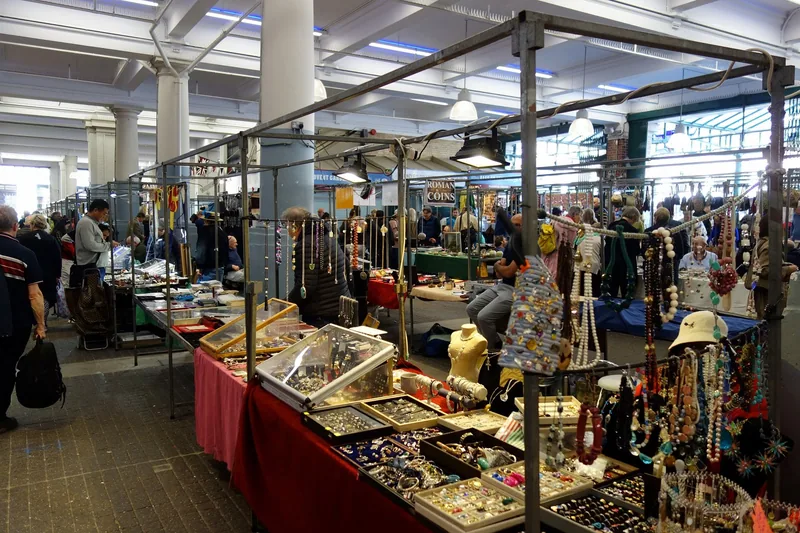
The Market Building and its two markets
The Market Building sits in the middle of the Piazza and is always open to walk through. Its outer arcades and lower level hold small shops, cafés and restaurants, while the covered central hall is home to the Apple Market.
Apple Market: crafts and antiques under the glass roof
The Apple Market is open every day from 10:00 to 18:00. On Mondays it is dedicated to antiques and collectables, and from Tuesday to Sunday the stalls sell British handmade crafts, such as jewellery, prints, ceramics, soaps and small gifts. It is one of the better places in central London to find a souvenir made by the person selling it.
Monday is the day for old things in the Apple Market. If you like vintage jewellery, old maps, coins, cutlery or small collectables, plan your Covent Garden visit for a Monday, when the craft stalls make way for antique and collectables dealers. The rest of the week is better for new handmade gifts.
East Colonnade Market and Jubilee Market
Along the eastern side of the Market Building, the East Colonnade Market has smaller stalls and is open from 10:30 to 19:00. On the south side of the Piazza, Jubilee Market Hall is a separate covered market with its own stalls and weekly pattern. Its goods are more mixed, and it is worth a quick walk through to compare.
Beauty, fragrance and accessories in the Market Building
Covent Garden has become one of London's main destinations for beauty and fragrance. In and around the Market Building you will find perfume houses and skincare brands such as Penhaligon's, Miller Harris, Byredo, L'Occitane and Chanel, alongside British accessories brands like Aspinal of London and Cambridge Satchel. Most offer testers and advice, so it is a good place to try before you buy.
The Piazza, street performers and St Paul's Church
The open Piazza on the west side of the Market Building is famous for its street performers, who work in front of St Paul's Church, often called the actors' church because of its long links with the nearby theatres. The shows are free, but performers rely on the money the audience gives at the end, and it is polite to give something if you stayed to watch.
The Piazza gets very crowded around the shows, especially on weekend afternoons, and crowds are where pickpockets work. Keep your phone and wallet secure while you watch.
Covent Garden is the heart of Theatreland, and many visitors shop in the afternoon and see a show in the evening. Our guide to West End theatre explains how to choose a show and buy tickets.
King Street, Floral Street and the streets around the Piazza
The streets that lead off the Piazza have their own character, and it pays to explore them rather than stay in the square.
- King Street runs west from the Piazza and is pedestrianised, with a line-up of British and international flagship stores.
- Floral Street, just north of the Piazza, is known for fashion boutiques and a quieter feel.
- Henrietta Street, on the south-west side, is a pedestrian street with lifestyle shops, boutique hotels and restaurants.
- The Royal Opera House arcade, beside the opera house, has luxury accessories, beauty and snack stops.
- Long Acre and James Street are busier streets with mainstream fashion chains, useful if you need something practical.
At 7 Mercer Walk, between Long Acre and Seven Dials, Stanfords is one of the world's best-known map and travel bookshops. It is a good place to buy a detailed London street map or a guide for your next trip; see our guide to London's best bookshops for more.
Seven Dials: the village north of Covent Garden
A few minutes' walk north of the Piazza, seven streets meet at a small roundabout with a tall pillar in the middle. This is Seven Dials, laid out in the 1690s by Thomas Neale, who designed the street plan to fit in as many houses as possible. The pillar carries sundials, and the column itself was said to be the seventh "dial". The monument you see today is a later replacement of the original.
The area was once one of London's poorest slums, but today Seven Dials is one of its most pleasant shopping districts. The Covent Garden estate says it has about 90 shops and more than 50 cafés, restaurants, bars and pubs, spread along Monmouth Street, Earlham Street, Shorts Gardens, Mercer Street and Neal Street. Expect independent fashion, trainer and streetwear shops, grooming and beauty boutiques and concept stores alongside some international brands.
Seven Dials is calmer than the Piazza on a Saturday. When the market hall and King Street are at their most crowded, walk north up Neal Street or James Street into Seven Dials. The streets are narrower, but the pace is slower, and you are more likely to find somewhere to sit down.
Seven Dials Market for lunch
In a former banana warehouse on Earlham Street, Seven Dials Market is an indoor food hall with close to 20 food stalls, covering everything from tacos and dumplings to pasta and desserts. It is a practical place for a quick, reasonably priced lunch between shops. For more ideas, see our guide to cheap eats in London.
Neal's Yard and Neal Street
Neal's Yard is a small courtyard hidden between Shorts Gardens and Monmouth Street, reached through narrow passages. Its brightly painted buildings make it one of the most photographed corners of the West End. The courtyard took on its modern identity in the 1970s, when an entrepreneur bought one of the empty warehouses and turned it into a hub for natural food and healthy living.
Neal's Yard Remedies, the natural skincare brand, opened its first shop here in 1981, and its flagship is still in Seven Dials. Around the courtyard are small cafés, a bakery and wine bars. It is tiny, so it takes only a few minutes to see, but it is a pleasant place to stop for coffee.
Neal Street runs from Long Acre up to Shaftesbury Avenue and is one of the main shopping streets of the area, with fashion, shoes and outdoor clothing. It is a good link between Covent Garden station and Seven Dials.
Practical tips: stations, toilets and opening hours
Getting there
Covent Garden station on the Piccadilly line is only a minute from the Market Building, but it has 193 steps between the platforms and the street. Use the lifts, and do not attempt the stairs with heavy bags. At busy times the estate suggests getting off at Leicester Square (Piccadilly and Northern lines), five minutes away. Holborn and Charing Cross are also close, and Tottenham Court Road on the Elizabeth line is about 15 minutes' walk. Our guide to using the Tube explains fares and touching in and out.
The smoothest step-free way into the Market Building is from Russell Street or the bottom of James Street, according to the estate, because the cobbles make other routes harder for wheelchairs and pushchairs. Our page on step-free transport in London lists accessible stations nearby.
Toilets, water and cash
Inside the Market Building there are toilets that cost £1.50, and toilets on either side of the portico of St Paul's Church cost 50p, according to the Covent Garden estate (September 2026). An accessible toilet is in Tavistock Court, beside Jubilee Market. See our guide to public toilets in London for free options elsewhere. The estate also lists free water refill points in a few shops and in Seven Dials Market.
Almost every shop and stall accepts cards and contactless payment. There are cash machines on King Street and Long Acre if you need notes for a small stall or to give to a street performer.
Opening hours and Sundays
The Piazza and Market Building are always open, but the shops usually trade from about 10:00 to 20:00 Monday to Saturday and from about 11:00 to 18:00 on Sunday. Many shops in Covent Garden are small, so they are not bound by the six-hour Sunday limit that applies to large shops, but most still keep shorter Sunday hours.
Combining Covent Garden with the rest of the West End
Covent Garden sits between several other good areas for a day out. Trafalgar Square and the National Gallery are about ten minutes' walk south-west. To the west, Leicester Square leads to Chinatown and the streets of Soho, with more independent shops and restaurants.
If you want bigger stores, Oxford Street is 15 to 20 minutes' walk north-west; our guide to shopping on Oxford Street explains which parts are worth your time. For second-hand clothes and records, see our guide to vintage and second-hand shopping in London.
In December the Piazza has a giant Christmas tree and decorations, and the Market Building becomes one of the most atmospheric places in London for Christmas shopping. Our guide to Christmas in London covers the season. For gift ideas at any time of year, see our list of London souvenirs worth buying.
Frequently asked questions
What time do the shops in Covent Garden open?
The Piazza and Market Building are always open to the public. Most shops trade from around 10:00 to 20:00 Monday to Saturday and from around 11:00 to 18:00 on Sunday. The Apple Market is open daily from 10:00 to 18:00, and the East Colonnade Market from 10:30 to 19:00.
What day is the antiques market in Covent Garden?
The Apple Market in the Market Building is dedicated to antiques and collectables on Mondays. From Tuesday to Sunday it sells British handmade crafts instead. Jubilee Market Hall on the south side of the Piazza has its own separate pattern of stalls.
Is Covent Garden expensive for shopping?
Many shops in the Market Building and on King Street are premium brands, so prices are higher than average. You can still shop on a modest budget at the craft stalls, in Seven Dials and on Neal Street, and the street performers and Piazza are free to enjoy.
How do I get from Covent Garden to Seven Dials?
Walk north from the Piazza along James Street or Neal Street. You reach the Seven Dials pillar in about five minutes. Neal's Yard is on the way, reached through a narrow passage off Shorts Gardens or Monmouth Street.
Is Covent Garden station step-free?
Covent Garden station has lifts, but the stairs have 193 steps, so always use the lifts. At busy times it can be easier to use Leicester Square, which is about five minutes' walk away. Check TfL's step-free information for your journey before you travel.
Sources
- Covent Garden - Frequently asked questions (checked September 2026)
- Covent Garden - Getting to Covent Garden (checked September 2026)
- Covent Garden - The Market Building and Piazza (checked September 2026)
- Covent Garden - Seven Dials (checked September 2026)
- Covent Garden - Neal's Yard (checked September 2026)
- Stanfords - Our stores (checked September 2026)