
Liberty is a shop you can visit like a building. The black-and-white block on Great Marlborough Street was finished in 1924 out of the timbers of two scrapped warships, and it costs nothing to walk in, climb the stairs and look. If you do want to buy, the fabric floor and the small print goods are what the shop does better than anywhere else.
Our overview of London's department stores places Liberty among its rivals and says what each one is for. This page goes inside: which door to use, what to look for in the woodwork, how the fabric hall and the haberdashery actually work, and what is worth carrying home.
The short version for anyone short of time: enter from Great Marlborough Street, walk up the main staircase to the top, look down through the atriums, then come back down through the fabric floor. Twenty minutes, no money spent, and it is one of the more memorable interiors in central London.
Liberty: the practical details
- Address
- Regent Street, London W1B 5AH; the shop front and main doors are on Great Marlborough Street
- Nearest station
- Oxford Circus, about three minutes on foot
- Hours
- 10:00-20:00 Monday to Saturday; 12:00-18:00 Sunday, with browsing from 11:30 (September 2026)
- Bank holidays
- 10:00-20:00
- Festive hours
- 24 November to 26 December: 10:00-21:00 Monday to Saturday; Christmas Eve 09:00-17:00; closed Christmas Day; 10:00-20:00 on Boxing Day and New Year's Day
- Entry
- Free, no ticket, no dress code
- Customer services
- Third floor
Where the building came from
Arthur Lasenby Liberty opened his first shop on Regent Street in 1875, having borrowed £2,000 from the man who would become his father-in-law and hired three members of staff. He sold objects and cloth from Japan and the Far East at a moment when London society was fascinated by them. The loan was repaid inside eighteen months. The style the shop helped to popularise is still called stile Liberty in Italy, the Italian name for Art Nouveau.
The mock-Tudor building came much later, and Arthur did not live to see it. He died seven years before it opened. The architects were Edwin T. Hall and his son Edwin S. Hall, and in 1922 the builders Higgs and Hill were given a lump sum of £198,000 to put it up. They did so using more than 24,000 cubic feet of ship timber salvaged from two three-decker men-of-war: HMS Impregnable, built from around 3,040 oaks felled in the New Forest, and HMS Hindustan, which happened to match the length and height of the new store. The old ships' decks became the shop floors, and they still creak.
The 1920s were the height of a Tudor revival in English architecture, and the shop was planned around three atriums, each ringed by small rooms with fireplaces so that customers would feel they were walking through a house rather than a warehouse. That is still the effect, and it is the reason Liberty feels nothing like a modern store: instead of one open sales floor, you get a series of wooden rooms opening off galleries.
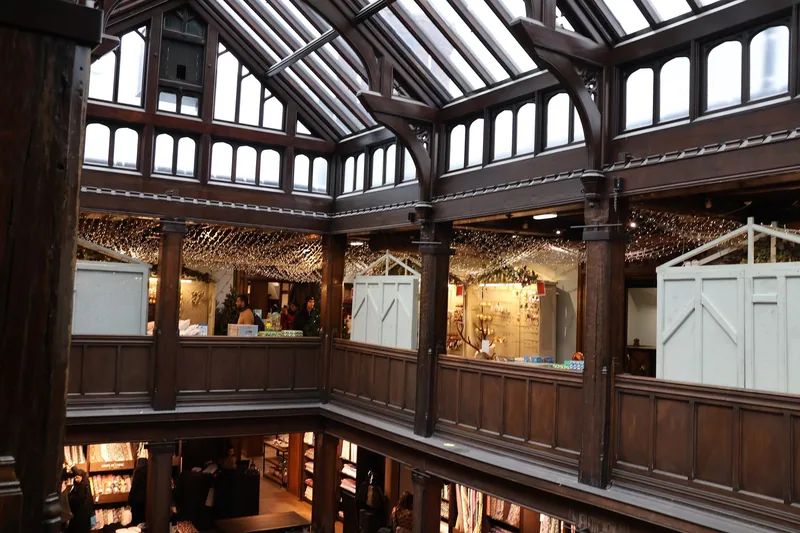
Photo: DiscoA340 · CC BY-SA 4.0 · Wikimedia Commons · resized
Eight things to look for inside, none of which cost anything
Liberty publishes its own list of curiosities hidden in the fabric of the building. These are the ones easiest to find:
- The statue of Arthur Liberty at the flower shop entrance on Great Marlborough Street.
- The main staircase and the three atriums. Go to the top floor and look down; then look up from the ground floor. The carved panels and pillars came from the company's own furniture workshop in Archway, run by the craftsman Lawrence Turner.
- Miniature glass paintings set into the windows among the panelling, taken from the captain's quarters of one of the ships.
- The Shields of Shakespeare and painted portraits of the six wives of Henry VIII.
- The war memorial carved into the old staircase, remembering Liberty staff killed in the First World War.
- Carved wooden animals scattered through the building, most of them around the third-floor central atrium. Children who are bored of shopping will hunt these happily for twenty minutes.
- The Liberty clock on the bridge over Kingly Street, put up in 1925, showing St George and the dragon, with the inscription: "No minute gone comes ever back again, take heed and see ye nothing do in vain."
- The weathervane, a gilded copper model of the Mayflower, more than four feet high and weighing over a hundred pounds. Look up from the street.
There is also a chandelier, said to be the longest in Europe, hanging down the back stairwell. Liberty's own advice is to view it either from the fourth floor looking down or from the lower ground floor looking up, because from the middle you see only a section of it.
The building is free and the flower shop entrance is the one to use. There is no admission charge, no bag search beyond the usual, and nobody minds visitors who are only looking. Come in from Great Marlborough Street rather than through the Regent Street block, because that is where the woodwork starts immediately.
The fabric floor and the haberdashery
This is the part of the shop that people travel for. Liberty sells its own printed fabric by the metre, designed in an in-house studio that still hand-paints its patterns and draws on an archive of some 45,000 designs.
The base cloths are worth understanding before you go, because they are what the price hangs on:
| Cloth | What it is | Typically used for |
|---|---|---|
| Tana Lawn cotton | The classic fine, dense, slightly silky cotton | Shirts, dresses, linings, quilting |
| Cotton dobby and quilting cotton | Heavier, more textured cottons | Patchwork, bags, children's clothes |
| Silk crepe de chine and silk satin | Printed silks, much more expensive per metre | Scarves, blouses, linings |
| Linen and wool | Seasonal, smaller ranges | Jackets, trousers, furnishing |
| Furnishing fabric and wallpaper | Wider widths, heavier weights | Curtains, cushions, walls |
Fabric is cut to order at a counter, so join the queue and take a ticket if there is one. Ask for the remnant bin or the end-of-roll pieces if you only need a small amount; the price per metre falls sharply and the prints are the same. For a visitor who sews, a half-metre of Tana Lawn is the lightest, flattest and most distinctive thing you can carry out of London.
The haberdashery next to it sells buttons, ribbons, trims and thread, and it is one of the few places in central London that still does. If you are comparing it with anywhere else, the other serious haberdashery department in the West End is inside John Lewis on Oxford Street; our Oxford Street guide covers that end of the street.
What is actually worth buying
Liberty is an expensive shop, and a lot of what it sells is available elsewhere. The things that are genuinely specific to it are the printed goods, because the prints are its own:
- Small print items. Notebooks, pouches, handkerchiefs, card holders, ribbon, covered buttons. Light, flat and unmistakably from here.
- Scarves. Silk squares in archive prints, at a wide range of prices depending on the cloth and the size.
- Fabric by the metre, as above, which is the best value per pound spent in the whole building.
- Liberty's own fragrance and beauty lines, and a fragrance hall that carries niche perfume houses not sold in the other big stores.
- Stationery and wrapping paper, often overlooked, always in the prints.
What to skip: the designer fashion floors, unless you have a specific reason, because the same labels are stocked across the West End. The same goes for the general homeware. Our shortlist of London souvenirs worth buying has the wider comparison.
All prices in British shops include 20% VAT, and visitors cannot reclaim it at the airport; the scheme that allowed that ended in Great Britain at the start of 2021. The one remaining route is for the store to ship goods directly to an address outside the UK. Our page on tax-free shopping rules explains what is left of the system.
Eating, resting and the quiet hours
Liberty has cafés and a restaurant inside, and the shop is a good place to sit down in the middle of a West End day when the streets outside are full. It is also one of the better indoor options in bad weather; see our list of things to do in London when it rains.
The quiet times are weekday mornings between opening and about half past eleven, and the last hour before closing. Saturdays are busy all day. Sundays are compressed into six hours by the trading laws, which is why the tills only open at noon, with half an hour of browsing beforehand. The upper floors stay calmer than the ground floor at every hour, because most people who come in to look never leave the beauty hall.
Late November to Boxing Day is the one period with different hours. Liberty extends closing to 21:00 from Monday to Saturday between 24 November and 26 December, opens 09:00 to 17:00 on Christmas Eve and closes on Christmas Day. Its Christmas shop opens in early autumn and is busy from the day it does. See our guide to Christmas shopping in London, and check which dates are affected in our page on public holiday closures.
What is around the corner
Liberty sits at the junction of three very different shopping areas, which makes it a good starting point rather than a destination on its own.
Straight across Great Marlborough Street are the pedestrian lanes of Carnaby Street and the streets behind it, which is where the independent shops and the cheaper eating are. A minute the other way is Regent Street and its flagships. North is Oxford Circus; south and east is Soho.
If the building has given you an appetite for the decorative arts, the V&A holds the national collection of textiles and design, including Arts and Crafts material of exactly the kind Liberty was selling in the 1880s. For the other end of the department store scale, our pages on Selfridges and Fortnum & Mason cover the two stores most visitors pair it with, and Fortnum's tea rooms are one of the standard stops in our guide to afternoon tea.
Frequently asked questions
Is Liberty free to enter?
Yes. It is a shop, not a museum, so there is no ticket and no charge. Visitors are welcome to walk around the galleries and look at the woodwork without buying anything. The main doors are on Great Marlborough Street, and the building is open during normal shop hours.
Is the Liberty building really made from ships?
The frame and much of the interior are. More than 24,000 cubic feet of timber from two scrapped three-decker warships, HMS Impregnable and HMS Hindustan, went into the 1924 building, and the ships' decking was reused as the shop flooring. The mock-Tudor styling was a 1920s fashion, not an original Tudor house.
What should I buy at Liberty?
The printed goods are what the shop does that nobody else does: fabric by the metre, scarves, notebooks, pouches, ribbon and stationery in Liberty's own designs. Fabric offers the most for the money, especially remnants. The designer fashion floors stock labels you can find elsewhere in London.
What time does Liberty open on a Sunday?
Tills open at 12:00 and the store closes at 18:00, with browsing allowed from 11:30. English law limits large shops to six hours of Sunday trading between 10:00 and 18:00, which is why the Sunday hours are shorter than the rest of the week.
Which Tube station is closest to Liberty?
Oxford Circus, on the Central, Victoria and Bakerloo lines, is about a three-minute walk. Piccadilly Circus and Tottenham Court Road are both under ten minutes away on foot, and the Elizabeth line at Tottenham Court Road or Bond Street is a useful alternative when Oxford Circus is closed for crowding.
Sources
- Liberty - Store information, address and opening hours (checked September 2026)
- Liberty - Our heritage: the 1924 building and what to look for (checked September 2026)
- legislation.gov.uk - Sunday Trading Act 1994, Schedule 1 (checked September 2026)
- GOV.UK - Tax-free shopping (checked September 2026)
- The Crown Estate - The history of Regent Street (checked September 2026)