
The Metropolitan line is the magenta one and the Hammersmith & City is pink, and they share the oldest railway tunnel in the world: the stretch from Paddington through Baker Street and King's Cross to Farringdon, opened by the Metropolitan Railway in January 1863. Today the Metropolitan is the only Underground line that runs fast trains out of London altogether, as far as Amersham and Chesham in Buckinghamshire, 40 kilometres from the centre. The Hammersmith & City is the local stopping service that shadows it, six trains an hour from Hammersmith to Barking.
For a visitor the practical question on the Metropolitan is not where the trains go but which ones stop where. Three different stopping patterns leave Baker Street, and the difference between the fastest and the slowest train to Amersham is nine minutes. The general business of using the Underground is in our guide to the Tube; this page covers these two lines and nothing else.
The two lines at a glance
- Metropolitan line stations
- 34, from Aldgate to Amersham, Chesham, Uxbridge or Watford
- Hammersmith & City stations
- 29, from Hammersmith to Barking
- Furthest station from central London
- Chesham, Zone 9
- Baker Street to Amersham
- 46 minutes on a fast train, 52-55 on a semi-fast
- Baker Street to Uxbridge
- 39 minutes
- Trains an hour, Metropolitan at Baker Street
- 22-24 at the peak, 16 off-peak
- Trains an hour, Hammersmith & City
- 6, all day
- Trains
- Eight-car S8 stock on the Metropolitan, seven-car S7 on the Hammersmith & City; both air-conditioned and walk-through
- Night Tube
- Neither line runs a night service
- Zones 1-9 daily cap
- £23.30 peak, £16.30 off-peak (September 2026)
Which Metropolitan train stops where
All Metropolitan trains from Aldgate run through Liverpool Street, Moorgate, Barbican, Farringdon, King's Cross St Pancras, Euston Square, Great Portland Street and Baker Street. From Baker Street northwards they take the fast pair of tracks, so the next stop is Finchley Road, six minutes later; Swiss Cottage, St John's Wood and the rest belong to the Jubilee line, which runs beside it on the slow pair.
After Finchley Road and Wembley Park the patterns diverge, and this is what the destination board is really telling you:
- All-stations trains call at Preston Road and Northwick Park before Harrow-on-the-Hill, and then at every station on the way out, whether to Uxbridge or up the Amersham line. Harrow-on-the-Hill comes up 21 minutes after Baker Street.
- Semi-fast trains skip Preston Road and Northwick Park, reaching Harrow-on-the-Hill in 19 or 20 minutes, and then call at all stations.
- Fast trains skip Preston Road, Northwick Park, North Harrow, Pinner, Northwood Hills and Northwood as well, running Wembley Park to Harrow-on-the-Hill to Moor Park and then out to Rickmansworth, Chorleywood, Chalfont & Latimer and Amersham. Baker Street to Amersham on one of these is 46 minutes against 55 on the slowest.
Uxbridge trains leave the main line at Harrow-on-the-Hill and take the western branch through West Harrow and Rayners Lane; Watford trains branch at Moor Park; Chesham trains branch at Chalfont & Latimer. Chesham has through trains to and from central London, and no longer depends on the shuttle that older guidebooks describe.
A fast Metropolitan train will pass the station you are standing at. If you are waiting at Pinner, Northwood or Preston Road, watch the platform indicator rather than the first train you hear. Some trains go through these stations at speed on the same pair of tracks, and there is no announcement on the platform to warn you they are not stopping.
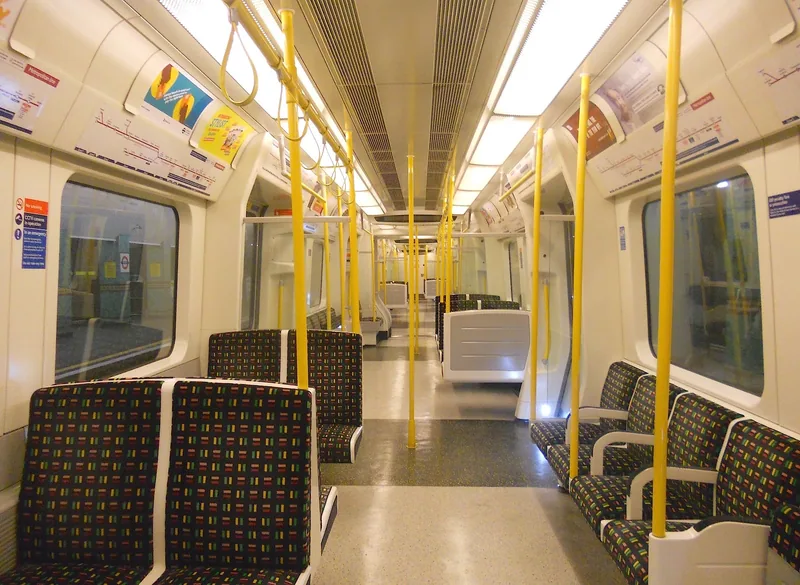
Photo: PeterSkuce · CC BY-SA 4.0 · Wikimedia Commons · resized
The Hammersmith & City: a local service with an inconvenient name
The Hammersmith & City starts at its own small terminus at Hammersmith, in a building on the north side of the Hammersmith gyratory that is separate from the District and Piccadilly station and 520 metres away from it. From there it runs east through Ladbroke Grove and Westbourne Park to Paddington, joins the 1863 tunnel to Farringdon, then continues past Liverpool Street to Aldgate East, Whitechapel, Mile End, West Ham and Barking.
It is a useful line and an unreliable one to plan around, because there are only six trains an hour at every hour of the day. The stretch from Paddington to Liverpool Street is shared with the Circle and the Metropolitan, so on that section three lines between them give a train every three or four minutes; east of Aldgate East it is shared with the District, which is far more frequent. The part where you are genuinely dependent on six trains an hour is the western end, from Paddington out to Hammersmith, and the Elizabeth line and the Circle both cover parts of it.
The eastern end is where it earns its keep: Whitechapel, Mile End and Bromley-by-Bow are on it, which makes it the direct line from Paddington and King's Cross to the East End without a change.
The trains, and why these two lines feel better than the rest
Both lines run S stock: eight cars on the Metropolitan, seven on the Hammersmith & City, part of the same 192-train fleet as the Circle and District. They are air-conditioned, they walk through from end to end, and the Metropolitan's eight-car trains are the longest on the Underground. On a warm day this is where you want to be.
The Metropolitan has one more advantage. Because the outer sections are above ground and the trains are fast, a seat from Baker Street to Amersham is a proper 46-minute railway journey with countryside out of the window, at Underground fares. Air conditioning across the network is covered in which Tube lines have air conditioning; the short version is that these two and the pair covered in our guide to the District and Circle lines are the only cooled Tube lines, and they are cooled because their tunnels are shallow.
Step-free access, and the platforms that only work one way
The Metropolitan is unusually good at both ends and poor in the middle. In central London, King's Cross St Pancras, Farringdon and Moorgate are step-free to the sub-surface platforms these lines use, Liverpool Street is step-free to the eastbound platform, and Barbican and Euston Square are step-free to the westbound platform only. Aldgate, Great Portland Street, Baker Street and Finchley Road are not step-free at all, Baker Street is the painful omission, since that is where most people join the line. For the Barbican Centre, that westbound-only lift is worth knowing before you set out; our guide to the Barbican and Moorgate covers the walk from the step-free side.
Beyond Wembley Park the list is long: Wembley Park, Harrow-on-the-Hill, Pinner, Chorleywood, Chalfont & Latimer, Amersham, Chesham, Ickenham, Hillingdon and Uxbridge all have a step-free route to the platform, and Uxbridge and Chesham need no lift at all because the platforms are level with the street. Rickmansworth and Ruislip are step-free in one direction only.
On the Hammersmith & City the step-free stations are Hammersmith, Wood Lane, Farringdon, Moorgate, Whitechapel, West Ham and Barking, with Liverpool Street eastbound, Barbican westbound and Euston Square westbound. The platforms at these stations also have designated level-access boarding points: on an eight-car Metropolitan train the place to wait is the third door of car 4 or the first door of car 5. Our guide to step-free and accessible transport in London explains how to plan a journey that works in both directions.
Weekends: the line most likely to be halved
Because the Metropolitan shares its outer tracks with Chiltern Railways and its inner tracks with three other Underground lines, weekend closures here are frequent and often split the line rather than shut it. A typical pattern is no service between Baker Street and Wembley Park, or between Harrow-on-the-Hill and Amersham, with the rest running.
The substitute for the outer sections is good: Chiltern Railways trains from Marylebone call at Harrow-on-the-Hill, Rickmansworth, Chorleywood, Chalfont & Latimer and Amersham, and they are faster than the Tube. They are not, however, covered by an Oyster or contactless Tube fare on every part of the route, so check before you tap. For the Hammersmith & City the Circle and the District between them cover most of the line. Check the Friday status on TfL's status page, and see getting around when the Tube is not running for the worse days.
Neither line has a night service on any night, and the Metropolitan is one of the later starters on a Sunday morning, as our page on first and last Tube trains records. Wembley Park is the exception worth knowing about on event nights, when the Metropolitan and Jubilee lines run extra trains late; our page on getting to Wembley Stadium has the detail.
The journey these lines own: the Tube into the Chilterns
Here is the trip nothing else on this site covers. Get on a fast Metropolitan train at Baker Street and 46 minutes later you are at Amersham, 150 metres above sea level on the edge of the Chiltern Hills, with beech woods and a 17th-century market hall and no Underground station anywhere near you that is not this one. Chesham, one branch over, is the furthest station from central London on the whole network.
| Northbound from Baker Street | Fast train | Zone |
|---|---|---|
| Finchley Road | 6 minutes | 2 |
| Wembley Park | 13 minutes | 4 |
| Harrow-on-the-Hill | 19 minutes | 5 |
| Moor Park | 27 minutes | 6/7 |
| Rickmansworth | 31 minutes | 7 |
| Chalfont & Latimer | 39 minutes | 8 |
| Amersham | 46 minutes | 9 |
| Chesham | 47 minutes | 9 |
The figures are the station-to-station intervals in TfL's own timetable for a fast train, not an estimate. A Zones 1-9 day costs £16.30 off-peak with a contactless card or Oyster, capped, which means the return trip to Buckinghamshire and everything else you do that day comes to less than a single main-line ticket would. Our page on how the London travel zones work explains why Zone 9 exists at all.
Travel out after 09:30 and the Chilterns cost you £16.30 for the whole day. The Zones 1-9 cap is £23.30 at peak times and £16.30 off-peak, so a train from Baker Street at ten in the morning rather than half past eight saves £7.00 a head before you have bought anything.
Two shorter versions of the same journey are worth knowing. Harrow on the Hill is 19 minutes from Baker Street and has a hill, a school and a view over four counties. Wembley is 13 minutes away, and the Metropolitan is the fast way there, because it skips the stations the Jubilee line stops at.
Frequently asked questions
Is the Metropolitan line really the world's first underground railway?
The Metropolitan Railway opened in January 1863 between Paddington and Farringdon, and that was the first underground passenger railway anywhere. The tunnel is still in daily use by the Metropolitan, Circle and Hammersmith & City lines, so the stretch from Paddington through Baker Street and King's Cross to Farringdon is the oldest part of any metro system in the world.
How do I tell a fast Metropolitan line train from a slow one?
By the platform indicator, which lists the calling points. Fast trains run Baker Street, Finchley Road, Wembley Park, Harrow-on-the-Hill, Moor Park and then the Amersham branch. Semi-fast trains add Pinner and Northwood; all-stations trains add Preston Road and Northwick Park too. Baker Street to Amersham is 46 minutes fast and up to 55 minutes on an all-stations train.
Which is the furthest Underground station from central London?
Chesham, in Buckinghamshire, at the end of a single-track branch off the Metropolitan line at Chalfont & Latimer. It is in Zone 9, about 47 minutes from Baker Street on a fast train, and it has through trains to central London rather than a shuttle.
How often does the Hammersmith & City line run?
Six trains an hour, at every hour of the day, every day. Between Paddington and Liverpool Street it shares track with the Circle and Metropolitan lines, so the combined service on that stretch is much better; on the western end towards Hammersmith, six an hour is all there is.
Are the Metropolitan and Hammersmith & City lines step-free?
In parts. King's Cross St Pancras, Farringdon and Moorgate are step-free in the centre, and so are Wembley Park, Harrow-on-the-Hill, Amersham, Chesham and Uxbridge further out. Baker Street, Great Portland Street, Aldgate and Finchley Road are not, and Barbican, Euston Square, Liverpool Street, Rickmansworth and Ruislip are step-free in one direction only.
Sources
- Transport for London - Metropolitan line working timetable and station intervals (Unified API) (checked September 2026)
- Transport for London - Hammersmith & City line timetable data (Unified API) (checked September 2026)
- Transport for London - Metropolitan line route sequence (Unified API) (checked September 2026)
- Transport for London - Stations, platforms, lifts and step-free data (checked September 2026)
- Transport for London - Daily and weekly capping, including Zones 1-9 (checked September 2026)
- Transport for London - Four Lines Modernisation and the S stock fleet (checked September 2026)
- Transport for London - Step-free access (checked September 2026)