
The easiest way into West African food in London is not a restaurant with a menu. It is a hot counter where you point at what you want, a server fills a foil container, and you pay by what is in it. Peckham, Woolwich and Dalston all have them, and a full plate costs less than a sandwich in the centre.
Nigerians and Ghanaians make up two of London's larger communities, and their food is sold from three quite different kinds of place: the point-and-choose takeaway, the sit-down restaurant that fills up after church on Sunday, and the charcoal suya grill that appears on the pavement after dark. Our guide to Ethiopian and West African food introduces the dishes; this page is about how the places themselves work, and about the difference between the Nigerian and the Ghanaian version of the same table.
Almost every West African kitchen in London cooks halal or will tell you plainly that it does not, and pork is rare on these menus. Our page on halal eating in London covers how to ask.
Where to go, and when
- Peckham
- Rye Lane, plus the side streets running east and west from it. Peckham Rye station, Zone 2, Windrush line with Southern, Southeastern and Thameslink
- Woolwich
- Powis Street, Plumstead Road and Woolwich New Road. Woolwich, Zone 4, Elizabeth line; Woolwich Arsenal for the DLR
- Dalston
- Ridley Road and Kingsland High Street, Zone 2
- Also
- Old Kent Road, Thamesmead, Tottenham, East Ham and Barking
- Busiest
- Sunday early afternoon, when congregations come out
- Payment
- Cards are normal, but the smallest takeaways and the suya grills may want cash
- Typical spend
- A filled container of rice, one meat and a stew is one of the cheapest full meals in London
How the point-and-choose counter works
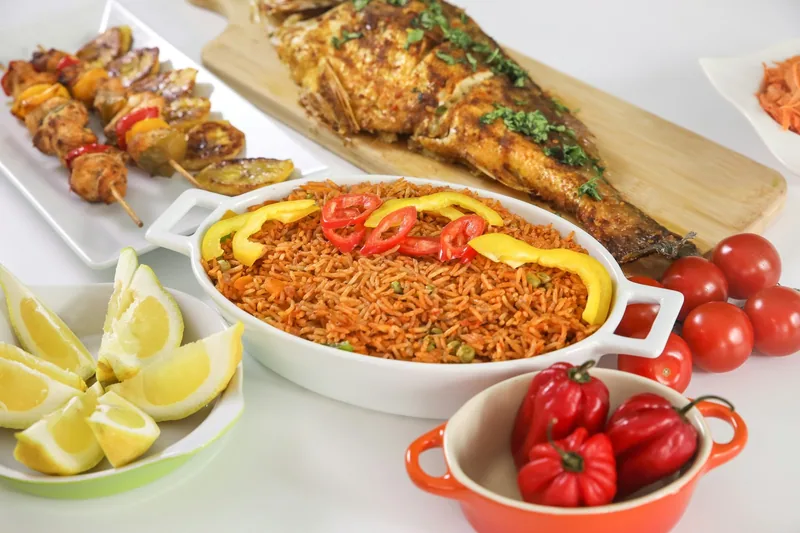
Walk in and you will see a row of deep metal trays behind glass: two or three rices, a pot of stew, several soups, fried plantain, a tray of meat, sometimes a tray of fish. There is no printed menu on the wall in many of these places, and the server expects you to build the plate out loud.
The sequence is always the same, and saying it in this order removes all the awkwardness.
- Choose the base. Jollof rice, plain white rice, fried rice, or a swallow such as pounded yam or eba. You can ask for half and half.
- Choose the soup or stew to go over or beside it: egusi, efo riro, ogbono, okra, or the plain red stew.
- Choose the protein. This is priced separately and per piece. Goat, beef, chicken, fish, or "assorted", which means a mixture of tripe, cow skin and other offal cuts.
- Add plantain if there is a tray of it, which there almost always is.
- Say how hot you want it. "Less pepper" is understood everywhere and is not treated as an insult.
The container is weighed or priced by what went in it, and the total is told to you rather than rung up item by item. Eat in if there are tables; most of these places have four or five, and the majority of what they sell walks out of the door.
Order the protein before the soup is ladled on. Meat sits under the sauce once it is served, and asking for a swap after the container is full means starting again. Point at the tray of goat or fish first, then at the soup, then at the rice. The servers work at speed and this is the order they expect.
Nigeria and Ghana are not the same menu
London treats West African food as one cuisine because the shops sell to both communities. In practice a Nigerian kitchen and a Ghanaian kitchen give you different meals.
| Dish | Which kitchen | What you get |
|---|---|---|
| Waakye | Ghanaian | Dried sorghum leaves turn the rice and beans a deep reddish-brown. It arrives with shito, gari, spaghetti, boiled egg and a piece of wele |
| Banku and tilapia | Ghanaian | A sour fermented corn and cassava dough with a whole grilled tilapia and a fiery pepper and onion relish |
| Kenkey | Ghanaian | Fermented corn dough steamed in a leaf or husk, eaten with fried fish and pepper. Sour, and an acquired taste |
| Red red | Ghanaian | Black-eyed beans stewed in palm oil with ripe fried plantain alongside |
| Groundnut soup | Ghanaian | Peanut-based, with chicken or goat and fufu. Thick, mild, and the safest first order in a Ghanaian kitchen |
| Asun | Nigerian | Smoked goat cut small and tossed with peppers and onion. A bar snack that defeats most people on heat |
| Ofada rice and ayamase | Nigerian | Short local rice with a dark green pepper sauce made with bleached palm oil. Looks unremarkable, tastes like nothing else |
| Small chops | Nigerian | A party plate: puff-puff, samosas, spring rolls, peppered chicken or gizzard, sold by the box |
Shito is the Ghanaian jar to take home: a near-black paste of dried chilli, ginger, garlic, dried shrimp and smoked fish cooked down in oil. It keeps for months and turns plain rice into something worth eating. Every Ghanaian shop sells it, in several strengths.
Suya: where it is, and how it is sold
Suya is an evening trade. The grill is often a converted oil drum set up outside a shop or in a car park, and the man working it slices beef thin, dusts it heavily with yaji, a ground mix of peanut, chilli, ginger and stock, and cooks it fast over charcoal.
It is sold by the portion rather than by the skewer, chopped onto a sheet of paper or into foil, topped with raw onion and sliced tomato and dusted again. Ask for extra yaji on the side if you want to control it yourself. Ram suya and chicken suya appear on the same grills, and kidney and liver are usually cheaper.
The grills do not keep published hours. They appear from mid-evening and pack up when the meat runs out, which on a Friday can be well after midnight and on a wet Tuesday can be nine o'clock. Our page on late-night food in London covers the other options if you arrive too late.
Yaji contains ground peanut, and it is on everything at a suya grill. The spice mix is rubbed into the meat before cooking and sprinkled over it again afterwards, so there is no peanut-free portion from the same grill. Anyone with a peanut allergy should avoid suya entirely rather than ask for it plain. Groundnut soup in Ghanaian kitchens carries the same warning.
Woolwich, the least visited of the three
Woolwich has a large Nigerian and Ghanaian population and almost no tourists, and since the Elizabeth line opened it is about fifteen minutes from Canary Wharf and a little over twenty from Tottenham Court Road. The station is in Zone 4, which means the journey sits inside the same daily cap as a day of travel in the centre.
The food is spread along Powis Street, Woolwich New Road and Plumstead Road rather than concentrated in one block. You will find African supermarkets with frozen fish cabinets and sacks of garri, two or three point-and-choose counters, a Ghanaian bakery or two, and restaurants that only really come alive at the weekend. Our page explaining the Elizabeth line for visitors covers the fares and the step-free stations.
Peckham is the livelier street scene and our Peckham guide covers what else is there; Dalston has the market. Woolwich is the one to choose if you want to shop without a crowd.
Shopping: what to buy and what it is for
African food shops in all three areas sell the same core stock, and a short list makes them easy to navigate. Garri is dried cassava granules, used to make eba and eaten soaked in cold water with sugar and peanuts. Egusi is ground melon seed, sold in bags and used to thicken soup. Palm oil is bright orange and solid at room temperature. Stockfish and dried crayfish carry the savoury weight in most stews. Agege bread is a soft, slightly sweet white loaf sold in a thin bag and eaten with everything.
Yams are sold whole, by the tuber, and they are heavy; a butcher's counter at the back will cut goat, cow foot and tripe to order. For the market end of the same trade, see our overview of London's food markets, and for how far cash still matters in small shops, money, cards and contactless.
Drinks, and the Sunday rhythm
Supermalt is the drink you will see on every table: a dark, sweet, non-alcoholic malt drink served very cold, sold in bottles and cans everywhere from the supermarkets to the suya grill. Chapman is the other one, a soft red mix of bitters, grenadine, citrus and lemonade with cucumber in it, non-alcoholic in most versions. Zobo, made from dried hibiscus with ginger and pineapple, is the third.
Palm wine appears on some restaurant lists, usually bottled rather than fresh, and it is mildly alcoholic and sweet-sour. A good many West African restaurants in London hold no alcohol licence at all, which nobody minds; see drinking without alcohol for how normal that has become across the city.
Sunday is the day these restaurants are at their fullest and their best, from about one in the afternoon, when congregations come out of churches that in some cases are the largest in London. It is also the day to book if you are more than four people. Weekday lunch is the opposite: quiet, quick, and the same food.
Heat, and how to manage it honestly
Scotch bonnet chilli is in the base of most stews rather than added at the end, so a dish cannot be made mild once it is cooked. What a kitchen can do is give you less of the sauce and more of the rice, and put the hottest element, usually a fresh pepper relish, on the side.
Ask for "less pepper" when you order. It is standard phrasing, it will be taken seriously, and it is far more useful than asking whether something is spicy, because the answer to that is almost always no by the standards of the person answering. Plantain, plain rice and Supermalt all help; water does not.
Vegetarians, children and allergies
This is a difficult cuisine for vegetarians, and not for the obvious reason. Dried crayfish and smoked fish are used as seasoning rather than as ingredients, which means they are in stews that appear to be vegetable dishes, including many versions of egusi and efo riro. Moin moin often has fish in it. Ask specifically about crayfish powder, not about meat. Beans, plantain, jollof made without stock, and Ghanaian red red are the reliable choices. See vegan and vegetarian London.
Beyond peanuts and shellfish, the other allergens to watch are wheat, in agege bread, meat pies, chin chin and spring rolls, and egg in several party foods. Anyone ordering from a hot counter should say what they cannot eat before pointing at anything; our page on eating without gluten in London explains what a business is required to tell you.
Children usually do well with jollof, fried rice, plantain and chicken, all of which can be served without sauce. Portions are large and sharing one container between two small children is normal. Our guide to London with kids has more.
What to eat next
The nearest neighbour to this food in London is the Caribbean kitchen, which shares the peppers, the plantain and a good deal of history; see our guide to Caribbean food in London. For another community whose restaurants are concentrated in one or two streets a long way from the centre, read about Filipino food in Earl's Court, and for a cuisine built around rice and slow-cooked lamb, our page on Persian food in London.
Frequently asked questions
How do I order at a West African takeaway in London?
Choose the base first, rice or a swallow, then the soup or stew, then the meat or fish, which is priced per piece. Add plantain if it is there, and say "less pepper" if you want it milder. The server fills a container and tells you the total.
Where is the best area in London for Nigerian and Ghanaian food?
Rye Lane in Peckham has the greatest concentration of shops and takeaways. Woolwich, on the Elizabeth line in Zone 4, has a large community and far fewer visitors. Dalston's Ridley Road, Old Kent Road, Tottenham and East Ham all have their own clusters.
What is the difference between Nigerian and Ghanaian food?
Nigerian menus lean on egusi, efo riro, ofada rice, pepper soup and suya. Ghanaian menus centre on waakye, banku with grilled tilapia, kenkey, groundnut and light soups, and red red. Both cook jollof rice, and both claim the better version.
Is West African food in London very spicy?
Often, yes. Scotch bonnet goes into the base of the stew, so heat cannot be removed afterwards. Asking for less pepper works, and a kitchen will usually serve the hottest relish on the side. Groundnut soup, waakye and fried rice are among the milder dishes.
Can vegetarians eat at a Nigerian restaurant?
With care. Dried crayfish and smoked fish are used as seasoning in stews that look vegetarian, so ask about crayfish powder rather than about meat. Beans, plantain, red red and some vegetable soups are safe when the kitchen confirms they are made without fish.
Sources
- Transport for London - The Elizabeth line (checked September 2026)
- Transport for London - Fare capping (checked September 2026)
- Food Standards Agency - Food allergy and intolerance advice for consumers (checked September 2026)
- Food Standards Agency - Food hygiene ratings search (checked September 2026)