
Use the booking site's air-conditioning filter, then confirm it in one email with the hotel itself, naming the room type you have chosen. That second step is the one that matters, because "climate control", "cooling available" and "fans on request" all appear under the same filter, and because a hotel can have air conditioning in the lobby, the restaurant and half the rooms but not in yours.
Air conditioning is standard in London's newer chain hotels, in aparthotels, in compact-room hotels and at the upper end of the market. It is missing from a large part of the rest, particularly the converted Victorian and Georgian houses that make up much of the hotel stock in Kensington, Bloomsbury, Bayswater and Pimlico. Nobody hides this; they simply do not mention it, and most of the year it does not matter.
For about ten weeks a year it matters a great deal. This page is about the booking decision: why so much of the stock has no cooling, how to read what a listing is promising, and what to ask before you pay. The season itself is covered in London in summer, and the hot days and what to do on them in London in a heatwave.
Air conditioning in London hotels: the essentials
- Usually has it
- Purpose-built chain hotels, aparthotels, compact-room hotels, airport hotels, grand hotels
- Often does not
- Townhouse hotels, guest houses, small independents in period buildings
- When it matters
- Late June to early September, and any top-floor room in a heatwave
- Typical July temperature
- Heathrow's 1991-2020 mean daily maximum is 23.89 °C, and August is a shade below it
- In a heat event
- Central London can stay above 18 °C overnight because of the urban heat island
- Words that are not air conditioning
- "Fan on request", "cooling in public areas", "ventilation", "climate-controlled building"
- The check that works
- One email naming your room type, with the reply kept
Why so many London hotels have none
Three separate reasons stack up, and only the first is the one visitors guess.
The climate does not demand it. Heathrow, out at the western edge of the city, is the station with the long published record, and its 1991 to 2020 Met Office averages peak in July at 23.89 °C of mean daily maximum, with 23.40 °C in August. An open window and a fan really are enough for most of the summer, and plant that earns its keep for ten weeks a year is expensive to own for the other forty-two.
The buildings resist it. Air conditioning needs a condenser unit outside, and in central London the outside is a listed facade, a lightwell shared with three neighbours, or a roof visible from the street. Section 7 of the Planning (Listed Buildings and Conservation Areas) Act 1990 prohibits alteration of a listed building in any way that would affect its character as a building of special architectural or historic interest without consent. Westminster alone has 56 conservation areas, and the streets full of townhouse hotels are inside them.
London planning policy actively discourages it. Few visitors expect this one, and it bears on new buildings rather than old ones. Policy SI 4 of the London Plan requires major development proposals to show through an energy strategy "how they will reduce the potential for internal overheating and reliance on air conditioning systems", working down a cooling hierarchy: reduce the heat entering the building, minimise heat generated inside it, manage it with thermal mass and high ceilings, then passive ventilation, then mechanical ventilation, and only at the sixth and last step "provide active cooling systems". A new London hotel is expected to design the heat out before it is allowed to chill the air.
"Mechanical ventilation" and "air conditioning" are two different things, and both are legal to advertise. Mechanical ventilation moves air; air conditioning cools and dries it. A windowless compact room with strong forced ventilation can still be warm in August. If a listing describes a system without using the word cooling, assume it does not cool.
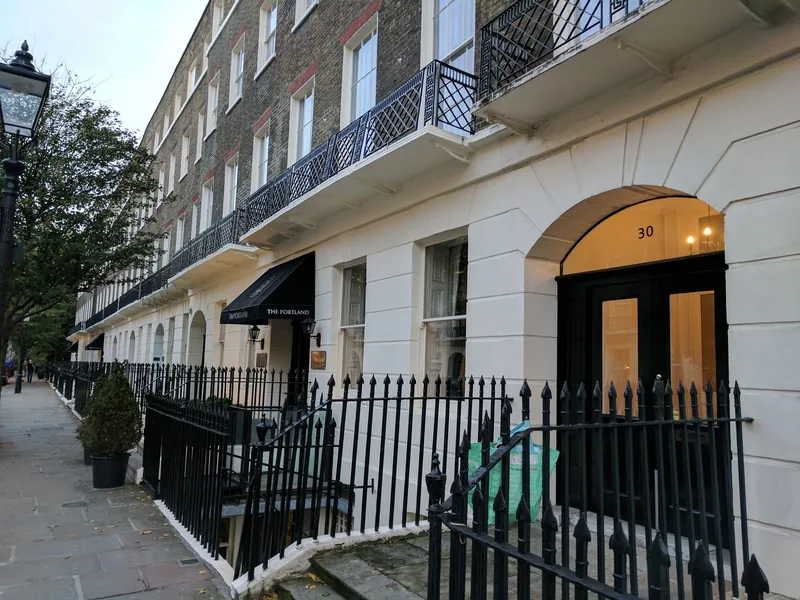
Photo: Enchufla Con Clave · CC BY-SA 4.0 · Wikimedia Commons · resized
The words on a booking page, translated
Booking sites collapse several different things into one tick box. These are the phrases you will meet and what they usually mean.
| What the listing says | What it usually means | Good enough in August? |
|---|---|---|
| Air conditioning, individually controlled | A unit in the room with a thermostat you set | Yes. This is what you want |
| Air conditioning (seasonal) | The building system is switched between heating and cooling by date | Usually, but it can be running as heating in a warm May |
| Climate control | Ambiguous. Sometimes cooling, sometimes only heating | Ask before you book |
| Air conditioning in public areas | Lobby and restaurant only | No |
| Air conditioning in selected rooms | Some room types have it and the cheapest usually do not | Only if your room type is named |
| Fan available on request | A portable fan from a cupboard, if any are left | No, though it helps |
| Mechanical or forced ventilation | Air is moved, not cooled | No |
| Nothing said at all | There is none | No |
The same ambiguity runs through room names. "Superior" and "executive" rooms in a period hotel are sometimes the ones that have been fitted with cooling, while the standard rooms upstairs have not, and the difference is not always spelled out. British booking pages are full of words like this that look plainer than they are, and we go through the rest of them in our page on the standard London hotel room.
How to check properly, in four steps
- Filter, but do not trust the filter. Use it to build a shortlist, not to make a decision.
- Read the room type, not the hotel page. The amenity list attached to the specific room you are booking is the one that binds.
- Send one email. "We have booked the [room type] for [dates]. Could you confirm that this room has air conditioning that we can control ourselves, and that it runs overnight?" Three facts, one reply, kept as evidence.
- Ask the window question separately, because it is a separate question. See the next section.
The phrase "that we can control ourselves" is doing real work. Some hotels run a building-wide system on a timer, so the room cools during the day and not at night, which is the opposite of what a traveller needs. And a few switch the system off entirely outside a fixed summer season, which catches out visitors in a warm late September.
Hold a refundable rate while you wait for the answer. A disappointing reply then costs you nothing, as our page on rooms you can cancel sets out, and July prices move quickly enough that the flexible premium tends to come back to you anyway. Timing the booking is a subject of its own.
The window is a separate question from the air conditioning
It is often said that a listed building means windows that do not open. That is not how listing works. Listing controls what may be altered or removed, so it restricts replacing a sash window or bolting a condenser to a protected facade; it does not stop a window opening, and original sash windows in London's Georgian and Victorian hotels open perfectly well.
What actually limits the opening is more ordinary, and worth asking about in its own right.
- Restrictors. Many hotel windows above the ground floor carry a catch that limits the opening to a few centimetres, fitted to stop anyone falling out. More windows are held shut by this than by anything to do with heritage, and it is as common in new buildings as in old ones.
- Secondary glazing. Rooms facing a main road often have a second internal pane fitted for noise. It is effective, and it is not designed to be opened for air.
- Sealed facades. Many buildings put up since the 1990s have windows that do not open at all, by design, because the building is mechanically ventilated.
- No insect screens. British windows do not have them. An open window on a warm night in a leafy square has consequences.
The practical conclusion is that "the window opens" and "the room has cooling" are two different promises, and in a hot week you want at least one of them in writing.
Which kinds of London hotel have it
Reliably cooled
- Purpose-built chain hotels, especially those built since about 2000
- Aparthotels and serviced apartments, covered in our guide to that category
- Compact-room and pod hotels, where mechanical cooling replaces the window: see pod and capsule hotels
- Airport hotels, described in staying overnight at a London airport
- Most of the grand hotels, though a few historic suites are the exception
Often not cooled
- Townhouse hotels in period terraces, common in Kensington and Bloomsbury
- Guest houses and B&Bs, as our guide to London B&Bs explains
- Older independent hotels near the main termini
- Hostel dormitories, described in hostels in London
- Top-floor and loft rooms in any old building, cooled or not
Two caveats. A cooled room in a new-build hotel one zone out is usually cheaper than a warm room in a period building in the centre, and because contactless capping treats Zone 2 the same as Zone 1 on a day's travel, the longer journey adds nothing to your fares. And aspect beats equipment: a north-facing room on a low floor with no cooling at all will often beat a west-facing room under the roof with a small unit, so ask about the floor and which way the window faces even when the answer on air conditioning is yes.
Already booked into a warm room
If the hotel cannot be changed, the room often can. These are the requests that work, and they all have to be made in advance rather than on the hot afternoon itself.
- Move down, and away from the west. Heat rises through a terraced house and settles under the roof, and a west-facing room takes the full afternoon sun. A second-floor room facing north or east is a different night's sleep from a fourth-floor room facing the sunset.
- Reserve a fan by email, not at the desk. Hotels that keep a stock of portable fans hand them all out within an hour of the first genuinely warm afternoon. A note on the booking a week earlier puts your name on one.
- Ask whether the system runs at night, which is the hour you need it and the hour some building systems shut down.
- Treat the rest of the building as part of the room. Lobbies, bars and breakfast rooms are cooled in hotels where the bedrooms are not, and nobody minds you sitting in one with a book at 16:00.
Everything else about surviving a hot London day, from when the railway starts slowing down to where the shade is, belongs in the heatwave guide linked above. The line-by-line answer on trains is in which Tube lines have air conditioning.
Why the temperature reading understates the problem
Two official facts explain why a warm night here is harder work than the forecast suggests. The first is the alerting system: the UK Health Security Agency and the Met Office issue joint Heat-Health Alerts, coloured yellow, amber and red, through a core season that runs from 1 June to 30 September, with extraordinary alerts outside it. Yellow is aimed at people who are already vulnerable; amber signals impacts across the whole health service and risk to the whole population; red means a significant threat to life for healthy people too.
The second is the urban heat island, and the Greater London Authority is blunt about it in the London Plan. The built-up area soaks up heat by day and holds it by night, leaving parts of the city several degrees above the surrounding countryside, with daytime readings well over 30 °C and nights that do not fall below 18 °C. A bedroom that cannot shed its heat after midnight begins the following morning already warm, which is the real argument for cooling in a four-night stay rather than a one-night one.
The loft conversion is the room to refuse in July. Top-floor rooms in London terraces sit immediately under a dark, thinly insulated roof, and a small unit fitted into that space will lose the argument by the third consecutive hot day. In a converted house in high summer, take a lower floor and the stairs that come with it.
Is it worth paying more for?
Between late June and early September, yes, and we would pay for it before we paid for a better address. Four situations make it close to essential: you sleep badly when warm, you are travelling with a baby or an older relative, the room is under the roof, or you are staying four nights or more, which is the point at which a hot bedroom starts to spoil the days as well as the nights.
Between October and May, no. A London room without cooling is comfortable for seven months of the year, and that money buys more as a shorter walk home from the theatre. Which district gives you that walk is a separate question, answered in our comparison of the districts; whether to come in the warm months at all is covered in the best time to visit London. What else a cheap rate quietly omits is in our guide to the budget end of the market.
Frequently asked questions
Do London hotels have air conditioning?
Many do and many do not. It is standard in purpose-built chain hotels, aparthotels, compact-room hotels and at the upper end of the market, and frequently absent from the converted period houses that make up much of central London's stock. Check the room type rather than the hotel, and confirm it with the hotel directly.
Why do so many London hotels have no air conditioning?
The summer is short, so a system would sit idle most of the year; the buildings are old and often listed or in conservation areas, which restricts fitting external plant; and London planning policy requires major new developments to reduce reliance on air conditioning by designing heat out of the building first.
Can hotel windows in London be opened?
Usually a little. Restrictors are commonly fitted above ground level to prevent falls, rooms on busy roads may have sealed secondary glazing for noise, and many modern buildings have windows that do not open at all. Listing does not stop a window opening; it restricts altering or replacing it. There are no insect screens on British windows.
How warm are London summers, in numbers?
At Heathrow, the station with the long published record for the London area, the 1991 to 2020 mean daily maximum peaks at 23.89 °C in July, with August at 23.40 °C. Individual heat events go far beyond that, and the built-up centre can hold above 18 °C overnight, so the daytime figure understates how a bedroom feels.
What should I ask a hotel about air conditioning before booking?
Put three things in one email: does this exact room type have air conditioning, can the guest set it, and does it run through the night. Ask about the window as a fourth, separate question. Keep the reply, and do not give up a refundable rate until it arrives.
Sources
- Met Office - Heathrow long-term climate averages, 1991 to 2020 (checked September 2026)
- GOV.UK - Heat-Health Alerting system (checked September 2026)
- Greater London Authority - The London Plan 2021, Policy SI 4 Managing heat risk (checked September 2026)
- Planning (Listed Buildings and Conservation Areas) Act 1990, section 7 (checked September 2026)
- Westminster City Council - Conservation areas (checked September 2026)
- Transport for London - Fare capping (checked September 2026)