
A London pod hotel sells a very small private room, usually with its own tiny shower and toilet, in a location you could not otherwise afford. The bed fills most of the floor, there may be no window, and a large suitcase may not open flat. For one or two nights, alone or as a couple who get on well, that is a good trade. For a week, for a family, or for anyone who dislikes enclosed spaces, it is not.
The name causes confusion. In Japan, a capsule hotel means a berth in a shared room: you climb into a box, pull a blind across and keep your belongings in a locker. Almost nothing in London works like that. What London sells under the words pod, cabin, capsule, micro and compact is a conventional hotel room shrunk to the smallest size the fire regulations and the plumbing allow, behind a lockable door, with a bathroom cubicle in the corner.
Our guide to budget hotels in London covers the cheap end of the market as a whole. This page is about the compact-room end of it specifically: exactly how small these rooms are, what disappears when a room gets that small, and how to tell in advance whether you will be fine or miserable.
Pod rooms at a glance
- What you get
- A private, lockable room with a bed, usually with a compact en-suite shower room
- Typical floor area
- Single figures in square metres, including the bathroom
- Usually missing
- A wardrobe, a chair, a desk, floor space beside the bed, sometimes a window
- Usually present
- Good mattress, air conditioning or forced ventilation, fast wi-fi, blackout, a lounge downstairs
- Best for
- One or two nights, solo travellers, couples travelling light, early flights
- Avoid if
- You dislike enclosed spaces, have large luggage, are travelling with children, or are staying a week
What London actually sells under these names
Three different products use the same vocabulary, and the difference matters more than the name.
- The compact private room. This is the mainstream London version. A small, well-designed room with a double bed, a shower room, air conditioning, a television and clever storage. It is a proper hotel room with the floor area cut to the bone, and it comes with a 24-hour reception, daily housekeeping and a lobby.
- The cabin. Sold mainly near airports and at one or two central sites, laid out like a ship or a train berth, with a bed that folds or a mattress on a platform. Even smaller than the compact room, and usually priced by the hour or the night with very early and very late check-in built in.
- The genuine capsule or pod bunk. Rare in London, and where it exists it is almost always inside a hostel rather than a hotel: a sleeping berth with a privacy screen in a shared dormitory, with shared bathrooms along the corridor. If a listing mentions shared facilities or a locker, this is what you are buying. Our guide to hostels in London covers that world properly.
The word on the booking site tells you very little. The floor area, the bathroom description and the word "shared" tell you everything.
How small is small: reading the floor area
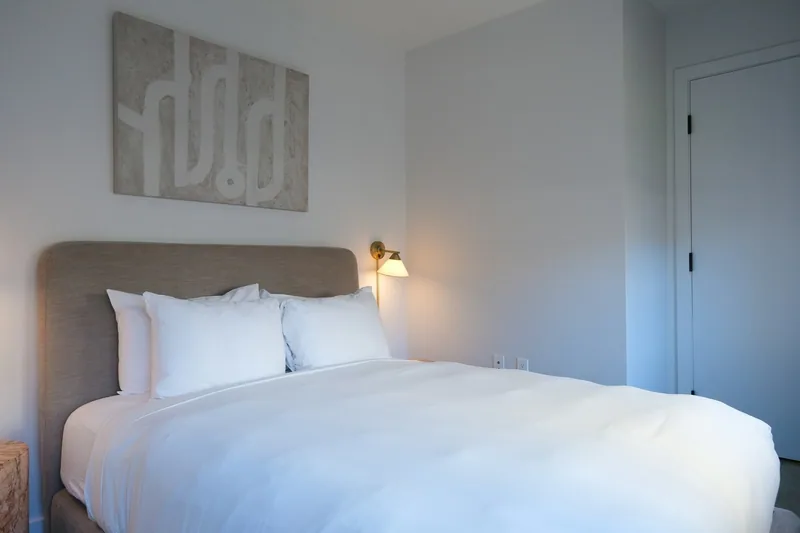
Most compact-room hotels publish the size of the room, which is welcome, because a square-metre figure is the only honest measure. Photographs of very small rooms are taken with wide lenses from the doorway and always flatter.
Here is how to turn that number into something you can picture. A standard British double bed is about 1.35 metres by 1.90, so it occupies roughly 2.6 square metres. A compact shower room takes about 2 more. The published figure minus about 4.5 is therefore the free floor of the room.
| Stated floor area | What that means in the room | Our view |
|---|---|---|
| Under 7 m² | The bed touches two or three walls. Standing room on one side only. Nowhere to put an open case | One night, one person, hand luggage only |
| 7 to 9 m² | A narrow strip of floor beside the bed and a shelf or rail instead of a wardrobe. One cabin bag can be opened on the bed | The London standard. Fine for two or three nights for one or two people travelling light |
| 10 to 13 m² | Room to open a large suitcase on the floor, and usually a small seat or a fold-down desk | Comfortable for a couple for up to about a week |
| No figure given | Words such as compact, cosy, snug, bunk or interior are doing the work instead | Ask before booking, or assume the lowest band |
One more test that costs nothing: look for a photograph taken from the far corner rather than the doorway, and for a picture of the bathroom. If neither exists on the hotel's own site, that is information too.
The luggage problem, which is the real problem
Ask anyone who has disliked a pod room and they will mention the bags before they mention the walls. Two adults with two large suitcases in a 7-square-metre room have nowhere to put them except on the bed, and there is only one bed.
Plan for it rather than discover it.
- Bring soft bags if you can. A soft holdall can be squashed under the bed or stood on end; a hard shell cannot.
- Unpack immediately and get the case out of the way. Most compact rooms have a platform bed with storage underneath, designed for exactly this.
- Ask about a luggage room. Many of these hotels have one, precisely because the rooms do not. Some charge for it by the bag, which belongs in your sum: our page on hotel extras and hidden costs covers which charges are normal.
- If you are arriving with everything you own, use a station left-luggage counter for the first day rather than dragging it around: see left luggage in London. Getting a big case through a busy Tube station is its own problem, explained in our guide to taking luggage on the Tube.
Two large suitcases will not fit beside the bed in a seven-square-metre room. If you are on a long trip with full-size cases, either choose a room in the 10 to 13 square metre band or accept that one case will live on the bed all week. This is the single most common complaint about London's pod rooms, and it is entirely predictable before you book.
The window question
Many compact rooms in central London have no external window. Others have an internal window facing a corridor or a lightwell, or a narrow slot high in the wall. This is legal and, from a fire-safety point of view, perfectly conventional in a modern hotel, but it changes the experience of the room in ways photographs do not show.
What it means in practice: the room is completely dark when the light is off, which helps if you are jet-lagged and hate if you wake in the night; you have no idea what the weather is doing; and the air is entirely mechanical. Rooms of this kind always have forced ventilation, and most have proper air conditioning, which matters in a London summer, when the daily maximum at Heathrow averages around 24 °C in July and reaches considerably more in a hot spell.
Listings describe this in code. "Interior room", "inside cabin", "windowless" and "no natural light" are the honest versions. "Skylight", "frosted window" and "light well" mean you will not see the sky. If the room description says nothing at all about a window, it usually means there is not much of one.
Sleeping in a very small room
The good news first: compact-room hotels tend to be new or newly converted buildings, which means better mattresses, better soundproofing and better air handling than a tired old hotel of the same price. Many get this part right.
The things to check are the controls. Look for an air-conditioning unit you can set yourself rather than a building system; a bedside switch, because in a small room the ceiling light is harsh; and a door that seals, since corridor noise travels a long way. An extractor fan that runs with the bathroom light is a nuisance in the middle of the night.
The other consideration is what you will do in the room when you are not asleep. The answer in a pod room is almost nothing. There is no chair, no desk and often nowhere to sit but the bed. If you need to work, take calls, or simply retreat for an afternoon when it rains, this is the wrong sort of room, and a small serviced apartment will serve you better: see our guide to aparthotels and serviced apartments.
Who should avoid pod rooms
We would steer these travellers elsewhere, and we would say so firmly rather than let them find out at 23:00 on the first night.
Pod rooms suit
- Solo travellers who want a central address and a door that locks
- Couples on a short city break travelling with cabin bags
- Anyone with an early flight or a late arrival, especially near an airport
- People who intend to be out from breakfast until late
- Travellers who would rather spend the money on theatre tickets and dinner
Look elsewhere if
- Enclosed or windowless spaces make you anxious. A pod room is not the place to find out
- You are two adults of any size sharing for more than about three nights
- You are travelling with children: most of these rooms take two people and no more
- You use a wheelchair or a walking aid, or need space to manage a condition
- You are staying a week or more, or plan to work from the room
- You have full-size checked luggage
Claustrophobia deserves a plain sentence. If you already know that small rooms, internal cabins or lifts without windows make you uncomfortable, a windowless 7-square-metre room in the middle of a city is a bad idea, and no amount of clever design changes that. The NHS has straightforward information on the condition, linked below.
Accessibility is the other firm no. Compact rooms are compact in every dimension, including door widths and the space beside the bed, and the bathroom is a moulded cubicle with a step. Some of these hotels do have fully accessible rooms, but they are ordinary-sized rooms, not pods, and there are very few of them, so book early and confirm the details in writing. Our guide to accessible London explains what to ask.
What the building gives you instead of the room
Good compact-room hotels understand that they have sold you a small room, and they put the missing square metres downstairs. That is the part worth judging, because it is where you will spend your evenings.
Look for a lounge with real seating rather than a corridor with two armchairs; a bar or café open late; a laundry room; a luggage store; and self-service check-in that works at three in the morning. If the hotel's own photographs are all of the ground floor, that is not a trick, it is the point.
What you usually do not get is room service, a proper restaurant, a concierge or a porter. In the UK's voluntary quality schemes, run by VisitEngland and the AA, star ratings now start at three and are awarded for the range and quality of services as well as the rooms, with simpler levels called Visitor Ready and Quality Assessed below them. A very good compact-room hotel can therefore sit low in a star scheme and still be exactly the right place to sleep.
What to check before you pay
- The floor area in square metres, and whether that figure includes the bathroom.
- Window or no window, and whether you can choose. Some hotels charge a small supplement for an external window, and it is usually worth it.
- Maximum occupancy. Two is normally the limit. A booking form that lets you select three people does not mean three will fit.
- The bed. A "double" in this market is often 1.35 metres wide, which is narrow for two adults for a week. Some cabins have bunks instead.
- Storage. Is there a rail, a shelf or under-bed space, and will a large case fit under the bed?
- Luggage storage on arrival and departure day, and whether it is charged.
- Air conditioning you control, particularly for a summer stay.
- The total price against a normal small room in the same district. Compact rooms are not always cheaper than a plain room two streets away, especially midweek in winter.
Prices in this part of the market move as sharply as anywhere else in London, so the date matters more than the brand: see when to book a London hotel. And whatever you book, check the listing carefully first, using the advice in our guide to booking safely and spotting accommodation scams.
The alternatives at roughly the same price
Before you accept a very small room, price these three against it for your own dates, because they often land within a few pounds of each other.
- A private room in a hostel. Frequently larger than a pod room, sometimes with a shared bathroom, and with a kitchen and a bar attached. Better for a solo traveller who wants company, as our page on solo travel in London explains.
- An ordinary room one zone out. The daily fare cap for Zones 1 and 2 is the same £8.90 as for Zone 1 alone, so moving to Zone 2 buys floor space at no cost in fares. Our comparison of the main areas to stay shows where that works.
- A small hotel in a station district. Rooms around Victoria or Bloomsbury are often no dearer than a central pod and are twice the size, though they come with stairs and older plumbing.
If the reason you are looking at pod rooms is simply the total cost of the trip, our breakdown of what a London trip costs is worth reading before you commit, and students should also see London on a student budget.
One night in a pod, the rest somewhere larger, often beats a week of either. A compact central room is at its best on the first night after a long flight and on the last night before an early one. Splitting a longer stay between a pod near your arrival station and a normal room for the middle of the trip gives you the location when you need it and the space when you do not.
Frequently asked questions
Are there real capsule hotels in London?
Very few in the Japanese sense of a berth in a shared room. What London calls pod, cabin or capsule accommodation is almost always a small private room with a lockable door and its own shower. Genuine capsule-style bunks do exist in one or two hostels, where the bathrooms are shared.
How small is a London pod hotel room?
Typically single figures in square metres, including the bathroom. As a guide, a standard British double bed takes about 2.6 square metres and a compact shower room about 2, so a 7-square-metre room has roughly two and a half square metres of free floor. Most hotels publish the figure; ask if yours does not.
Do pod hotel rooms have windows?
Many do not, and others have an internal window onto a corridor or a lightwell. Rooms without external windows have mechanical ventilation and are usually completely dark, which some people like and others find oppressive. Look for the words interior, inside or no natural light in the room description.
Can two people share a pod room comfortably?
For two or three nights, yes, if you are travelling with small bags and are content to be in each other's way. For a week, most couples find it wearing, mainly because there is nowhere to sit and nowhere to put luggage. A room in the 10 to 13 square metre band is much easier to share.
Are pod hotels suitable for families?
Generally no. Most of these rooms take a maximum of two people and cannot take a cot or an extra bed, and two adjoining pod rooms are rarely connected. Families are better served by a family room in a budget hotel or by an apartment with a separate bedroom.
Is a pod hotel cheaper than a normal hotel in London?
Usually, for the same central location, which is the whole point of them. Compared with a plain hotel room a zone or two further out, the difference is often small, so compare the total price for your dates rather than assuming. Remember to include breakfast, luggage storage and any window supplement.
Sources
- NHS - Claustrophobia (checked September 2026)
- VisitEngland - Quality schemes for accommodation (checked September 2026)
- Met Office - Heathrow long-term climate averages, 1991 to 2020 (checked September 2026)
- Transport for London - Victoria Coach Station left luggage (checked September 2026)
- Transport for London - Fare capping (checked September 2026)
- Competition and Markets Authority - Providing clear and accurate information about prices (checked September 2026)