
Four Tube lines have air-conditioned trains: the Circle, District, Hammersmith & City and Metropolitan. Every Elizabeth line and London Overground train is air-conditioned too, and the Piccadilly line becomes the first deep Tube line to join them when its new trains start running, in a window Transport for London gives as December 2026 at the earliest and June 2027 at the latest.
The split is not random. The four air-conditioned Tube lines are the shallow ones, built from 1863 onwards by digging a trench along a street and roofing it over. There is room around those tunnels for warm air to escape. The seven deep-level lines, from the Bakerloo to the Waterloo & City, were bored much deeper through clay, in tubes barely wider than the trains, and the heat a cooling unit throws out has nowhere to go.
TfL puts the number at 192 S-stock trains, air-conditioned throughout, reaching 40 per cent of the Underground network. That figure flatters the experience slightly, because the four lines it covers are the ones a visitor uses least. If you are crossing the centre between Oxford Circus, Holborn and Bank, you are almost certainly on a line with no air conditioning at all. Our introduction to the Underground sets out which line goes where.
Air conditioning on London's rail network, September 2026
- Tube lines with air conditioning
- Circle, District, Hammersmith & City, Metropolitan (192 S-stock trains; 40% of the network)
- Tube lines without
- Bakerloo; Central; Jubilee; Northern; Piccadilly; Victoria; Waterloo & City
- Also air-conditioned
- All Elizabeth line trains, all London Overground trains, the new DLR fleet
- Next to change
- Piccadilly line: 94 new trains entering service from December 2026 to June 2027
- Hottest platforms (August 2024, evening peak)
- Victoria line, average 31.1 °C
Why only those four lines could have it
Air conditioning does not destroy heat. It moves it, from inside the carriage to outside, and adds a little more from the machinery doing the moving. On a surface railway that is fine. In a deep tube tunnel the heat stays in the tunnel, warms the clay around it, and comes back at the next train.
The Circle, District, Hammersmith & City and Metropolitan lines share most of their track, so TfL modernised them as a single project and replaced their trains with one fleet. Those trains are the walk-through silver ones with no doors between carriages. If you board at Baker Street, Paddington, King's Cross St Pancras, Victoria or Liverpool Street and the carriages run into one another without internal doors, you are on an air-conditioned train.
The same project is still installing new signalling, which is why parts of these lines close at weekends. That is a separate annoyance from the temperature, and our page on travelling during disruption covers how to check before you set off.
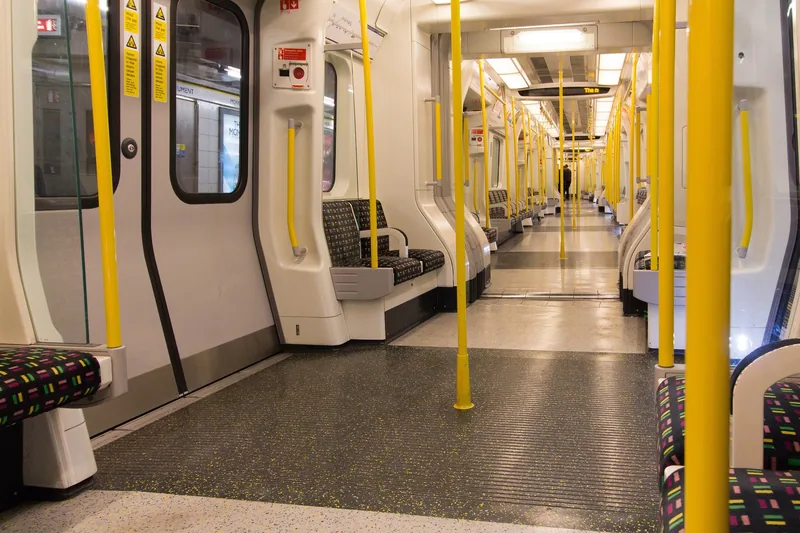
Photo: The wub · CC BY-SA 4.0 · Wikimedia Commons · resized
The Piccadilly line changes the answer, and soon
TfL is replacing the Piccadilly line's 86 trains, which have run since 1975, with 94 built by Siemens Mobility. The published list of features includes walk-through carriages, wider doorways and, in TfL's own words, air conditioning for the first time on a deep Tube train. The first train arrived in London in October 2024 for testing. TfL says the first of them should carry passengers some time between December 2026 and the following June, with the rest arriving in stages after that.
This matters for visitors more than most upgrades, because the Piccadilly line is the cheap way in from Heathrow and the line that serves King's Cross, Covent Garden, Leicester Square, Piccadilly Circus, Knightsbridge and South Kensington. If you are comparing routes from the airport, we compare the fast train and the cheap train from Heathrow.
A phased roll-out means you cannot count on it. During 2027 the Piccadilly line will run old and new trains on the same track. Arriving at Heathrow in, say, March 2027 does not guarantee an air-conditioned train; it means you might get one.
What the deep lines have instead
Since it cannot cool the trains, TfL cools the tunnels and the platforms. The Victoria and Jubilee lines have enhanced tunnel ventilation, and on the Victoria line the capacity of thirteen ventilation shafts has been doubled. Older stations with fewer shafts get industrial-sized fans and chiller units pumping cold air in.
There has also been a long search for something better. TfL tested a convection cooling panel on a disused platform at Holborn as part of the government-backed TIES Living Lab programme; in laboratory conditions the prototype cut air temperature near the panel by 10 to 15 degrees. The stations TfL has modelled as needing cooling if Piccadilly line frequencies rise are Green Park, Holborn, Knightsbridge, Leicester Square and Piccadilly Circus. None of this is a promise, and TfL has been clear that further work depends on funding.
How hot it actually gets, in numbers
TfL logs platform temperatures on the deep lines and publishes the monthly averages for the evening peak through the London Datastore. The figures below are for 2024, the most recent complete year.
| Line | January 2024 | August 2024 |
|---|---|---|
| Victoria | 25.7 °C | 31.1 °C |
| Central | 23.3 °C | 30.6 °C |
| Bakerloo | 22.9 °C | 29.9 °C |
| Northern | 22.4 °C | 28.8 °C |
| Piccadilly | 20.5 °C | 27.4 °C |
| Jubilee | 17.4 °C | 26.2 °C |
| Waterloo & City | 17.1 °C | 24.1 °C |
| Sub-surface lines (the air-conditioned four) | 13.1 °C | 25.7 °C |
Two things stand out. The Victoria line is the hottest place on the network in every month of the year, which surprises people who expect the Central line to win. And the sub-surface lines behave like the weather: cold in January, warm in August. The deep lines do not.
These are platform readings, not carriage readings, and they are averages across the line rather than the worst spot on the worst day. A packed Victoria line train at Oxford Circus on a July evening is hotter than 31 degrees.
Winter is the part nobody expects
Put the January column next to the outside air. At the Met Office's Heathrow station the January mean daily maximum, averaged over 1991 to 2020, is 8.42 °C. The Victoria line platforms averaged 25.7 °C that month. You will come down the escalator in a winter coat into something close to a warm spring afternoon, sweat for twenty minutes, then walk back out into the cold.
Few things about the winter Tube catch visitors out more, and it changes what you carry. Layers you can take off in thirty seconds beat one thick coat. Our advice on what to pack and our month-by-month guide to London in winter go further.
Take the coat off before you reach the platform, not after. The heat builds as you descend, and the worst moment is standing still on a crowded platform. Unbutton at the ticket hall.
The air-conditioned services that are not the Tube
TfL states that all London Overground and Elizabeth line trains are air-conditioned. The new DLR fleet is too: the trains being introduced across the network by the end of 2026 have air conditioning, walk-through carriages and charging points, and the first of them returned to passenger service in September 2026 after its testing programme.
For a visitor this is more useful than it sounds, because these services duplicate parts of the Tube. The Elizabeth line runs under the same central corridor as the Central line. The Overground's six named lines loop around the places the Tube reaches awkwardly, and the DLR covers the whole of Docklands. All three charge Tube fares and sit inside the same daily ceiling on your card, so picking the cooler one costs you nothing.
Choosing a cooler route across central London
On a hot day it is often possible to swap a deep line for a cool one without adding much time.
- Across the centre, east to west. Take the Elizabeth line rather than the Central line. It calls at Liverpool Street, Farringdon, Tottenham Court Road, Bond Street and Paddington. It is faster as well as cooler.
- Around the centre. The Circle and District lines link Westminster, Victoria, South Kensington, Paddington, King's Cross St Pancras, Liverpool Street and Tower Hill. They are slow, and on a hot afternoon they are worth the extra few minutes.
- To Greenwich and Docklands. Use the DLR rather than the Jubilee line where the route allows.
- Short hops in the West End. Walk. Several central stations are closer together than the map suggests, as our guide to the pairs it is quicker to walk between sets out.
Timing helps as much as the route. The hottest carriages are the ones that have been shuttling through the tunnels since the morning, at the end of the evening peak. Travelling outside 16:00 to 19:00 is a real improvement, and there is more in our guide to travelling outside the London rush hour.
Surviving a hot journey on a line with no air conditioning
TfL's standing advice in hot weather is short: carry water with you, offer your seat to anyone who may need it, and tell a member of staff at the next station if you feel unwell. On a bus, tell the driver. Staff are trained for this and would much rather help you on the platform than deal with it in a tunnel.
There are water points at a number of stations and more than a hundred public drinking fountains around the city, so you can refill rather than buy; our page on drinking water and where to refill a bottle lists them. Eating and drinking are allowed on the Tube, with the exception of alcohol, and nobody minds a water bottle. What is genuinely unpleasant is doing a long deep-line journey with heavy bags, which we cover in our guide to taking suitcases on the Underground.
If you are travelling with a baby or a small child, the heat is a stronger argument than usual for the bus, which has opening windows and a view. See getting around with a pushchair and our guide to London buses.
The Circle line is the cheapest shade in London. If you need twenty minutes out of the sun and you already have a day's travel on your card, ride one air-conditioned circuit and get off where you started. It costs nothing extra once you have touched in and out at the same station within the time limit.
Where else the heat catches visitors out
The Tube is only part of it. Many London hotels, particularly older and cheaper ones, have no air conditioning at all, and an upper-floor room in a converted townhouse can be far warmer than the street. Travelling in July or August, you want to check this before booking; we have a guide to finding a London hotel with air conditioning.
For everything else a hot spell in the city throws at you, from which museums stay cool to when the lidos fill up, see our pages on what to change on a 34 °C day, the London summer, July in the city and the swimming ponds and lidos.
Frequently asked questions
Which Tube lines have air conditioning?
The Circle, District, Hammersmith & City and Metropolitan lines. They share a fleet of 192 air-conditioned S-stock trains, which TfL says covers 40 per cent of the Underground network. No other Tube line has air-conditioned trains in service in September 2026.
Is the Central line air-conditioned?
No. The Central line is a deep-level tube and its trains have no air conditioning. Its platforms averaged 30.6 °C in the evening peak in August 2024, second only to the Victoria line. TfL has no funded date for replacing the Central line fleet.
Which is the hottest Tube line?
The Victoria line, by TfL's own platform temperature data, in every month of the year. In August 2024 its platforms averaged 31.1 °C during the evening peak, and even in January they averaged 25.7 °C. The Central and Bakerloo lines come next.
Will the Piccadilly line have air conditioning?
Yes. TfL has ordered 94 new trains from Siemens Mobility that will be the first air-conditioned deep Tube trains in London. They are due to start entering passenger service between December 2026 and June 2027 and will replace the current fleet gradually, so both types will run for some time.
Is the Elizabeth line air-conditioned?
Yes. TfL states that all Elizabeth line and all London Overground trains are air-conditioned, and the new DLR fleet is as well. Because these services charge the same pay as you go fares as the Tube and count towards the same daily cap, using them on a hot day costs nothing extra.
Sources
- Transport for London - Four Lines Modernisation (checked September 2026)
- Transport for London - Piccadilly line upgrade (checked September 2026)
- Transport for London - TfL trials innovative cooling solution designed to reduce temperatures on the Tube network (checked September 2026)
- London Datastore - London Underground average monthly temperatures, 2013 to 2024 (checked September 2026)
- Made by TfL - Inside the Piccadilly line's major upgrade, 29 July 2026 (checked September 2026)
- Met Office - Heathrow climate averages 1991-2020 (checked September 2026)