
London with a pushchair works if you build the day around three things: the Elizabeth line, the DLR and buses. All of those take a buggy without folding it. The deep Tube lines are where the stairs, the gaps and the arguments are.
Ninety-five Tube stations out of more than 270 are step-free, which sounds better than it feels when the one you need is not among them. But every Elizabeth line station, every DLR station, every tram stop and every bus in London is accessible, and between them they cover a surprising amount of what a visiting family actually wants to see.
Our guide to step-free and accessible transport covers the network from a wheelchair user's point of view, and London with kids covers the trip as a whole. This page is specifically about the buggy: where it goes, when you must fold it, and how to avoid the days that end in tears.
The pushchair network at a glance
- Fully step-free modes
- Elizabeth line (all 41 stations), DLR (all stations), trams (all stops), buses (all of them)
- Partly step-free
- Tube: 95 stations. London Overground: more than 60 stations
- Buggy spaces on trains
- Most Tube trains have a multipurpose area. The Central, Bakerloo and Waterloo & City lines do not
- When you must fold on a bus
- If a wheelchair user needs the space and you cannot share it, or if the buggy is too wide for the doors or aisle
- What children pay
- Under-5s travel free. Children aged 5 to 10 travel free with a fare-paying adult, up to four per adult
The Elizabeth line is the spine of a pushchair day
If one thing has changed family travel in London, it is this line. All 41 stations are step-free from street to platform, and the stations from Paddington eastwards to Woolwich, plus the Heathrow stations, are step-free from street to train. There is no gap to bump over and no step up.
Look at where it goes and you will see the shape of a good day: Paddington, Bond Street for Oxford Street, Tottenham Court Road for the British Museum and Soho, Farringdon, Liverpool Street, Whitechapel, Canary Wharf, Woolwich. The trains are long, the carriages are wide, and there is real floor space near the doors.
One exception is worth remembering: at Custom House, level access to the train is from the fifth carriage only. Our guide to how the Elizabeth line works for visitors covers the rest.
The DLR does the same job east of the centre. Every station is step-free, the trains are level with the platform, and the front seats are at the window because there is no driver. For a family heading to Greenwich, the Docklands or the Olympic Park, the DLR is the easiest railway in London.
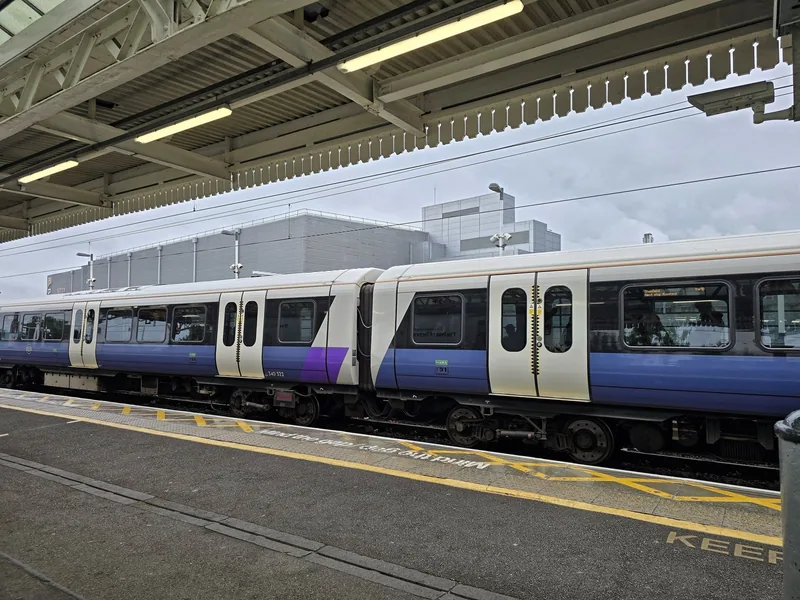
Photo: Acabashi · CC BY-SA 4.0 · Wikimedia Commons · resized
Buses: how the kneeling and the ramp actually work
Every London bus is low-floor and wheelchair-accessible. The driver can lower the front of the bus towards the kerb, which removes most of the step, and can deploy a ramp at the middle doors.
Board through the front doors as normal with a single buggy. With a double buggy, TfL says you may board through the exit doors, but check with the driver first: catch their eye from the kerb and point at the middle doors, and they will usually open them.
Inside, the wheelchair space is the bay with the backrest and the bell. It is available on a first-come basis when no wheelchair user needs it, and a buggy is welcome there. Keep the buggy out of the central aisle, put the brake on, and stand beside it rather than behind it.
Buses are the best way to see central London with a small child, because the child can see out, the journey is warm and dry, and you never carry the buggy up anything. They are slower than the Tube and that is often a feature rather than a fault.
When you must fold, and what happens if you refuse
This is the part that causes real difficulty, so it is worth being precise.
If a wheelchair user boards and needs the space, TfL's guidance is that you should share the space if that is possible, and otherwise fold the buggy or move. Most of the current fleet has a wheelchair area of at least 1.6 metres and many have 1.9 metres or more, which means a wheelchair and one unfolded buggy can usually share. Where they can share, drivers are told to allow it.
Where they cannot, the wheelchair user has priority. The driver will make an announcement, and will ask directly if the announcement is ignored. This is not negotiable and it is not personal.
You must also fold if the buggy is too wide for the doors or the aisle, which mostly affects large double buggies on older single-deck routes.
If you are asked to leave the bus, the next one is free. TfL's own guidance points out that a passenger who gets off to make room can board the following bus using the Hopper fare, which allows unlimited bus journeys within an hour of touching in for a single £1.75 fare. You are not paying twice.
On the Tube: lifts, gaps and the lines with no buggy space
TfL's advice is to use lifts where they exist. On a step-free station that is straightforward. On a station with escalators only, you are carrying the buggy, and staff will help you up and down stairs but will ask you to take the child out and fold the buggy first. That is the rule, and it is a sensible one.
Most Tube trains have a multipurpose area near a set of doors, with tip-up seats and space for a buggy. Three lines do not: the Central line, the Bakerloo line and the Waterloo & City line. On those, you are in the standing area by the doors, holding the buggy, and at busy times that is genuinely unpleasant.
Two physical hazards are worth naming. The door runners on Tube trains have narrow grooves that catch small front wheels, so lift the front of the buggy over them. And several lines have a step up into the train as well as a gap, so board backwards, pulling the buggy up after you, with the child facing you.
Above all, put the brake on when you stop, keep your child fastened in, and never let go of the handle on a platform.
Not every station with a lift is step-free to the train. Some stations have a lift to the platform but still a gap and a step up into the carriage. TfL's step-free Tube guide distinguishes "street to platform" from "street to train", and the difference is exactly the one that matters with a buggy.
Planning a step-free route before you leave the hotel
TfL Go and the online Journey Planner both have a step-free option. Turn it on and the app will route you round the stations with stairs, even if that means a longer journey. It will also show you how busy each station is, which matters more with a buggy than without one.
The printed step-free Tube guide, available as a PDF from TfL's Tube maps page, is worth downloading before you travel and keeping on your phone. It shows every accessible station and the two categories of access, and it works with no signal, which is useful underground.
Assistance is available without booking. TfL calls it turn up and go: find a member of staff, tell them where you are going, and they will see you onto the train and arrange for someone to meet you. It is intended for disabled passengers, but staff will help a struggling parent too.
Timing beats routing
The single biggest improvement you can make to a day with a buggy is not the route. It is the hour.
Lifts are the bottleneck at step-free stations, and at 08:30 the queue for one can be longer than the wait for a train. Ramps take the driver thirty seconds to deploy, which is nothing at 11:00 and awkward on a full bus at 17:45. Our guide to avoiding the rush hour has the exact windows, but the short version for families is: out after 09:30, back before 16:00 or after 19:00.
Weekends are different. Sunday brings engineering work, which sometimes closes the lift-equipped station you were relying on and replaces the train with a bus. Check the status page on Sunday mornings before you commit to a plan.
Boats, taxis and the cable car
The river is the most buggy-friendly way to cross London. Buggies are welcome on the Uber Boat river bus, boarding by ramp, with a dedicated space on board, and every pier is step-free except Cadogan, Wandsworth Riverside Quarter and London Bridge City. Most sightseeing tour boats take them too. Our page on the river bus has fares and routes; remember that river fares sit outside your daily cap.
Every licensed London black cab is wheelchair-accessible and has a ramp, and drivers are used to loading a buggy without folding it. This is the expensive answer to a bad afternoon, but it is a reliable one, and our page on black cabs, minicabs and Uber explains what a central journey costs. Note that a minicab or private hire car will usually require the buggy folded into the boot.
The London Cable Car accepts folding buggies only, and they must not block the gangway or the lift.
Arriving with a buggy
All the Heathrow stations are step-free from train to street, which makes the Elizabeth line the obvious arrival route. Our comparison of every option from Heathrow to central London sets the costs against each other.
From the other airports the picture varies, and the detail is in our guides to Gatwick, Stansted and Luton. The general rule is that a main-line train with level boarding beats a coach, because a coach means folding the buggy and putting it in the hold, and then waiting for it at the other end.
Airlines will usually let you take a buggy to the aircraft door and return it there, but policies differ and some return it to the carousel instead. Ask when you check in, because an hour in an arrivals hall with no buggy is a long hour.
What it all costs
Children under five travel free on the whole network, with no card and no paperwork. Children aged 5 to 10 travel free on buses and trams without a card, and free on the Tube, DLR, Overground and Elizabeth line when travelling with a fare-paying adult, up to four children per adult.
That means a family of two adults and two young children usually pays two adult fares and nothing else, which makes London cheaper for young families than most visitors expect. The full rules, including what changes at 11, are in our guide to children's fares on London transport.
Days that work, and one that does not
A day that works: Elizabeth line to Woolwich or Canary Wharf, DLR to Greenwich, boat back to Westminster, bus to the hotel. Not a single flight of stairs.
Another: a bus along the river, an hour in St James's Park, lunch, and one of the free national museums in the afternoon, all of which have lifts, baby-changing facilities and somewhere to park a buggy.
A day that does not work: three deep Tube lines with four interchanges, in August, at 17:00, with a sleeping toddler. Split that itinerary across two days instead.
For breaks in between, our list of city farms and playgrounds is organised by area, and our guide to public toilets in London covers where to find baby-changing facilities, which is the question every parent actually has at 15:00. Families travelling with anyone who also has mobility needs will find the rest of the picture in accessible London.
Frequently asked questions
Do I have to fold my pushchair on a London bus?
Not normally. You may use the wheelchair space when no wheelchair user needs it. You must fold, share or move if a wheelchair user boards and the space cannot be shared, and you must fold if the buggy is too wide for the doors or the aisle. If you have to leave the bus, the Hopper fare lets you board the next one within the hour at no extra cost.
Which Tube lines have space for a buggy?
Most Tube trains have a multipurpose area near one set of doors. The exceptions are the Central line, the Bakerloo line and the Waterloo & City line, where there is no dedicated space and you will be standing in the doorway area. On those lines, travel outside the busiest hours if you possibly can.
Can I take a pushchair on an escalator?
TfL's advice is to use lifts where they are available. Where there are only stairs, staff will help you carry the buggy but will ask you to carry your child and fold the buggy first. Planning a step-free route in TfL Go usually avoids the question altogether.
Is the Elizabeth line really step-free everywhere?
All 41 stations are step-free from street to platform. From Paddington eastwards to Woolwich, and at the Heathrow stations, it is also step-free from platform to train, with no gap or step. At Custom House, level access to the train is from the fifth carriage only.
Do young children pay to travel in London?
Children under five travel free everywhere on the TfL network, and no ticket or card is needed. Children aged 5 to 10 travel free on buses and trams, and free on the Tube, DLR, Overground and Elizabeth line when accompanied by a fare-paying adult, up to four children per adult.
Sources
- Transport for London - Getting around with your buggy (checked September 2026)
- Transport for London - Step-free access (checked September 2026)
- Transport for London - Help from staff and turn up and go (checked September 2026)
- Transport for London - Bus and tram fares and the Hopper (checked September 2026)
- Transport for London - Children's free and discounted travel (checked September 2026)
- Transport for London - River Bus piers and accessibility (checked September 2026)