
In London, only a licensed black cab can be hailed in the street or picked up at a taxi rank. Minicabs and ride-hailing apps such as Uber are "private hire" vehicles: they are legal only when booked in advance through a licensed operator, and a car that offers you a ride without a booking is unlicensed for that trip, uninsured and unsafe.
Visitors often use "taxi" for any car with a driver, but London's rules draw a sharp line between two kinds of service. Black cabs, officially "taxis" or hackney carriages, have fares set by Transport for London (TfL) and shown on a meter. Private hire vehicles, which include minicabs, chauffeur cars and app-based services, set their own prices and must always be pre-booked.
Both kinds are licensed by TfL, and both can be a sensible choice. This guide explains how each works, what they cost, and how to make sure the car you get into is the one you booked.
Taxis and minicabs: key facts
- Black cab minimum fare
- £4.40 at all times
- Typical 2-mile black cab fare
- £12.60 to £20.20 (weekday daytime)
- Heathrow to central London by black cab
- £70 to £120, 30 to 60 minutes
- Card payment in black cabs
- Required, including contactless; no surcharge
- Minicabs and apps
- Must be pre-booked through a TfL-licensed operator
- Check a minicab licence
- TfL online licence checker
- Taxi and private hire enquiries
- 0343 222 4000 (Monday to Friday, 09:00 to 17:00)
Black cab, minicab or app: the legal difference
The difference is not the colour of the car. TfL points out that black taxis can be any colour; what makes them taxis is that they are purpose-built vehicles licensed to "ply for hire", which means they can pick up passengers who wave them down.
| Black cab (taxi) | Minicab or app (private hire) | |
|---|---|---|
| Hail in the street | Yes, when the roof light is on | Never |
| Use a taxi rank | Yes | No |
| Book by phone or app | Yes (up to £2 extra) | Must always be booked |
| Fare | Set by TfL, shown on the meter | Set by the operator; an estimate must be given before the journey |
| Wheelchair access | All black cabs | Only vehicles designated as wheelchair accessible |
| Driver checks | Enhanced background and medical checks, plus the Knowledge of London exam | Enhanced background and medical checks |
| Congestion Charge | Exempt | Not exempt |
App-based ride services, including Uber, work under the private hire rules. The app is the booking, and the confirmation it shows you is what makes the journey legal.
How to find and hail a black cab
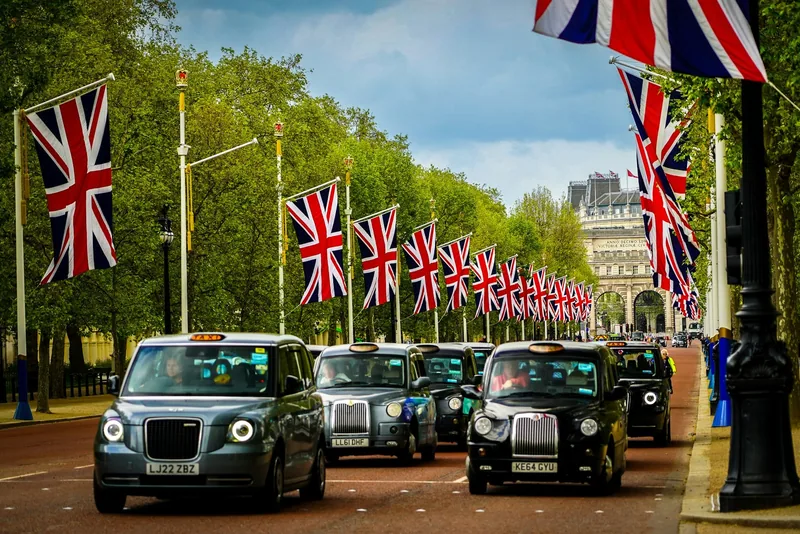
You can stop a black cab anywhere it is safe to do so. When the cab is free, the yellow or orange "TAXI" light on its roof is switched on; hold out your arm and it will pull over. TfL says there are more than 600 taxi ranks across the capital, and you can also book a black cab by phone, app or website, which adds up to £2 to the fare.
London's black cab drivers must pass the Knowledge of London, a demanding test of the city's streets. Drivers with a green badge can pick up anywhere in London, while those with a yellow badge work in particular suburban areas. The driver's licence is displayed in the front and rear windscreens, and a white licence plate on the back of the cab shows the vehicle's licence number and how many passengers it can carry.
Tell the driver your destination before you get in. Unless they have a good reason not to, drivers must accept any journey of up to 12 miles (20 miles from Heathrow) or up to one hour, as long as the destination is in Greater London.
What a black cab costs
Black cab fares are set by TfL and calculated by the taximeter. The rate depends on when you travel: there is one tariff for weekday daytime, a higher one for weekday evenings and weekends, and the highest for nights and public holidays. The table shows TfL's typical fares, effective from 25 April 2026.
| Distance | Approx. time | Mon-Fri 05:00-20:00 | Mon-Fri 20:00-22:00 and weekends 05:00-22:00 | Every night 22:00-05:00, public holidays |
|---|---|---|---|---|
| 1 mile | 6-13 min | £8.40-£13.00 | £8.40-£13.20 | £9.00-£13.20 |
| 2 miles | 10-20 min | £12.60-£20.20 | £13.40-£20.40 | £13.60-£20.40 |
| 4 miles | 16-30 min | £21.00-£31.00 | £23.00-£32.00 | £23.00-£35.00 |
| 6 miles | 28-40 min | £33.00-£42.00 | £41.00-£45.00 | £41.00-£45.00 |
The minimum fare is £4.40. Traffic makes a big difference: a slow crawl through the West End at rush hour costs more than the same distance on empty streets. Check the current table on TfL's taxi fares page.
Extras and what is included
- No extra charge for luggage, extra passengers or assistance dogs.
- Up to £2 extra if you book by phone, app or online.
- £4 extra between 20:00 on 24 December and 06:00 on 27 December, and between 20:00 on 31 December and 06:00 on 2 January.
- Up to £60 for soiling, if the cab has to be taken out of service for cleaning.
You never need cash for a black cab. Every London taxi must have a working card machine in the passenger area and accept contactless payment, with no surcharge. If a driver says the machine is not working, you can report it to TfL's taxi and private hire team. Tipping is your choice; our guide to tipping in London covers what is usual.
Minicabs and ride-hailing apps: always book
A minicab can only take you if you have booked it through a TfL-licensed private hire operator, by app, by phone, or in person at the operator's office. TfL says the operator must give you a booking confirmation before the journey starts, and it must include at least:
- the car's registration number (number plate)
- the driver's first name
- the driver's private hire licence number
- a photo of the driver, where you can receive one
Check these against the car that arrives. TfL's advice is clear: if the driver or the car is not the same as in your booking confirmation, do not get in.
Private hire fares are not regulated by TfL, but the operator must give you an accurate fare estimate before the journey, unless you have agreed a fixed price. With an app, you normally see the price before you confirm, and it can change with demand. Minicabs cannot use taxi ranks and cannot be flagged down.
Is an app cheaper than a black cab?
Sometimes, but not always. Because app prices change with demand, they can be well above a metered fare late at night, when it rains or after a big event. For short trips in central London, compare the app's price with TfL's black cab fare table above before you book. A black cab also avoids the wait for a car to reach you, which matters on a busy street.
How to check a driver and vehicle are licensed
TfL licenses private hire drivers, vehicles and operators separately, so all three should be legitimate.
- The driver must wear a private hire ID showing their name, photo and licence number.
- The vehicle must show licence discs on the front and rear windscreens, with the TfL licence number, expiry date, registration number and how many passengers it may carry.
- The operator must be licensed by TfL; you can check any company on the TfL licence checker.
A "pre-booked" sticker in the window is optional and, according to TfL, should not be taken as proof that the vehicle is licensed. Private hire vehicles in London must also be no more than 10 years old.
A licence sticker does not make a street pick-up legal. TfL says a minicab journey is unbooked, and therefore illegal and uninsured for you, if you approach a driver directly, if a driver approaches you, or if a door attendant or bouncer walks you to a car. This is common outside clubs and busy stations late at night. Walk away and book through an app or a licensed office instead.
Taxis to and from the airports
A black cab between Heathrow and central London costs £70 to £120 and takes 30 to 60 minutes, according to TfL. Two extras apply at Heathrow: £1.60 for journeys that start at a Heathrow taxi rank, and an extra of about £6.00 for being dropped off in a terminal drop-off zone. Heathrow's own drop-off charge is £7 per entry, so check what the meter shows rather than assuming the extra covers it. If you want to avoid the drop-off extra, TfL says you can ask to be dropped at the park and ride car parks and take the free bus to the terminal.
For most visitors, the train is far cheaper. The Elizabeth line costs £15.50 from central London, and the Piccadilly line £5.90. For a family with heavy luggage arriving late, though, a cab can be worth the money. Our comparison of every way from Heathrow into London sets out the options side by side.
At London City Airport there is no extra charge for journeys from the taxi rank, but up to £6.00 extra for drop-off at the terminal forecourt; our London City Airport guide explains the alternatives. Gatwick, Luton and Stansted are outside Greater London, so you can agree a fare with the driver before you set off. If you do not agree one, the meter price applies. TfL advises asking whether a negotiated fare includes any airport drop-off fee.
Late at night
After the pubs close, black cabs and apps are in high demand, and prices on the apps often rise. Before you book, check whether public transport still runs. The Night Tube operates on Friday and Saturday nights on the Central, Jubilee, Northern, Piccadilly and Victoria lines, and London's night buses run through the night on many routes. Our guide to nights out in London suggests areas where transport home is easy.
If you take a car, book it before you leave the venue and wait inside until it arrives. Share the booking details with a friend. Our guides to safety in London and travelling alone have more advice. In an emergency, call 999.
Wheelchair users and assistance dogs
All black cabs are wheelchair accessible, according to TfL, and drivers must carry wheelchair users. The cabs have an induction hearing loop, high-visibility grab handles and minimum interior dimensions for safe access. If the driver helps you in or out, or secures your wheelchair, they should not leave the meter running.
Both taxi and private hire drivers must carry assistance dogs at no extra charge, and drivers who refuse face prosecution. Private hire vehicles only have to carry wheelchair users if they are designated as wheelchair accessible, so say so when you book. See our guide to accessible transport in London for other options.
When a cab makes sense, and when it doesn't
For one or two people in central London, the Tube or bus is almost always cheaper and often faster. A Zone 1 Tube journey costs £3.00 off-peak with contactless, and a full day of Tube travel in Zones 1-2 is capped at £8.90 per adult. Our explainer on pay as you go fares and caps shows how this works.
A cab starts to make sense when you are three or four people sharing a short ride, when you have luggage, or when a direct door-to-door trip saves a complicated change of trains. Four adults paying £3.00 each for a Zone 1 Tube ride spend £12.00, which is within the range of a 2-mile daytime black cab fare. With children under 11, who travel free on the Tube with an adult, public transport is usually the cheaper choice.
If you plan to use cars a lot, remember that private hire vehicles are not exempt from central London's Congestion Charge while black cabs are. For arrival days at the big stations, our guide to London's main railway stations helps you plan the first and last legs of your trip.
Lost property and complaints
Items left in a black cab are handled by TfL's lost property service, which you contact online. There is a fee to get items back, including a value-based fee for items found in taxis, paid to the driver. For items left in a minicab or app car, contact the operator directly. For more help with lost passports, bank cards and phones, see our page on emergency numbers and what to do if something goes wrong.
To complain about a taxi or private hire journey, contact TfL's taxi and private hire team online or on 0343 222 4000. Include the driver's licence number or the vehicle's registration number if you can.
Frequently asked questions
Can you hail an Uber in the street in London?
No. Uber and other ride-hailing cars are private hire vehicles, and in London they must be booked in advance through a licensed operator. Only black cabs can be hailed in the street or taken from a taxi rank. A driver who offers you a ride without a booking is breaking the rules, and you would not be insured.
Do London black cabs take credit cards?
Yes. TfL requires every black cab to have a working card payment device in the passenger compartment and to accept contactless card payments. There is no extra charge for paying by card. You can still pay in cash if you prefer.
How much is a black cab from Heathrow to central London?
TfL gives a typical fare of £70 to £120, with a journey time of 30 to 60 minutes, depending on traffic and the time of day. There is a £1.60 extra for journeys starting at a Heathrow taxi rank. The Elizabeth line and Piccadilly line are much cheaper alternatives.
How can I tell if a minicab is licensed?
The driver should wear a TfL private hire ID with their photo and licence number, and the car should show TfL licence discs on the front and rear windscreens. Your booking confirmation should match the number plate and driver. You can also check drivers, vehicles and operators on TfL's online licence checker.
Are black cabs more expensive than Uber?
It depends on the time and demand. Black cab fares are regulated and metered, while app prices are set by the operator and can rise sharply when demand is high. For short trips in daytime the difference may be small, so compare the app's price with TfL's published fare table.
Sources
- Transport for London - Taxi fares (checked September 2026)
- Transport for London - Guide to taxis and private hire (checked September 2026)
- Transport for London - Find a taxi or minicab (checked September 2026)
- Transport for London - Safer travel at night (checked September 2026)
- Transport for London - Licence checker (checked September 2026)
- Transport for London - Lost property (checked September 2026)